What Is a PP Cup? 7 Things Buyers Should Know About Polypropylene Cups
Not every plastic cup is the same plastic. A cup labeled “PP” is made from polypropylene, a resin with its own melting point, its own chemical behavior, and its own limits — and those limits matter the moment a hot drink, a chilled smoothie, or a heat-sealed lid enters the picture. Here is what the resin code actually means and what to verify before placing a bulk order.
Somewhere on the bottom of nearly every disposable cup is a small triangular symbol with a number inside it. Most customers never look at it. Most buyers should. That number is the resin identification code, and for a huge share of bubble tea cups, smoothie cups, and foodservice drinkware, it reads “5″ — polypropylene.
This guide breaks down what PP actually is at a material level, why beverage brands specify it over other plastics, where it performs well and where it doesn’t, and the specific technical questions a buyer should ask a supplier before committing to a production run.
What Does “PP” Mean on a Plastic Cup?
PP stands for polypropylene, a thermoplastic polymer produced by polymerizing propylene monomer. On packaging, PP is identified by Resin Identification Code #5 — the small number stamped inside the recycling triangle on the base of the cup. That code exists precisely because “plastic” is not a single material; it’s a category that includes at least seven distinct resin families, each with different melting behavior, rigidity, clarity, and chemical resistance.
The word “thermoplastic” matters here too. Unlike a thermoset plastic, which cures into a permanent shape and cannot be re-melted, a thermoplastic like PP can be heated, molded, cooled, and — under the right processing conditions — reprocessed again. That property is what allows PP to be injection molded into rigid cup bodies or thermoformed into thin-wall disposable cups, and it’s also part of why PP carries genuine recyclability, at least in facilities equipped to sort and process resin #5.
Why “PP” and “plastic cup” are not interchangeable terms
A cup described only as “plastic” tells a buyer almost nothing about how it will perform. PET (#1), HDPE (#2), PVC (#3), LDPE (#4), PP (#5), and PS (#6) each have a different molecular structure. PET is largely amorphous, which gives it excellent clarity but a relatively low softening point. PP, by contrast, is semi-crystalline, with a melting point in the range of roughly 160–170°C (320–338°F) — well above PET’s practical heat tolerance. That structural difference is the reason PP shows up specifically on cups that may encounter warm filling temperatures, while PET dominates cold-beverage cups where crystal clarity is the priority. Any buyer sourcing cups for a menu that includes both hot and cold drinks needs to know which resin code is actually on the quote — not just that it’s “food-grade plastic.”
What Are PP Cups Made Of?
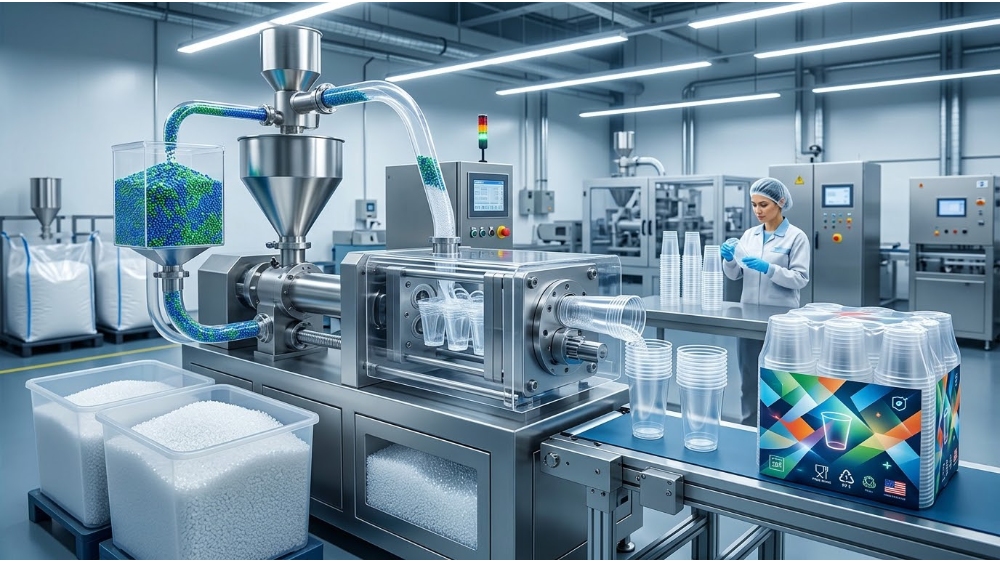
A finished PP cup is rarely 100% raw polymer. It’s a formulated compound built around a polypropylene base resin, with a small percentage of functional additives blended in during extrusion or injection molding.
Polypropylene resin
The base material is either PP homopolymer or PP copolymer resin, supplied as pellets to the cup manufacturer. Homopolymer PP tends to be stiffer and has a higher heat-deflection temperature; copolymer PP (often impact copolymer) trades a little rigidity for better low-temperature impact resistance, which matters for cups that get chilled, stacked, or shipped in cold climates.
Additives
Standard additive packages can include UV stabilizers (to prevent yellowing or embrittlement from light exposure during storage), antistatic agents (so stacked cups don’t cling and jam automated fillers), slip agents (to help cups de-nest cleanly on a filling line), and nucleating or clarifying agents. Clarifying agents are worth flagging specifically: standard PP has a natural haze, and cups marketed as “clear PP” or “clarified PP” rely on these additives to approach — though rarely fully match — the transparency of PET or PS.
Colorants
Color is introduced through pigment masterbatches compounded into the resin before molding. For cups in direct food or beverage contact, colorant migration is a real regulatory concern; pigments used should be compliant with food-contact colorant regulations in the market where the cup will be sold, not general-purpose industrial pigments.
Food-contact considerations
In the United States, polypropylene intended for repeated food contact generally falls under FDA regulations for olefin polymers (21 CFR 177.1520), while cups sold into the EU need to meet the compositional and migration-limit requirements of the EU framework for food-contact plastics. A buyer sourcing PP cups for beverage use should request documentation confirming the resin is virgin, food-grade material — not reprocessed industrial-grade PP regrind, which may carry contaminants and is not appropriate for direct food or drink contact even though it is technically the same base polymer.
Why Are PP Cups Used for Beverage Packaging?
PP earns its place in beverage packaging for five overlapping material properties, not one single feature.
Why brands specify polypropylene for drinkware:
Heat resistance — higher melting point than PET, tolerates warmer fill temperatures
Flexibility — resists cracking when squeezed, flexed, or lid-sealed under pressure
Impact resistance — holds up to drops, stacking loads, and transit handling at room temperature
Moisture resistance — non-polar structure means negligible water absorption over time
Chemical resistance — stable against acids, alcohols, and most beverage formulations
Heat resistance is the property that most often drives the decision. PP’s melting point sits meaningfully above PET’s practical service temperature, which is why PP is the common choice anywhere a cup might see fill temperatures beyond what a cold-beverage resin can handle — bubble tea shaken with hot-brewed tea, syrups dispensed warm, or product held briefly at elevated ambient temperature during transport.
Flexibility matters at the sealing stage as much as in the customer’s hand. Many bubble tea and milk tea cups go through automated heat-sealing machines that press a film lid onto the rim under pressure and heat. A resin with good flex fatigue resistance tolerates that rim compression without micro-cracking, which protects seal integrity.
Impact resistance at room and moderately cold temperatures keeps cups intact through the realistic abuse of a supply chain — palletized shipping, vending drop dispensers, and customers who squeeze a cup harder than intended.
Moisture resistance and chemical resistance work together: PP’s non-polar hydrocarbon backbone doesn’t readily absorb water or react with common beverage acids (citrus juices), sugars, or mild alcohol content, so the cup’s structural properties and the beverage’s flavor profile both stay stable over the cup’s service life.
What Are PP Cups Used For?
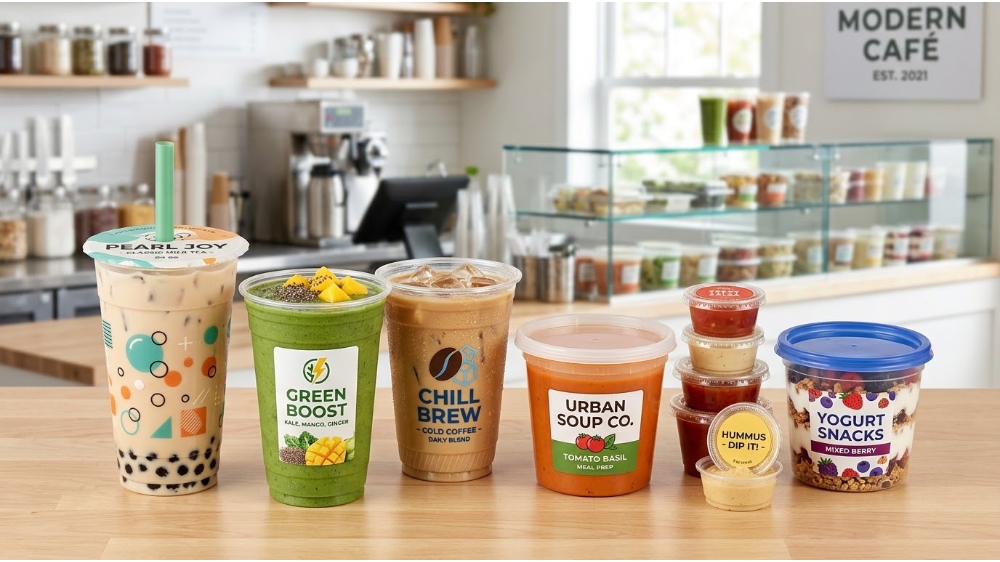
Polypropylene’s balance of heat tolerance, flexibility, and chemical stability puts it across a wide range of beverage and foodservice formats.
Bubble tea and milk tea
PP is one of the dominant materials for bubble tea and milk tea cups, particularly larger-format cups (16–24 oz and up) that need to hold tapioca pearls, ice, and liquid without deforming under the heat-sealing process used to cap them.
Smoothies and blended drinks
Thicker blended beverages benefit from PP’s rigidity and impact resistance, especially in cups that get shaken, blended in-cup, or topped with heavy garnishes.
Hot drinks — where the specification allows
PP cups are used for hot beverage applications, but this needs a caveat rather than a blanket claim: suitability depends on wall thickness, resin grade, and the manufacturer’s actual heat rating, not the resin code alone. A supplier should confirm the specific cup is rated for the fill temperature intended before it’s used for near-boiling liquids.
Juice and cold drinks
PP also serves cold-beverage formats, particularly where a brand wants one resin across its hot and cold cup lineup for supply-chain simplicity, or where slight haze is an acceptable trade-off for durability.
General foodservice applications
Beyond drink cups, the same resin shows up in portion cups, soup containers, dessert cups, and injection-molded lids and tubs — anywhere foodservice packaging needs a rigid, stackable, food-contact-safe plastic that survives handling and moderate heat.
How Do PP Cups Compare to PET Cups?
PET and PP are the two resins buyers compare most often, because both show up constantly in beverage cup catalogs, and the choice between them is rarely arbitrary.
Property
PET Cups
PP Cups
Resin code
#1
#5
Clarity
Naturally crystal-clear
Naturally hazy; clarified grades reduce but rarely eliminate haze
Heat tolerance
Softens at relatively low temperatures; not suited to hot fill
Higher melting point; can tolerate warmer fill within spec
The practical takeaway for a buyer is straightforward: if the priority is showcase-level clarity for a cold drink, PET is usually the better fit. If the menu includes anything warm, anything heat-sealed under pressure, or anything that needs a bit more flex tolerance, PP is the more defensible choice — provided the specific cup and wall thickness are actually rated for the temperature involved.
What Are the Advantages and Limitations of PP Cups?
Polypropylene is a genuinely useful packaging resin, but it is not a universal solution, and buyers are better served by an honest account of where it falls short.
Advantages
PP offers a meaningfully higher heat tolerance than PET, better flex and impact resistance for handling and sealing, strong chemical resistance across common beverage formulations, and a lighter weight-to-rigidity ratio that can reduce material cost and shipping weight compared to thicker-walled alternatives.
Limitations — read this before assuming “PP means heat-safe”
The single most important limitation is this: PP is more heat tolerant than PET, but it is not automatically suitable for every high-temperature application. A thin-wall, economy-grade PP cup designed for room-temperature or mildly warm beverages is not the same product as a heavier-gauge PP cup engineered and tested for near-boiling hot fill. Wall thickness, resin grade, and the presence (or absence) of impact modifiers all change the actual heat performance of a finished cup — the resin code by itself is not a heat rating.
Beyond heat, a few other trade-offs are worth knowing:
PP cup limitations buyers should factor in:
Natural haze — standard PP will not match PET or PS-level clarity without added clarifying agents
Cold brittleness — some PP grades stiffen and become more prone to cracking at low temperatures unless impact-modified
Recycling access — #5 PP is accepted by fewer municipal recycling programs than #1 PET in many regions, so “recyclable” does not guarantee curbside collection everywhere
Resin quality variance — recycled or reprocessed PP can perform noticeably differently from virgin PP, and isn’t appropriate for food contact unless specifically certified as such
None of these are reasons to avoid PP. They’re reasons to specify it deliberately — matching wall thickness and resin grade to the actual beverage temperature and handling conditions, instead of treating “PP cup” as a single interchangeable product.
What Should Buyers Check When Ordering PP Cups?
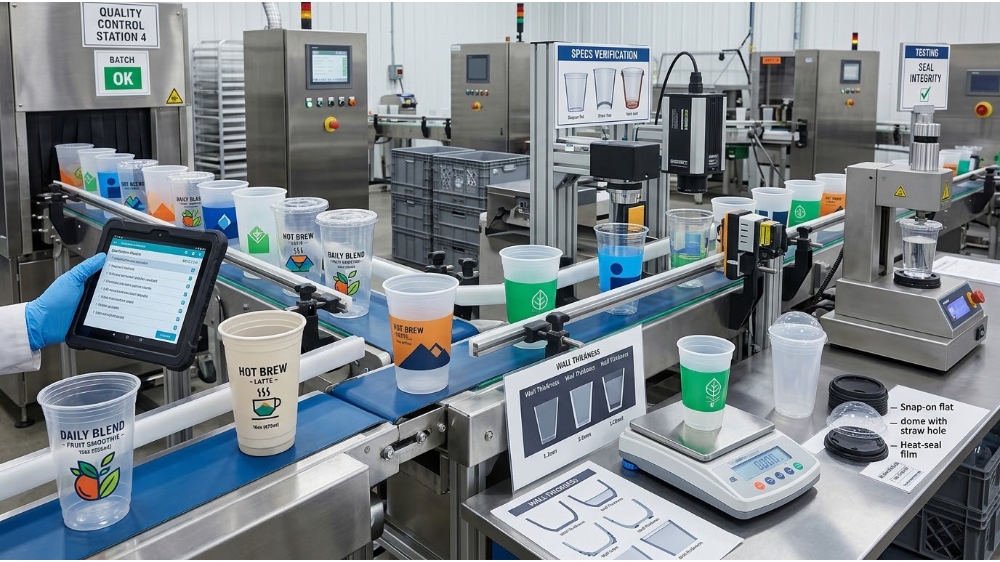
Ordering PP cups at production volume involves more technical detail than picking a size off a catalog page. The following specifications determine whether a cup performs correctly on the filling line and in the customer’s hand.
Specification
Why it matters
Cup capacity
Confirm actual fill capacity versus brim (overflow) capacity — the two numbers differ, and menu portioning depends on the correct one.
Wall thickness
Directly affects rigidity, heat tolerance, and cost. A thicker wall generally means better hot-fill performance and less deformation under pressure.
Weight
Per-cup weight affects material cost, shipping cost, and — for sustainability-focused brands — total plastic footprint per unit sold.
Rim diameter
Must match existing sealing equipment and lid stock; a mismatched rim diameter breaks compatibility with heat-seal film or snap lids already in use.
Clarity
Confirm whether the cup is standard PP (visibly hazy) or clarified PP, and whether that clarity level meets brand presentation standards for the intended drink.
Lid compatibility
Verify the cup rim and body are designed for the specific lid type — flat sipping lids, domed lids for toppings, or heat-seal film — before committing to tooling.
Sealing performance
Rim flatness and consistency affect whether an automated sealing machine achieves a leak-proof seal run after run, not just on a sample cup.
Intended beverage temperature
Get a written maximum fill temperature from the supplier for the specific cup and wall gauge — not a generic statement that “PP is heat-resistant.”
Food-contact documentation
Request compliance certification (such as FDA or EU food-contact documentation) and confirmation of virgin resin sourcing before approving bulk production.
Working through this list before tooling or bulk production starts is the difference between a cup that performs consistently across a real filling line and one that looks fine in a sample box but causes seal failures, deformation complaints, or compliance gaps once it’s running at volume.
Sourcing PP cups for a beverage or foodservice program?
Get a specification review that matches wall thickness, resin grade, rim diameter, and lid compatibility to your actual menu and fill temperatures before you commit to a production run.
No. “Plastic cup” is a general term covering several distinct resins, including PET, PP, PS, and others. PP specifically refers to polypropylene, identified by Resin Identification Code #5, with its own melting point, flexibility, and chemical resistance profile.
Can PP cups hold boiling hot liquid?
Some can, but not all. PP has a higher heat tolerance than PET, but actual performance depends on wall thickness and resin grade. Always confirm the maximum rated fill temperature for the specific cup with the manufacturer rather than assuming all PP cups handle near-boiling liquids equally.
Are PP cups recyclable?
PP is technically recyclable and carries Resin Identification Code #5, but municipal recycling programs accept #5 plastics less consistently than #1 PET in many regions. Check local recycling infrastructure before marketing a PP cup as broadly recyclable.
Why are PP cups slightly cloudy instead of clear?
Standard polypropylene is semi-crystalline, which gives it a natural haze rather than the crystal clarity of amorphous resins like PET. Clarified PP grades use additives to reduce haze, but typically don’t fully match PET-level transparency.
What information should I request from a PP cup supplier before ordering?
Ask for the maximum rated fill temperature, wall thickness specification, rim diameter, lid compatibility details, and food-contact compliance documentation confirming virgin, food-grade resin rather than reprocessed material.
Post time:
Sep-09-2026
For inquiries about our products or pricelist, please leave your email to us and we will be in touch within 24 hours.