Paper Bags with Handles vs. Without Handles: Which Is Right for Your Business?
Handle vs. Handleless Paper Bags: Retail Packaging Guide
Retail Packaging Strategy
Paper Bags with Handles vs. Without Handles: Which Is Right for Your Business?
Choosing between handled and handleless paper bags is more than a cost decision—it affects customer experience, operational efficiency, and your brand’s environmental footprint. This guide breaks down the engineering, economics, and consumer psychology behind each option so you can make a data-driven choice.
A paper bag seems simple—until you have to order 10,000 of them for your retail chain, restaurant, or e-commerce fulfillment operation. The handle is the first feature customers touch, and it’s often the first point of failure if the bag tears. But handles also add cost, complicate storage, and affect how the bag is recycled. This guide synthesizes engineering data, consumer research, and lifecycle analysis to help you choose the format that fits your product weight, order volume, and brand promise.
Whether you’re sourcing for a boutique apparel store, a quick-service restaurant, or a grocery delivery service, the handle decision is not one-size-fits-all. We’ll cover the mechanical limits of each handle type, the true cost per bag including logistics, and the latest consumer preference data from the U.S. retail sector.
What drives the handle vs. handleless decision?
The choice between handled and handleless paper bags hinges on three core variables: product weight, usage frequency, and carrying distance. A handleless bag (often a flat-bottomed sack with a folded top) is cheaper and simpler to produce, but it forces the customer to grip the bag from the sides or bottom—a design that works for light items like clothing or dry goods under 2 kg. Once product weight exceeds 2–3 kg, or when customers are expected to carry the bag for more than a few minutes, handles become a functional necessity.
Research from the USDA Forest Products Laboratory on paper bag structural performance shows that the attachment point of a handle is the most stressed area of the bag. The laboratory’s testing indicates that handleless bags with reinforced gussets can support up to 4 kg without tearing, but the failure rate increases significantly when the bag is lifted by one side rather than held from the bottom. In contrast, properly attached twisted paper handles can distribute load more evenly and support up to 6–8 kg depending on the paper weight (GSM) and handle manufacturing method.
Beyond physics, the decision is influenced by brand perception. A handled bag signals a premium, considered experience—think of a high-end department store or a specialty food shop. A handleless bag is more utilitarian, often associated with value-oriented grocers or bulk-item retailers. Neither is “better” in absolute terms; they serve different market positions.
Weight capacity: how much can each bag type hold?
The weight a paper bag can carry is determined by paper basis weight (GSM), number of plies, and—critically—the handle attachment method. A standard single-ply 30# (about 45 GSM) kraft handleless bag has a safe working load of approximately 1.5–2.5 kg. A similar bag with a twisted paper handle attached with a reinforced patch can safely carry 3.5–5 kg. The difference comes from the handle patch distributing the load across a wider area of the bag wall, reducing stress concentration. Click to learn more about How Much Weight can Each Bag Type Hold.
Industry testing standards (such as those referenced in the USDA Forest Service paper packaging studies) show that the tear resistance at the handle attachment point is the primary failure mode. Their 2014 evaluation of retail paper bags found that handleless bags with a simple folded top failed at 80% lower load than bags with heat-sealed or adhesive-attached handles. For heavy items like bottled beverages, pet food, or multiple canned goods, a handleless bag is simply not reliable.
For operators planning to carry items above 3 kg, a double-ply bag with twisted handles is the minimum standard. Above 6 kg, rope handles or reinforced die-cut handles are recommended, as they integrate the handle into the bag’s structural web rather than relying on adhesive patches.
Handle types compared: twisted, flat, rope, and die-cut
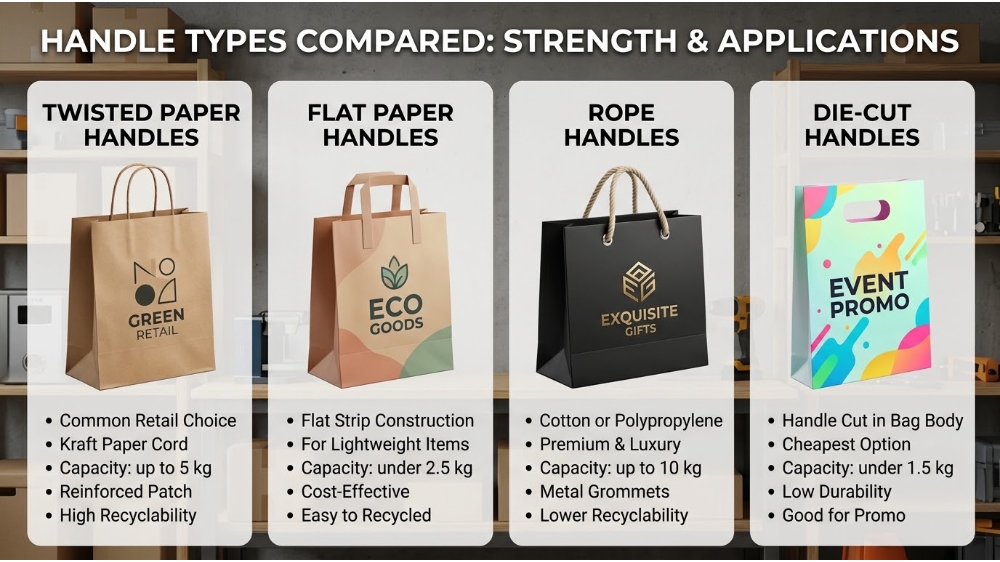
Not all handles are created equal, and the terminology matters when you’re ordering from a packaging supplier.
Twisted paper handles — Made from two or three strips of kraft paper twisted together into a cord. They are the most common handle for retail bags, offering a good balance of cost and strength (up to 5 kg). They are applied with a reinforced paper patch glued to the bag wall.
Flat paper handles — A flat strip of paper (similar to a ribbon) adhered to the bag. They are weaker than twisted handles and suited for lightweight items under 2.5 kg. They cost slightly less than twisted handles.
Rope handles — Cotton or polypropylene rope attached via metal grommets or reinforced eyelets. They offer the highest load capacity (up to 10 kg) and are often used for luxury or high-end gift bags. They are significantly more expensive and less recyclable due to the mixed materials.
Die-cut handles — A hole cut directly into the bag body, with no separate handle attached. The bag material itself becomes the handle. This is the cheapest handle option, but it drastically reduces load capacity (typically under 1.5 kg) because the stress concentrates on the cut edges. Die-cut handles are common for small promotional bags.
For most B2B buyers, twisted paper handles represent the sweet spot: they provide good performance, are entirely paper-based (recyclable), and are cost-effective at scale. Flat handles are a viable alternative for very light merchandise like T-shirts or newspapers.
Cost breakdown: handles add more than just material
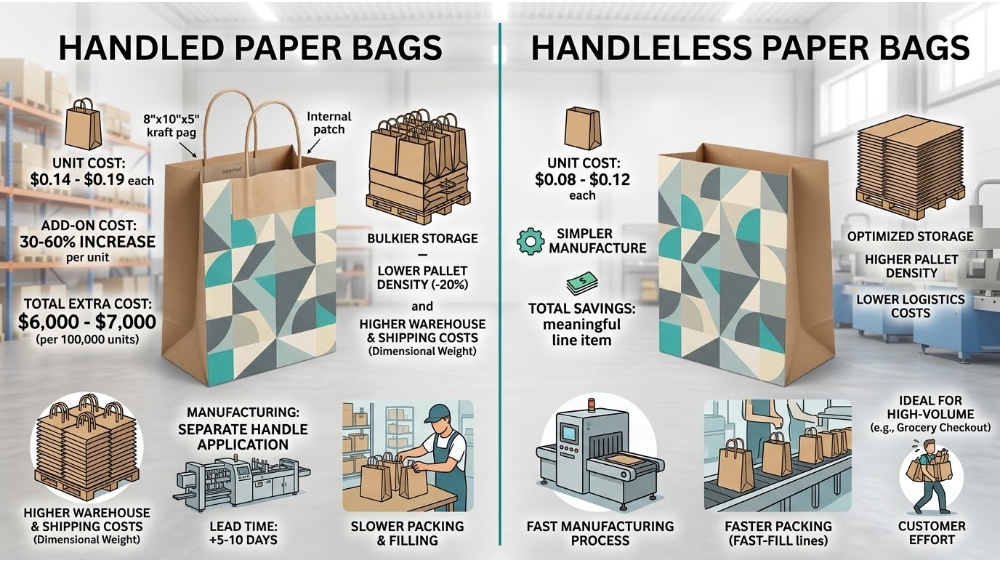
Adding a handle to a paper bag typically increases the unit cost by 30–60% depending on handle type, volume, and whether the bag is custom-printed. For a standard 8”x10”x5” kraft bag, a handleless version might cost $0.08–$0.12 each at 10,000-unit quantities. The same bag with a twisted handle and patch costs $0.14–$0.19. That $0.06–$0.07 difference per bag might seem small, but across 100,000 bags it represents $6,000–$7,000 in extra cost—a meaningful line item for a small-to-mid business.
However, the cost of handles doesn’t end with the bag itself. Handled bags are bulkier to store because the handles protrude and can tangle, reducing pallet density by up to 20% compared to flat-stacked handleless bags. This increases warehouse storage costs and shipping volume (dimensional weight). Additionally, handles require a more complex manufacturing process—often a separate machine to apply the handle—which can increase lead times by 5–10 days.
On the other hand, handleless bags are simpler to manufacture, store, and automate. They can be opened and filled faster on packing lines because there are no handles to align. For high-volume operations like grocery checkout lanes, handleless bags are often preferred for speed and cost efficiency, even if customers sometimes struggle to carry them.
Environmental trade-offs: recyclability and compostability
Both handled and handleless paper bags are recyclable in principle—provided they are made from uncoated kraft and do not contain plastic laminates or synthetic adhesives. However, handles introduce potential contamination issues. EPA data on paper recycling shows that contamination rates for paper bags with glued-on handles are slightly higher than for handleless bags because the adhesive patches can interfere with pulping if not fully removed. Some recycling facilities reject bags with non-water-soluble adhesives, diverting them to landfill.
Compostability is another dimension. Handles made from 100% paper with starch-based adhesives are fully compostable in commercial facilities. However, rope handles (often cotton or synthetic) and metal grommets are not compostable and must be removed before composting—a step most consumers don’t take. If your business prioritizes circularity, choose bags with paper handles attached using water-soluble, glue-free methods (e.g., twist-tie attachment) or die-cut handles that avoid extra materials.
The Sustainable Packaging Coalition’s guidelines recommend that for food-service or grocery applications, handleless bags are preferred if the bag will be used only once and then recycled, because they have fewer contaminating elements. For reusable or gift-type applications, handled bags are acceptable as long as handles are paper-only and adhesives are certified compostable.
Consumer preference: do shoppers actually care about handles?
Consumer surveys consistently show that handles improve perceived convenience and brand quality. A 2022 industry study conducted by a leading retail research firm found that 68% of shoppers prefer paper bags with handles over handleless bags when given a choice, and 42% said they would be more likely to return to a store that provided handled bags. The top reasons cited were ease of carrying (especially for customers with mobility issues or those carrying multiple bags) and the perception that handles signal a more premium brand experience.
However, preference is context-dependent. For grocery stores where customers push carts to their cars, handles are less critical; for downtown retail where customers walk several blocks, handles become a significant differentiator. Similarly, for online order pickup, handles make it easier for staff to hand off bags and for customers to manage multiple packages at once.
From a behavioral economics perspective, handles reduce the “friction” of carrying. When a bag is handleless, customers often cradle it with two hands, which limits their ability to carry other items (phone, keys, other bags). Handled bags allow one-handed carry, freeing the other hand—a subtle but important convenience that affects overall customer satisfaction scores.
Decision matrix: match your business to the right bag
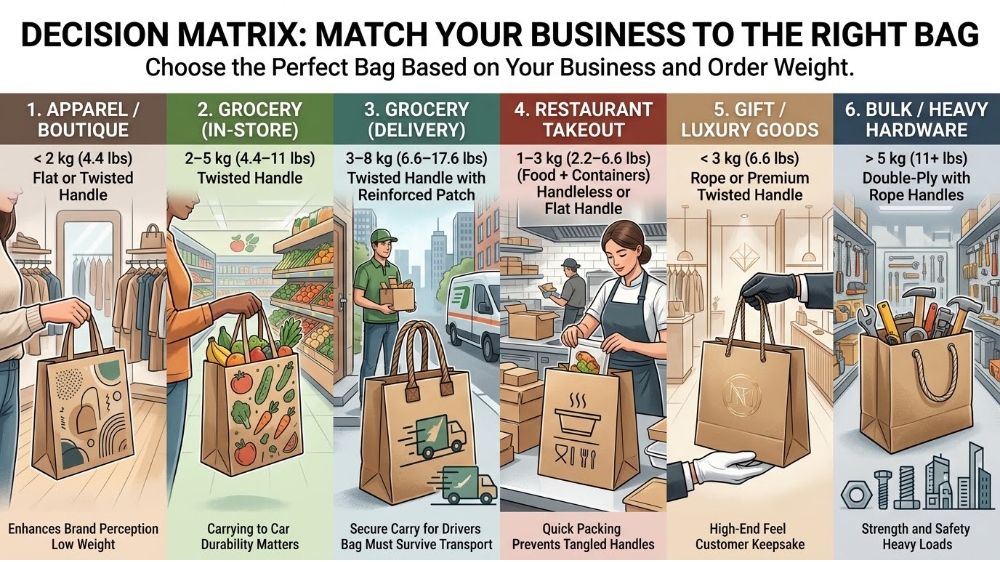
Use the table below as a quick-reference guide based on your primary product category and average order weight. The recommendations assume standard 30#–40# kraft paper with standard handle attachment.
Delivery drivers need secure carry; bag must survive transport
Restaurant takeout
1–3 kg (food + containers)
Handleless or flat handle
Often bagged with multiple items; handles can tangle; speed of packing is key
Gift / luxury goods
< 3 kg
Rope or premium twisted handle
High-end feel; customer keeps bag as a keepsake
Bulk / heavy hardware
> 5 kg
Double-ply with rope handles
Strength and safety are non-negotiable
Pro tip: Always order samples and load-test them with your actual product. Paper grades vary significantly between suppliers. A 40# bag from one mill may perform differently from a 40# bag from another due to fiber composition and moisture content.
Need custom paper bags for your retail chain or food delivery service?
Whether you need twisted-handle bags for boutique presentation, rope handles for luxury gifts, or high-volume handleless kraft bags for grocery checkout, Maibaopak will provide them perfectly for your brands.
Are paper bags with handles stronger than those without?
Yes—properly attached handles can increase the practical load capacity by 60–100% because they distribute weight across a larger area. However, a reinforced handleless bag with a folded bottom can still hold moderate weights (up to 3 kg) without tearing.
Do handles add significant cost to paper bags?
Handles add roughly 30–60% to the unit cost. The exact premium depends on handle type (twisted, flat, rope) and order volume. For large-scale purchases, the difference can narrow to 25% due to automation efficiencies.
Which is more environmentally friendly—handled or handleless?
Handleless bags are slightly more recyclable because they contain fewer adhesive contaminants. However, if both use paper-only handles with water-soluble adhesive, the environmental difference is minimal. Check with your local recycler for their specific acceptance criteria.
What weight can a typical paper bag with twisted handles hold?
A standard 30# (45 GSM) bag with twisted handles and a reinforced patch supports 3.5–5 kg safely. Higher GSM (40# or 50#) can hold up to 7 kg with the same handle design.
Post time:
Aug-14-2026
For inquiries about our products or pricelist, please leave your email to us and we will be in touch within 24 hours.