7 Packaging Factors That Affect Food Quality During Takeout & Delivery
Every takeout order faces a gauntlet of temperature drops, moisture migration, structural stress, and ventilation mismatches. This guide breaks down the seven critical packaging factors—backed by research and industry data—to help you choose containers that preserve food quality from kitchen to customer.
A takeout container is more than a vessel—it’s a microclimate that actively shapes the food inside. Temperature, moisture, structural integrity, ventilation, and material chemistry all interact in the minutes between kitchen and customer. When one factor is overlooked, quality suffers. When all seven are optimized, food arrives tasting as intended.
This guide synthesizes findings from food science research, industry packaging surveys, and engineering studies to provide a practical framework for selecting delivery packaging. Whether you operate a quick‑service restaurant, a ghost kitchen, or a full‑service brand, these principles will help you reduce complaints, improve repeat orders, and protect your food’s reputation.
01 — Temperature: Hot food, cold food, steam, and heat retention
Temperature is the most immediate quality factor. Hot foods must stay above 140°F to remain safe and palatable; cold foods must stay below 40°F to prevent spoilage and maintain texture. The rate of heat loss depends on container material, insulation, and the volume of food relative to package size. A 2024 ASME framework on smart take‑away packaging identifies heat retention as the primary design criterion for hot meals, noting that containers with double‑walled structures or reflective liners can extend holding time by up to 40%.
Steam is temperature’s companion. Hot food releases water vapor, which condenses on the lid and drips back onto the food if not managed. This is especially damaging for crispy items. The solution is not just insulation—it’s controlled venting, which we explore in section four. For cold foods, condensation forms on the outside of the container when warm ambient air meets a cold surface; this can weaken paperboard and create a messy customer experience. Use insulated liners or double‑walled cups for cold beverages and salads to minimize external sweating.
Heat‑retention best practices:
Use insulated materials (foam, corrugated, or reflective films) for delivery times over 20 minutes
Pre‑heat containers (e.g., in a warming cabinet) before packing hot food
Separate hot and cold items in multi‑compartment boxes to prevent cross‑temperature transfer
Consider active warming solutions (heat packs) for long‑distance delivery
02 — Moisture: Fried food, sauces, soups, and condensation
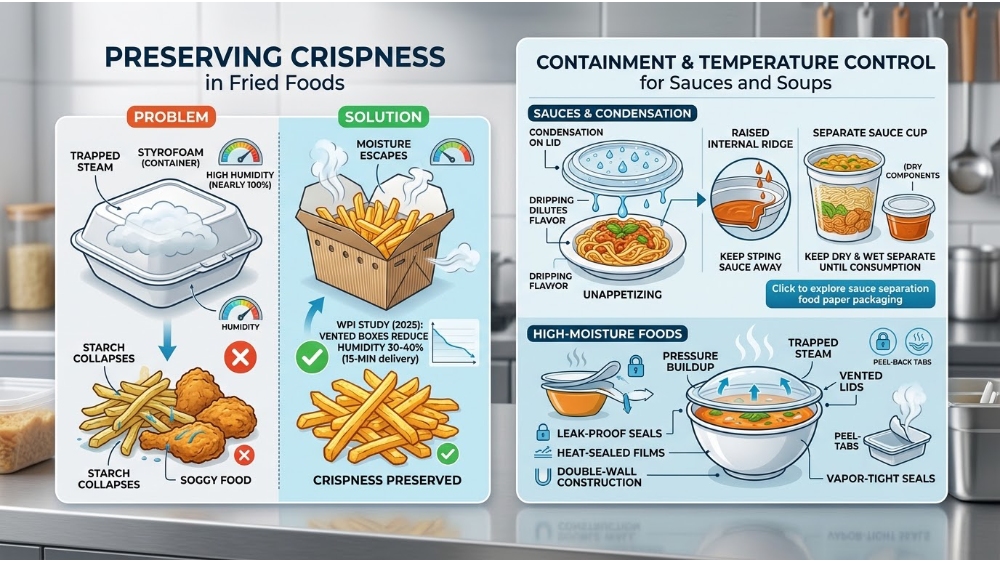
Moisture is the enemy of crispness and the friend of sogginess. Fried foods—fries, chicken, onion rings—depend on a low‑humidity environment to maintain their starch‑based crust. When sealed in a non‑vented container, trapped steam raises internal relative humidity to nearly 100% within minutes, causing gelatinized starch to absorb moisture and collapse. A Worcester Polytechnic Institute study (2025) demonstrated that vented fry boxes reduce internal humidity by 30‑40% over a 15‑minute delivery window, significantly preserving crispness.
Sauces and soups present the opposite challenge: they need containment, not ventilation. Leak‑proof seals, heat‑sealed films, and double‑wall construction prevent messy spills and maintain temperature. Condensation on lids can drip into sauces, diluting flavor and creating an unappetizing appearance. For sauced items like pasta or curry, consider containers with a raised internal ridge to keep the sauce away from the lid, or use a separate sauce cup to keep wet and dry components separate until consumption. Click to explore sauce separation food paper packaging
For high‑moisture foods like steamed vegetables or soups, vapor‑tight seals are essential to prevent leakage and retain heat. However, these same seals trap steam, which can cause pressure buildup—use vented lids or peel‑back tabs to release excess steam safely.
03 — Structure: Rigidity, stackability, compression, and lid fit
A collapsed box ruins a meal before it’s opened. Structural integrity—the ability to resist crushing, buckling, and warping—is a top concern for delivery drivers and customers alike. The National Restaurant Association’s 2022 packaging survey found that 42% of delivery complaints relate to squashed or damaged food, often caused by inadequate box rigidity. Board thickness (caliper), flute type for corrugated, and the use of supporting folds all contribute to stackability and compression resistance.
Lid fit is equally critical. A loose lid allows heat to escape and contaminants to enter; a tight lid creates a seal that traps moisture but may cause pressure buildup if the food is hot. The ideal lid has a slight interference fit that stays closed during transit but can be opened easily by the customer. Hinged lids with locking tabs or corner clips provide extra security for stacked orders. For tall items like burgers, dome lids create headspace that prevents the bun from being squashed and keeps condensation away from the crown. Click to explore burger paper box with dome lid
Structural integrity checklist:
Choose board caliper based on food weight: 18pt+ for heavy entrees, 12‑16pt for sides
Test stackability with 4‑6 boxes stacked; look for sagging or bowing
Ensure lid tabs engage securely without requiring excessive force
Use gusseted or reinforced corners for heavy items like whole chickens or large pizzas
04 — Ventilation: Why fries need holes and soups need seals
Ventilation is the deliberate management of steam flow. Fried foods—fries, chicken tenders, falafel—release steam rapidly after cooking. Without an escape path, that steam saturates the air inside the package, condenses on the food, and triggers moisture migration. The solution is perforations that allow steam to exit while keeping heat in. Research from the Anchor Packaging “Deliver Taste Chef Intended” guide (2022) recommends a vent area of 2‑3% of the box surface for optimal moisture‑heat balance.
Soups, stews, and saucy dishes, by contrast, require a near‑total seal to prevent leakage and retain temperature. Vented lids for soup bowls often include a small steam‑release hole to prevent pressure buildup, but the seal around the rim must be liquid‑tight. The rule is simple: high‑moisture + high‑steam = vented; high‑liquid + low‑steam = sealed. For mixed meals (e.g., a burger with fries), compartmentalized boxes allow separate venting for each section—fries get holes, the burger area stays relatively closed to retain heat.
Perforation engineering matters: hole size, placement, and number dictate airflow. For fry boxes, 3‑5mm diameter holes arranged on the sides or back provide effective steam release without letting fries escape. For sandwiches, a few small top vents allow steam to escape without drying out the bread.
05 — Material: Kraft, SBS, PE, PLA, and grease barriers
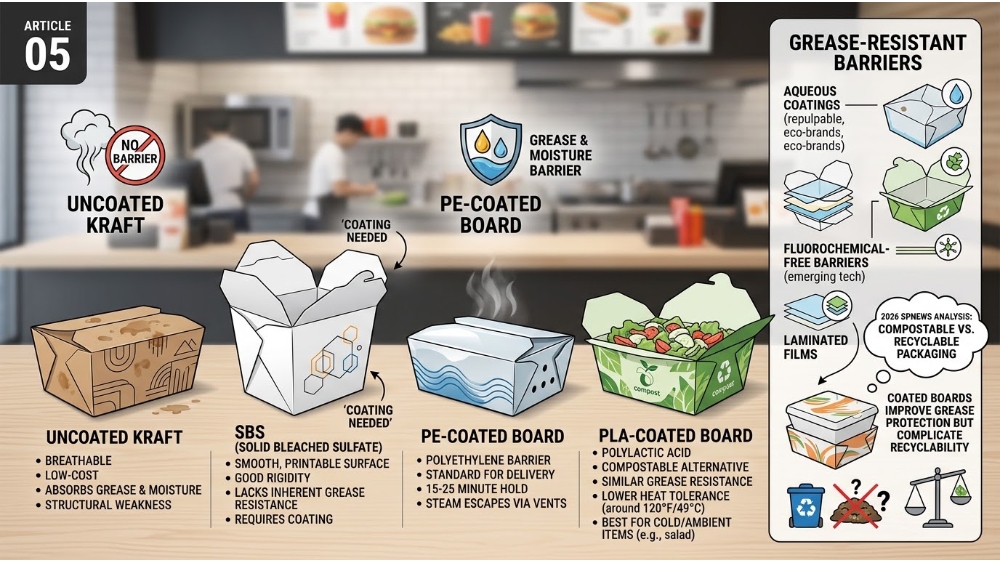
The material of a takeout container dictates its thermal performance, grease resistance, and environmental footprint. Uncoated kraft is breathable and low‑cost but absorbs grease and moisture, leading to structural weakness and staining—best for short‑hold counter service. SBS (solid bleached sulfate) paperboard offers a smooth, printable surface and good rigidity, but lacks inherent grease resistance; it requires coating.
PE‑coated board provides a polyethylene barrier that resists grease and moisture, making it the standard for fast‑food delivery. It performs well for holds of 15‑25 minutes, with steam escaping through vent holes. PLA‑coated board (polylactic acid) is a compostable alternative that offers similar grease resistance but with lower heat tolerance (around 120°F). For hot fried foods, PLA can soften, so it’s better suited to cold or ambient‑temperature items.
Grease‑resistant barriers come in various forms: aqueous coatings (repulpable, good for eco‑brands), fluorochemical‑free barriers (emerging technologies), and laminated films. A 2026 SPNews analysis on compostable vs. recyclable packaging highlights that while coated boards improve grease protection, they complicate recyclability. Operators must weigh performance against sustainability goals and local waste infrastructure.
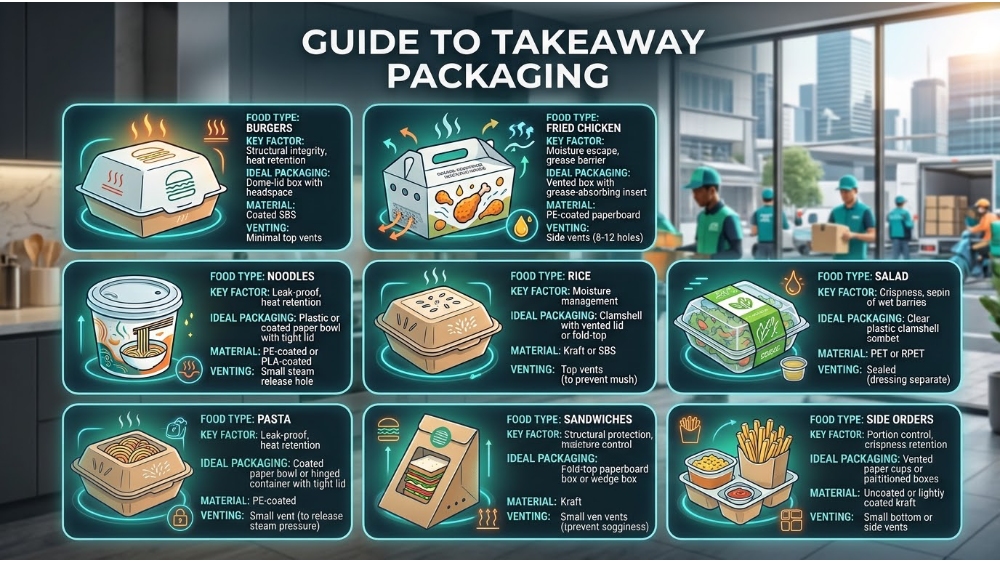
Different foods have different packaging needs. A one‑size‑fits‑all approach fails for delivery. Below is a comparative table that matches each food type with its primary packaging requirements, derived from industry best practices and the EPJ Web of Conferences (2014) study on take‑out packaging attributes.
Food Type
Key Factor
Ideal Packaging
Material
Venting
Burgers
Structural integrity, heat retention
Dome‑lid box with headspace
Coated SBS
Minimal top vents
Fried chicken
Moisture escape, grease barrier
Vented box with grease‑absorbing insert
PE‑coated paperboard
Side vents (8‑12 holes)
Noodles
Leak‑proof, heat retention
Plastic or coated paper bowl with tight lid
PE‑coated or PLA‑coated
Small steam release hole
Rice
Moisture management, stackability
Clamshell with vented lid or fold‑top
Kraft or SBS
Top vents (to prevent mush)
Salad
Crispness, separation of wet ingredients
Clear plastic clamshell with separate dressing cup
PET or RPET
Sealed (dressing separate)
Pasta
Leak‑proof, heat retention
Coated paper bowl or hinged container with tight lid
PE‑coated
Small vent (to release steam pressure)
Sandwiches
Structural protection, moisture control
Fold‑top paperboard box or wedge box
Uncoated or lightly coated kraft
Small side vents (to prevent sogginess)
Note that packaging must also accommodate portion sizes and meal combinations. A burger and fries combo benefits from a compartmentalized tray that vents the fries while insulating the burger. For multi‑item orders, flexible hinged containers with dividers offer the best balance of all factors.
07 — How to choose the right packaging for your business
Selecting packaging that optimizes all seven factors requires a systematic approach. Start by mapping your menu items to their primary quality risks: does this food lose heat quickly? Is it prone to sogginess? Does it need structural protection? Then test packaging prototypes under real delivery conditions—measure temperature at 10, 20, and 30 minutes; assess crispness, structural integrity, and customer feedback.
Work with a supplier that offers customisation options for hole patterns, coatings, and board calipers. The WPI study emphasizes that small design tweaks—like increasing vent hole count from 6 to 10—can dramatically improve fry quality without affecting heat retention. Similarly, choosing a PE coating over uncoated kraft can extend acceptable hold time for greasy items by 10 minutes.
Step 1: Identify the primary quality threat for each menu item (e.g., heat loss, moisture, structural damage).
Step 2: Match the threat to the appropriate packaging factor (temperature → insulation; moisture → venting; structure → board caliper).
Step 3: Test prototypes with your actual delivery route and measure outcomes.
Step 4: Solicit customer feedback and iterate—packaging that performs well in trials may need adjustment for real‑world conditions.
Step 5: Partner with a supplier that offers consistent quality and can scale with your business.
Frequently Asked Questions
What is the most important packaging factor for fried food?
Moisture control—specifically ventilation to release steam—is the most critical factor. Without proper venting, fried foods become soggy within minutes. Use containers with strategically placed holes and grease‑resistant coatings to preserve crispness.
Can I use the same packaging for hot and cold foods?
Not ideally. Hot foods need insulation and steam release; cold foods need barrier protection and moisture control. Use separate packaging lines or compartmentalized containers with thermal separation to avoid cross‑temperature degradation.
How do I know if my packaging is structurally adequate?
Test stackability by loading multiple filled containers and checking for sagging or collapse. Also inspect lid fit—a secure lid prevents spills and maintains internal temperature. Use board caliper guidelines based on food weight and delivery distance.
Are compostable materials as effective as traditional plastics?
Compostable materials like PLA can perform well for cold or ambient foods, but they have lower heat resistance and may soften with hot, greasy items. They also require industrial composting facilities to break down properly. Evaluate your local waste infrastructure and choose accordingly.
Need packaging that delivers quality every time?
Talk to a packaging specialist about matching design, materials, and venting to your specific menu, hold times, and delivery radius.