How Much Do Plastic Cups Cost? 8 Hidden Factors That Secretly Inflate Your Bill
Two suppliers quote the same “16oz clear plastic cup,” and the prices are 30% apart. It isn’t a coincidence, and it isn’t always a scam. Cup pricing is built from eight interlocking variables—most of which never appear as a single line on a quote sheet. Here’s what actually drives the number, so you can compare quotes like a buyer instead of guessing like a shopper.
“How much does a plastic cup cost?” is the wrong question for anyone buying at scale. A single cup, on its own, has almost no meaningful price—cost only becomes real once resin type, wall thickness, cavity mold, print method, and order volume are all fixed. Change any one of those variables and the per-unit price can move by double digits.
This guide breaks the plastic cup quote into its real cost components, explains why identical-looking cups can carry very different price tags, and gives you a framework for comparing supplier quotes on equal terms instead of chasing the lowest number on a spreadsheet.
Why Supplier Quotes for the “Same” Cup Differ So Much
Buyers usually request a quote by describing a cup in general terms: “16oz clear cup, straight wall, for cold drinks.” That description leaves at least six variables undefined—resin grade, wall thickness, cup weight, mold cavity count, printing method, and packing configuration. Two suppliers can both answer that request honestly and still land 20-40% apart, because each filled in the blanks differently.
This is the core reason plastic cup pricing feels opaque. A cup is not a commodity with one fixed spec the way a sheet of steel is; it’s an assembled set of decisions, and every decision has a cost attached. A cheaper quote is not automatically a worse cup, and a higher quote is not automatically a better one—but without knowing which variables moved, a buyer cannot tell the difference. The rest of this guide unpacks each variable individually so a quote becomes readable instead of a black box.
The eight variables behind every plastic cup quote:
Resin type and grade (PET, PP, PS, or bioplastic)
Cup size and volume
Cup weight and wall thickness (measured in grams, not just “thin” or “thick”)
Cup shape and mold complexity
Printing method and color count
Order quantity and mold amortization
Lids, sleeves, and secondary packaging
Freight, tariffs, and delivery terms
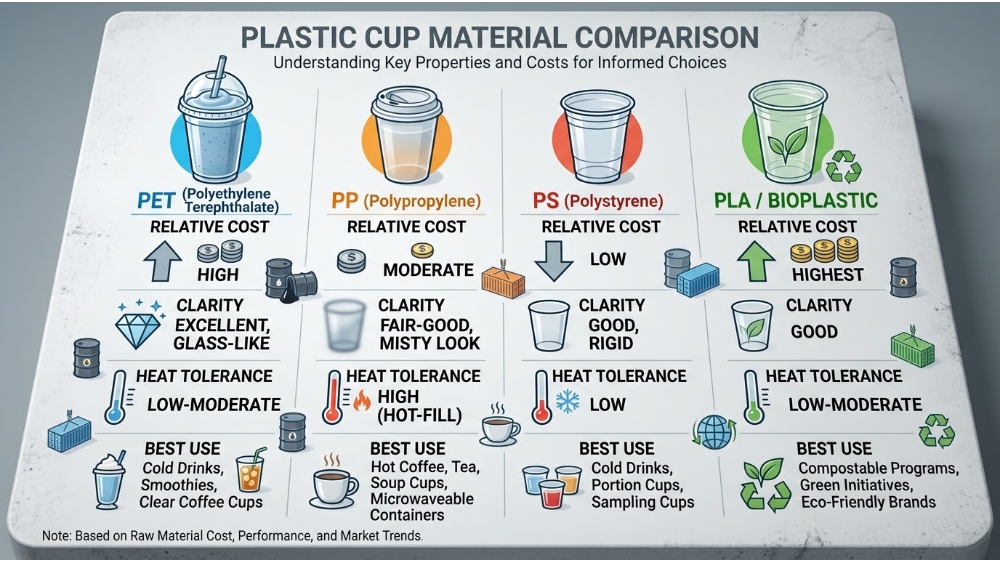
Material: PET, PP, PS, and Biodegradable Resins Compared
Resin choice is usually the single largest driver of plastic cup cost, because raw material accounts for the majority of a cup’s total manufacturing expense. The resin market also moves independently of cup demand—crude oil prices, regional supply contracts, and even shipping disruptions for pellet imports can shift a supplier’s input cost before a single cup is molded.
PET (polyethylene terephthalate) is the default choice for clear, crack-resistant cold cups because of its glass-like clarity and rigidity, but it is generally the most expensive common resin used in disposable cups. PP (polypropylene) costs less than PET and tolerates higher temperatures, making it the standard for cups intended for hot-fill or reusable use, though it has a slightly hazier, less “premium” look. PS (polystyrene) is typically the lowest-cost option and molds easily into rigid shapes, but it is more brittle and is losing ground in many markets due to environmental restrictions. PLA and other compostable bioplastics sit at the top of the cost range—often noticeably above standard PET—because feedstock, certification, and lower production volumes all add expense.
A supplier quoting a lower price per thousand cups may simply be quoting a lower-cost resin, not cutting corners on manufacturing. The first question in any cup quote comparison should be: what resin, and what grade, is this price actually based on?
Material
Relative cost
Clarity
Heat tolerance
Best use
PET
High
Excellent
Low-moderate
Cold drinks, bubble tea, smoothies
PP
Moderate
Fair-good
High
Hot-fill, reusable, dishwasher-safe cups
PS
Low
Good (rigid)
Low
Cold cups, portion cups, tasting cups
PLA / bioplastic
Highest
Good
Low-moderate
Compostable programs, sustainability-led brands
Cup Size and Volume: The Cost Curve Isn’t a Straight Line
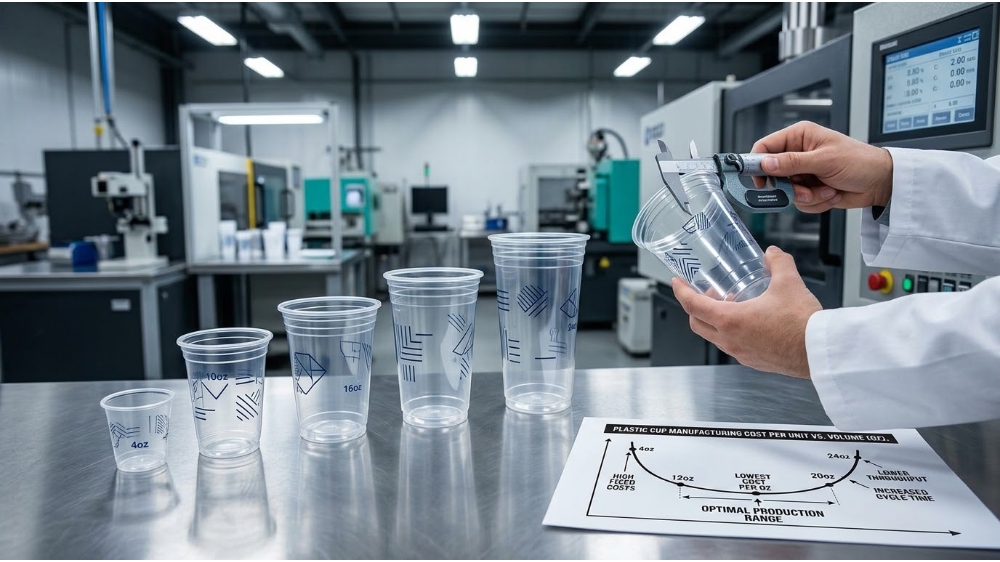
It’s tempting to assume a 22oz cup simply costs proportionally more resin than a 12oz cup, but the relationship is not linear. Larger cups require more material per unit, yes, but they also typically run at lower speeds per production cycle on the same equipment, since more plastic must be formed, cooled, and ejected in each cycle. That lower throughput raises the labor and machine-time cost allocated to every cup.
Very small cups have the opposite problem: below a certain volume, fixed costs like the mold, tooling changeover, and minimum wall thickness needed for structural rigidity stop scaling down proportionally, so the price per unit doesn’t drop as fast as the size does. In practice, this means the cost-per-ounce curve is flattest in the mid-range sizes most common in foodservice—roughly 12oz to 20oz—and steepens at both the very small and very large ends of a supplier’s size range.
For buyers standardizing a cup lineup, it’s often more cost-efficient to consolidate around two or three sizes that sit in a supplier’s efficient production range than to stock five sizes chosen purely for menu granularity.
Weight and Wall Thickness: Why a Heavier Cup Costs More
This is the variable buyers most often overlook, and it’s usually the one causing the “same size, different price” confusion. Two 16oz cups can look identical on a spec sheet and still differ by several grams of resin per cup, because wall thickness—not just outer dimensions—determines how much plastic goes into each one.
A heavier PET cup costs more for a straightforward reason: resin is priced by weight, so every additional gram of wall thickness is additional purchased material, multiplied across the entire order. On a run of 500,000 cups, a difference of just 0.5 grams per cup adds up to 250 kilograms of extra resin—a cost that shows up directly in the quote. Thicker walls also extend cooling time in the mold, which reduces how many cups a machine can produce per hour and adds machine-time cost on top of the material cost.
The trade-off is that thinner cups are more prone to denting, cracking under pressure, or “oil-canning” (the visible flex when a cup is squeezed), which can hurt the perceived quality of a branded product. Buyers choosing between a lighter, cheaper cup and a heavier, sturdier one are really choosing between unit cost and structural confidence—there is no version of a thicker wall that doesn’t cost more.
Why does a heavier PET cup cost more?
Resin is purchased and priced by weight, not by cup count
Thicker walls mean more grams of plastic per cup, multiplied across the order
Thicker walls extend cooling time, lowering cups-per-hour output
Lower output per hour raises the machine-time cost allocated to each cup
Cup Shape and Structural Design
A straight-wall cylindrical cup is the simplest and cheapest shape to mold and stack. Anything that departs from that baseline—tapered walls for stackability, ribbed or fluted sidewalls for grip, square or hexagonal cross-sections, or embossed logos molded directly into the plastic—adds cost through tooling complexity and, in most cases, slower cycle times.
Tapered cups nest more tightly for shipping and dispensing, which can offset some of their added mold cost through freight savings, since more cups fit in the same case or sleeve volume. Ribbed and textured walls improve grip and reduce the visible flex of a thinner cup, letting some brands use a lighter wall weight without sacrificing perceived sturdiness—effectively trading a design cost for a material cost. Fully custom shapes, including brand-specific silhouettes or curved profiles, require a dedicated mold and carry the highest upfront tooling investment, which is typically amortized into the per-unit price over the life of the order.
For most foodservice and retail buyers, a standard tapered or straight-wall shape offers the best cost-to-function ratio; custom geometry makes sense mainly when it’s tied to a brand identity that justifies the tooling investment.
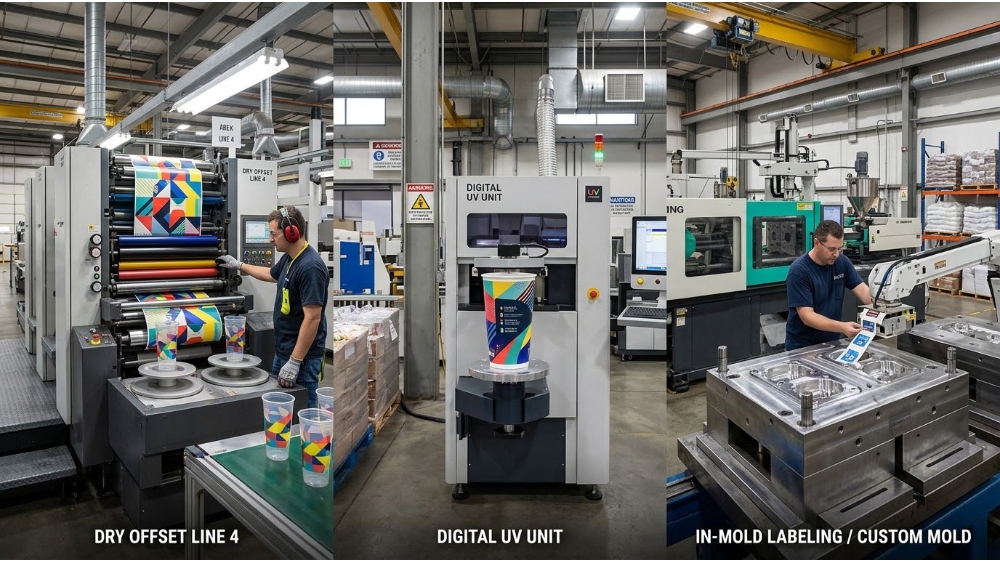
Printing and Branding: Offset, Digital, and Custom Molds
Printing is where many buyers first notice cost swings, because it’s the most visible customization choice. Cost here depends on three things: print method, number of colors, and print coverage (a small logo versus a full 360-degree wrap).
Offset printing (also called wet offset or dry offset, depending on the cup material) is the standard for mid-to-high volume runs and offers strong color accuracy, but each additional ink color typically adds its own setup and running cost, since colors are applied in separate passes. Digital printing has lower setup costs and makes small or variable-quantity runs economical, but its per-unit cost is often higher at large volumes compared to offset. In-mold labeling and molded-in branding sit at the premium end, embedding the design into the cup itself rather than printing on the surface, which typically requires a dedicated mold and the highest tooling investment of the three methods.
A one-color logo on a stock cup shape is the least expensive branding option available; a full-wrap, multi-color, custom-mold cup is the most expensive—and everything else on this list sits somewhere between those two points.
Order Quantity: MOQs, Tiers, and Economies of Scale
Plastic cup manufacturing is a fixed-cost-heavy process: mold setup, tooling amortization, and production changeovers cost roughly the same whether an order is 10,000 units or 500,000 units. That’s why quotes are almost always tiered, with the unit price dropping in steps as quantity crosses certain thresholds rather than falling smoothly.
Minimum order quantities (MOQs) exist because below a certain volume, the fixed setup cost per cup becomes disproportionately high—sometimes higher than the material cost itself. Custom printing and custom molds raise MOQs further, since the tooling investment needs enough units to amortize across before it becomes cost-effective. Buyers who order just below a price-break threshold often pay a noticeably higher unit price than buyers who round up to the next tier, even though the material cost per cup hasn’t changed at all.
Order volume
Typical pricing behavior
Best suited for
Under 10,000 units
Highest unit price; stock designs only
Testing, small events, single-location trial
10,000-100,000 units
Custom printing becomes cost-viable
Regional chains, seasonal promotions
100,000-500,000 units
Meaningful step-down in unit price
Multi-location brands, annual contracts
500,000+ units
Lowest unit price; custom molds justified
National chains, private-label programs
Lids, Secondary Packaging, and Freight: The Line Items Buyers Forget
The cup itself is rarely the whole cost. Lids are priced and quoted separately from cups in most cases, and matching a dome lid, flat lid, or straw-slot lid to a specific cup rim diameter can restrict which suppliers are even eligible to bid. Sleeves, individual wrapping, and printed carton packaging add further cost, especially for programs that require retail-ready shelf packaging rather than simple bulk cases.
Freight is often the largest hidden variable of all. Cups are lightweight but bulky, meaning shipments are frequently priced by volume (“cubed out”) rather than weight, so a shape or nesting design that reduces stacked height directly reduces freight cost per unit—sometimes by more than the cup’s own manufacturing cost difference between suppliers. Import duties, port handling fees, and inland trucking to a final warehouse are all costs that a factory-gate cup price does not include, and buyers comparing an FOB quote to a landed-cost quote are not actually comparing the same number.
How to Read a Plastic Cup Quote Without Overpaying
The fastest way to compare two supplier quotes fairly is to normalize them against the same eight variables covered above, rather than comparing the bottom-line price alone. Ask for the resin type and grade, the exact cup weight in grams, the wall thickness, the print method and color count, the MOQ tier the price reflects, and whether the quote is FOB (factory) or landed (delivered), including duties and inland freight.
A price that looks unusually low relative to competing quotes is almost always explained by one of these variables moving—typically a lighter wall weight, a cheaper resin, or a factory-gate price that excludes freight and duties. That isn’t necessarily a problem, but it needs to be a deliberate trade-off rather than a surprise that shows up after the order lands. Buyers who standardize their request-for-quote template around resin, weight, shape, printing, quantity, and delivery terms consistently get quotes that are easier to compare and harder for any single supplier to quietly underspec.
For businesses sourcing cups alongside lids, sleeves, and full packaging programs, working with a single supplier who can quote all of these variables together—rather than piecing together cups from one factory and lids from another—typically reduces both the coordination overhead and the freight cost of shipping mismatched components separately. Maibaopak works with B2B buyers to break down cup, lid, and packaging quotes into these same eight variables so pricing decisions are based on specs, not guesswork. You could learn about how to choose a plastic cup supplier correctly by reading Plastic Cup Supplier Guide: 10 Checks Before a Bulk Order.
Not sure why your cup quotes don’t match up?
Talk to a packaging specialist about resin selection, wall weight, print method, and order tiers—matched to your volume, budget, and delivery timeline.
Why do two suppliers quote different prices for the same size cup?
The “same size” cup can still differ in resin type, wall thickness, print method, and MOQ tier—all of which affect price. A lower quote is usually explained by one of these variables, not by one supplier simply charging less for an identical product.
Does a thicker plastic cup always cost more?
Yes. Resin is priced and purchased by weight, so a heavier wall means more material per cup, multiplied across the order. Thicker walls also slow production cycle times, adding machine-time cost on top of the material cost.
Is PET or PP cheaper for bulk plastic cups?
PP is generally the lower-cost resin and tolerates higher temperatures, while PET typically costs more but offers superior clarity and rigidity for cold drinks. The right choice depends on whether clarity or heat resistance matters more for the application.
How much does custom printing add to plastic cup cost?
It depends on the method and color count: offset printing adds cost per color due to setup and run time, digital printing has lower setup cost but higher per-unit cost at scale, and molded-in branding carries the highest upfront tooling cost of the three.
Post time:
Sep-07-2026
For inquiries about our products or pricelist, please leave your email to us and we will be in touch within 24 hours.