Do Paper Bags Leak with Greasy Food? How Restaurants Prevent Oil Leaks in Takeout Packaging
Grease-Proof Paper Bags: Stop Takeout Oil Leaks
Foodservice Packaging Guide
Do Paper Bags Leak with Greasy Food? How Restaurants Prevent Oil Leaks in Takeout Packaging
A hot burger, a basket of wings, or a pile of loaded fries—placed in an untreated paper bag, grease stains appear within minutes, and structural failure follows shortly after. The question isn’t whether paper leaks, but how to engineer it not to. This guide breaks down the science of grease migration, compares barrier coating technologies, and gives operators a decision framework for oil-resistant takeout packaging that actually works.
A paper bag is a network of cellulose fibres held together by hydrogen bonds. That network is naturally porous and hydrophilic—it loves water and has no inherent defence against oil. When hot, greasy food contacts the bag, the oil migrates into the fibre structure through capillary action, driven by the food’s temperature and the bag’s lack of a continuous barrier layer.
This guide explains the physics of grease leakage, evaluates every major barrier coating on the market, and provides a hold‑time‑based framework for selecting takeout packaging that keeps oil inside the bag—and off your customers’ hands.
Why Does Greasy Food Leak Through Paper Bags?
Paper bags fail against grease for two interconnected reasons: fibre porosity and the thermodynamics of hot oil. Uncoated paper has an open fibre structure with voids large enough to allow triglyceride molecules—the primary components of cooking oils—to wick inward. The capillary pressure increases as the oil viscosity decreases with temperature, meaning a 180°F chicken wing pushes oil into the paper far faster than a room‑temperature sandwich.
The second mechanism is structural softening. When oil saturates the fibre wall, it displaces the hydrogen bonds that give paper its tensile strength. The bag becomes limp, the seams weaken, and eventually the oil breaks through to the outside surface. This isn’t just a cosmetic issue; a greasy, compromised bag can fail entirely during handling, leading to product loss and a poor customer experience. Research from the paper and packaging industry consistently identifies grease resistance as the single most important functional property for hot‑food takeout bags, second only to physical durability.
What Are Grease‑Barrier Coatings for Paper Packaging?
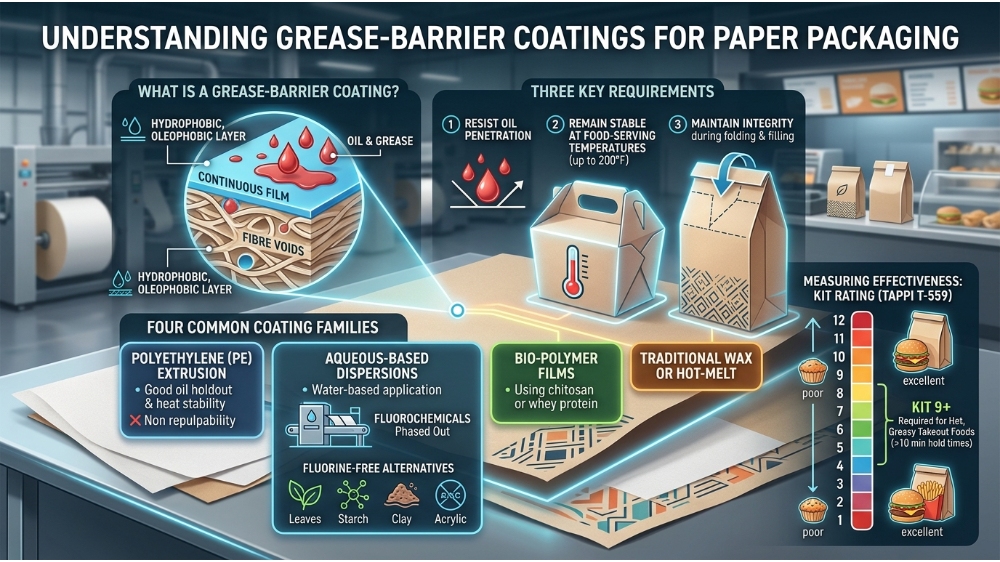
A grease barrier is a continuous film applied to the paper surface that closes the fibre voids and creates a hydrophobic, oleophobic layer. The coating must do three things: resist oil penetration, remain stable at food‑serving temperatures (up to 200°F), and maintain its integrity during the bag’s folding and filling process.
The most common commercial barriers fall into four families: polyethylene (PE) extrusion coatings, aqueous‑based dispersions, bio‑polymer films (such as chitosan or whey protein), and traditional wax or hot‑melt coatings. Each has a distinct performance profile. PE coatings offer excellent oil holdout and heat stability, but they are not readily repulpable in standard paper recycling streams. Aqueous coatings are water‑based, applied via flexo or gravure, and can be formulated with fluorochemicals—though that chemistry is rapidly being phased out—or with fluorine‑free alternatives like modified starches, clays, and acrylic copolymers.
The effectiveness of any coating is measured by its Kit rating, a standardised test (TAPPI T‑559) that ranks grease resistance from 1 (poor) to 12 (excellent) using a series of castor‑oil‑based solutions. A Kit rating of 9 or above is generally required for hot, greasy takeout foods with hold times beyond 10 minutes.
Coated vs. Uncoated Paper Bags: A Performance Comparison
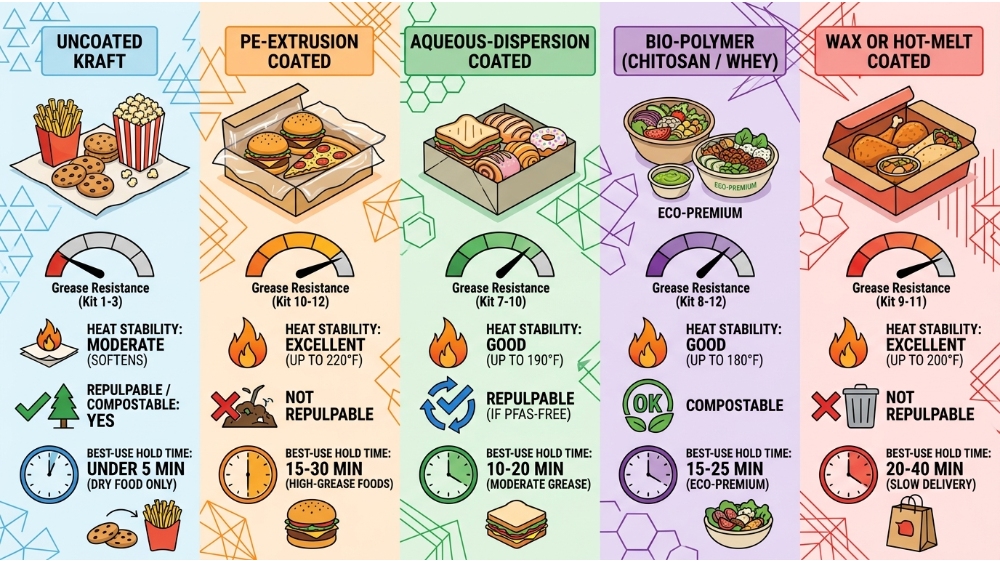
Choosing between coated and uncoated bags is not a binary decision—it’s a sliding scale of performance, cost, and sustainability. The table below compares the five most common paper bag constructions against real‑world takeout criteria.
Material / Coating
Grease resistance (Kit rating)
Heat stability
Repulpable / compostable
Best‑use hold time
Uncoated kraft
1–3
Moderate (softens)
Yes
Under 5 min (dry food only)
PE‑extrusion coated
10–12
Excellent (up to 220°F)
Not repulpable
15–30 min (high‑grease foods)
Aqueous‑dispersion coated
7–10
Good (up to 190°F)
Repulpable (if PFAS‑free)
10–20 min (moderate grease)
Bio‑polymer (chitosan / whey)
8–12
Good (up to 180°F)
Compostable
15–25 min (eco‑premium)
Wax or hot‑melt coated
9–11
Excellent (up to 200°F)
Not repulpable
20–40 min (slow delivery)
The uncoated kraft bag is acceptable only for dry, cool items like bread or packaged snacks. For hot fried chicken, sauced wings, or a double cheeseburger, uncoated paper will show oil migration within 2–3 minutes and full saturation by 10 minutes. Learn more about kraft bag by Complete Guide of Kraft Paper Bags for Food Packaging.
PE and bio‑polymer coatings provide the robust barrier needed for delivery, while aqueous coatings strike a middle ground for short‑hold counter service where repulpability is a priority.
How Hold Time and Food Temperature Affect Grease Migration
Grease migration is a function of time, temperature, and oil viscosity. A 2019 study on oil penetration in paperboard found that migration depth increases by roughly 40% when the oil temperature rises from 120°F to 180°F, and that penetration rate is nearly linear for the first 20 minutes. This means that a bag that works for a 5‑minute counter hold may fail catastrophically in a 25‑minute delivery scenario—even with the same food and bag.
Hold‑time packaging guidelines for greasy foods:
Under 10 min (dine‑in / counter): Aqueous‑coated or high‑density uncoated kraft with a grease‑resistant insert works, provided the food is not swimming in oil.
10–20 min (standard delivery): PE‑coated or bio‑polymer‑coated bag with Kit ≥9 is the minimum baseline.
20–30 min (extended delivery): Double‑wall construction or PE coating with a reinforced bottom seam and a grease‑absorbing pad is recommended.
30+ min (catering / long‑distance): Use a coated paper bag inside a sealed, insulated carrier—the bag contains the grease, the carrier retains heat.
Temperature also affects seam integrity. Most paper bags are glued at the side and bottom seams. Standard starch‑based adhesives weaken under oil saturation and heat. For delivery applications, operators should specify heat‑resistant, oil‑resistant adhesives or opt for bags with heat‑sealed seams, which provide a much more reliable oil barrier at the critical fold points.
PFAS‑Free Grease Resistance: What Replaces the Old Chemistry?
For decades, the gold standard for grease‑proof paper was fluorochemical treatment—PFAS compounds that created an extremely effective oil and water barrier. But with the European Union’s 2026 PFAS restriction now in force and similar regulations pending in multiple US states, the packaging industry has accelerated its shift to fluorine‑free alternatives.
The replacement technologies fall into three categories. The first is barrier‑enhanced paperboard, where the base paper is refined to a higher density and treated with a thin layer of clay or calcium carbonate to reduce porosity. These “mineral‑filled” papers offer a Kit rating of 5–7 without any chemical coating—sufficient for short‑hold bakery or sandwich wraps but inadequate for hot fried foods.
The second category is bio‑polymer coatings, which have advanced rapidly. Recent research published in 2024 demonstrated that a bilayer coating of whey protein isolate and carnauba wax achieved a Kit rating of 12—equal to the best fluorochemical treatments—while being fully compostable. Another emerging technology uses chitosan (derived from shellfish waste) cross‑linked with epoxidised soybean oil, producing a hydrophobic network that resists oil migration for over 30 minutes at 160°F.
The third category is aqueous dispersion coatings formulated without PFAS, using styrene‑acrylic or polyester resins. These are the direct replacements for the older fluoropolymer dispersions. They offer Kit ratings of 8–10, are repulpable, and are already widely available from major packaging converters. The shift to PFAS‑free is not a future trend—it is the current operating reality for any foodservice operator selling into regulated markets.
How to Choose the Right Grease‑Proof Paper Bag for Your Restaurant
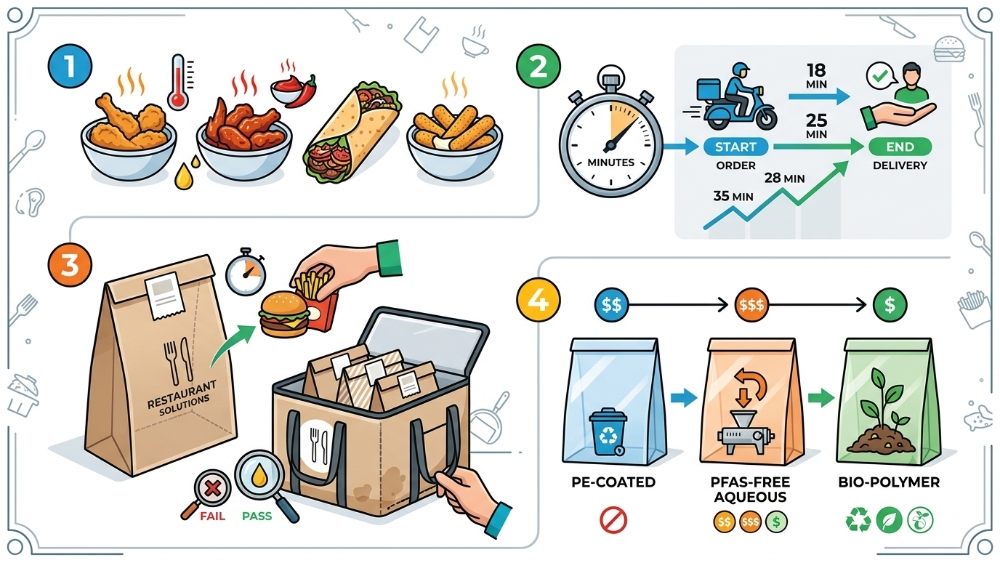
Selecting the correct grease‑barrier bag is a four‑step process that starts with your actual menu and delivery logistics, not with a supplier catalogue.
Step 1: Map your menu by grease load and temperature. Fried chicken and mozzarella sticks have moderate grease but high surface temperature. Sauced chicken wings and loaded fries have high grease volume plus acidic sauces that can attack certain coatings. Burritos and hot sandwiches have moderate grease but often include wet fillings that create steam—which can delaminate some water‑sensitive coatings.
Step 2: Measure your real hold time. Do not guess. Track orders from the fryer to the customer’s hand for at least 50 deliveries, across all dayparts. If your average is 18 minutes, design for 25. If it’s 28, design for 35.
Step 3: Test the bag with your actual product. Order a minimum of 100 sample bags of each candidate construction. Fill them with your hottest, greasiest menu item, seal them, and place them in your standard delivery bags. Check for oil staining on the exterior at 5‑minute intervals. The bag must show zero bleed‑through at your design hold time. Also inspect the bottom seam—this is where most failures occur.
Step 4: Balance performance with cost and sustainability goals. A PE‑coated bag offers the best barrier at the lowest cost, but it is not recyclable in paper streams. An aqueous PFAS‑free coating is repulpable but may cost 15‑20% more and offer slightly lower heat resistance. A bio‑polymer bag may command a premium but can be marketed as compostable, which has value to certain customer demographics.
For operators running multiple locations, consistency of supply is as critical as barrier performance. Work with a packaging partner who can document Kit ratings, provide batch‑to‑batch coating uniformity, and offer custom sizing to reduce waste. The ideal bag is one that you can order in volume, trust to perform, and adjust over time as your menu and delivery radius evolve.
Need grease‑proof packaging that actually works for delivery?
Talk to a packaging specialist about matching bag construction, coating technology, and hold‑time performance to your specific menu and delivery conditions.
Yes—uncoated paper bags leak because oil migrates through the porous fibre network within minutes. However, paper bags with a grease‑barrier coating (PE, aqueous, or bio‑polymer) can prevent leakage for 15–30 minutes, depending on the coating type and food temperature.
What is the best paper bag for greasy takeout food?
For standard delivery holds of 10–20 minutes, a PE‑coated paper bag with a Kit rating of 10 or higher is the most reliable and cost‑effective option. For eco‑conscious brands, a bio‑polymer (chitosan or whey‑based) coated bag with equivalent Kit performance offers compostability and strong oil holdout.
How long can greasy food stay in a paper bag before it leaks?
In an uncoated kraft bag, oil breakthrough occurs in 2–5 minutes for hot fried foods. In a high‑quality PE‑coated or bio‑polymer bag, you can expect 20–30 minutes of leak‑free performance, provided the seams are properly constructed and the bag is not overfilled.
Are grease‑proof paper bags safe and PFAS‑free?
Yes—modern PFAS‑free grease‑proof bags use mineral fillers, bio‑polymers, or aqueous polymer dispersions that are FDA‑compliant for food contact. They contain no fluorinated compounds and meet the new EU and US state regulations restricting PFAS in food packaging.
Post time:
Aug-13-2026
For inquiries about our products or pricelist, please leave your email to us and we will be in touch within 24 hours.