
Bakery items are among the most structurally and chemically diverse foods in the takeaway ecosystem. A crusty artisan loaf has a hard, dry exterior but a moist, chewy crumb. A frosted layer cake is a delicate emulsion of fat, sugar, and air that collapses under pressure. A buttery croissant relies on distinct, flaky layers that must remain separate. The packaging that protects one can destroy another. This guide breaks down the science of moisture migration, grease penetration, and physical support across the four primary bakery food packaging categories, providing a clear framework for selecting the right format for every item in your case.
Bakery Packaging Types Guide | Boxes, Bags, Trays & Containers
Foodservice Packaging Guide
Different Types of Bakery Packaging: Boxes, Bags, Trays, and Containers Explained
A croissant fresh from the oven is a marvel of laminated butter and steam. Ten minutes in the wrong package, and it collapses into a greasy, soggy shadow of itself. Bread goes stale, cakes lose their crumb, and cookies turn brittle. The choice between a box, a bag, a tray, or a container isn’t just about aesthetics—it’s about preserving the precise moisture equilibrium, structural integrity, and sensory experience of every baked good. Here is the definitive guide to matching bakery packaging formats to your specific menu items.
Why Bakery Packaging Is a Matter of Food Science
Fresh bakery products degrade through two primary physical mechanisms: moisture loss (staling) and moisture gain (sogginess). Starch retrogradation—the recrystallization of amylopectin molecules—accelerates when moisture leaves the product, causing bread to firm and become dry. Conversely, high-humidity environments inside sealed packaging cause condensation, which hydrates crusts and turns crisp surfaces into leathery or wet textures.
The ideal packaging acts as a selective barrier. It must retain enough moisture to keep the crumb tender but allow enough vapor transmission to prevent condensation that ruins crusts. Research published by the Institute of Food Technologists highlights that the optimal water activity (aw) range for most baked goods is between 0.85 and 0.95. Packaging materials with different water vapor transmission rates (WVTR) either maintain this equilibrium or rapidly disrupt it. This is why a paper bag works for crusty bread but fails miserably for a cream-filled doughnut. Learn more about packaging materials by Top 7 Bakery Packaging Materials Every Bakery Should Consider in 2026.
Bakery packaging failure points:
- Moisture loss leading to staling and crumb firmness
- Moisture gain from condensation causing soggy crusts
- Grease penetration from butter, oils, and fillings
- Physical compression damaging delicate laminated structures
Bakery Boxes: Rigid Protection for Cakes and Pastries
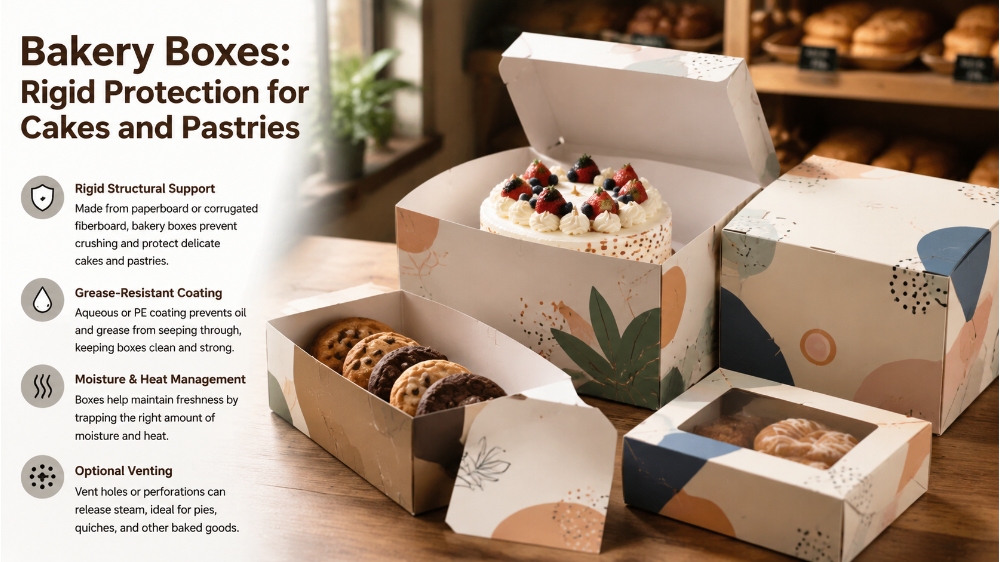
Boxes are the heavy artillery of bakery packaging. Made primarily from paperboard or corrugated fiberboard, they offer rigid structural support that prevents crushing—critical for tall layer cakes, delicate decorated cookies, and fragile pastry towers. The closed, four-sided structure provides a stable microclimate, but this comes with a caveat: boxes trap heat and moisture effectively, which is excellent for keeping brownies fudgy but disastrous for crispy croissants.
For cakes and frosted items, the box serves as a protective exoskeleton. The interior is often coated with a grease-resistant barrier—typically aqueous or polyethylene (PE) coating—to prevent oil from the buttercream or glaze from wicking into the board and staining the exterior. Uncoated kraft boxes absorb grease rapidly, leading to structural softening and an unsightly presentation within minutes. A coated paperboard box, by contrast, maintains its integrity and preserves the visual appeal of the bakery item. For items like pies or quiches that emit steam, boxes can incorporate small vent holes or perforations to release vapor, though this is less common than in fry packaging due to the typically shorter hold times for baked goods.
Bakery Bags: Breathable Solutions for Bread and Buns
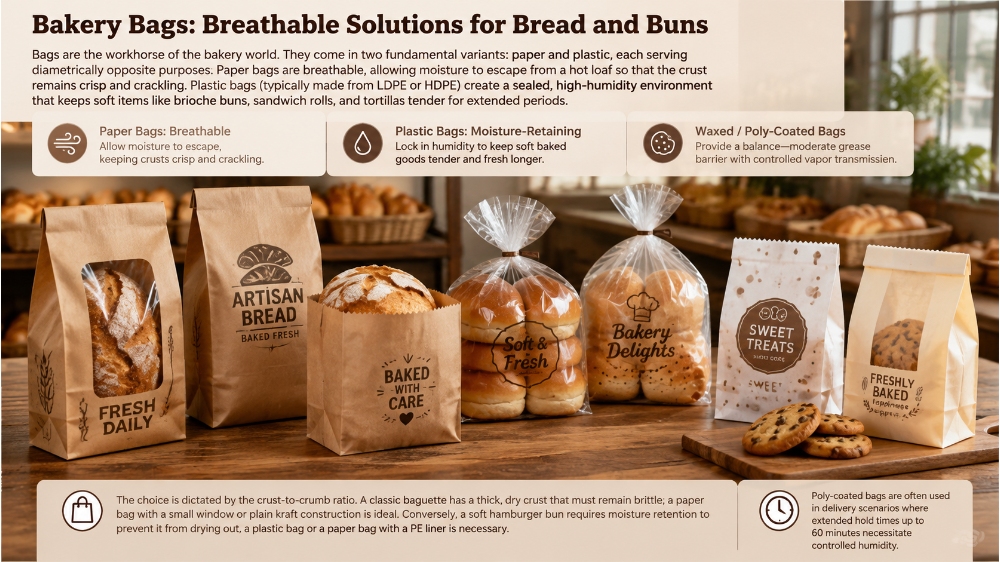
Bags are the workhorse of the bakery world. They come in two fundamental variants: paper and plastic, each serving diametrically opposite purposes. Paper bags are breathable, allowing moisture to escape from a hot loaf so that the crust remains crisp and crackling. Plastic bags (typically made from LDPE or HDPE) create a sealed, high-humidity environment that keeps soft items like brioche buns, sandwich rolls, and tortillas tender for extended periods.
The choice is dictated by the crust-to-crumb ratio. A classic baguette has a thick, dry crust that must remain brittle; a paper bag with a small window or plain kraft construction is ideal. Conversely, a soft hamburger bun requires moisture retention to prevent it from drying out; a plastic bag or a paper bag with a PE liner is necessary. Foodservice operators often use waxed paper bags for cookies and pastries, as the wax coating provides a moderate grease barrier while allowing some vapor transmission. Poly-coated bags are less common for premium display but are frequently used in delivery scenarios where extended hold times up to 60 minutes necessitate controlled humidity.
Bakery Trays: Display-Ready Bases for Cookies and Croissants
Trays represent the open-face philosophy of bakery packaging. Typically made from molded pulp, corrugated paperboard, or rigid plastic (like PET or RPET), trays provide a stable base without fully enclosing the product. This makes them ideal for self-service display cases, farmers’ markets, and in-store merchandising where visibility is paramount. The open-top design allows steam to escape immediately, preserving crispness for items taken hot from the oven.
However, the lack of a lid means trays offer no protection against environmental contaminants or moisture loss over time. They are best suited for items with a short dwell time in the consumer’s hands—less than 15 to 20 minutes. For extended transport, trays are frequently paired with a clear plastic dome or a sleeve to create a hybrid system. Molded fiber trays are particularly popular for their earthy, natural aesthetic and high breathability, though they absorb grease aggressively unless lined with a parchment insert or coated. Premium operators often choose a rigid plastic tray with anti-fog properties to maintain visual clarity when used with a lid. Click to explore cake box with tray
Bakery Containers: Clear Visibility for Delicate Desserts
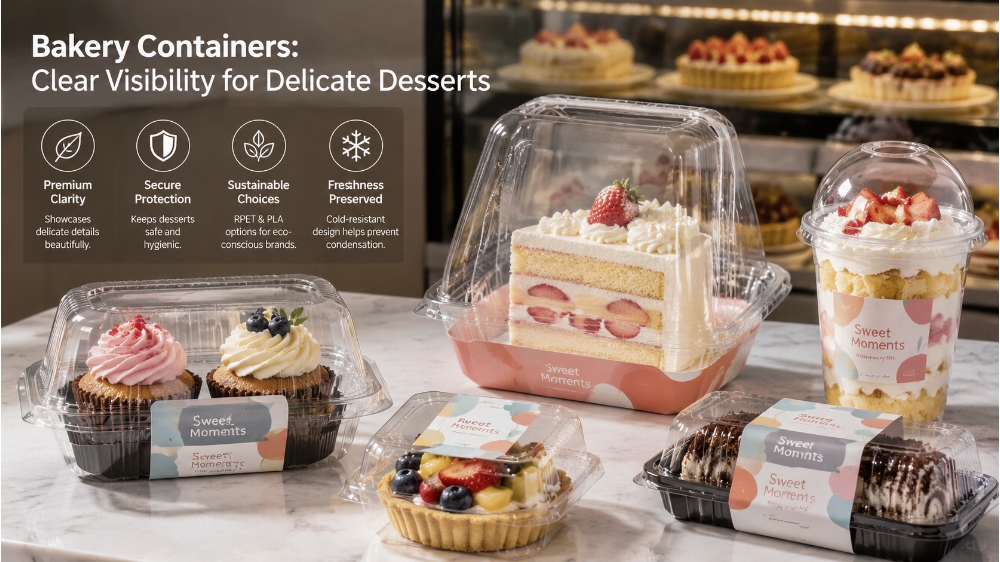
Containers—typically clear plastic clamshells, hinged-lid boxes, or PET cups—offer the best of both worlds: full enclosure with unimpeded product visibility. This category is essential for high-value items like decorated cupcakes, fruit tarts, and multi-layer cakes where visual appeal drives purchase intent. The transparent structure allows customers to inspect the product without opening the package, maintaining hygiene and structural integrity.
Material selection in this category is critical. PET (polyethylene terephthalate) is rigid, clear, and offers good oxygen barrier properties but has a moderate water vapor transmission rate. RPET (recycled PET) provides the same clarity with a sustainability story. PLA (polylactic acid), derived from corn starch, is a compostable alternative that is gaining traction in eco-conscious markets, though it has lower heat tolerance (typically below 110°F) and can deform in hot display cases. Ventilation is handled via small perforations or the natural gap between the base and the lid. For cream-based desserts that require refrigeration, containers must be cold-resistant and prevent condensation from forming on the inside of the lid, which can drip and ruin delicate decorations.
Material Breakdown: Paperboard, Kraft, PLA, and Molded Fiber
The substrate defines the packaging’s performance envelope. Each material has distinct trade-offs in terms of cost, sustainability, grease resistance, and moisture handling. Below is a comprehensive comparison of the four primary materials used in bakery packaging.
| Material | Grease resistance | Moisture control (WVTR) | Best bakery application |
|---|---|---|---|
| Uncoated kraft paperboard | Poor—absorbs oil rapidly | High—very breathable | Bread, baguettes, dry pastries |
| PE-coated paperboard | Excellent—full oil barrier | Low—moisture retentive | Cakes, frosted goods, buns |
| Aqueous-coated board | Very good—repulpable barrier | Moderate—vented designs available | Eco-premium boxes for pastries |
| Molded fiber (pulp) | Poor—absorbs grease unless lined | High—highly breathable | Trays for cookies, hot items |
| PLA (bioplastic) | Good—inherent oil resistance | Low—good moisture barrier | Clamshells, cold desserts |
| PET / RPET | Excellent—non-porous | Very low—high barrier | Containers for fruit tarts, salads |
Research into functionalized PLA coatings, such as those published in ACS journals, is demonstrating that biodegradable materials can now achieve grease resistance comparable to traditional PE coatings. These innovations are critical for foodservice operators looking to reduce PFAS and persistent chemical usage while maintaining package performance.
How to Match Packaging to Your Specific Bakery Item
Matching packaging to a bakery item is a systematic exercise in risk assessment. You must evaluate three core attributes of the product: moisture content, grease content, and structural fragility. A high-moisture, high-grease, fragile item (like a frosted layer cake) demands a PE-coated box with a secure lid. A low-moisture, low-grease, sturdy item (like a plain bagel) can use a simple uncoated paper bag.
Consider the hold time. For in-store consumption (under 10 minutes), display trays and open bags are sufficient. For takeout and delivery (15 to 30 minutes), you need a closed system with balanced venting. For items like croissants and danishes, which contain significant butterfat, the grease resistance of the packaging is non-negotiable. If the paper absorbs the melted butter, the product loses its flaky texture, and the package becomes translucent and unappealing.
Testing is imperative. Simulate your actual delivery conditions: pack a fresh batch of your product in the candidate packaging, place it in a standard delivery bag, and assess the texture, temperature, and appearance at 10, 20, and 30-minute intervals. If the crust is soft, consider a more breathable material or adding vent holes. If the product is dry, switch to a lower-WVTR material like a PE-coated bag. Consistency in packaging means consistency in product quality, which reduces customer complaints and builds brand trust. You could learn more practical detail by reading Custom Bakery Packaging Guide: 7 Steps to Brand Your Baked Goods.
Decision matrix for bakery packaging:
- High moisture / soft: Buns, tortillas → Plastic bag or coated paper
- Low moisture / crisp: Bread, croissants → Uncoated paper bag or vented box
- Fragile / decorated: Cakes, cupcakes → Rigid box or clear PET container
- Greasy / oily: Pastries, cookies → Coated board or waxed paper
Need custom bakery packaging engineered for your product line?
Talk to a packaging specialist about matching material science, structural design, and barrier performance to your specific baked goods and delivery radius.
Frequently Asked Questions
What is the best type of packaging for bakery bread?
The best packaging depends on the crust. For crusty artisan bread, use a breathable paper bag to allow steam escape and prevent a soggy crust. For soft sandwich bread, use a plastic bag or PE-coated paper to retain moisture and keep the crumb tender.
Are paper or plastic bakery bags better for the environment?
Paper bags are renewable, compostable, and recyclable but offer poor grease and moisture retention. Plastic bags provide superior food preservation but are often single-use. The “best” choice depends on your sustainability goals and the specific food item—molded fiber or coated paper often offers a balanced middle ground.
Do bakery boxes need ventilation holes?
Ventilation is essential for hot, high-moisture items like pies or quiches to prevent condensation. For dry cakes and pastries, venting is usually unnecessary and can actually accelerate staling by allowing moisture to escape.
How do I keep my pastries from getting soggy in a container?
Ensure the container has adequate venting or a moisture-absorbing insert. Avoid sealing the container while the pastry is still hot, as this traps steam. For delivery, a box with side perforations allows moisture to escape without cooling the product too quickly.
Post time: Aug-07-2026