Custom Bakery Boxes vs Stock Packaging: Which Is Better for Your Bakery Business?
Custom Bakery Boxes vs Stock: Which Is Better?
Bakery Packaging Strategy Guide
Custom Bakery Boxes vs Stock Packaging: Which Is Better for Your Bakery Business?
Every bakery owner faces the same packaging dilemma: invest in custom branded boxes or stick with cost-effective stock packaging? The decision affects your brand perception, your profit margins, and your customers’ unboxing experience. This data-driven guide breaks down the real costs, benefits, and trade-offs so you can choose the right packaging strategy for your bakery.
A bakery’s packaging is more than a vessel — it’s a silent salesperson, a brand ambassador, and a logistical puzzle all in one. The choice between custom bakery boxes and stock packaging isn’t merely about aesthetics; it’s a strategic decision that impacts your bottom line, your brand equity, and your operational efficiency. This guide examines every angle, from the physics of moisture migration in pastry boxes to the economics of print runs and the psychology of color on a shelf.
Whether you’re a single-location artisan bakery or a multi-store chain, this analysis will help you determine the optimal packaging mix for your unique situation.
What Are the Real Costs of Custom Bakery Boxes vs Stock Packaging?
The most immediate question for any bakery owner is cost. At first glance, stock packaging appears significantly cheaper — typically $0.20 to $0.80 per unit compared to $0.80 to $3.00+ for custom bakery boxes. However, this surface-level comparison misses several critical cost factors that can dramatically shift the total expense picture.
Custom bakery boxes carry upfront setup fees that can range from $150 to $1,200 per design, covering plate-making, die-cutting, and color matching. These one-time costs are amortized across your order quantity, meaning the per-unit price drops substantially as volume increases. For orders under 500 units, custom boxes often cost 60–100% more than stock. But once you cross the 2,500-unit threshold, the premium can shrink to just 15–25%.
Then there are the hidden costs of stock packaging. While the per-unit price is low, stock boxes force you into fixed sizes that may not fit your products properly. A croissant that rattles around in an oversized box is more likely to arrive damaged, increasing refunds and replacement costs. The Packaging World Bakery Market Update 2025 noted that bakeries using ill-fitting stock boxes reported up to 8% higher product damage rates compared to those using custom-sized packaging.
Storage and waste are another dimension. Stock boxes must be ordered in case quantities — often 250 or 500 units per size. If you carry multiple pastry shapes, you’re tying up capital and storage space in boxes that may move slowly. Custom packaging, by contrast, can be ordered just-in-time in mixed sizes, reducing inventory carrying costs. The Smithers Pira 2024 Packaging Futures report estimated that mid-sized bakeries can reduce packaging inventory costs by 18–22% by switching to a custom, just-in-time ordering model.
Finally, consider the cost of missed opportunities. A branded custom bakery box that delights customers and encourages social media sharing has a marketing value that stock packaging simply cannot match. When you factor in the customer acquisition cost savings from organic word-of-mouth, custom packaging often pays for itself within 6–12 months.
How Do Custom Bakery Boxes Boost Brand Recognition and Sales?
Your bakery box is the last thing a customer touches before they enjoy your product — and it’s often the first thing they photograph and share. The Dieline 2025 consumer survey found that 68% of consumers say food packaging design influences their purchase decision, and 72% are more likely to repurchase from a brand that uses distinctive, high-quality packaging.
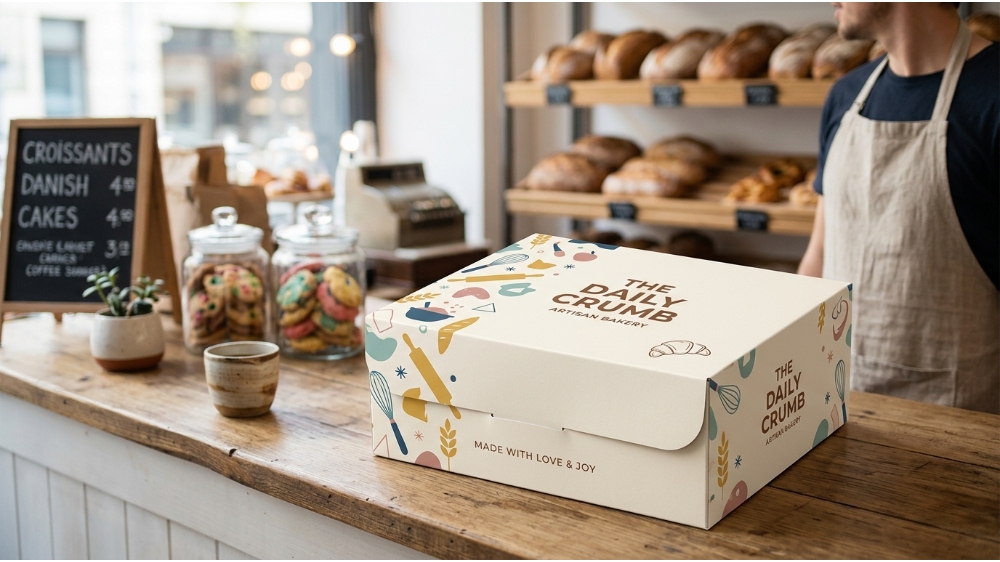
Custom bakery boxes give you control over every visual element: color palette, typography, logo placement, finish (matte, gloss, soft-touch), and even tactile features like embossing or debossing. These design elements work together to create a cohesive brand experience that builds recognition and trust. A consistent branded box can increase brand recall by 40% according to consumer psychology studies cited in the Packaging World Bakery Market Update.
Brand impact of custom bakery packaging:
68% of consumers say packaging design influences purchase decisions
72% are more likely to repurchase from a brand with distinctive packaging
Consistent branding on packaging increases brand recall by up to 40%
Custom boxes can justify a 10–15% price premium on packaged goods
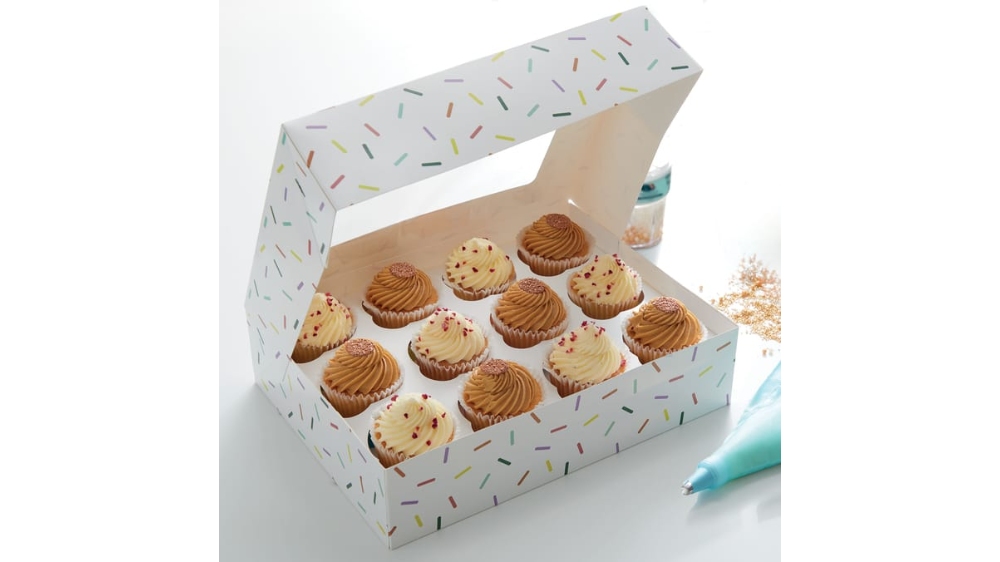
Beyond aesthetics, custom packaging can solve specific functional problems. Tailored dimensions reduce product movement, preventing broken cookies or crushed croissants. A window cutout can showcase your product’s visual appeal. Interior dividers can separate delicate items. These features reduce waste, refunds, and customer complaints — directly benefiting your bottom line.
Perhaps most importantly, custom bakery boxes transform every order into a marketing opportunity. A beautifully branded box that travels through a neighborhood, sits on an office desk, or appears in an Instagram photo is advertising you don’t pay for per impression. In an era where social media drives food trends, packaging that photographs well is an invaluable asset. You could read 7 Ways Custom Bakery Packaging can Increase Brand Recognition to improve custom packaging knowledge.
What Are the Minimum Order Quantities and Lead Times for Custom vs Stock?
Operational agility is a critical consideration, especially for bakeries with seasonal menus or limited storage space. Stock packaging typically ships within 2–5 days with no minimum order quantity (MOQ) beyond a single case. Custom bakery boxes, however, require planning — traditional offset printing often demands 1,000-10,000 units with 3-5 weeks lead time.
The good news is that digital printing technology has transformed the custom packaging landscape. According to Printing United’s 2024 digital packaging report, digital presses now offer MOQs as low as 100 units with turnaround times of 7–10 business days. While the per-unit cost is higher for these short runs, the reduced minimums make custom boxes accessible to bakeries of almost any size.
Lead time isn’t just about production — it’s also about design iteration. Each round of design revisions adds 1–3 days, and many bakery owners underestimate this phase. The Packaging World Bakery Market Update noted that 43% of bakery owners who order custom boxes experience at least one design-related delay that forces them to purchase stock boxes as a stopgap.
A strategic approach is to plan seasonal packaging changes well in advance. If you know you’ll need holiday-themed boxes for November–December, start the design process in August. For everyday packaging, establish a core custom design that stays consistent year-round, and supplement with stock boxes for new product trials or unexpected demand spikes.
Which Packaging Type Is More Sustainable — Custom or Stock?
Sustainability is no longer a niche concern — it’s a mainstream expectation. The EPA’s Sustainable Materials Management program emphasizes that the most sustainable package is the one that uses the least material overall. Custom bakery boxes can be engineered with precision to fit your products exactly, reducing material waste and void space in shipping.
Custom packaging also gives you control over material specifications. You can specify FSC-certified board, plant-based inks, water-based coatings, and 100% recyclable or compostable structures. Stock boxes, by contrast, are often produced with cost as the primary driver, using mixed materials that may not be easily recyclable.
However, stock packaging has its own sustainability story. Because stock boxes are produced in massive quantities and often sourced locally, their per-unit carbon footprint for transportation can be lower. A stock box produced within 200 miles of your bakery has a significantly smaller shipping footprint than a custom box sourced from a supplier on the other side of the country.
The sustainability equation also includes end-of-life considerations. Custom boxes that use mono-materials (all paper or all plastic) are easier to recycle than stock boxes with mixed-material coatings. The Smithers Pira report projects that by 2028, 60% of bakery packaging will incorporate certified sustainable materials, driven largely by custom packaging designed with circular economy principles. Click to learn more about sustainability bakery packaging by reading Eco Friendly Bakery Packaging: Sustainable Options Without Increasing Packaging Costs.
Sustainability factors to evaluate:
Material certifications: FSC, SFI, or PEFC for paper sources
Coating types: PE, aqueous, or PLA for grease resistance
Recyclability: mono-material designs are easier to recycle
Shipping distance: local sourcing reduces carbon footprint
Fit efficiency: custom sizing reduces void space in shipping
Ultimately, neither custom nor stock is inherently more sustainable — it depends on material choices, production methods, and logistics. The most sustainable approach is often a hybrid: custom boxes for your high-volume core products (using certified sustainable materials) and stock boxes for trial items or emergency replacements.
When Should a Bakery Choose Stock Over Custom Packaging?
Despite the branding advantages of custom bakery boxes, there are clear scenarios where stock packaging is the smarter choice. Knowing when to use stock boxes is as important as knowing when to invest in custom designs.
Choose stock packaging when you’re testing a new product with uncertain demand. Committing to 1,000 custom boxes for a new pastry that may not find its audience is a risky investment. Stock boxes let you validate product-market fit before making a larger packaging commitment.
Stock boxes are also ideal for low-margin, high-volume items where the cost per unit matters more than the presentation. A loaf of sandwich bread or a bag of dinner rolls is unlikely to benefit from elaborate packaging — a simple branded sticker on a stock bag can provide adequate brand presence without the custom box premium.
Lead time is another factor. When you unexpectedly run out of packaging or need to fulfill a last-minute wholesale order, stock boxes are your safety net. Every bakery should maintain a small inventory of stock boxes in common sizes as a backup.
Finally, consider your sales channels. If you sell primarily through third-party retailers, grocery stores, or foodservice distributors, those partners may have packaging requirements that preclude custom boxes. In these cases, stock packaging that meets food safety and labeling standards is the practical choice.
The smartest bakery operators adopt a hybrid strategy: custom boxes for their signature products, seasonal specials, and gift collections, while using stock boxes for daily bread, trial items, and emergency restocking. This approach maximizes brand impact where it matters most while maintaining operational flexibility.
How to Choose the Right Packaging: A 5-Step Decision Framework
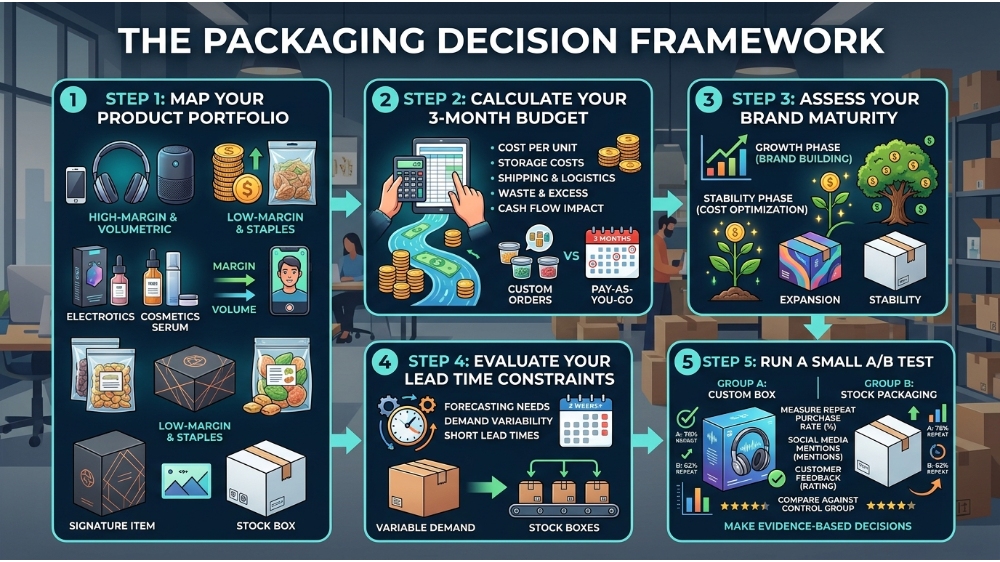
Making the right packaging decision requires a structured approach that considers your unique business context. This five-step framework, drawn from industry best practices and the Smithers Pira adoption curve data, helps you evaluate your options systematically.
Step 1: Map your product portfolio — Segment your products by margin, volume, and customer touchpoint. High-margin signature items that are frequently gifted or photographed are prime candidates for custom packaging. Low-margin, high-volume staples are better suited to stock boxes with stickers.
Step 2: Calculate your 3-month packaging budget — Include not just the per-unit cost, but also storage, shipping, and waste. Account for the cash flow impact of larger custom orders versus the pay-as-you-go model of stock boxes.
Step 3: Assess your brand maturity — Are you in a growth phase where brand building is a priority, or in a stability phase where cost optimization matters more? Brands in expansion mode typically benefit more from custom packaging investments.
Step 4: Evaluate your lead time constraints — Can you forecast packaging needs four weeks in advance, or do you require shorter lead times? The more variable your demand, the more you may need stock boxes as a buffer.
Step 5: Run a small A/B test — Put custom boxes on one SKU and measure repeat purchase rate, social media mentions, and customer feedback over 60 days. Compare these metrics against a control group using stock packaging. Real data beats assumptions every time.
This framework helps you make evidence-based decisions rather than emotional ones. It also positions you to scale your packaging strategy as your business grows, moving from all-stock to hybrid to full-custom as your volume and brand equity increase.
Custom Bakery Boxes vs Stock Packaging: Side-by-Side Comparison
Criteria
Custom Bakery Boxes
Stock Packaging
Cost per unit
$0.80 – $3.00+ (volume dependent)
$0.20 – $0.80
Setup fees
$150 – $1,200 (one-time)
$0
Minimum order quantity
1,000 – 10,000 units (digital vs offset)
As low as 1 case (25–100 units)
Lead time
7 – 28 days
1 – 5 days
Branding potential
Full customization — colors, logo, finishes, die-cuts
Premium brands, gift boxes, wholesale accounts, signature items
Daily bread, trial products, emergency restocking
Storage requirement
Can order just-in-time in mixed sizes
Requires inventory of multiple fixed sizes
* Pricing and MOQs based on typical US supplier ranges for mid-volume orders (1,000–10,000 units). Actual costs vary by region and material specifications.
Frequently Asked Questions
Can I print my logo on stock bakery boxes?
Yes — you can use adhesive labels, stamps, or heat-transfer stickers on blank stock boxes. However, the quality and durability of these methods are lower than full-color custom printing, and you’re limited to the existing box dimensions.
Do custom bakery boxes increase my shipping costs?
Not necessarily. Custom boxes designed to fit your products precisely can reduce dimensional weight and void space, often lowering shipping costs. Oversized stock boxes can actually increase shipping fees due to wasted space.
What’s the minimum order for digital custom boxes?
Digital printing now allows MOQs as low as 100 units, though per-unit prices are higher at this volume. For offset printing, 500–1,000 units is typically the sweet spot for cost efficiency.
Are custom bakery boxes more eco-friendly than stock?
They can be — if you specify FSC-certified board, plant-based inks, and recyclable mono-materials. However, stock boxes sourced locally from recycled materials can be equally green. Always request material certifications from your supplier.
Need a packaging strategy that fits your bakery?
Whether you’re exploring custom bakery boxes or optimizing your stock packaging mix, the right partner makes all the difference.