7 Ways Custom Bakery Packaging Can Increase Brand Recognition
Custom Bakery Packaging for Brand Recognition | 7 Strategies
Branding & Packaging Strategy
7 Ways Custom Bakery Packaging Can Increase Brand Recognition
In a crowded market, your bakery’s box is often the first and last impression. This guide reveals seven science‑backed strategies to turn custom packaging into your most powerful brand‑recognition tool—driving loyalty, social sharing, and repeat orders.
Every time a customer carries your bakery box out the door, they become a walking billboard. The question isn’t whether you can afford custom packaging—it’s whether you can afford not to. Research consistently shows that packaging is one of the top three factors influencing repeat purchase decisions in foodservice. But not all boxes are created equal. Here are seven ways to engineer your packaging for maximum brand recognition.
From colour psychology to structural innovation, each strategy is grounded in consumer behaviour studies and real‑world bakery results. Whether you’re a single‑shop artisan or a multi‑location chain, these principles will help you turn packaging into a silent sales force that works 24/7.
Why packaging is a brand asset, not a cost
Most bakery owners view packaging as a necessary expense—something to hold the product and nothing more. That perspective leaves money on the table. Your box is the first physical interaction a customer has with your brand outside your storefront. It travels with them, sits on their kitchen counter, and appears in their social media photos. Each of those moments is a brand impression that costs you nothing extra.
A 2023 study on food packaging design influence found that packaging consistently ranks among the top three factors influencing repeat purchase decisions in the food sector. When customers receive a box that feels intentional—with thoughtful colours, a clear logo, and a pleasant tactile experience—they perceive the entire bakery as more professional and trustworthy. That perception translates directly into willingness to pay a premium and to recommend your bakery to friends.
Brand assets are anything that builds mental availability for your business. Your packaging, when treated as a strategic asset, does exactly that. Every box that leaves your shop carries your visual identity into the world, creating cumulative brand exposure that grows with every sale.
How color psychology drives instant recognition
Colour is the fastest visual cue the human brain processes. Within milliseconds, customers associate specific colours with emotions, qualities, and even price points. Warm tones like terracotta and gold suggest artisanal craftsmanship; cool blues and greens signal calm and health‑consciousness; high‑contrast black‑and‑white packaging telegraphs modern, minimalist sophistication.
Recent research on visual roughness in package design shows that colour consistency across a brand’s packaging family increases recognition by up to 80% after three exposures. That means if your cookie boxes, cake boxes, and pastry bags all use the same primary colour palette, customers will identify your brand faster and more accurately than if each product uses a different colour scheme.
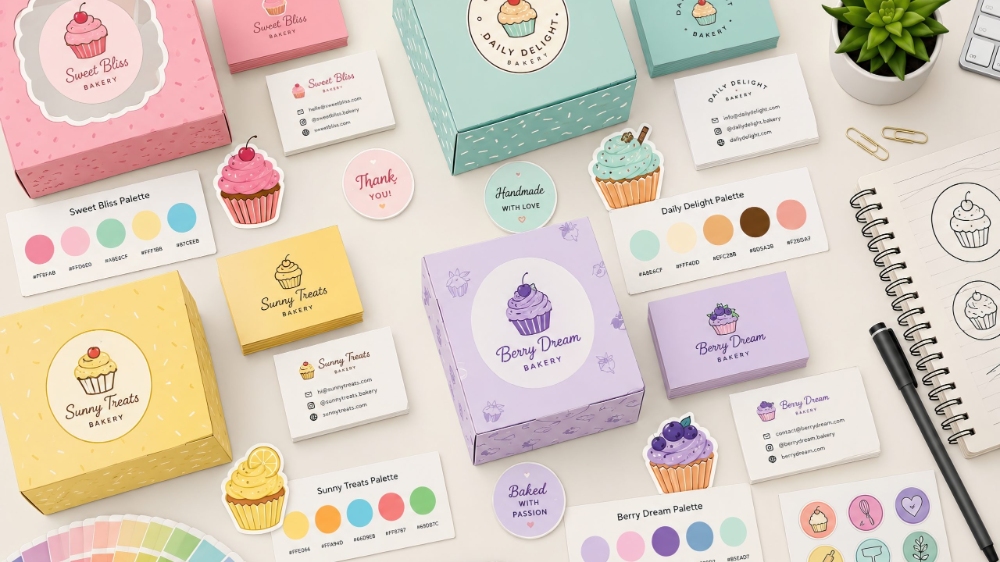
For a bakery, the winning formula is often a hero colour that appears prominently on all packaging, paired with one or two accent colours used sparingly for variety. This creates a cohesive “brand world” that customers come to associate with your specific bakery experience. To figure out the color issues, you should contact the packaging expert over decades experience, such as Maibao Packaging.
Colour‑recognition checklist:
Choose one primary brand colour and use it on 80% of your packaging surface
Use accent colours for product‑specific differentiation (e.g., pink for strawberry, brown for chocolate)
Ensure your logo has high contrast against the packaging background
Test your colour palette in both natural daylight and indoor lighting conditions
Structural design that customers remember
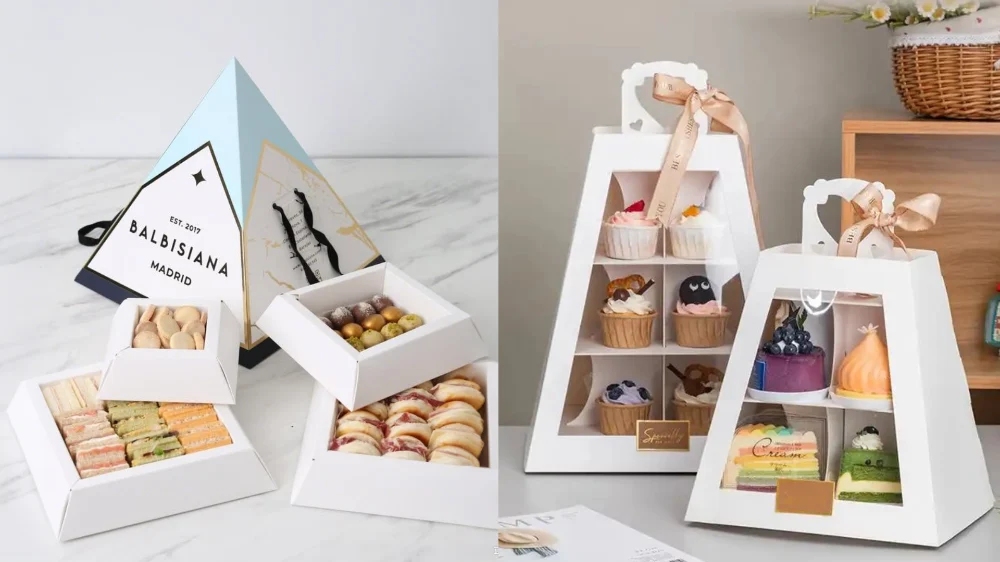
Printing gets all the attention, but structure is what makes a package unforgettable. A box that folds differently, opens with a satisfying click, or has a unique footprint stands out on a crowded counter. Customers remember how a box feels in their hands almost as much as how it looks. Click to explore unique bakery box
The same food packaging study noted that structural novelty significantly increases the time a customer spends handling a package, which correlates with stronger brand recall. When a bakery uses a die‑cut window, a dual‑compartment insert, or a box that transforms into a serving tray, it creates a moment of delight that customers associate with that bakery alone.
Structural design also communicates value without a single printed word. A thick, rigid board signals premium quality; a flimsy, thin board suggests cheapness. For bakeries, the right structural choice—like a box with a built‑in riser for cakes or a clamshell with a secure latch for pastries—can elevate perceived value far beyond the cost of the packaging itself.
Sustainable materials that build trust
Yes—and the effect is growing stronger every year. Consumers increasingly evaluate brands not just on product quality but on environmental responsibility. A bakery that uses recycled, compostable, or certified sustainable packaging signals that it cares about the same things its customers care about.
A 2022 consumer attitude study found that 67% of respondents view food brands using sustainable packaging as more trustworthy than those using conventional plastics. A broader meta‑analysis published in 2023 confirmed that sustainable product attributes, including packaging, directly improve profit potential because customers are willing to pay a premium for perceived environmental benefit.
However, sustainability must be communicated clearly. A plain brown kraft box with no branding can read as “cheap” rather than “eco‑conscious.” The winning approach is to use sustainable materials as the canvas for your brand colours and logo, making it clear that sustainability is a deliberate choice, not a cost‑cutting measure.
Material
Perceived value
Best use
Brand perception
Uncoated kraft (recycled)
Medium
Artisan bread, rustic pastries
Earthy, honest, traditional
PE‑coated paperboard
High
Greasy or moist items (croissants, muffins)
Professional, reliable, premium
Aqueous‑coated board
High
Eco‑premium positioning
Modern, responsible, high‑end
Molded fiber (unlined)
Low–Medium
Very short holds, dry items
Eco‑focused, minimal
Molded fiber (lined)
High
Eco delivery with moisture barrier
Innovative, premium eco
Storytelling and typography that connect emotionally
Your box is a blank canvas for your bakery’s story. The words you choose—and the fonts you use to display them—tell customers who you are without a single conversation. A playful script font suggests a whimsical, family‑friendly bakery; a clean, geometric sans‑serif signals modern efficiency; a serif with high contrast evokes tradition and craftsmanship.
Typography hierarchy is equally important. Your brand name should be the most prominent element, followed by the product name, and finally any descriptive copy or tagline. This visual hierarchy guides the customer’s eye and ensures your brand name is the first thing they remember.
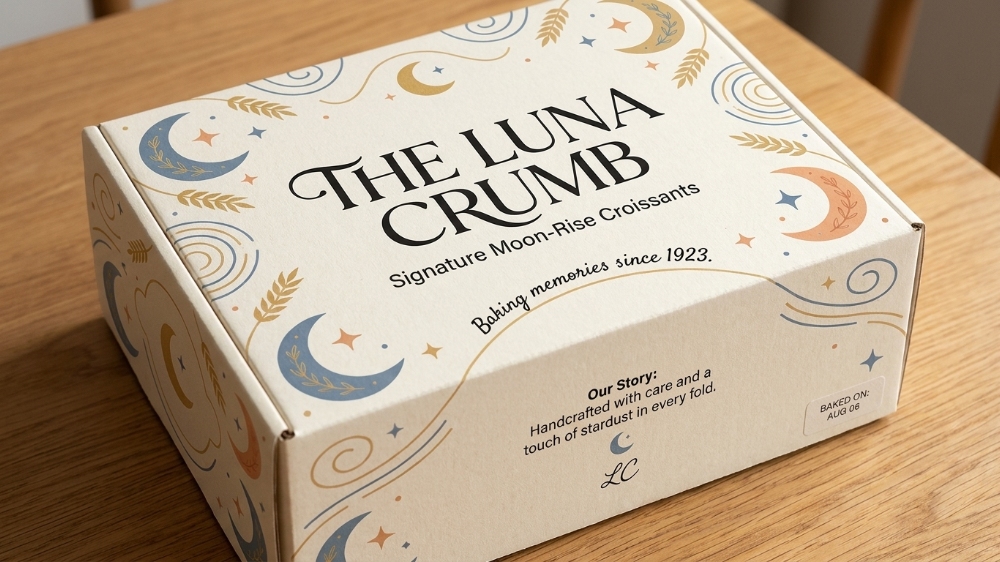
Storytelling elements—like a short “Our Story” blurb on the box bottom, a production date, or the baker’s signature—create an emotional connection. Customers buy into a narrative, not just a product. When your packaging tells a story that aligns with your customer’s values, it transforms a transaction into a relationship.
Unboxing experiences that trigger social sharing
In the age of Instagram and TikTok, unboxing is free advertising. A package that feels special—with a beautiful interior print, a neatly folded tissue paper, or a cleverly designed insert—makes customers reach for their phones. User‑generated content from unboxing videos and photos amplifies your brand reach exponentially, often to audiences you’d never reach through paid ads.
To engineer shareability, focus on three elements: surprise (an unexpected detail, like a pun on the box flap), beauty (a photogenic colour or pattern), and practicality (easy to open without damaging the contents). When customers share your packaging online, they’re not just showing the product—they’re showing your brand to their entire network, complete with your logo and design visible in every frame.
Encourage sharing by adding a simple call‑to‑action on the box: “Tag us in your unboxing!” or a QR code that leads to your Instagram profile. This turns every customer into a potential brand ambassador.
Unboxing element
Shareability score (1–5)
Typical customer action
Interior custom print
4.5
Photograph and share the inside design
Peel‑off seal with message
4.0
Film the unboxing process
Die‑cut window revealing product
4.0
Share product shot with packaging visible
Ribbon or custom sticker
3.5
Tag the bakery in close‑up photos
Simple branded box (no extras)
2.0
Post product‑only photos
Measuring ROI: from impressions to repeat sales
Unlike traditional advertising, packaging ROI is measurable with the right tracking in place. Start by establishing a baseline: your current repeat purchase rate, average order value, and social media mention volume before you introduce new packaging. After the redesign, track these same metrics over 90 days.
A cost‑effective method is to include a unique promo code on the new packaging (e.g., “BAKERYBOX10”) and track how many customers use it. Compare redemption rates against your control group (customers who received old packaging). If the redemption rate is significantly higher, you have direct evidence that the packaging drove engagement.
Also monitor organic social mentions. Use a free tool like Google Alerts or manual tracking to count how many times your bakery is tagged with the new packaging visible. Even a 10% increase in repeat business can justify a packaging investment within three to six months, depending on your margin structure.
ROI tracking checklist:
Track repeat customer rate before and after packaging change
Use unique QR codes or promo codes on packaging
Monitor social media mentions and tag volume
Send a post‑purchase survey asking about packaging
Calculate cost per impression: packaging cost ÷ number of visible brand exposures
For bakeries scaling across multiple locations, packaging consistency becomes even more critical. Working with a supplier who can provide a consistent, tested format across your full menu eliminates variability and ensures your brand is presented uniformly everywhere. Many successful bakeries have transformed their packaging into a competitive advantage by applying these seven principles—and you can too after you connect Maibao Packaging expert 20+ years experience.
Frequently Asked Questions
How much does custom bakery packaging cost compared to stock options?
Custom packaging typically costs 20–50% more per unit than stock, but the brand value and repeat business it generates often offset the premium. For many bakeries, ROI breaks even within three to six months of consistent use.
What’s the minimum order quantity for custom printed bakery boxes?
Most suppliers require MOQs between 1,000 and 5,000 units for custom printing. However, some offer low‑MOQ programs starting at 500 units for small bakeries, with higher per‑unit costs.
Can I use the same packaging for multiple product types?
Yes—with modular design. A neutral base box with interchangeable inserts or stickers allows you to differentiate products without reprinting the entire box. This reduces inventory complexity and ensures brand consistency.
How do I choose between coated and uncoated board for my bakery?
Choose coated board (PE or aqueous) for moist, greasy, or high‑oil items like croissants and cookies. Choose uncoated kraft for dry, low‑moisture items like bread loaves or crackers where breathability is more important than grease resistance.
Ready to turn your bakery packaging into a brand‑recognition engine?
Talk to a packaging specialist about custom design, material selection, and structural engineering that matches your brand identity and operational needs.