
The question every bakery owner asks is simple: “Can I afford to switch to eco-friendly packaging?” The answer, in 2025, is increasingly yes — and the reasons go beyond goodwill. Sustainable bakery packaging is no longer a premium niche; it’s becoming the default, driven by material innovation, volume economics, and regulatory pressure that actually penalizes single-use plastics. This guide breaks down the real cost of sustainable bakery packaging, compares material options, and gives you a practical roadmap to make the switch without blowing your budget.
Eco Friendly Bakery Packaging: Sustainable Options Without Increasing Costs
Sustainable Foodservice Packaging Guide
Eco Friendly Bakery Packaging: Sustainable Options That Don’t Increase Your Packaging Costs
Switching to eco-friendly bakery packaging has long been seen as a cost premium. But new materials, smarter sourcing, and shifting regulations have flipped the equation. Here’s how bakeries of any size can go green without blowing their packaging budget.
Does Sustainable Bakery Packaging Really Cost More?
The short answer: not anymore — if you know what to look for. A few years ago, eco-friendly packaging carried a clear premium. Today, the gap has narrowed dramatically. In many cases, sustainable options are cost-competitive with conventional plastic packaging, especially when you factor in total cost of ownership.
Take tray-seal packaging, for example. A traditional plastic clamshell for baked goods averages about $0.18 per unit. A tray-seal system using a fiber-based tray and thin film top averages just $0.11 per unit — a nearly 40% material cost reduction. That’s not a premium; that’s a saving. And tray-seal isn’t an outlier. Plastic-free trays and clamshells made from paperboard, sugarcane fiber, or compostable materials may have a slightly higher upfront cost, but the long-term benefits — reduced waste, better brand perception, and regulatory avoidance — far outweigh the initial investment.
For small bakeries, the key is order volume and consistency. Businesses that buy packaging reactively in small batches pay higher unit costs. Those who partner with a single supplier for consistent, predictable volumes lock in better pricing. Sustainable packaging is now widely available across the formats bakeries use every day — from bags and boxes to trays and wraps — and the price gap to conventional options has shrunk to a few cents per unit, or even zero.
Eco-Friendly Bakery Packaging Materials: A Side-by-Side Comparison
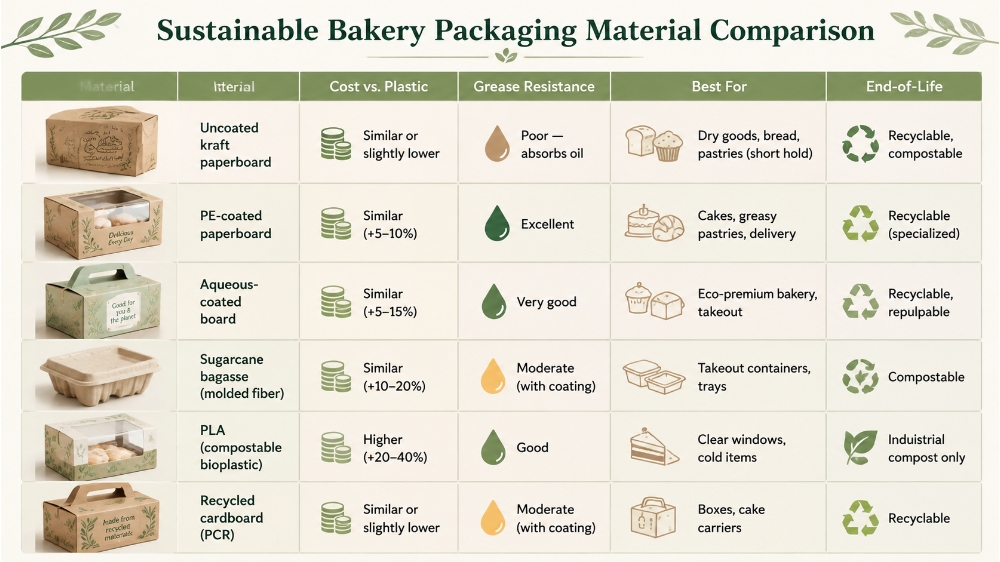
Not all sustainable materials are created equal. The right choice depends on your product, hold time, and brand positioning. Here’s how the main options stack up on cost, performance, and sustainability. Read Top 7 Bakery Packging Materials to learn more in detail.
| Material | Cost vs. Plastic | Grease Resistance | Best For | End-of-Life |
|---|---|---|---|---|
| Uncoated kraft paperboard | Similar or slightly lower | Poor — absorbs oil | Dry goods, bread, pastries (short hold) | Recyclable, compostable |
| PE-coated paperboard | Similar (+5–10%) | Excellent | Cakes, greasy pastries, delivery | Recyclable (specialized) |
| Aqueous-coated board | Similar (+5–15%) | Very good | Eco-premium bakery, takeout | Recyclable, repulpable |
| Sugarcane bagasse (molded fiber) | Similar (+10–20%) | Moderate (with coating) | Takeout containers, trays | Compostable |
| PLA (compostable bioplastic) | Higher (+20–40%) | Good | Clear windows, cold items | Industrial compost only |
| Recycled cardboard (PCR) | Similar or slightly lower | Moderate (with coating) | Boxes, cake carriers | Recyclable |
Key insight: Uncoated kraft and recycled cardboard are often the lowest-cost sustainable options and work well for dry bakery items like bread, cookies, and pastries. For greasy items like croissants or cake, aqueous-coated or PE-coated boards add grease resistance at a modest cost increase. New bio-based coatings now deliver grease resistance at low coat weights, making them cost-effective even for high-grease applications.
How to Switch to Sustainable Bakery Packaging Without Increasing Costs
Switching doesn’t have to mean a line-item cost increase. Here’s a four-step strategy that works for bakeries of any size.
1. Consolidate your supplier base
One of the biggest cost drivers in packaging is fragmentation. Buying bags from one supplier, boxes from another, and trays from a third means you’re paying premium rates on every order. Consolidating with a single, full-service packaging partner — like one-stop expert, Maibao Packaging — allows you to aggregate volume across product categories, negotiate better unit pricing, and reduce shipping costs. Many suppliers now offer low minimum order quantities (MOQs) as low as 20–50 pieces for custom sustainable packaging, making it accessible even for small baker
Don’t over-specify. A thick, grease-resistant coated board is overkill for a dry loaf of bread. Similarly, an uncoated kraft bag is fine for cookies but will fail for a greasy croissant. Match the material to the product. This isn’t just about cost — it’s about reducing material waste and improving customer experience. Over-packaging is expensive and unnecessary.
3. Leverage volume and predictability
Unit costs drop significantly when you order in consistent, predictable volumes. Work with your supplier to forecast usage and set up recurring orders. This reduces emergency orders, which are always more expensive, and gives your supplier confidence to offer better pricing. A packaging partner that supplies the same core materials consistently makes it easier to plan stock and manage costs month to month.
4. Design for sustainability and brand impact
Sustainable packaging is a sales driver, not just a cost. Forty-three percent of U.S. consumers rate the environmental impact of packaging as very important in their purchasing decisions. A well-designed, eco-friendly package can command a premium price, increase customer loyalty, and reduce marketing spend. Custom-printed sustainable packaging — available from suppliers like Maibao’s custom printing service — turns your packaging into a brand asset that pays for itself.
Regulations Are Making Sustainable Packaging the Cheaper Option
This is the game-changer that many bakery owners overlook. Regulatory pressure is shifting the cost equation decisively in favor of sustainable packaging.
In the European Union, the Packaging and Packaging Waste Regulation (PPWR) — which took effect in 2025 — mandates that all packaging must be recyclable by 2030, with minimum post-consumer recycled (PCR) content targets ranging from 10% to 65% by 2026. The regulation also includes bans on PFAS and other harmful substances in food packaging.
In the United States, extended producer responsibility (EPR) laws are rolling out from July 2025, starting in Oregon and Colorado, with California following in 2026. Under EPR, producers pay fees based on packaging type, volume, and sustainability credentials. Harder-to-recycle materials attract higher “eco-modulated” fees, while recyclable, reusable, or recycled-content packaging is rewarded with lower fees. The UK is also introducing EPR rules in 2025–2026, with packaging fees ranging from £215 to £485 per tonne for non-compliant materials.
What this means for your bakery: If you’re still using conventional plastic packaging, you’re not just paying for the material — you’re paying regulatory fees that will only increase over time. Switching to sustainable packaging now locks in lower costs and protects you from future fee hikes. The cost gap isn’t just closing; it’s reversing.
Regulatory timeline at a glance:
- July 2025: EPR laws take effect in Oregon and Colorado (US)
- 2025–2026: UK EPR fees roll out (£215–£485/tonne for non-compliant packaging)
- 2026: California EPR takes effect
- 2030: EU PPWR mandates 100% recyclable packaging
- 2040: EU PPWR mandates 10–65% PCR content across materials
How to Choose the Right Sustainable Bakery Packaging for Your Products
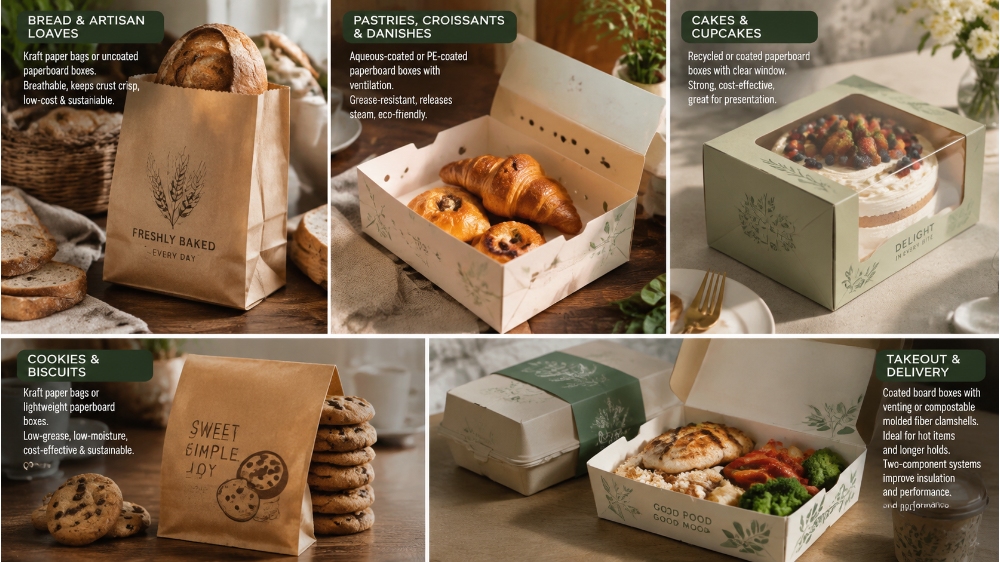
Selecting the right packaging comes down to four variables: product type, hold time, grease level, and brand positioning. Here’s a practical decision framework.
For bread and artisan loaves
Best choice: Kraft paper bags or uncoated paperboard boxes. Bread is dry and doesn’t require grease resistance. Uncoated kraft is breathable, which helps maintain crust crispness, and is one of the lowest-cost sustainable options available. For a premium look, consider recycled cardboard boxes with a custom print.
For pastries, croissants, and danishes
Best choice: Aqueous-coated or PE-coated paperboard boxes with ventilation. Pastries are high-grease and high-moisture items that need both grease resistance and steam release. Aqueous-coated board offers good grease resistance and is repulpable, making it a strong eco-premium choice. PE-coated board provides excellent grease protection and is the standard for delivery holds of 15–25 minutes.
For cakes and cupcakes
Best choice: Recycled cardboard or coated paperboard boxes with a clear window. Cakes need structural integrity and presentation. Recycled cardboard is cost-effective and sturdy. For a premium look, custom-printed cake boxes with a PLA-based clear window offer a sustainable alternative to plastic windows.
For cookies and biscuits
Best choice: Kraft paper bags or lightweight paperboard boxes. These are low-grease, low-moisture items that don’t need heavy-duty protection. Thin paper bags are the most cost-effective option and are widely available in sustainable formats.
For takeout and delivery
Best choice: Coated board boxes with optimized venting (for hot items) or compostable molded fiber clamshells. For delivery holds beyond 20 minutes, consider a two-component system: a vented inner box inside an insulated outer bag. Molded fiber options are growing in popularity, but unlined versions absorb moisture and grease aggressively — choose a lined or coated version for greasy items.
Need help choosing the right sustainable bakery packaging?
Talk to a packaging specialist about matching material, design, and cost to your specific bakery menu and delivery needs.
Frequently Asked Questions
Is eco-friendly bakery packaging really more expensive than plastic?
Not anymore. In many cases, sustainable options are cost-competitive — and sometimes cheaper — than conventional plastic, especially when you factor in volume pricing, regulatory fees, and brand value[reference:29][reference:30].
What is the cheapest sustainable packaging for baked goods?
Uncoated kraft paperboard and recycled cardboard are typically the lowest-cost sustainable options. They work well for dry items like bread, cookies, and pastries. For greasy items, aqueous-coated or PE-coated board adds grease resistance at a modest cost increase[reference:31].
Does compostable bakery packaging actually break down?
It depends on the material and the waste stream. Fiber-based compostables (like bagasse or uncoated paper) break down in home or industrial composting. PLA bioplastics require industrial composting facilities, which are not universally available[reference:32]. Always check local composting infrastructure before choosing compostable materials.
How do I find sustainable bakery packaging wholesale that fits my budget?
Consolidate your supplier base, order in consistent volumes, and match the material to your product. Working with a single, full-service packaging partner like Maibao Packaging allows you to aggregate volume across categories and negotiate better pricing[reference:33].
Post time: Aug-05-2026