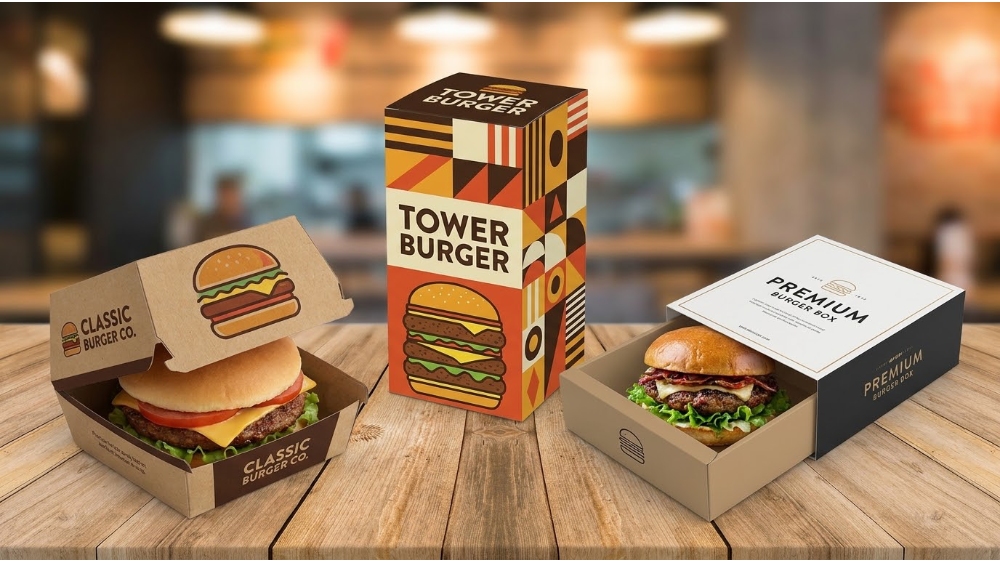
Clamshell burger boxes fit most burgers and most service models. Vertical-stand boxes protect tall, stacked burgers and suit hand-held eating. Drawer-style boxes deliver the most polished presentation, but they demand a tighter operation. The right structure depends on burger height, travel time, and how the customer eats, not on looks alone.
A burger box does four jobs at once: it holds the burger’s shape, manages steam, survives a delivery bag, and carries your brand. Structure decides how well it does each job. Two boxes made from the same board can behave very differently because one hinges, one stands, and one slides.
This guide compares the three main burger box structures by how they carry load, release heat, and open in the customer’s hands. It then maps each one to real service scenarios, so restaurant operators, brand owners, and procurement teams can specify burger packaging with fewer sampling rounds.
Burger Box Structures at a Glance
The three structures solve different problems. Clamshell boxes prioritize speed and simplicity. Vertical-stand boxes prioritize protection for tall burgers. Drawer-style boxes prioritize presentation. The table below shows how they compare before we look at each one in detail.
Structure
How it works
Best for
Main limitation
Clamshell
One piece, lid hinged to base, front lock tab
Standard burgers, counter and delivery service
Fixed lid height limits very tall stacks
Vertical-stand
Tall carton with upright walls and a folding top or front flap
Double or triple burgers, hand-held eating
More height means more heat loss and a higher tipping risk
Drawer-style
Inner tray slides into an outer printed sleeve
Premium burgers, retail, gift and combo sets
Two parts, slower packing, sleeve can slip in transit
No structure wins everywhere. Most burger brands end up using one primary structure and one secondary structure, chosen by menu height and channel.
Clamshell Burger Boxes: The One-Piece Workhorse
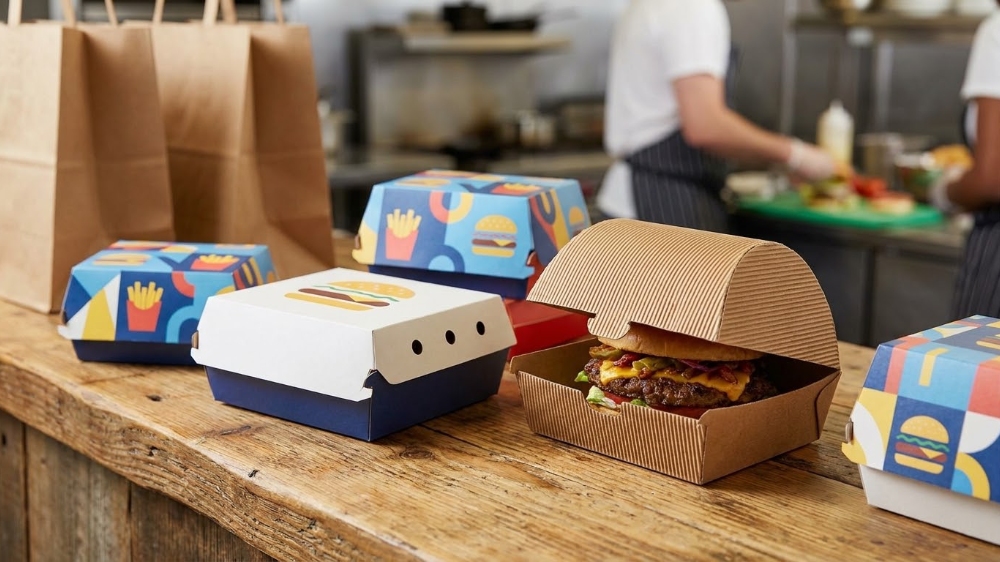
A clamshell burger box is a single die-cut piece that folds into a base with a hinged lid. A tab or tuck on the front panel locks the lid shut. Because there is only one part, staff can pack a burger in one motion, which is why clamshell boxes dominate quick-service counters and delivery kitchens.
The structure has two practical strengths. First, the hinge keeps the lid attached, so nothing gets lost or misaligned during a rush. Second, the lid creates a defined headspace above the burger. That air pocket gives steam somewhere to go instead of pressing straight onto the top bun.
A flat lid suits standard single-patty burgers and stacks neatly in storage. A domed or raised lid adds clearance for taller builds with extra toppings. Choose the dome only when your menu needs it, because a taller lid adds board cost and shipping volume.
Corrugated and paperboard builds
Paperboard clamshells are light and print well. Micro-flute corrugated clamshells are stiffer and hold shape better under bag pressure, which helps on longer delivery routes. Corrugated also gives a little more insulation than single-layer board.
Lock and vent details
Side tabs or a front lock tab keep the lid closed in transit. Small vent cut-outs or perforations on the sides release steam, but they should be sized so grease does not seep out. Test the lock with a loaded burger, because a lid that pops open under bag pressure causes more complaints than a plain-looking box.
The main trade-off is fixed geometry. If the burger is taller than the lid allows, the lid presses on the bun and the burger arrives flattened. If the cavity is much wider than the burger, the patty slides to one side. Fit matters more than any extra feature.
Vertical-Stand Burger Boxes: Built for Height
A vertical-stand burger box is a tall carton with upright walls, usually a pre-glued or auto-lock bottom and a folding top or front flap. It holds the burger in the position the customer will eat it, rather than lying flat. This structure earns its place when the burger is tall, layered, or messy.
The vertical format protects stacked builds because the walls support the burger from the sides instead of letting it spread out. Double and triple patties, fried chicken burgers with tall buns, and burgers with generous sauce all hold together better when they cannot slump sideways. Customers can also tear back the front panel and eat directly from the box, which turns the packaging into a hand-held tray.
Three design details decide whether a vertical box works:
Bottom construction: An auto-lock bottom pops open from flat in one motion and carries more weight than a simple tuck bottom. Pre-glued bottoms cut packing time during a rush.
Height-to-footprint ratio: A very narrow, very tall box can tip in a bag. Keep the footprint wide enough for a stable center of gravity.
Top closure: A tuck flap is fast. A hinged front panel with a lock gives better security for delivery.
The trade-offs are heat and handling. A taller box holds more air around the burger, so it cools faster unless the board is thick or the box is paired with an insulated bag. Vertical boxes also take more storage space than flat-folded clamshells, so check your back-of-house capacity before ordering large quantities.
Drawer-Style Burger Boxes: Sleeve and Tray
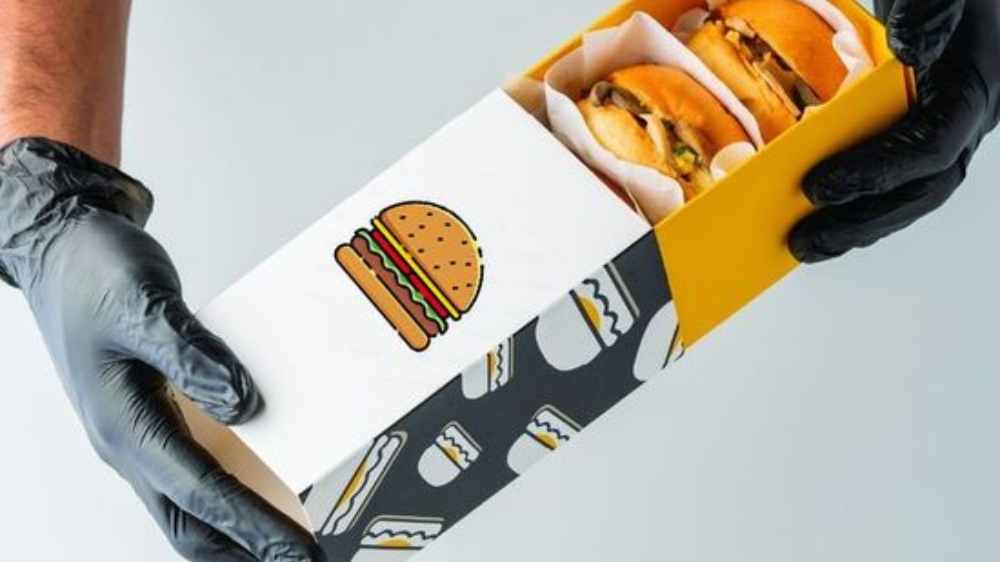
A drawer-style burger box has two parts: an inner tray that holds the food and an outer sleeve that slides over it. The sleeve carries the artwork. The tray carries the weight. This split is what makes the structure attractive for premium burgers, because the sleeve can be printed edge to edge while the tray stays food-safe and sturdy.
The unboxing moment is the main benefit. Sliding the tray out feels deliberate, and the sleeve gives brands a large, clean print surface for logos, flavor names, or limited-edition artwork. Drawer-style packs also adapt well to combos. A tray can include a divider or insert so a burger, fries, and a sauce cup share one pack without mixing.
The risks are practical, and operators should plan for them:
Sleeve slip: A loose sleeve can slide open when the bag is jostled. Specify a snug friction fit, and consider a tape band or sticker for delivery orders.
Packing speed: Two parts take more time to load than a clamshell. Staff need a clear sequence during peak hours.
Trapped steam: A closed sleeve over a closed tray holds heat and moisture. Add a vent cut-out in the tray or sleeve for hot burgers.
Drawer-style boxes work best where speed matters less than presentation, such as short-distance delivery, retail counters, event menus, and gift or meal-kit sets.
Application Scenarios: Matching Structure to Service
Start with the channel, not the catalog. The same burger needs different packaging at a drive-thru window than in a premium gift set. These pairings are practical starting points, not fixed rules.
Structure by service scenario:
Quick-service counter and drive-thru: Clamshell. Fast one-motion packing and easy stacking for high volume.
Third-party delivery: Clamshell with a secure lock tab, or vertical-stand for tall burgers. Add a tamper sticker where trust matters.
Gourmet and tall-stack burgers: Vertical-stand, so the burger keeps its height and sauce stays contained.
Food trucks and events: Open-top vertical or compact clamshell, since customers often eat standing up.
Premium retail, gift sets, and meal kits: Drawer-style, where the printed sleeve does branding work.
Burger and fries combos: Drawer-style with an insert, or a clamshell with a separate fries box.
Delivery distance is the most useful tie-breaker. For short trips, presentation structures like drawer-style work well. For longer trips, favor structures with a positive lock and vented walls. Corrugated clamshells and well-locked vertical boxes tolerate bag pressure and route vibration better than a loose sleeve.
Menu mix matters too. If 90% of your range is standard single and double burgers, a single clamshell size family can cover almost everything. Add a vertical-stand option only for the tall signature items that would be crushed otherwise. This keeps your SKU count and storage space under control.
Board, Coating, and Venting That Change Performance
Structure sets the shape, but material and venting decide how the box behaves with hot, greasy food. Three choices matter most.
Board type and weight
Kraft paperboard gives a natural look and good rigidity. White or coated board gives sharper print. Micro-flute corrugated adds stiffness and some insulation. Heavier board resists bag pressure, but it costs more and can make hinge folds less crisp, so ask for sample folds before approving a weight.
Grease barrier
Burgers release fat and sauce, so the inside surface needs a barrier. Common options include PE coating, aqueous coating, and other food-grade barrier layers. The best choice depends on hold time, local recycling rules, and your sustainability claims. Confirm that the coating meets food-contact requirements for your market, such as FDA rules in the United States or Regulation (EC) No 1935/2004 in the EU. Explore grease-proof burger packaging
Vents and windows
Vents reduce condensation, but too many let heat and aroma escape. Place them on the sides or back, away from where sauce collects. Windows show the product, yet they add a film layer that can complicate recycling. If you need a window, ask about fiber-friendly or separable options.
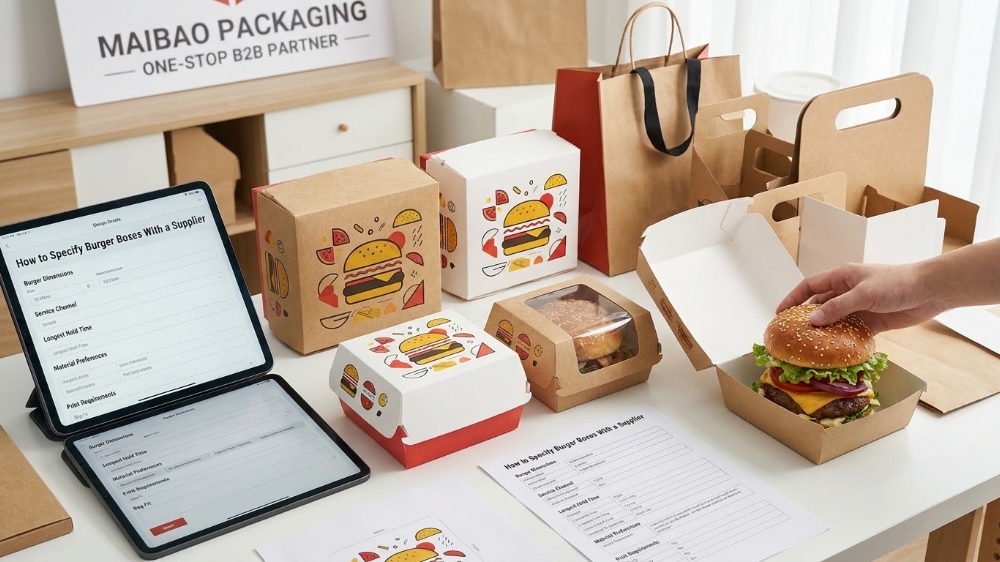
How to Specify Burger Boxes With a Supplier
Good specifications prevent most sampling problems. Give your supplier real product data, not just a box size. The more precisely the box matches the burger, the less you rely on padding and tape.
What to include in your burger box brief:
Burger dimensions: Diameter and compressed height of your largest and smallest builds
Service channel: Counter, drive-thru, delivery, retail, or events
Longest hold time: From the grill to the customer’s first bite
Material preferences: Kraft or white, coating type, recyclability goals
Print requirements: Number of colors, finish, and whether you need a window
Bag fit: The delivery bag or carrier the boxes must pack into
Then run three tests on samples: a fit test with a real burger, a pack-speed test with your actual staff, and a transport test in your normal delivery bag. A box that looks perfect on a table can still fail under bag pressure or during a rush.
Maibao Packaging works as a one-stop B2B packaging partner, so structure, material, printing, and bulk production can be planned together instead of across several vendors. For burger packaging matched to your menu, channel, and branding, talk to a specialist.
Need burger boxes matched to your menu and channel?
Talk to a packaging specialist about the right structure, material, and print for your burgers, hold times, and delivery routes.
Which burger box structure is the most cost-effective?
Clamshell boxes are usually the simplest to produce and pack, so they often have the lowest total cost for standard burgers. Final cost still depends on size, board, print, and order quantity, so compare quotes for your actual spec.
Can one burger box hold both a burger and fries?
Yes. Drawer-style trays with dividers and larger clamshell combo boxes both work. Keep fries in a vented compartment away from the burger, because fry steam softens buns quickly.
Do burger boxes need vent holes?
For hot burgers held more than a few minutes, small vents help release steam and reduce soggy buns. Use them sparingly and place them away from sauce, so grease does not seep through.
How much extra space should a burger box allow?
Leave enough clearance that the lid does not press on the top bun, and keep the sides snug enough that the patty cannot slide. As a rule of thumb, aim for a few millimeters of headspace and test with your tallest burger.
Post time:
Oct-08-2026
For inquiries about our products or pricelist, please leave your email to us and we will be in touch within 24 hours.