History of Hamburger Packaging: From Wax Paper Wrapping to Folding Clamshell Boxes
Hamburger Packaging History: Wax Paper to Clamshell Boxes
Foodservice Packaging Guide
History of Hamburger Packaging: From Wax Paper Wrapping to Folding Clamshell Boxes
A burger leaves the grill hot, greasy, and soft. Every package in its history, from paper wrap to lined carton to foam clamshell to folding paperboard box, was built to fix one failure of that moment. Here is how hamburger packaging evolved, why each format replaced the last, and what that history means when you choose burger packaging today.
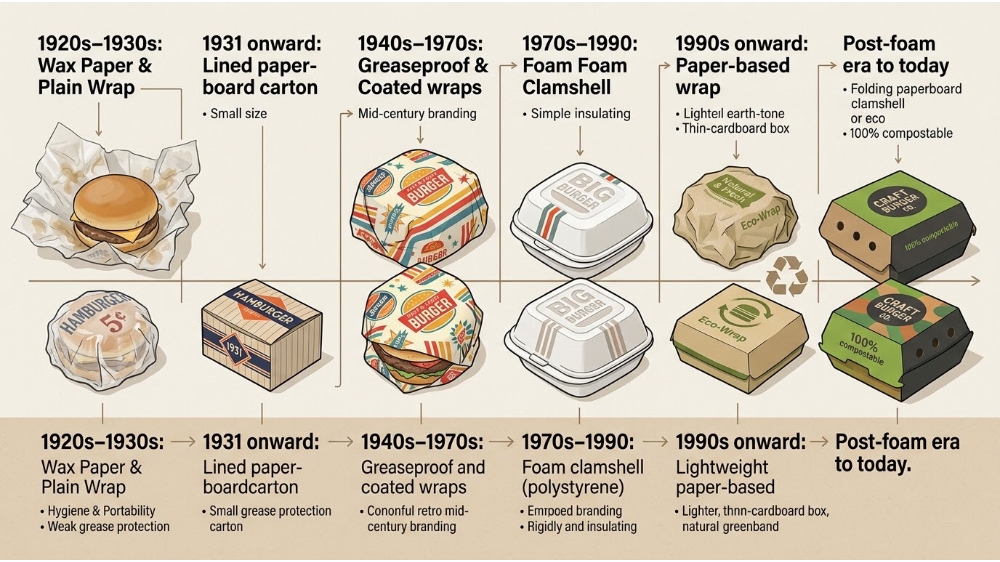
Hamburger packaging has moved through four main formats: the paper wrap, the lined paperboard carton, the foam clamshell, and today’s folding paperboard clamshell. Each replaced the one before it because it solved a specific problem: hygiene, squashed burgers in take-out bags, heat loss, or waste and regulation. The modern folding hamburger box has lasted because it is the best compromise so far: rigid enough to protect a tall burger, ventable enough to manage steam, and printable enough to carry a brand.
This guide traces that evolution from the 1920s to 2026, explains the engineering logic behind each change, and ends with a practical comparison to help you match burger wraps, cartons, and clamshell boxes to your menu and delivery model.
Why a Burger Needs Packaging: Four Problems That Shaped Every Format
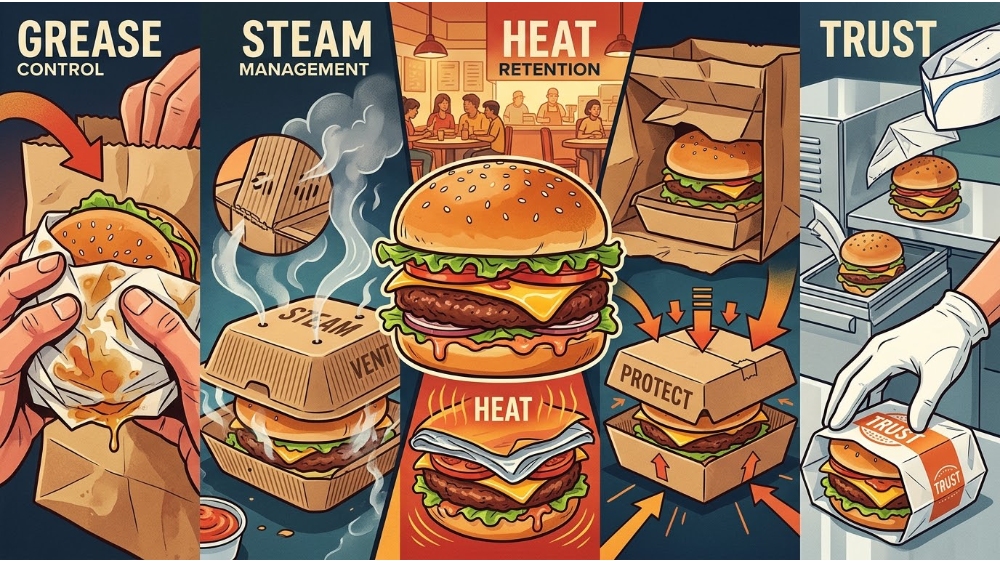
A burger is a difficult food to package. It leaves the grill hot, fatty, and full of water vapor, and it is built from parts that react badly to each other: a soft bun, a juicy patty, wet toppings, and sauce. Every format in burger packaging history can be read as an answer to one of four problems.
The four jobs of burger packaging:
Grease control: keep patty fat from soaking through to hands, bags, and delivery cartons
Steam management: let enough vapor escape that the bun and lettuce do not turn soggy
Heat retention: keep the patty warm without trapping so much moisture that quality drops
Structural protection: stop the burger being crushed in a bag, a tray, or a stack
These jobs pull against each other. Strong heat retention traps steam. Strong structure adds weight and cost. A tight wrap controls grease but offers no protection from pressure. That tension explains why no single format has won permanently, and why burger packaging changes whenever cost, regulation, or customer behavior shifts.
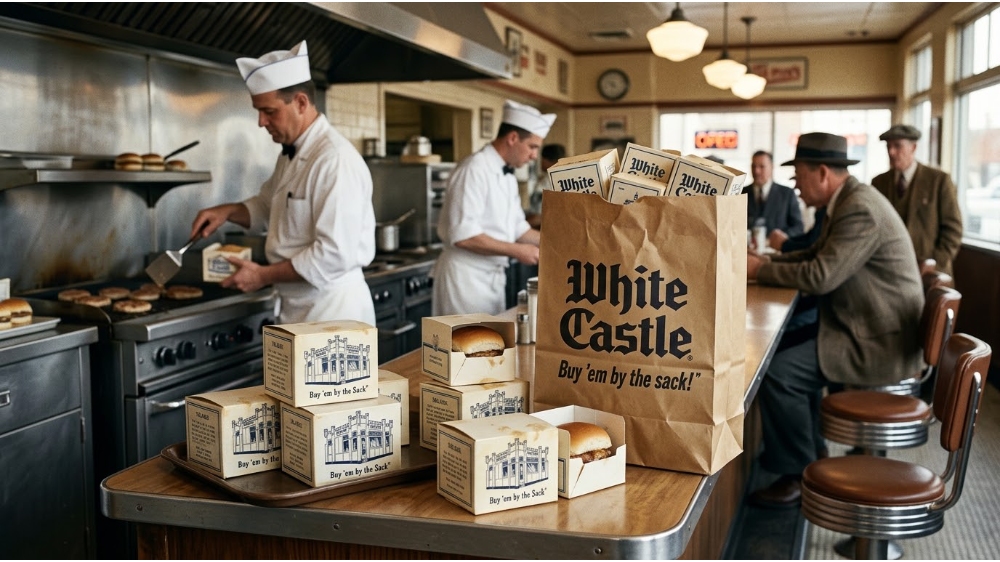
There was also a fifth, less technical job in the early years: trust. Before the 1920s, ground beef had a poor reputation for safety, and the founders of White Castle deliberately built a clean, white, standardized image around the burger to change that. Paper hats, spotless stainless steel kitchens, and wrapped sandwiches were parts of the same message. A wrapped burger signaled that nobody had handled it since the grill.
Wax Paper and the First Paper Wraps
The earliest packaging for the fast-food hamburger was paper. According to the Kansas Historical Society, J. Walter Anderson, who opened the first White Castle in Wichita with Billy Ingram in 1921, introduced paper hats, a food preparation manual, and paper-wrapped hamburgers as part of a standardized operation. The wrap made the burger portable and kept hands off the bun, which mattered when the product’s biggest obstacle was public suspicion.
Wax paper was a natural material for that job. Paper treated with wax resists moisture, and it had been used to wrap food since the late nineteenth century. Its big consumer breakthrough came in 1927, when Cut-Rite wax paper arrived on a roll with a cutting edge. Before that, wax paper was mostly sold as pre-cut sheets in an envelope, and the sheets could stick together in hot weather. The roll format moved wax paper from the butcher shop to the kitchen counter and made the wrapped sandwich an everyday idea.
For a hot burger, however, wax paper is only a partial answer. Wax is a thin, soft barrier. It resists a little moisture, but it can soften against a hot, fatty patty, and it does almost nothing to let steam escape. It also offers no protection against pressure, so a wrapped burger could arrive flattened and sticky at the bottom of a take-out bag. Waxed paper is also hard to recycle in most systems, a point that becomes important later in this story.
Even so, the paper wrap had real strengths, and they explain why wraps never fully disappeared.
What a paper burger wrap does well:
Costs very little per burger and can be applied in seconds on a busy line
Conforms to the burger’s shape and holds warmth close to the bun
Keeps hands and counters off the bread, which supports a clean-food image
Stores flat and compact, saving space behind the counter
1931: White Castle’s Small Box and the Take-Out Carton
The next leap solved a problem the wrap could not: compression. White Castle sold small, steam-grilled burgers and promoted take-out under the slogan “Buy ‘em by the sack.” Burgers at the bottom of a sack got squashed. In 1931, according to company histories, White Castle began serving each burger in its own individual cardboard box. One corporate history adds that the cartons had heat-resistant linings and calls them the first paper cartons used in the food industry. That claim comes from the company’s own account, so treat it with care, but it clearly marks a turning point.
The small box did three things at once. It protected the burger’s shape, it made a sack of ten or twenty burgers practical, and it created a unit that could be counted, priced, and marketed. In other words, the packaging format shaped customer behavior. People bought burgers by the bag partly because the box made bagging possible.
White Castle has kept that logic for more than ninety years. Its 30-slider Crave Case arrived in 2001 and its 100-slider Crave Crate in 2004. In 2020 the chain introduced the Crave Clutch, a 20-slider box styled like a 1990s boombox, which trade press described as its first new packaging in 16 years. The lesson for any food brand is that a box is not only protection. It is also a product format and a marketing surface.
The 1931 carton worked because the burger was small, thin, and steamed. A tall, juicy, full-size hamburger needed far more headspace than a slider box could give. That need would be met by a very different material.
Greaseproof Wraps and the Drive-In Era
As burger chains scaled in the decades after World War II, the paper wrap became the default package for quick-service burgers. Speed explains it. A wrap can be applied in seconds, costs a fraction of a box, and packs tightly in a warming bin. For a kitchen built around assembly-line timing, that mattered more than perfect structure. Records of packaging specifications at individual chains from this period are thin, so this is best read as a broad trend rather than a dated milestone.
The material changed even when the format did not. Plain wax gave way to papers engineered to hold back fat, and chains began treating wrap paper as a cost line to optimize. One documented example: in 1978, McDonald’s reduced the test weight of its sandwich wrap paper from 20 to 15 pounds. Lightweighting like this saved material and money long before packaging waste became a public issue.
Grease resistance carried a hidden cost. For years, one common way to make paper and paperboard repel grease was a fluorinated treatment. The US Food and Drug Administration later noted that these PFAS-based grease-proofing substances had been applied to fast-food wrappers and take-out paperboard containers. That story returns in 2024 and again in 2026, and it is one reason grease barriers now get more scrutiny than almost any other burger packaging feature.
The Foam Clamshell Era: When Insulation Won
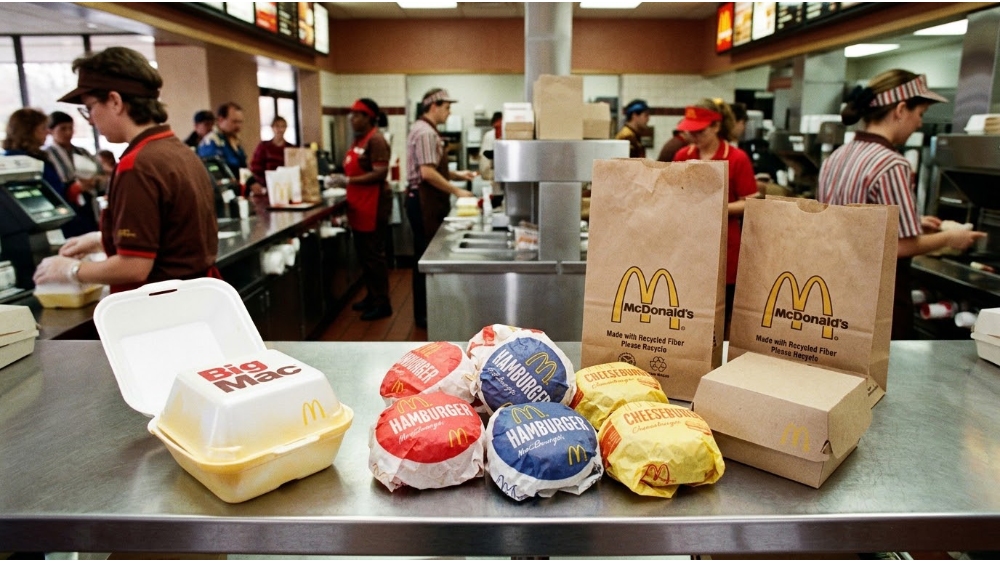
Polystyrene foam has been used in food service since the 1960s, and operators liked it for four reasons: it was light, it absorbed impact, it insulated, and it cost very little. For large sandwiches, a foam clamshell offered something paper did not: a rigid, hinged shell with generous headspace that kept the burger warm and uncrushed. McDonald’s used a foam clamshell for the Big Mac, and during the 1990 negotiations described below, the container was said to cost about two cents each.
Foam solved structure and heat retention better than any wrap. Its weakness was moisture. A closed foam shell holds steam as well as heat, so in practice a burger could stay hot while its bun slowly softened. This is an analysis of how the physics works rather than a measured result, but it matches the basic trade-off every burger package faces: insulation and ventilation pull in opposite directions.
Foam also had a visibility problem. It ended up as litter and took up bulky space in landfills. By the late 1980s that visibility had become a business risk, with environmental groups running campaigns against foam food packaging and dozens of US communities passing their own restrictions, some dating back to the late 1980s.
1990: McDonald’s Drops Foam and Paper Returns
The most important date in modern burger packaging is November 1, 1990. After a grassroots campaign by the Environmental Defense Fund that began in 1987, the two sides reached a tentative agreement on August 1, 1990. On November 1, McDonald’s announced that it would abandon polystyrene packaging for its sandwiches in favor of paper. The Environmental Defense Fund later described the collaboration as the first partnership between an environmental group and a Fortune 500 company.
The decision was not a simple engineering win. A former McDonald’s executive later described how the head of US operations favored foam for its insulation, rigidity, and low cost, and how a life-cycle consultancy argued that paper packaging was heavier and more resource-intensive to make. McDonald’s chose paper anyway, because customers and environmental groups focused on the bulky clamshell. The lesson is that a material can win in the lab and still lose in public.
The practical result was a return to paper-based wraps for sandwiches. The joint task force also moved carry-out bags from bleached to unbleached paper and introduced lighter recycled-fiber boxes. Packaging had become a sustainability decision as much as an operations decision.
What the 1990 switch changed for burger packaging:
Environmental performance became a purchasing criterion, not a public relations extra
Paper and fiber became the default material class for burger packaging
Suppliers had to deliver grease and moisture control without foam’s insulation
Lightweighting and recycled content moved from experiments to specifications
The Folding Clamshell Box and the Modern Burger Package
The folding paperboard clamshell took over much of the job foam had done. It is cut and creased from a single paperboard blank, folds into a hinged shell, and closes with a tuck or lock. Like foam, it gives a tall burger headspace and protects it from crushing. Unlike foam, it is made from fiber, it can be printed edge to edge, and it ships flat before assembly, which saves storage space.
Paper also had to solve what foam never did: grease and steam. Modern burger boxes add three features to manage them. A barrier coating or liner resists grease. Small vents or a vented lid release steam. Some designs also use a raised or textured base that keeps the bottom bun out of pooled fat. These details matter more than they once did, because delivery stretches the time between grill and first bite. A burger that once traveled across a counter now travels across town.
Regulation pushed in the same direction. Maine became the first US state to ban foam food containers when its governor signed the law on April 30, 2019, and New York City’s foam ban took effect on January 1, 2019. In December 2018, European Union officials agreed to ban some single-use plastics, including polystyrene food containers. Each rule removed one more reason to keep foam on the packaging menu.
The latest shift: fluorine-free grease barriers
The newest chapter returns to grease. On February 28, 2024, the US FDA announced that grease-proofing substances containing PFAS were no longer being sold by manufacturers for food contact use in the United States. In the European Union, the Packaging and Packaging Waste Regulation (Regulation (EU) 2025/40) began to apply on August 12, 2026. From that date, food-contact packaging cannot be placed on the EU market if PFAS meet or exceed set limits, including 25 parts per billion for an individual non-polymeric PFAS and 50 parts per million for total PFAS.
For burger packaging buyers, the practical consequence is clear. A grease barrier is no longer something to assume. Ask your supplier which fluorine-free coating or liner is used, and request compliance documentation for each market you sell into. Rules differ by country and state, so confirm them locally before you place a bulk order.
Timeline Summary and How to Choose Burger Packaging Today
The table below shows how each format handled the four jobs of burger packaging, and where each one fell short.
Era
Format
What it solved
Main limitation
1920s–1930s
Wax paper and plain paper wrap
Hygiene signal, portability, very low cost
Weak grease and pressure protection; wax is soft and hard to recycle
1931 onward
Lined paperboard carton
Protected shape; made sack and party-pack sales possible
Suits small burgers; little headspace
1940s–1970s
Greaseproof and coated wraps
Fast assembly at minimal cost
No structure; many grease treatments later faced scrutiny
1970s–1990
Foam clamshell
Rigid, insulating, roomy for tall burgers
Traps steam; litter and disposal backlash
1990s onward
Paper-based wraps and lighter boxes
Answered waste concerns without foam
Less insulation than foam
Post-foam era to today
Folding paperboard clamshell
Rigid, roomy, printable, fiber-based, ventable
Needs a fluorine-free grease barrier and venting to perform in delivery
Older formats did not disappear; they found their best fit. A greaseproof wrap still suits a simple burger eaten within minutes at the counter. A small carton or tray still suits sliders and multi-packs, which is the White Castle logic. A folding clamshell box suits tall, premium, or delivered burgers that need headspace and structure. Many operators combine formats, wrapping the burger first and placing it in a box for transport.
Choosing among them comes down to four variables: burger height, hold time, grease level, and delivery distance. Start with your real hold time, from grill to customer, not your ideal one. Then test with your actual product. Pack a fresh burger, close the box, seal it in a delivery bag, and inspect it at 10 and 20 minutes. If the bottom bun is soggy, the box needs better venting. If grease shows through, the barrier is too weak. If the burger is flattened, you need a stiffer board or more headspace.
Three lessons from a century of burger packaging
Format follows the food. The 1931 carton fit a small slider, the foam clamshell fit a tall sandwich, and today’s folding box fits both a tall burger and a delivery bag. Choose packaging for the burger you actually sell.
Perception and regulation move faster than materials. McDonald’s dropped foam in 1990 despite a lab argument in its favor, and grease barriers are changing again under new rules. Build supplier relationships that can adapt a specification quickly.
The box is a product format and a billboard. From White Castle’s sacks to its boombox-style Crave Clutch, packaging has shaped how burgers are sold. Printed burger boxes give a brand its largest surface at the moment of eating.
For businesses running multiple locations or a delivery-heavy menu, consistency matters as much as the design. A tested, repeatable box format removes one of the most common causes of burger quality complaints: packaging that was never designed for the burger inside it. For a sourcing consultation on custom printed burger boxes, wraps, and delivery-ready burger packaging matched to your menu and hold times, contact Maibao Packaging.
Need burger packaging that protects the burger through delivery?
Talk to a packaging specialist about matching box style, venting, barrier coating, and print to your burger menu, your hold times, and your delivery radius.
White Castle began serving each burger in its own individual cardboard box in 1931, according to company histories. The small lined carton protected the burger’s shape and made take-out by the sack practical.
Why did McDonald’s stop using foam clamshells?
After a campaign by the Environmental Defense Fund that began in 1987, McDonald’s announced on November 1, 1990, that it would replace polystyrene sandwich packaging with paper. The move responded to waste concerns and public pressure, even though foam performed well for insulation and cost.
Is wax paper still used for burgers?
Plain wax paper is rarely the best choice for a hot burger today. Wax softens against hot, fatty food and is hard to recycle, so most modern burger wrappers use greaseproof or coated papers designed for fast food.
Are folding clamshell burger boxes recyclable?
It depends on the barrier. Paperboard with a thin aqueous or similar fiber-friendly coating is more likely to be accepted for recycling than heavily laminated board, but local collection rules vary. Confirm the coating type and recyclability claims with your supplier.
Post time:
Oct-13-2026
For inquiries about our products or pricelist, please leave your email to us and we will be in touch within 24 hours.