
This guide focuses on the packaging decisions that change when a roaster begins supplying cafés, retailers, and distributors. It covers format simplification, brand consistency under operational pressure, case pack design, SKU discipline, and the supplier coordination required to keep packaging from becoming the bottleneck in wholesale growth.
Coffee Packaging for Wholesale Distribution: What Roasters Must Change
Wholesale Packaging Operations
Coffee Packaging for Wholesale Distribution: What Roasters Need to Change When Supplying Cafés and Retailers
Wholesale coffee packaging is not simply about using larger bags. It must support efficient filling, simplify bulk handling, and keep wholesale SKUs distinct from retail designs. Case packs should also match buyers’ receiving, storage, and reordering needs, helping roasters scale without creating unnecessary operational complexity.
A 12 oz retail bag and a 5 lb café bag share a material spec sheet, but they belong to two different operating systems. The retail bag competes for attention on a shelf. The wholesale bag must survive a warehouse, fit a café’s storage rack, open cleanly during a morning rush, and arrive in a case that a receiving clerk can scan and shelve without repacking.
DTC versus wholesale packaging: two different jobs
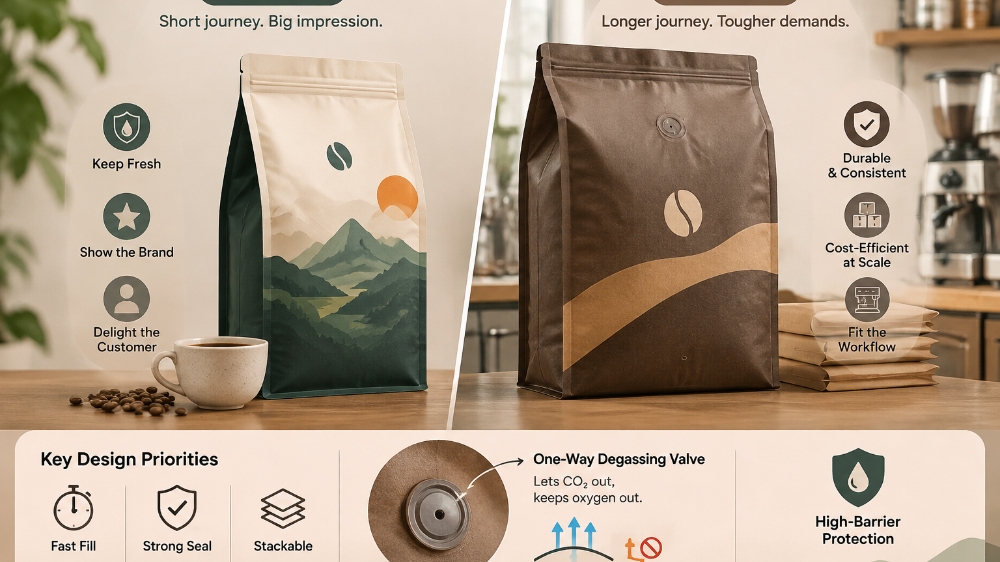
Direct-to-consumer packaging is designed for a short, controlled journey. The roaster fills the bag, ships it to someone who has already chosen the coffee, and the package’s main job is to protect freshness and deliver a brand moment. Wholesale packaging enters a longer and less predictable chain: the roaster ships to a distributor or directly to a café, the bag sits in storage, gets opened multiple times a day, and may never be seen by the person who ultimately drinks the coffee.
That shift changes the design brief. Durability and consistency matter more than shelf storytelling. Cost per unit becomes a harder constraint because every cent compounds across thousands of bags. And the format has to fit the buyer’s workflow, not the roaster’s brand presentation. As one wholesale-focused roaster explained, the move from DTC to wholesale meant packaging requirements shifted from “simply protecting coffee to supporting operational efficiency and brand consistency at a larger scale”.
The practical implication is that a roaster does not need one bag that does everything. It needs a wholesale format that prioritizes fill speed, seal integrity, and stackability, even if that means stripping back retail-level print complexity. Freshness protection stays non-negotiable: a high-barrier structure and a one-way degassing valve are as important in a 5 lb café bag as in a 12 oz retail bag. The valve lets carbon dioxide escape without letting oxygen in, and it allows the roaster to package immediately after roasting instead of waiting for degassing to finish.
Keeping brand consistency when the bag is barely seen
Brand consistency in wholesale does not require every bag to carry the same full-color retail artwork. It requires a recognizable visual system that survives different formats, different print methods, and the reality that many wholesale bags spend their lives behind a counter. Fazenda Coffee Roasters offers a useful model: when the company redesigned its packaging, it carried the same visual language into wholesale coffee bags using a kraft exterior, black panels, and the same chevron side pattern used across the retail range. The retail and wholesale formats look related without pretending to be identical objects.
A simpler approach works for roasters selling primarily to cafés: a blank or minimally printed wholesale bag paired with a clean, consistent label. If the bag is rarely seen by the final consumer, the label carries the operational information that matters—origin, roast level, lot, and roast date—while the bag itself stays cost-efficient and fast to fill. The brand appears where the café staff and wholesale buyer interact with it: on the label, on the case, and on the reorder document.
What breaks consistency in wholesale is not the absence of full print. It is the absence of a system. When every wholesale account receives a differently stamped bag, a differently sized label, or a different shade of kraft, the brand fragments across the channel. The fix is to define one wholesale label template and one wholesale bag format before the account list grows, then vary only the variable data: coffee name, origin, roast date, and lot.
For roasters preparing custom-printed wholesale bags, the artwork production step is where consistency is won or lost. A print-ready dieline and a disciplined file setup prevent the small dimensional and registration errors that turn a unified system into a batch of near-misses. The coffee bag artwork and dieline preparation guide covers the file requirements that keep wholesale runs repeatable.
Retail shelf and café back-bar are not the same environment
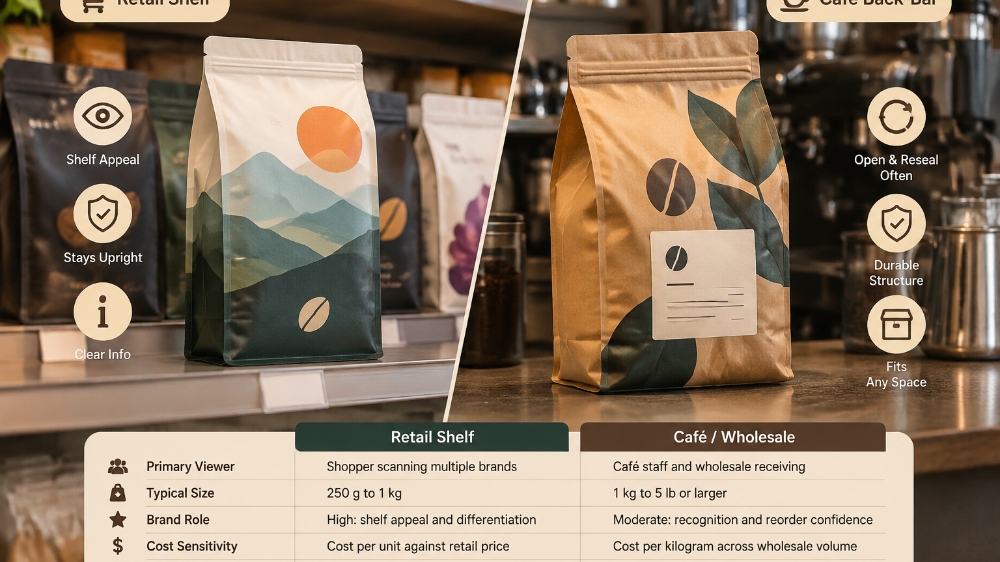
Retail shelf packaging and café back-bar packaging answer to different physical constraints. A bag on a multi-brand retail shelf has to stand upright, read clearly at a glance, and compete with adjacent brands. A bag in a café back-bar has to open and reseal repeatedly, tolerate being handled with wet or busy hands, and fit into a storage space that was not designed around the coffee bag’s dimensions.
The wholesale buyer for a café typically prioritizes large, sturdy bags that are easy to open many times a day over shelf-facing print complexity. A retail buyer, by contrast, needs a bag that holds its shape on a shelf and communicates origin and roast level without a salesperson. Some roasters solve this by running two formats: a retail bag with full print and a wholesale bag with a simpler structure and a high-quality label. Others use a single structural format and vary only the artwork and label data. Neither approach is inherently better. The decision depends on where the bag will actually spend its time.
| Decision factor | Retail shelf packaging | Café or wholesale packaging |
|---|---|---|
| Primary viewer | Shopper scanning multiple brands | Café staff and wholesale receiving |
| Typical size | 250 g to 1 kg | 1 kg to 5 lb or larger |
| Brand role | High: shelf appeal and differentiation | Moderate: recognition and reorder confidence |
| Opening and closing | Consumer convenience features | Repeated daily opening and closing |
| Cost sensitivity | Cost per unit against retail price | Cost per kilogram across wholesale volume |
| Labeling content | Consumer-facing origin, tasting notes, certifications | Batch, roast date, lot, and account-specific data |
The table makes the trade-off visible: a bag optimized for the retail shelf may be over-specified for a café account that never displays it. A bag optimized purely for café durability may lack the structural rigidity and print area a retail buyer requires. Splitting the brief by channel is usually cheaper than forcing one format to underperform in both.
Case packing and secondary packaging: design for the buyer
A wholesale case is not just a shipping carton. It is the unit the buyer orders, receives, stores, and counts during reorder. A case quantity chosen because twelve feels standard can create real friction: it may tie up a small café’s cash and shelf space, or it may be too small for a distributor’s receiving process. One roaster found that twelve bags per case was a poor fit for small wholesale accounts and tested six-unit cases with two cases per master carton, which kept freight efficient while making reorders arrive sooner and picking more controlled.
The case pack should be built from both directions: how the product leaves the roaster’s line and how it enters the buyer’s back room. That means confirming the filled bag dimensions before specifying the case, because a few millimeters of slack repeated across thousands of units becomes movement, damage, and complaint. It also means deciding whether the case will carry mixed SKUs or a single SKU, whether it needs an inner pack, and whether the carton itself will be used as a display unit.
Secondary packaging checklist for wholesale coffee:
- Confirm case quantity against actual buyer reorder patterns, not industry habit
- Measure the filled bag, not the empty coffee bag, before finalizing case dimensions
- Decide whether cases are single-SKU or approved mixed-SKU assortments
- Label the case for receiving: product identity, count, lot, and handling notes
- Test the packed case through the actual shipping route before a large print run
The operational implication is that secondary packaging deserves its own approval loop. A roaster can approve a wholesale bag and still lose margin to a case that is oversized, under-labeled, or incompatible with the buyer’s receiving system. The case specification should be treated as a production document, not an afterthought to the bag artwork.
Managing packaging SKUs across multiple wholesale accounts
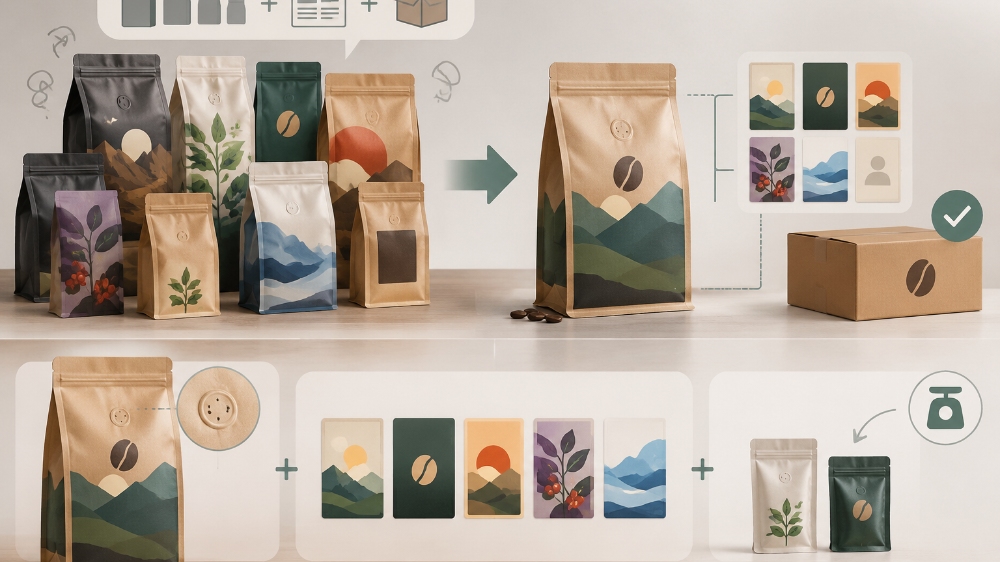
Wholesale SKU proliferation happens quietly. A roaster starts with one blend in one bag size, then adds a second origin, a decaf option, a seasonal release, and two private-label accounts that each need their own label. Before long, the packaging operation is managing a matrix of bag sizes, label templates, and case configurations that was never designed as a system. The result is more inventory, more changeover time, and more opportunities for the wrong label to end up on the wrong bag.
The discipline that controls this is not “fewer products.” It is a controlled SKU map. One validated bag structure can cover multiple physically similar coffees, with variable artwork and variable data separated into a controlled template set. A shared bag platform reduces the number of physical components the roaster stocks, while the label or print run carries the differentiation. Where private-label accounts require their own branding, that branding lives in its own template but draws from the same product data as the roaster’s own bags.
For roasters offering small trial packs to wholesale buyers or distributors, the same discipline applies at a smaller scale. A 50 g or 100 g sample bag does not need a separate structural platform if the fill weight and valve placement are specified correctly. The coffee sample bag specification guide explains how to define those small formats so they share the same operational logic as full-size wholesale bags rather than becoming a parallel packaging system.
Reducing manual labeling and packing labor
Hand labeling and manual packing are the hidden cost centers of wholesale coffee. A roaster can absorb hand-stamped 5 lb bags when there are three wholesale accounts. When there are thirty, the same process consumes production hours that should be going to roasting and fulfillment. One growing roaster described the shift plainly: “We found ourselves spending valuable production time on packaging preparation instead of roasting and fulfilment”. The problem is not the label itself. It is that every SKU and every account adds another manual step to a process that was designed for low volume.
Two changes reduce this labor without requiring a fully automated line. The first is on-demand or variable-data label printing, which allows one printer and one template to produce labels for multiple SKUs, including private-label accounts, seasonal releases, and retailer-specific disclosures, without pre-printed inventory for every variation. The second is specifying the wholesale bag for faster filling and sealing: a format that opens reliably, fills without a second hand, and seals consistently reduces the time per bag even before automation arrives.
The measurable impact can be substantial. Inglewood Coffee Roasters, supplying more than 300 cafés, reported a 300 percent improvement in fulfillment times after moving from hand-packed bags to automated bag production, alongside an approximately 40 percent reduction in packaging costs and an estimated $7,000 per week reduction in labor costs. Not every roaster needs the same equipment. But the direction is consistent: as wholesale volume grows, the packaging operation has to stop depending on manual label application and hand packing as the default.
Coordinating packaging suppliers with roast production
Packaging becomes a production constraint when supplier lead times and roast schedules operate on different clocks. A roaster may roast to a weekly wholesale order rhythm, while bag and label deliveries follow a monthly or quarterly procurement cycle. If the two are not coordinated, the roaster either holds more packaging inventory than necessary or runs short of the exact bag or label a wholesale account requires.
The practical fix is to treat packaging as a planning input, not a purchasing afterthought. That means sharing the wholesale demand forecast with the packaging supplier, agreeing on reorder points for the core bag and label SKUs, and separating long-lead custom print runs from short-lead variable-data labels. It also means keeping the wholesale bag specification stable enough that the supplier can hold tooling and repeat the run without re-approval each time. When a roaster changes bag structure or label template, the change should go through the same approval loop as a new coffee release, because a packaging change ripples through filling, sealing, case packing, and receiving.
What changes from small roaster to wholesale supplier
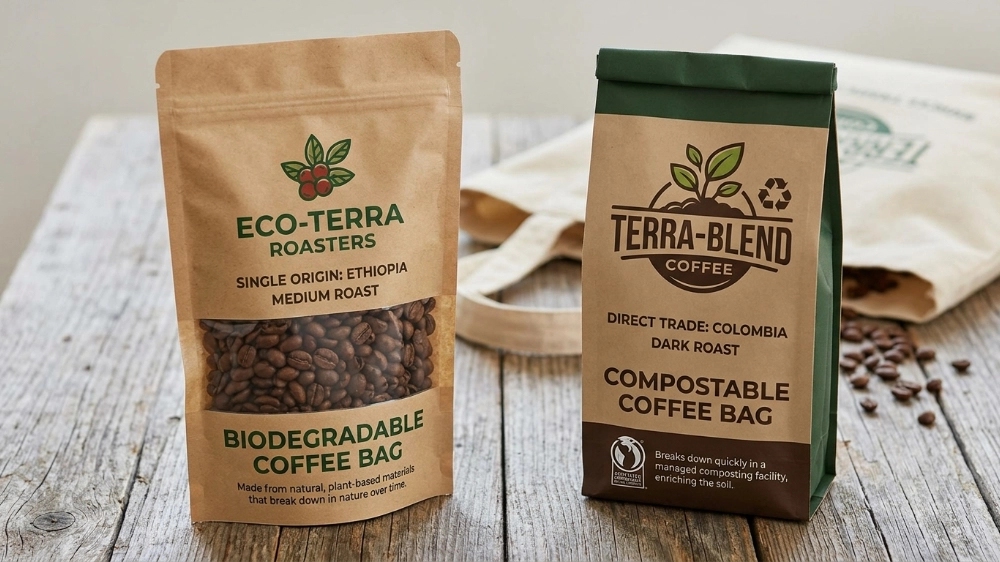
The transition from small roaster to wholesale supplier is not a single upgrade. It is a sequence of changes in how packaging is specified, purchased, and executed. The roaster that succeeds at wholesale volume usually changes four things before the account list outgrows the original packaging process.
First, the bag brief shifts from shelf appeal to fill speed, seal integrity, and format stability. Second, the brand system separates retail artwork from wholesale identification, so the two channels can evolve without forcing the same print spec. Third, the case pack is designed from the buyer’s reorder behavior rather than from the roaster’s production convenience. Fourth, labeling moves from a manual station to a templated, on-demand process that can handle SKU variation without adding headcount.
None of these changes requires abandoning the retail brand. They require recognizing that wholesale packaging is a different product with a different user, a different failure mode, and a different cost structure. The roasters who make the transition cleanly are the ones who stop asking the wholesale bag to behave like a retail bag and start building it around the wholesale supply chain it actually enters.
Need wholesale coffee packaging that works on the line, not just on the shelf?
Talk to a packaging specialist about matching bag format, case configuration, and label workflow to your wholesale accounts, roast schedule, and reorder rhythm.
Frequently asked questions
Does wholesale coffee packaging need a degassing valve?
Yes, in most cases. Roasted coffee releases carbon dioxide for days after roasting. Without a one-way valve, a sealed wholesale bag can inflate, distort on the shelf, or stress its seams during transport. The valve vents gas while blocking oxygen, and it allows the roaster to package without waiting for degassing to complete.
Can a roaster use the same bag for retail and wholesale?
A single structural format can work if it meets the café’s durability and opening needs and the retail buyer’s shelf requirements. But the branding and labeling usually need to differ. Wholesale bags often carry less print complexity and more variable data, while retail bags carry the shelf-facing brand story. Trying to force one bag to do both jobs is a common source of operational friction.
What case quantity is best for wholesale coffee?
There is no universal number. The right case quantity depends on the buyer’s shelf capacity, reorder frequency, and cash exposure. Small cafés may prefer six-unit cases because twelve bags of one SKU tie up cash and space. Distributors may require larger cases for receiving efficiency. Test the case quantity with pilot accounts before committing to a large carton run.
How can a roaster reduce packaging labor as wholesale accounts grow?
The two highest-impact changes are on-demand label printing and a wholesale bag format designed for fast filling and sealing. Variable-data printing lets one template produce labels for multiple SKUs and accounts without pre-printed inventory. A bag that opens and seals reliably reduces time per unit before any automation is added. Together, these changes remove manual steps without requiring a full production line overhaul.
Post time: Nov-24-2026