Coffee Bag Sizes Explained: Complete Size Chart for Coffee Roasters and Brands
Coffee Bag Sizes Explained: Complete Size Chart
Coffee Packaging Guide
Coffee Bag Sizes Explained: A Complete Size Chart for Roasters and Brands
From a 2 oz cupping sample to a 25 kg green-bean sack — how valve placement, whole-bean versus ground fill, and shelf or subscription logistics decide the coffee bag size that actually performs after sealing.
A standard coffee bag runs from a 2 oz cupping sample up to a 5 lb wholesale pouch, with the 8 oz to 12 oz band covering most specialty retail shelves and subscription boxes. The right pick depends less on a single ounce number and more on whether the bag carries a one-way degassing valve, whether it’s filled with whole bean or ground coffee, and where the bag has to sit next — a countertop retail rack, a supermarket planogram slot, or a wholesale storeroom shelf.
This guide lines up every commonly used coffee bag size in ounces, grams, and millimeters, then goes further than a typical size chart by explaining why valve and no-valve bags of the same stated weight behave differently on the shelf, and why café counters, grocery chains, and wholesale buyers converge on different size ladders even when the pouches look similar in a catalog. For a full range of ready-to-order kraft, foil-lined, and valve-fitted pouches, see this coffee bag packaging overview. Besides, we also present a paper bags guide for your need.
What Counts as a “Standard” Coffee Bag Size?
A coffee bag‘s labeled size is a weight figure in ounces, pounds, or grams, but that number alone doesn’t tell you whether a bag will actually fit your filling line, your shelf facing, or your customer’s brewing habits. Two “12 oz” bags from two different converters can differ noticeably in gusset depth and overall height, which is what actually determines how the bag stands, stacks, and photographs on a shelf.
Unlike coffee cups, which are sized purely by fluid volume, coffee bags split into at least three separate sizing logics depending on who’s buying. A roaster or café brand cares about weight matched to a price point and a brewing cadence — how many cups a bag brews before the customer reorders. A packaging buyer specifying a custom pouch cares about width, gusset depth, and height in millimeters, because those three numbers determine whether an existing valve punch, zipper die-cut, and case-pack carton can be reused without new tooling. A grocery or e-commerce buyer mostly cares about how many bags face upright on a fixed-depth shelf or fit a flat-rate shipping box without excess dunnage. None of these audiences are well served by a chart that only lists “standard bag: 12 oz,” which is why valve-position mismatches and shelf-fit reorders are such common headaches for new roasters. For the flip side of degassing needs, see this kraft paper coffee bag with valve line.
Demand for flexible coffee packaging is large enough that sizing decisions play out at real production scale. Reporting on roaster interviews, MTPak Coffee’s size survey found that 227 g (8 oz) remains a popular North American format because it maps to one standard measuring cup, while smaller 25 g pouches serve travel, sampling, and gifting occasions where a full retail bag would be wasteful. On the industrial side, the degassing hardware that most mid-size and large bags depend on is itself a fast-growing category: IndexBox’s 2026 market outlook estimates coffee packaging accounts for roughly 38% of global one-way degassing valve demand, driven by the spread of specialty roasters and retail-ready bagged coffee in supermarkets. That scale is exactly why the 8 oz–12 oz band, rather than any single “one true size,” anchors most retail bag programs.
Coffee Bag Size Chart: Oz, Grams, and Dimensions Compared
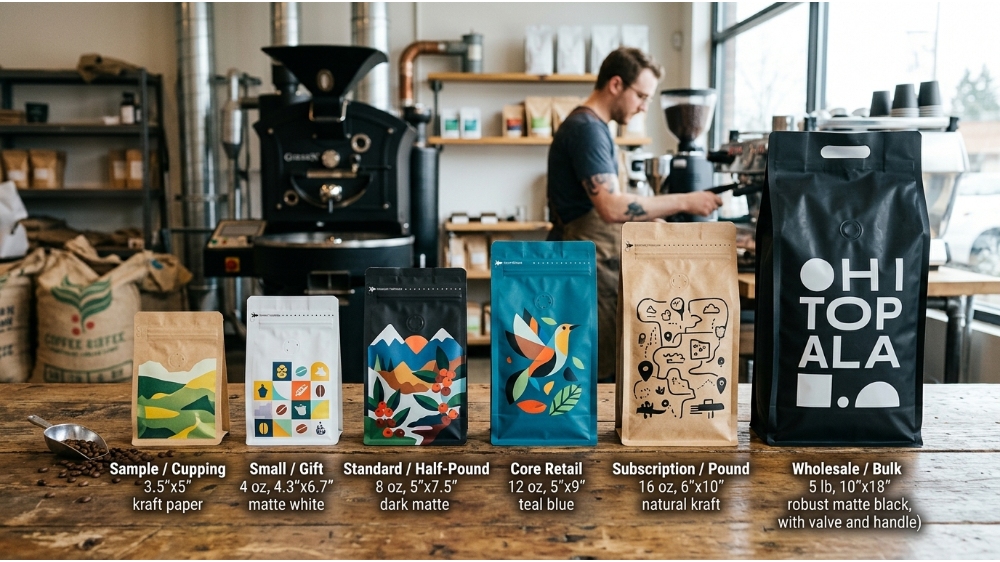
Bag weight capacity and bag footprint are two different specifications, and treating them as interchangeable is the most common reason a “12 oz” reorder arrives with the wrong gusset depth or won’t face correctly on an existing shelf rack. The table below lines up nominal size class, typical dimensions, metric conversion, and the use case each class is generally matched to for whole-bean fill.
Valve vs. No-Valve: How Degassing Changes the Size Math
Valve-fitted bags let trapped CO2 escape without letting oxygen back in, which is why almost every bag above 5 oz of fresh-roasted whole bean needs one to avoid bursting seams; no-valve bags work fine for ground coffee, pre-degassed beans, or short-turnaround stock where the roast-to-shelf window is only a day or two. Choosing between them changes which dimensions and which shelf life actually apply to your reorder.
Freshly roasted beans continue releasing carbon dioxide for days after roasting, and that gas needs somewhere to go. A one-way degassing valve vents the building pressure while blocking oxygen ingress, which is the mechanism that keeps aroma compounds intact for months rather than days. Industry supplier guidance on valve-fitted pouches notes that standard sizes for valve-equipped bags cluster at 8 oz, 12 oz, and 1 lb, since bags under roughly 5 oz rarely generate enough CO2 volume to need one, while larger 2–5 lb bags benefit from a valve even more because the total gas buildup scales with the amount of coffee sealed inside. That’s also why bulk bags without a valve are typically reserved for green (unroasted) coffee or for roasted coffee that will be reopened and used within a day of packing, such as café back-of-house stock rotated daily.
The tradeoff shows up in shelf presentation rather than in the coffee itself. A valved bag needs a flat, unobstructed panel for the valve punch, which usually pushes brands toward a stand-up or flat-bottom pouch rather than a simple pillow bag, and that panel placement has to be checked against label artwork so branding doesn’t get interrupted by the valve. No-valve bags have more layout freedom for full-bleed graphics but trade away shelf life, so a brand switching a 12 oz core size from valve to no-valve to cut cost should re-check expected sell-through speed before assuming the smaller bill of materials is a clean win.
Before finalizing a valve or no-valve coffee bag order, confirm:
Whether the coffee is whole bean or ground — ground coffee degasses faster and needs a valve sooner
Expected time from roast date to shelf sale, not just the bag’s printed weight
Valve placement against your label artwork and any front-panel branding
Gusset depth against your filling line’s nozzle clearance for whole bean versus ground fill
What Size Bags Do Cafés and Roasters Sell at the Counter?
Café counters and quick-service coffee shops rarely size a retail take-home bag to a single brewing recipe — they size it to a price tier that a barista can grab without checking a chart, which is why the same two or three sizes keep showing up across unrelated roasters. A sampler or gift-shelf item needs a small, low-commitment bag near the register; a core house blend needs the size that matches what a regular customer already expects to see; a subscription or bulk pickup needs a bag that reduces reorder frequency without asking the customer to commit to more coffee than they can use fresh.
That order-tier logic maps onto a fairly narrow band across the specialty coffee industry. Roaster-facing guidance describes 2 oz to 4 oz sample bags as best suited for cuppings, farmers-market flights, and “meet the roaster” tasting sets, with 8 oz useful for seasonal micro-lots near the register and 12 oz established as the familiar U.S. retail format for grocery shelves and online orders, while 16 oz and 1 lb bags serve repeat buyers and subscribers who already know the coffee and don’t need to be sold on trying it. Quick-service coffee counters that also run a retail shelf of bagged beans generally keep to just one or two of these sizes rather than stocking the full ladder, since a wider size range multiplies SKU count on a counter that already has limited shelf footprint next to the register.
Counter logistics add a constraint a size chart alone won’t show: retail bags at a café are almost always displayed upright on a narrow shelf or in a wire rack beside the espresso bar, and that rack has a fixed slot width. A bag that’s noticeably wider or taller than the rack’s slot either won’t stand cleanly or will tip forward during a rush — which is the practical reason most café retail programs standardize on one core width across their sample, standard, and subscription sizes rather than mixing pouch families from different converters.
Seller type
Core size ladder
Why
Specialty café retail shelf
4 oz, 8 oz, 12 oz
Matches gift-shelf, seasonal, and core blend without new rack tooling
Roaster direct-to-consumer
12 oz, 16 oz, 2 lb
Covers single-bag trial through subscription-size reorders
Micro-lot / limited release
4 oz, 8 oz
Small batch size makes a large bag look under-filled and stale-facing
Grocery and Supermarket Shelf Sizing for Bagged Coffee
Unlike refrigerated drink packaging, bagged coffee doesn’t need cold-case space — but it still has to face correctly on a fixed-depth dry-grocery shelf, and that constraint shapes size decisions just as strictly as a cooler door would. A grocery chain running thousands of doors across a chain has a direct cost incentive to standardize on one bag footprint per category rather than re-tooling a planogram for every roaster’s private-label SKU.
Coffee aisle shelving is generally built around fixed shelf depths and facing widths tuned to the dominant national-brand format, which is why the vast majority of bagged whole-bean and ground coffee sold in supermarkets lands in the 12 oz to 16 oz band rather than smaller sample sizes or larger wholesale bags — a taller or deeper bag simply won’t face correctly, or won’t fit the case count a planogram expects per linear foot of shelf. A packaging-cost breakdown from the industry notes that the 12 oz bag remains the most popular retail size because it strikes a balance between giving a household enough coffee for one to two weeks and encouraging repeat purchase, which is the same balance a grocery buyer is optimizing for when deciding how many facings of a new SKU to approve. Private-label and store-brand coffee almost always mirrors this sizing rather than deviating from it, since a non-standard bag height risks sitting awkwardly under the next shelf up.
E-commerce and subscription channels loosen this constraint somewhat, since there’s no physical shelf to face, but they introduce a different one: flat-rate shipping box dimensions. Mid to large bags in the 12 oz to 2 lb range balance shipping cost against customer value here, since a bag has to survive transit in a padded mailer or small box without excess dunnage driving up dimensional-weight shipping charges — which is one reason most direct-to-consumer roasters cap their online core size at 2 lb rather than shipping 5 lb bags loose.
Before finalizing a grocery or e-commerce coffee bag order, check:
Shelf facing height and depth against your tallest bag, including any resealable top-fold
Whether one 12–16 oz size covers most of the category, or a second size is genuinely needed
Flat-rate shipping box dimensions if the bag will also sell direct-to-consumer online
Barcode and weight-declaration placement against retailer planogram scanning requirements
Wholesale, Office, and Bulk Bag Sizes
Wholesale and back-of-house coffee buyers follow a looser ladder than retail shelves, mostly because storeroom space and brew-batch size drive the decision rather than shelf-facing rules — a café pulling from a bulk bag several times a day wants a different pouch profile than a household pulling one scoop each morning. Office coffee service and hospitality accounts sit closer to the retail band, since they’re really just high-volume repeat consumers rather than resellers.
For wholesale accounts, sizing generally follows brew-batch economics rather than a fixed retail tier: a roaster-facing sourcing guide describes 2 lb, 1 kilogram, and 5 lb bags as the formats that move the most coffee per bag and lower packaging cost per pound for cafés, offices, and wholesale accounts, since a café brewing multiple batches per shift doesn’t want to open a fresh 12 oz retail bag every hour. Larger format bags in this range also cut down on the number of times a valve or zipper closure is opened and resealed per pound of coffee moved, which matters for oxygen exposure over a bag’s working life once it’s in regular use behind a counter.
Office coffee service and hotel or catering accounts typically split the difference: they buy in the 1 lb to 2 lb range rather than true bulk, because storage space in a break room or banquet kitchen is limited and because a smaller bag stays fresher across the slower, more irregular brewing cadence of an office pot compared to a café’s continuous pour. Above the 5 lb retail-adjacent format, true bulk green coffee moves in much larger sacks — but that’s a separate green-bean logistics category rather than a roasted retail or wholesale bag size, and it isn’t sized, valved, or labeled the same way finished roasted coffee is.
How to Choose the Right Coffee Bag Size for Your Situation
The “right” standard size changes depending on who’s buying — a specialty café stocking a register-side retail shelf, a roaster running direct-to-consumer subscriptions, a grocery chain packing a fixed planogram slot, a wholesale or office account buying by the brew batch, or a packaging buyer specifying a custom pouch. Matching the buyer’s situation to a size — rather than defaulting to whatever weight sounds safely “standard” — avoids both valve-fit mismatches and wasted packaging spend.
Who’s choosing
Recommended size
Why
Specialty café retail shelf
4 oz sample, 12 oz core
Low-commitment trial size plus the familiar national retail format
Roaster subscription / DTC
12 oz first order, 1–2 lb repeat
Reduces reorder frequency once the customer already trusts the blend
Grocery / supermarket private label
12–16 oz as the default
Matches national-brand planogram facing and case-pack expectations
Café / wholesale back-of-house
2–5 lb valve bags
Matches multi-batch daily brewing without opening a fresh bag hourly
Office coffee service / catering
1–2 lb as the default
Fits limited break-room storage without over-committing to unused stock
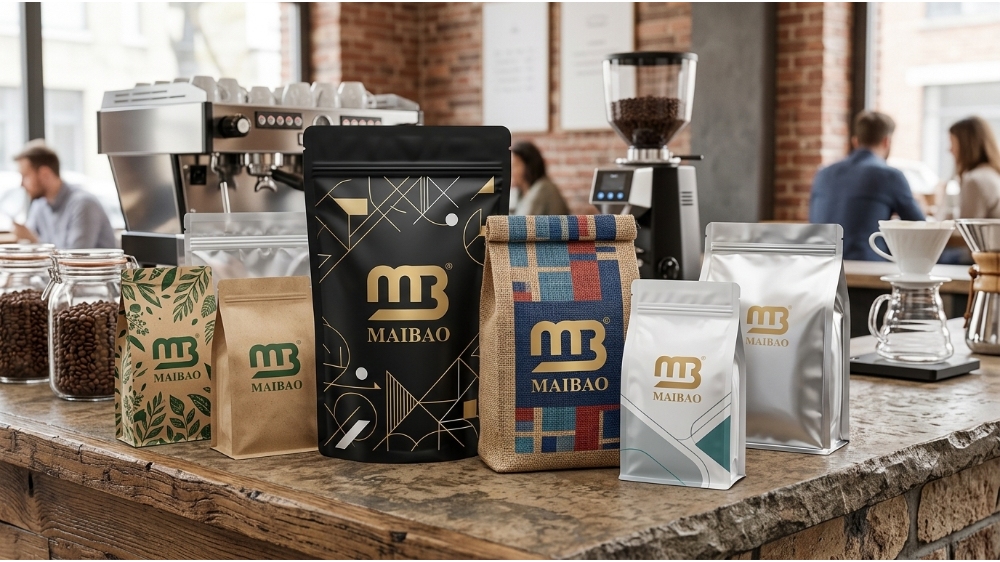
Brands evaluating a full lineup rather than a single size can review ready-made options such as custom kraft valve pouches or fully bespoke foil-lined bags by material, valve placement, and case-pack footprint before committing to a production run. Whatever the segment, the same rule applies: check gusset depth and valve position against your filling line and shelf before finalizing a size — the weight number printed on a spec sheet is only the starting point. Here we present a packaging business expert, Maibao Packaging for you.
Not sure which size fits your roast lineup or shelf?
Talk to a packaging specialist about matching coffee bag size, valve placement, and case-pack logistics to your actual order volume.
What is the most common coffee bag size for retail?
12 oz (340 g) is the single most-ordered size in North America, since it lasts a household one to two weeks while still fitting standard planogram facings. Most brands stock it as the core size, flanked by a 4–8 oz sample and a 16 oz–2 lb subscription option.
Do all coffee bags need a one-way degassing valve?
No — bags under about 5 oz of whole bean rarely generate enough CO2 to need one, and bags meant to be brewed within a day or two of roasting can skip it too. Anything above roughly 8 oz of freshly roasted whole bean generally needs a valve to avoid seam bursting and to preserve aroma over weeks rather than days.
Why does the same weight bag look different for whole bean vs. ground coffee?
Whole beans trap more air between particles than ground coffee, so a bag sized for 12 oz of whole bean will look under-filled if the same pouch is loaded with 12 oz of ground coffee. Always confirm bag dimensions against your actual grind, not just the target weight.
What size bag should I stock for a grocery or supermarket shelf?
Most bagged coffee sold in supermarkets lands in the 12–16 oz range because standard planogram facings and case-pack counts are built around that footprint. Larger 2–5 lb wholesale bags generally don’t face correctly on a retail shelf and are better suited to café or office back-of-house use.
Post time:
Jul-21-2026
For inquiries about our products or pricelist, please leave your email to us and we will be in touch within 24 hours.