
This guide specifies sample bags by use case rather than by nominal gram weight. That distinction is the difference between a cupping sample that pours consistently and a promotional pouch that arrives swollen or stale.
Coffee Sample Bags 50g–100g: Cupping, Trial & Promo Specs
Coffee Packaging Specification Guide
Coffee Sample Bags: How to Specify 50g–100g Packs for Cupping, Product Trials, and Promotions
A 50g–100g coffee sample bag is not a shrunken retail bag. It is a different packaging job with different fill physics, barrier priorities, and unit economics. This guide turns cupping, trial, and promotional use cases into a supplier-ready specification.
Roasted coffee is sold by weight but packed by volume. The gap between those two numbers becomes critical in the 50g–100g range, where a small miscalculation turns a sample bag into either a ballooning pouch or an underfilled, unpresentable pack. The problem is not unique to samples, but the margin for error is tighter because the same coffee bag also has to carry brand information, origin details, and a reseal or valve in a much smaller panel.
Fill Weight Is Not Bag Size: The Volume Gap
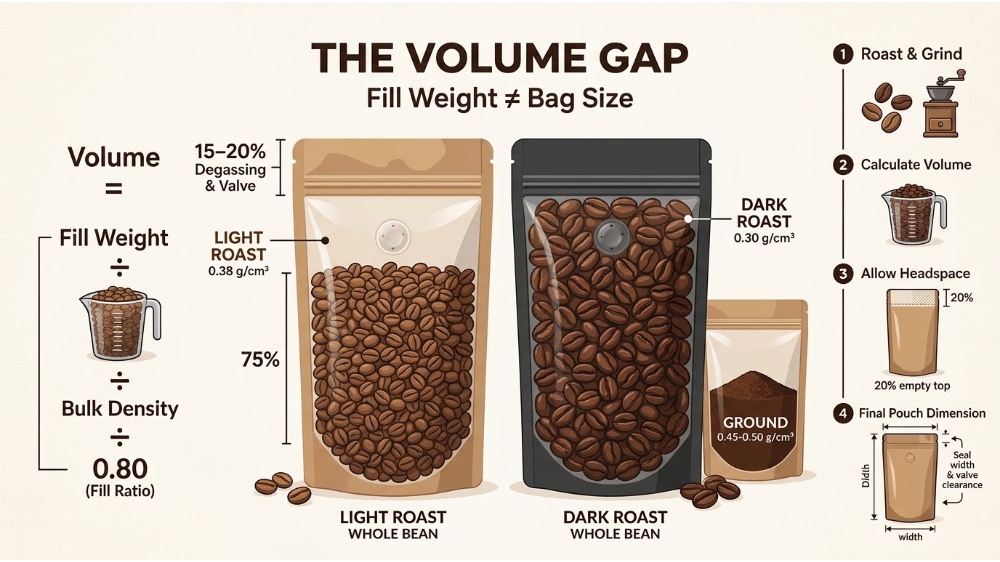
A 100g sample bag does not hold 100g of every coffee. Roasted whole-bean bulk density typically falls between 0.30 and 0.38 g/cm³ depending on roast level and origin. Dark roasts sit at the low end because the bean has expanded and lost mass. Light roasts sit higher. Ground coffee compresses to roughly 0.45–0.50 g/cm³, so the same fill weight occupies less volume but leaves less headspace for degassing.
The practical rule is to fill to 75–85 percent of pouch volume. The remaining headspace keeps a one-way valve working and prevents seams from bulging during the first days after roast. A simple specification formula is volume equals fill weight divided by bulk density, then divided again by a fill ratio of 0.80. For a 100g dark roast at 0.32 g/cm³, the usable volume target is roughly 390 cm³ before headspace allowance. That is why a bag labeled “100g” can quote a physical dimension closer to a 125g retail pouch once valve clearance and seam area are included.
Volume-first specification math:
- Choose roast level and grind before choosing a bag dimension
- Divide fill weight by bulk density to get occupied volume
- Divide by 0.80 to leave 15–20% headspace for degassing
- Add valve clearance and seal width to reach the finished pouch size
Cupping, Trial, and Promo: Three Different Specs
The same 100g pouch can serve all three purposes, but the specification priorities diverge. Cupping samples are dosed by grams per cup, trial packs are opened repeatedly over days or weeks, and promotional packs are judged on brand impression per unit spent.
SCA cupping protocol uses 8.25g of coffee per 150ml of water, weighed separately for each cup. A 100g sample therefore yields about 12 individual cupping bowls before grinder purge is counted. For a roaster supplying green or roasted samples to a buyer, the bag must deliver enough coffee for a full table, not a single brew. A 50g pack is a one-person evaluation; a 100g pack is a buyer’s sample table. The label should state net weight and the dose assumption used for cup-yield math, because a 15g home brew and an 8.25g cupping dose produce very different cup counts from the same bag.
Trial packs sit between sampling and retail. They are often sold in multi-origin sets or inserted into subscription boxes, so the bag needs a reseal that survives repeated opening. The barrier requirement is lower than a 250g retail bag because the coffee is consumed within days of opening, but the valve is still necessary if the pack is filled within 72 hours of roast. Promotional packs prioritize print impact and low minimum order quantities over extended shelf life. A 50g pouch printed digitally in six colors can carry a seasonal promotion or event giveaway without committing to gravure cylinders.
| Use case | Typical fill | Valve logic | Reseal | Barrier priority |
|---|---|---|---|---|
| Cupping sample | 50g–100g | Yes if roasted within 72h; optional if pre-degassed | Not essential | High oxygen barrier for aroma accuracy |
| Trial / subscription | 60g–100g | Yes for fresh roast; valve-free only if nitrogen-flushed | Zipper or tin tie | Medium to high; reseal matters more than long shelf life |
| Promotion / event | 50g–80g | Optional; depends on fill-to-use window | Often none | Print durability and cost per unit |
Valves, Zippers, and When to Skip Both
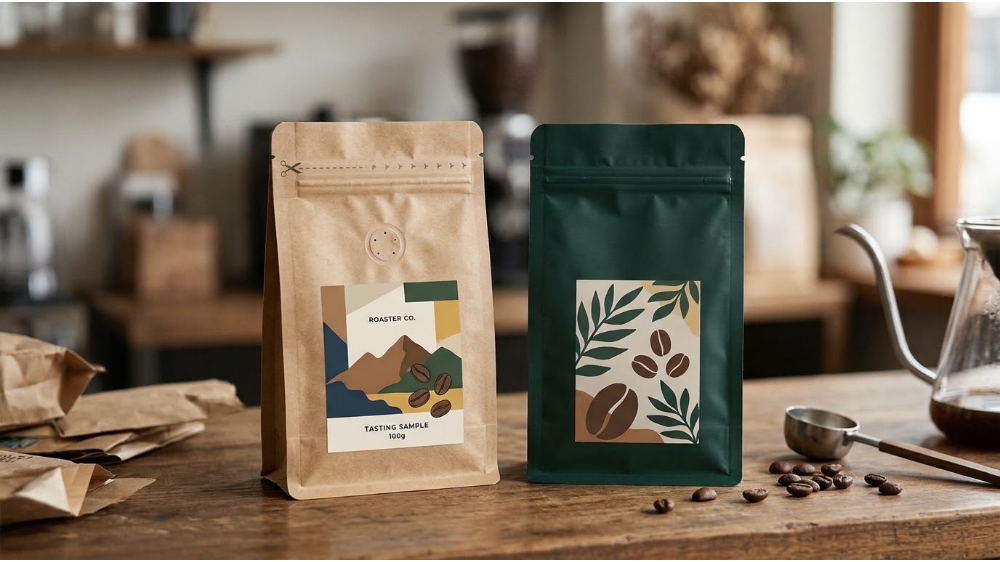
A one-way degassing valve is not automatically required on a 50g–100g bag. It is required when three conditions overlap: the coffee was roasted recently, the bag will be sealed without prior degassing, and the pack may experience pressure changes during storage or transport. Freshly roasted coffee releases carbon dioxide for days after roast. In a sealed pouch without a valve, that gas inflates the bag, stresses seals, and can produce a bloated pack that looks defective to a buyer.
Valves become optional when the coffee is pre-degassed before filling or when the roaster uses nitrogen flushing for coffee bags to displace oxygen before sealing. In a nitrogen-flushed pack, the internal atmosphere is already controlled, and the valve’s role shifts from pressure relief to a secondary safety feature. For short-lived promotional packs that will be opened within days, a valve-free pouch with a high-barrier film can be sufficient if the coffee is rested before packing.
Zippers are a separate decision. A zipper adds cost and reduces the printable front panel, but it changes how the consumer experiences a trial pack. A 100g trial pouch that cannot be resealed forces the user to transfer the coffee or clip the bag, which undermines the premium positioning the sample is meant to create. For subscription inserts and multi-origin tasting sets, a zipper is usually worth the unit cost. For a single-use cupping sample destined for a lab or buyer’s table, a plain tear-notch or tin tie is lighter and cheaper.
Barrier Structures for Short-Life Packs
Sample bags do not need the same barrier thickness as a 1kg wholesale bag, but they do need enough oxygen and moisture protection to deliver the coffee in the condition the roaster intended. A common structure for 50g–100g coffee samples is PET/VMPET/PE: polyester for print and puncture resistance, metallized PET for oxygen and light barrier, and polyethylene for seal integrity. This structure is lighter and more flexible than foil laminates, which makes it easier to fill and seal on small-format equipment.
Foil structures such as PET/AL/PE offer near-zero oxygen transmission and are appropriate when a sample must survive weeks of transit before evaluation. The trade-off is stiffness. A stiff foil pouch in a 50g format can feel disproportionately bulky and may not seal cleanly on a short-cycle filler. For most 50g–100g applications, a metallized high-barrier film is the practical middle ground. The exception is a sample destined for export by air or sea, where pressure changes and extended transit justify the extra barrier and valve reliability of a foil structure.
Print Method and MOQ at Sample Scale
The unit economics of a 50g–100g bag are driven less by film cost than by print setup and minimum order quantity. Digital printing allows runs of roughly 500–5,000 pouches with no cylinder charges, at a unit cost of about $0.15–$0.45 per bag for a 12oz-equivalent structure. Gravure becomes more competitive at 10,000 pieces and above, where cylinder cost is distributed across a larger run and the per-unit print cost drops to roughly $0.05–$0.12.
For sample bags, the decision usually favors digital. A promotional run of 1,000 pouches for a tasting event or a new-origin launch cannot absorb a gravure cylinder charge. A trial pack sold through a subscription box may justify 5,000 digitally printed pouches, but it rarely justifies 10,000. The right question is not “which print method is cheaper per bag” but “which print method keeps the total cash outlay aligned with the number of samples the promotion can actually move.” A sample bag that costs $0.40 digitally but requires no plate fee is cheaper than a $0.10 gravure bag that requires 10,000 units and $1,000 in cylinders for a 2,000-unit promotion.
Sample-run print economics:
- Digital: lower setup, higher unit cost, workable from ~500 pieces
- Gravure: higher setup, lower unit cost, efficient above ~10,000 pieces
- Promotional samples rarely justify gravure unless the run is part of a broader retail SKU
- Keep artwork within the dieline’s safe zone: small panels expose print misregistration faster
How to Write a Quote-Ready Specification
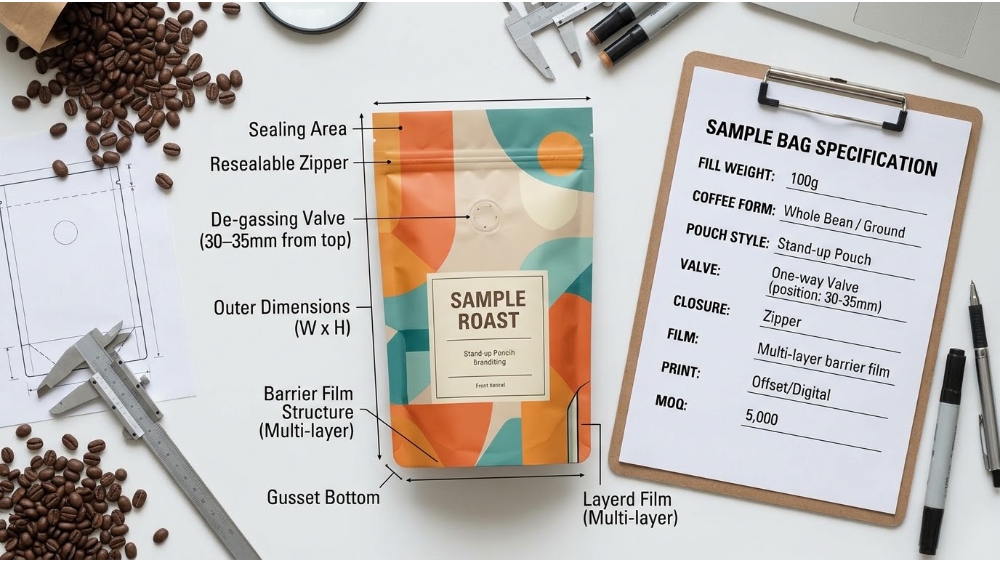
A sample bag specification should give the supplier the fill weight, the coffee form, the intended use, and the expected fill-to-use window. Those four inputs determine pouch volume, valve requirement, barrier level, and reseal option. A spec that lists only “100g stand-up pouch“ leaves the supplier guessing whether the bag will hold light-roast whole bean for export or dark-roast ground coffee for a same-day event.
The finished specification should include: pouch style and outer dimensions; fill weight and roast level; whole bean or ground; valve type and position if required; zipper or tin tie; film structure; print method and number of colors; MOQ; and any transit or drop-test requirement. Valve position is worth calling out explicitly because a valve mounted too close to the top seal can interfere with the fill and seal cycle on small pouches. A common position for a sample bag is 30–35mm from the top edge, on a flat panel clear of the zipper and the main artwork.
For a sample bag that will be filled on existing equipment, the supplier should confirm seal bar width, fill tube diameter, and valve application method before quoting. A pouch that looks correct on a dieline can fail on a filler if the zipper or valve sits outside the machine’s sealing window. This is especially relevant for 50g formats, where a few millimetres of misalignment consumes a larger share of the total panel.
Checks Before the Full Run
Pre-production samples should be filled with the actual coffee, not a surrogate, and checked for seal strength, valve function, and headspace behavior. A 100g sample bag filled with dark-roast whole bean will behave differently from the same bag filled with ground coffee: ground coffee settles more densely, leaving less headspace and changing the stress on the bottom seal. Drop testing from handling height and a short transit simulation will reveal whether the valve seat or zipper ends are vulnerable.
For promotional samples that will be handled repeatedly before opening, scuff resistance of the print surface matters. Matte finishes hide scuffs better than gloss, but they also show oily fingerprints. A quick rub test on the printed panel will indicate whether the ink system is appropriate for the handling the sample will receive.
Need sample bag packaging matched to your trial and promo runs?
Talk to a packaging specialist about fill volume, valve placement, print method, and minimum order quantity for 50g–100g coffee sample pouches.
Frequently Asked Questions
How many cups does a 100g coffee sample bag make?
At the SCA cupping dose of 8.25g per 150ml, a 100g bag yields about 12 cups before grinder purge. At a 15g home brew dose, the same bag yields roughly 6–7 cups. State the dose assumption on the label so buyers can compare samples accurately.
Do 50g coffee sample bags need a degassing valve?
Only if the coffee is packed within a few days of roast and will be sealed without prior degassing. A valve prevents pressure buildup and seal failure. If the coffee is rested before filling, or if the bag is nitrogen-flushed, a valve may be unnecessary for a short-life sample.
What is the typical dimension of a 50g–100g sample pouch?
A common sample or trial format is approximately 90 × 150mm with a 50mm bottom gusset, which covers roughly 60g–100g depending on roast density and fill ratio. Dark roasts and whole bean coffees require more volume than the same weight of ground coffee.
Can I print a 50g sample bag without a large minimum order?
Yes. Digital printing makes short runs of roughly 500–5,000 pouches practical, with no gravure cylinder charge. The unit cost is higher than a long gravure run, but the total outlay is lower for a promotion or trial that does not need 10,000 pieces.
Post time: Nov-23-2026