

This guide covers four test families that matter most for coffee packaging: seal strength, leak detection, drop resistance, and transit simulation. Each has a standard method, a practical acceptance threshold, and a specific failure mode it catches before the bag reaches a customer.
Coffee Bag QC Tests to Lock Before Production
Coffee Packaging Quality Control
Coffee Bag Quality Control: Seal Strength, Leak, Drop and Transit Tests to Specify Before Mass Production
Most coffee bag failures are not random defects. They are the predictable result of specifications that were never tested under mechanical or climatic stress. This guide defines the seal, leak, drop, and transit tests to lock into your purchase order before the first production run begins.
A coffee bag that looks perfect at the filling line can fail in a parcel hub, a humid container, or a retail shelf six weeks later. The tests that predict those failures are neither expensive nor exotic, but they must be specified before the first mass production run, not discovered during a post-season audit.
Why Pre-Production Testing Changes the Outcome
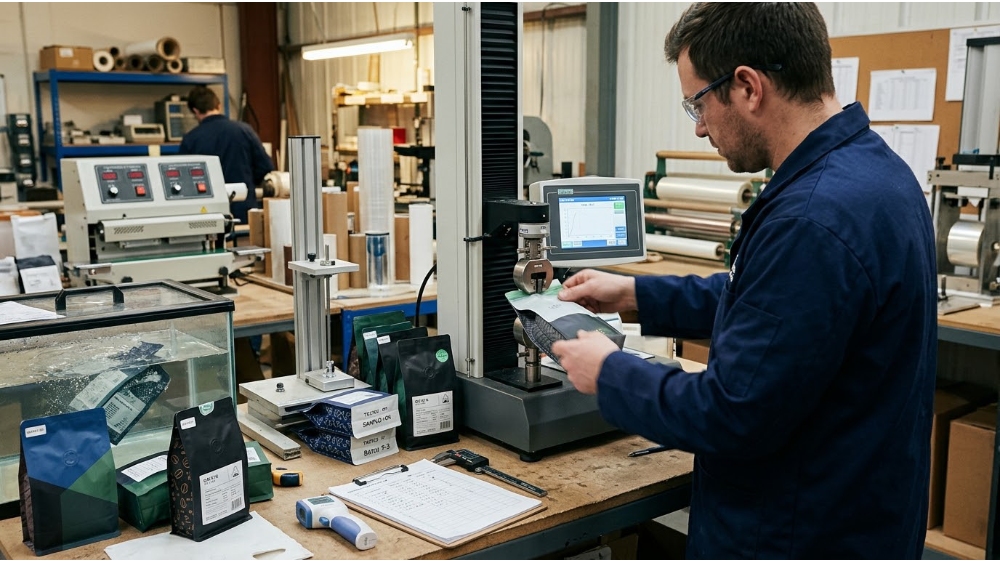
Once a bag enters mass production, the laminate structure, the heat-seal parameters, and the tooling are fixed. If a failure mode appears after the first container ships, the correction cycle involves new samples, new approval rounds, and often a second production run. The cost is not the bag itself. It is the delay, the replacement freight, and the retail chargebacks.
Seal strength testing is the step most often abbreviated in coffee packaging QC, and it produces the most in-field failures. On a bag-making machine, the fin-seal jaw temperature can drift upward over a four- to six-hour run if the thermocouple is not calibrated. A drift of even 10 to 12 degrees Celsius can over-fuse the sealing layer: the seal looks intact under visual inspection but turns brittle under peel force. A specification that requires peel testing at the start and end of each production shift catches this drift before the lot ships.
The same logic applies to leak, drop, and transit performance. A bag can pass a visual check and still carry a micro-channel at the valve seat or a weak bottom gusset fold. The only way to know is to test the finished structure under the stresses it will meet in the supply chain. Pre-production testing is not a quality department formality. It is the point where a purchase order becomes an engineering document.
Seal Strength: The First Release Gate
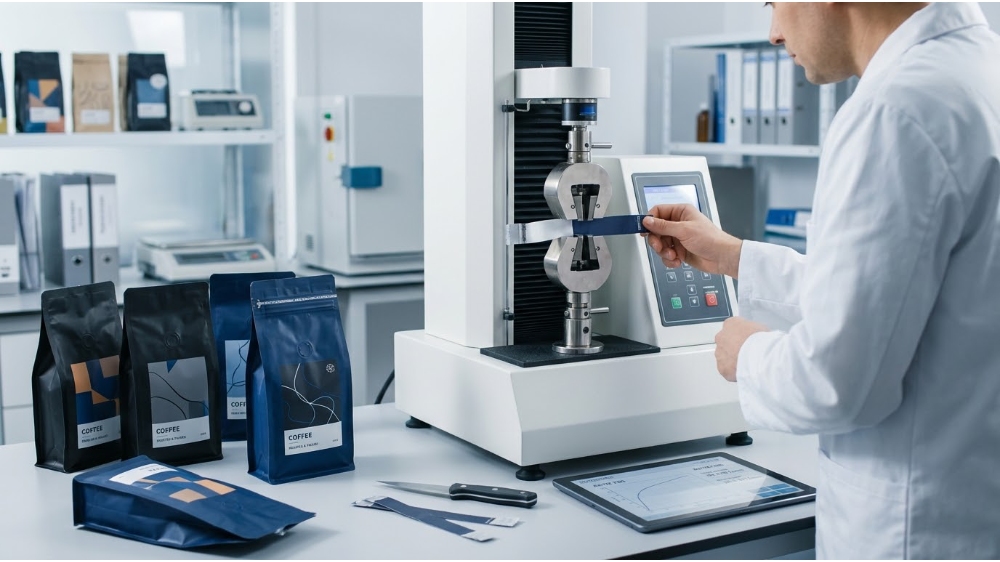
Seal strength measures the force required to separate the sealed layers of a flexible package. ASTM F88/F88M is the standard test method for this measurement, and it is used for process validation, process control, and capability assessment. The test is run on a strip cut across the seal, with the two tails pulled apart at a controlled rate. The peak force and the average force to separate the seal are both recorded, and the failure mode is noted because it identifies whether the sealing process or the material is the limiting factor.
For standard air-packed coffee bags, a minimum fin seal peel strength of 35 N/15mm is a practical specification floor. A lot should be flagged if more than one unit in a 32-piece AQL 2.5 sample falls below that threshold. For nitrogen-flushed bags, the floor should be raised to 40 N/15mm. Nitrogen flushing creates a small internal positive pressure at the moment of sealing, and that pressure loads the fin seal continuously over shelf life. The seal must resist both handling stress and internal gas pressure, so a higher baseline is not over-specification. It is the correct threshold for the filling method. Brands that use nitrogen flushing for coffee bags should state the flush level in the packaging brief so the seal acceptance criterion matches the actual headspace condition.
Seal strength also has a practical upper limit for formats that the consumer peels open. If the seal is too strong, the bag becomes difficult to open without tearing the film. The specification should set a minimum for integrity and, where relevant, a maximum for openability. For most coffee bags, the minimum is the critical number. The maximum is a usability consideration, not a safety gate.
Leak and Headspace Integrity
A strong seal can still leak. Leak testing detects the channels, pinholes, and incomplete valve bonds that allow gas to move in or out of the package, even when the peel strength is above the minimum. For coffee, the most important leak path is often the valve seat and the area where the valve flange meets the laminate. A micro-leak at that interface will not show up in a peel test, but it will allow oxygen ingress and carbon dioxide loss over time.
Bubble emission testing per ASTM D3078 is the conventional method for gross leaks. The bag is immersed in water, a vacuum is applied, and a continuous stream of bubbles from a single point indicates a leak. It is fast, visual, and suitable for production-line screening. For smaller leaks and for finished coffee bags that must remain intact, vacuum decay testing per ASTM F2338 is more appropriate. The bag is placed in a sealed chamber, a vacuum is drawn, and the pressure rise over a defined period is measured. A pressure rise above the acceptance threshold indicates a leak. Vacuum decay is non-destructive and quantitative, which makes it useful for auditing lots that will be sold as nitrogen-flushed or long-shelf-life product.
A leak test is not redundant with a seal strength test. One measures the force to separate a seal. The other measures whether gas can pass through the finished package. A bag can have a seal that peels at 45 N/15mm and still fail a vacuum decay test because a pinhole exists in the bottom gusset or the valve adhesive has a void. Specify both, and run the non-destructive leak test before the destructive peel test so that the same sample set can be used efficiently.
Drop Test: What a Pass Actually Proves
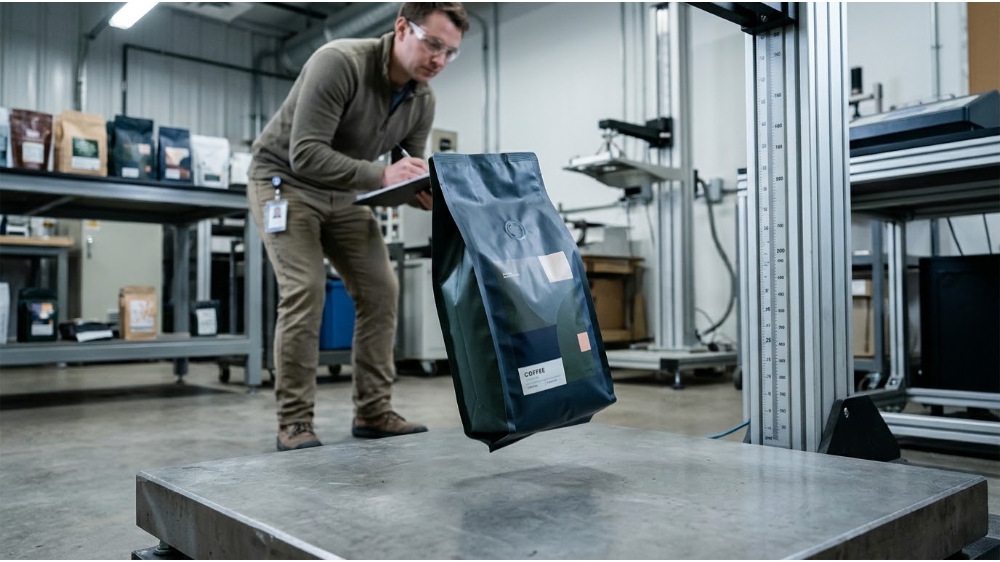
Drop testing simulates the shocks of sorting, loading, and last-mile handling. ISTA 3A is the general simulation protocol for individual packaged products shipped through parcel delivery systems, covering packages up to 70 kg. For a coffee bag parcel below 23 kg, a common ISTA 3A drop height is 760 mm, with a sequence that includes one corner, three edges, and six faces. The exact drop height and sequence vary with package weight and configuration, so the specification should reference the ISTA 3A procedure rather than a single universal height.
A drop test pass means that the bag’s seams, valve attachment, and bottom gusset folds survive a defined impact without visible rupture or delamination. It does not mean the bag is indestructible, and it does not replace transit simulation. A bag can pass a single drop and still fail under repeated vibration. The value of the drop test is that it concentrates impact energy at the weakest geometric points: the fin seal ends, the valve flange corners, and the bottom gusset crease. Those are the locations where a small crack becomes a leak in the parcel network.
The test sample must be a finished, filled bag at the actual fill weight, using the production laminate and the production valve. An empty bag or a water-filled surrogate changes the mass distribution and the stress path, and the result will not represent the shipping condition. For a coffee bag with a degassing valve, inspect the valve seat after each drop. A valve that remains attached but lifts slightly at the edge has failed the intent of the test, because the next vibration cycle can open the channel.
Transit Simulation and E-commerce Stress
Drop testing is a single event. Transit testing is a sequence: preconditioning at controlled temperature and humidity, random vibration, shock, and compression. ISTA 3A combines these elements for parcel shipping. ASTM D4169 provides a broader framework for distribution cycle testing, and it is useful when the coffee bag moves through a known retail or palletized channel rather than a parcel network.
For coffee, the climatic part of transit is as important as the mechanical part. A sea container can move from 40% relative humidity to above 90% within a day, and temperature swings from below freezing to above 40 degrees Celsius are common on long routes. Those cycles stress the adhesive layers between the film and the foil, and they can cause delamination at the zipper weld line or the valve flange.
A bag that passes a room-temperature peel test may still fail after thermal cycling because the adhesive becomes brittle or the residual solvent level was too high at lamination. The transit specification should therefore include the actual route conditions, not a generic shipping test claim. For brands building coffee packaging for e-commerce and subscription orders, the transit test should reproduce the parcel journey, including the number of handling touches and the expected seasonal temperature range.
Random vibration is the key test in ISTA 3A for parcel networks. It exposes weak seal edges and valve bonds to repeated low-amplitude stress, which is closer to the real damage mechanism than a single high drop. A lot that passes drop but fails vibration often has a seal that is strong in peel but brittle in flex. The vibration result tells you to adjust the sealing temperature or the laminate, not to add more tape to the carton.
Writing the Tests into Your Specification
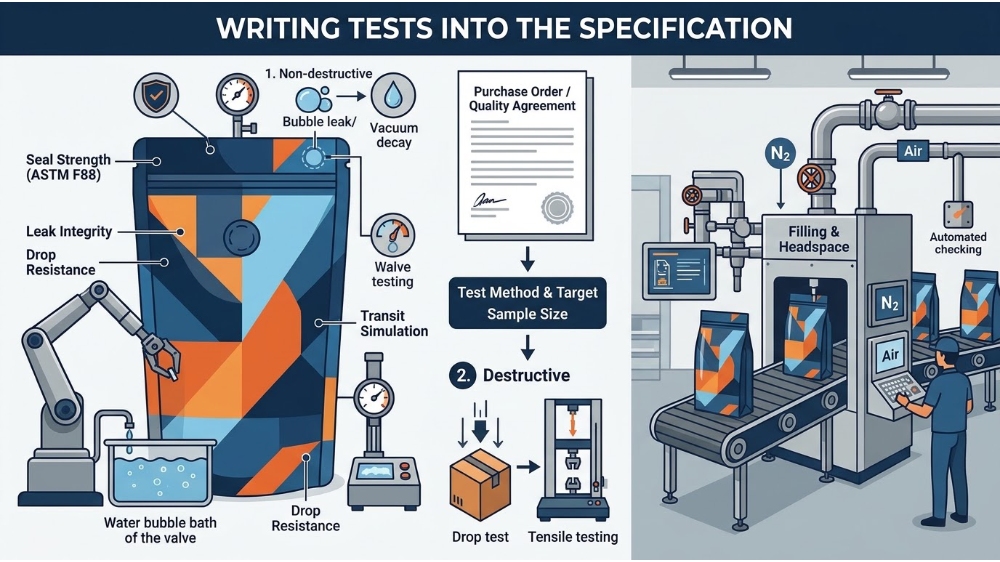
A test that is not written into the purchase order is a suggestion, not a specification. The quality agreement or purchase order should name the test method, the acceptance threshold, the sample size, and the point in production where the test is performed. The table below summarizes the four test families and the practical thresholds discussed in this guide.
| Test family | Method reference | Practical acceptance floor | Sample / frequency |
|---|---|---|---|
| Seal strength (fin seal) | ASTM F88/F88M | 35 N/15mm air-packed; 40 N/15mm nitrogen-flushed | 32 pieces, AQL 2.5; start and end of shift |
| Leak / headspace integrity | ASTM D3078 (bubble); ASTM F2338 (vacuum decay) | No continuous bubble stream; pressure rise below agreed threshold | Per lot; valve zone and fin seal ends included |
| Drop resistance | ISTA 3A drop sequence | No seam rupture, valve lift, or visible delamination | 3–5 filled bags at production fill weight |
| Transit simulation | ISTA 3A; ASTM D4169 | No leak, delamination, or valve failure after full sequence | At least one complete shipping unit |
The sequence of testing matters as much as the tests themselves. Run the non-destructive checks first: barrier verification if the laminate is new, valve function, and vacuum decay leak testing. Then run seal strength on cut strips. Save the drop and transit tests for last because they consume the sample. This order prevents a lot from being rejected on a destructive test when the real failure was a barrier or valve defect that could have been caught earlier.
A specification should also state the headspace condition: air-packed, nitrogen-flushed, or carbon dioxide pass-through. Seal strength and leak thresholds change with the filling method, and a supplier cannot set the correct acceptance criterion if the brief does not say how the bag will be filled. The most common specification gap in coffee packaging is not the bag dimension or the print color. It is the missing statement of headspace atmosphere, which determines whether the seal is tested against 35 N/15mm or 40 N/15mm and whether the leak test is a pass/fail screen or a quantitative release gate.
Need coffee bags that pass seal, leak, and transit tests before mass production?
Talk to a packaging specialist about matching bag structure, valve type, and laminate to your fill method, your distribution route, and your shelf-life target.
Get Maibao One-stop Solutions
Frequently Asked Questions
Do I need both seal strength and leak testing?
Yes. Seal strength measures the force required to separate the sealed layers. Leak testing detects channels or pinholes that allow gas to pass through the finished package. A bag can have a strong peel seal and still leak at the valve seat or a gusset fold, so the two tests catch different failure modes.
What seal strength should I specify for nitrogen-flushed coffee bags?
A minimum fin seal peel strength of 40 N/15mm is a practical baseline for nitrogen-flushed bags, compared with 35 N/15mm for air-packed bags. The internal positive pressure from flushing loads the seal differently, so the higher threshold reflects the actual stress on the package over shelf life.
Can I use a supplier’s generic ISTA 3A report for my bag?
Only if the report covers a package with the same dimensions, fill weight, laminate structure, valve type, and closure system. ISTA 3A results are tied to the packaged product’s mass and geometry. A report for a different bag format does not transfer automatically, even if the supplier is the same.
How many samples should be tested before mass production?
For seal strength, a 32-piece sample under AQL 2.5 is a common release plan, with testing at the start and end of each production shift. For drop and transit, use at least three to five filled bags for drop and one complete shipping unit for transit simulation. The exact sample size should be written into the quality agreement rather than agreed verbally.
Post time: Nov-20-2026