

This guide separates the scenarios where nitrogen flushing changes the commercial outcome from those where a valve and a barrier film already solve the problem. It is written for roasters specifying packaging and for buyers comparing supplier claims, with the practical variables that determine whether a nitrogen line is an asset or an unnecessary cost.
Nitrogen Flushing for Coffee Bags: When Roasters Need It and What Buyers Should Know
Coffee Packaging Specification Guide
Nitrogen Flushing for Coffee Bags: When Roasters Need It and What Buyers Should Know
Nitrogen flushing is not default. It pays off for long shelf life, ground coffee, or long transit; fast-turnover local whole bean often needs only a valve and barrier film. Decide by residual oxygen target, not the label.
Roasted coffee begins losing aromatic quality almost immediately after the cooling tray, but the rate of loss depends far more on the package than on the calendar. Oxygen drives oxidation of lipids and volatile compounds, moisture accelerates structural staling, and carbon dioxide released by fresh beans creates internal pressure that must go somewhere. Nitrogen flushing addresses one part of that system: it displaces oxygen from the coffee bag headspace before sealing. It does not stop carbon dioxide release, and it does not compensate for a weak barrier film.
What Nitrogen Flushing Changes, and What It Does Not
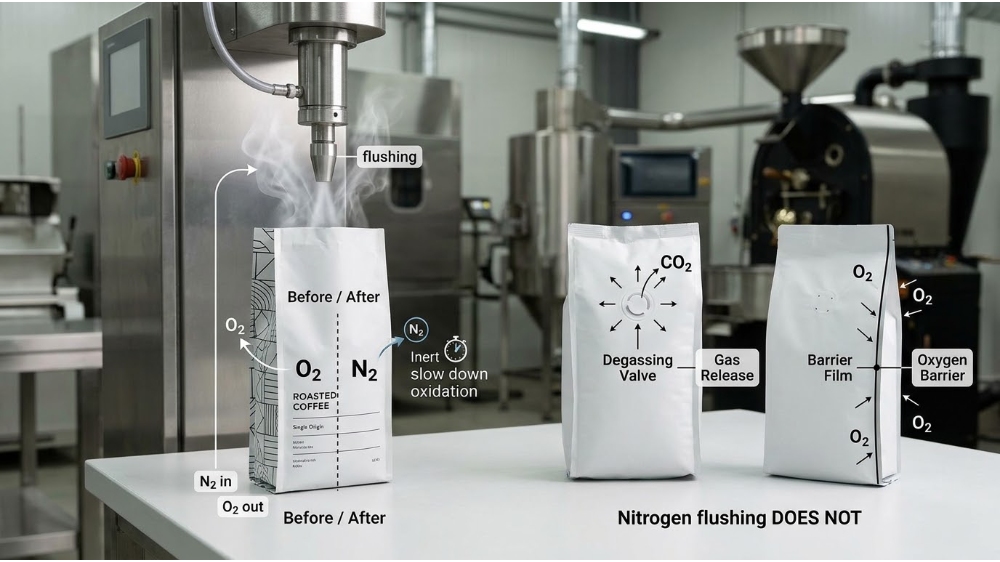
Nitrogen flushing replaces oxygen-rich air in the bag headspace with inert nitrogen immediately before the final seal. The purpose is narrow and measurable: it lowers residual oxygen at the moment of closure, slowing the oxidation reactions that turn coffee stale. Packaging suppliers describe the process as modified atmosphere packaging, and its effect is real when the residual oxygen number is controlled and verified.
The common misreading is that nitrogen flushing is a complete freshness strategy. It is not. Roasted coffee continues to release carbon dioxide for days and weeks after packaging, and nitrogen does nothing to stop that release. A sealed bag without a one-way degassing valve will inflate, distort, and potentially split regardless of how well it was flushed. Nitrogen also cannot correct a film with poor oxygen barrier properties; oxygen will migrate through the packaging wall over time, eroding the benefit of a low starting residual oxygen level.
In practical terms, nitrogen flushing is a complement to two other components: a one-way degassing valve that manages internal pressure, and a barrier film that manages oxygen ingress after sealing. A bag with nitrogen but no valve is a pressure problem waiting to happen. A bag with nitrogen but a weak film is a short-lived benefit.
The Roast Date Window Nitrogen Cannot Close
Freshly roasted coffee emits a large volume of carbon dioxide in the first one to three days after roasting. Dark roasts can release up to roughly 10 liters of gas per kilogram of coffee, with a substantial share arriving within the first 24 to 48 hours. This is why a bag sealed immediately after roasting without a valve puffs up overnight and why roasters have historically rested coffee in open containers before packing. Resting solves the pressure problem, but it exposes the coffee to oxygen at the worst possible moment.
The one-way valve removed that trade-off. A valve is a pressure-activated device that vents carbon dioxide outward and admits nothing inward, so coffee can be sealed within minutes of the cooling tray rather than hours later. Nitrogen flushing and a valve therefore belong to the same packaging decision: the valve handles the gas the coffee produces, while nitrogen lowers the oxygen the coffee sits in while it produces it.
What nitrogen cannot do is make coffee that is still actively degassing behave like coffee that has finished. If a roaster flushes and seals a very fresh roast in a high-barrier bag with a valve, the valve will vent the early carbon dioxide, but the internal atmosphere is a mix of nitrogen and the coffee’s own gas. This is normal and generally acceptable. The operational point is that the packaging system must be designed around the roast date, not around the assumption that nitrogen freezes the coffee in its just-roasted state.
When Nitrogen Flushing Earns Its Cost
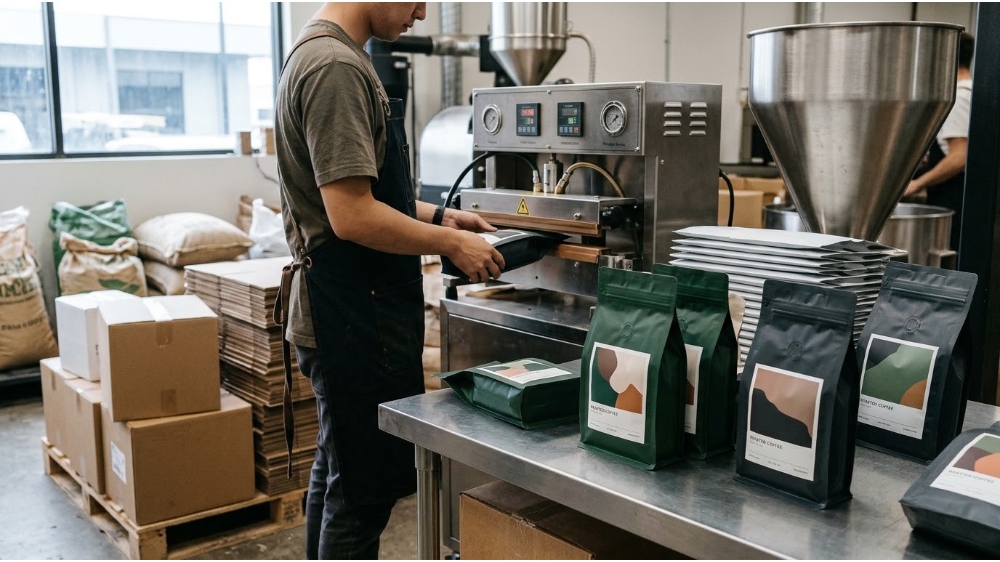
Nitrogen flushing becomes commercially necessary when the gap between roast date and consumption is long enough that oxygen damage would otherwise be visible to the buyer. The clearest cases are export and long retail distribution, private-label or contract roasting with shelf-life commitments, and pre-ground coffee sold in retail packs.
Ground coffee is the strongest case. Grinding increases surface area by orders of magnitude, and ground coffee can stale in days where whole bean takes weeks. A roaster who wants to sell pre-ground retail packs with a multi-month best-before date cannot rely on a valve and a moderate film alone; a low residual oxygen starting point is part of the specification. Industry guidance commonly treats oxygen levels above 5 percent as a threshold for significant oxidation within days, with a residual oxygen target of no more than 3 percent as a baseline and 2 percent or lower in many contract and private-label requirements. Premium specialty programs sometimes target below 1 percent.
The cost side is often smaller than roasters expect. One specialty roaster reported that nitrogen flushing added roughly four cents per bag while extending whole-bean vibrancy by about four weeks. For a business shipping pallets to distributors or holding inventory for e-commerce, that per-bag cost is trivial relative to the cost of a stale-bag complaint or a retailer rejection. The calculation changes for a local roaster selling whole bean within two to three weeks; there, the same four cents buys protection the customer may never need.
When a Valve and Barrier Film Are Enough
For roasters with short, controlled distribution, a one-way valve plus a high-barrier film covers the essential freshness risks without the capital and operational overhead of a nitrogen system. The valve manages the carbon dioxide that fresh coffee inevitably produces. The film manages oxygen ingress and moisture transmission after sealing. Together they allow immediate packaging and a stable bag shape without a gas-flushing step.
This is not a compromise solution for low-quality coffee. It is a fit-for-purpose specification. A local specialty roaster selling whole bean through a cafe or weekend market, with turnover measured in days to a few weeks, does not face the same oxidation timeline as an exporter shipping a container. The valve prevents the bag from inflating, the film slows oxygen ingress, and the roast date label tells the buyer when to consume. Adding nitrogen would reduce the starting oxygen level further, but the marginal benefit over a correctly specified valve-and-film system is small in that context.
The decision boundary is not “nitrogen versus no nitrogen.” It is “how much unprotected time will this coffee spend between sealing and brewing, and what does the buyer expect when the bag is opened.” If the answer is a few weeks and a local customer, valve and film are enough. If the answer is several months, a distributor warehouse, or a retail shelf, nitrogen flushing moves from optional to specified.
| Scenario | Nitrogen flush | Valve + barrier film | Why |
|---|---|---|---|
| Local whole-bean, under 3 weeks | Optional | Sufficient | Turnover is faster than meaningful oxygen damage; valve manages CO2 |
| Regional wholesale, 4–8 weeks | Useful | Baseline requirement | Slower turnover benefits from lower starting oxygen; film must be specified |
| Retail pre-ground, 3–12 months | Required | Required | Grinding accelerates staling; residual oxygen target must be low and verified |
| Export or contract roasting | Required | Required | Transit time and buyer specifications typically demand 2–3% residual oxygen or lower |
| E-commerce, 2–6 weeks | Useful | Required | Delivery variability adds unprotected time; nitrogen reduces starting oxygen |
The Residual Oxygen Number Buyers Should Ask For
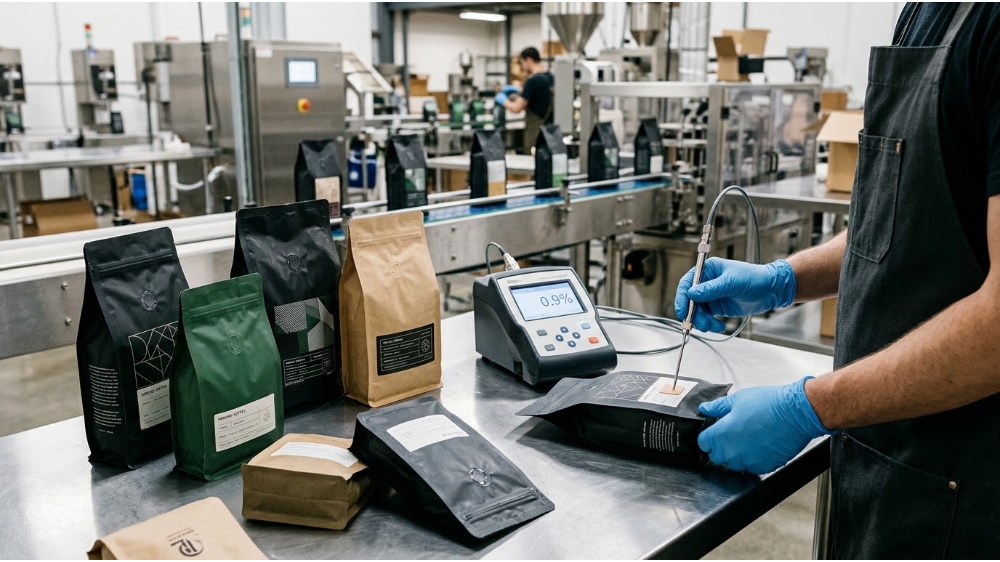
The phrase “nitrogen flushed” on a supplier specification is not a performance guarantee. It describes a process step, not an outcome. The number that matters is residual oxygen: the percentage of oxygen remaining in the sealed package after flushing. A supplier who cannot state a target and a verification method has not specified the process in a meaningful way.
Industry guidance treats 3 percent residual oxygen as a minimum baseline, with levels above 5 percent associated with significant oxidation within days. Many quality-focused roasters and private-label contracts require 2 percent or lower, and premium programs with extended shelf-life claims may target below 1 percent. The appropriate target depends on the product and the claimed shelf life, but the principle is consistent: the lower the residual oxygen, the slower the oxidative decline, provided the barrier film prevents oxygen from re-entering.
Verification is the second half of the specification. A bench-top headspace analyzer can test a sample bag pulled from the line, and an on-line analyzer can monitor oxygen continuously during packaging. Buyers should ask how often the measurement is taken, what the acceptable range is, and what happens when a sample falls outside it. A supplier with flushing equipment but no documented sampling protocol may be flushing inconsistently, and a bag that averages 3 percent across a run can still contain individual packs well above that level.
Residual oxygen questions for a packaging supplier:
- What is the residual oxygen target for this coffee and this bag format?
- Is the measurement taken on the headspace of a sealed bag, and with what device?
- How frequently is a sample checked during a production run?
- What oxygen transmission rate does the film provide after sealing?
- Is a one-way valve fitted, and what opening and closing pressure does it use?
Matching the Gas to the Whole Packaging System
Nitrogen flushing performs best when it is treated as one component of a packaging system rather than a standalone upgrade. The film structure determines how much oxygen tries to enter after sealing. The valve determines how pressure from carbon dioxide is managed. The flush determines the oxygen level at the starting line. The roast date and the distribution route determine how long the coffee must hold its quality. A change to any one of these alters the others.
A common specification failure is to invest in nitrogen flushing while accepting a film with a poor oxygen barrier. The initial residual oxygen may be low, but oxygen migrates through the packaging wall and the advantage disappears over weeks. Another failure is to specify a high-barrier film and nitrogen but omit the valve, which produces a tight package that inflates as the coffee degasses. The buyer’s leverage lies in requiring the supplier to describe the combination, not just individual features.
For roasters scaling from local sales to regional or national distribution, the packaging specification should be revisited at the point where transit time and warehouse dwell time begin to exceed the window that a valve-and-film system can protect. That is the moment nitrogen flushing becomes a rational capital decision, and it is also the moment to insist on residual oxygen verification rather than accepting a process label. A bag that is flushed to 2 percent and protected by a high-barrier film with a functioning valve is a different product from a bag that is merely described as nitrogen flushed.
Frequently Asked Questions
Does every coffee bag need nitrogen flushing?
No. Whole-bean coffee sold locally within a few weeks can be well protected by a one-way valve and a high-barrier film. Nitrogen flushing becomes necessary when shelf life must extend for months, when the product is pre-ground, or when distribution includes long transit and warehouse time.
Can nitrogen flushing replace a degassing valve?
No. Nitrogen flushing lowers oxygen in the headspace, but it does not stop roasted coffee from releasing carbon dioxide. Without a one-way valve, a sealed bag can inflate or split as CO2 accumulates. The valve and the flush address different problems and are normally used together.
What residual oxygen level should a buyer require?
A common baseline is no more than 3 percent residual oxygen, with 2 percent or lower required in many contract and private-label specifications. Premium programs with long shelf-life claims may target below 1 percent. The buyer should ask how the level is measured and how often it is checked during production.
Is nitrogen flushing worth the cost for a small roaster?
For a small roaster selling whole bean locally with fast turnover, the benefit is usually marginal compared with a correctly specified valve and barrier film. For a small roaster selling pre-ground coffee online or shipping wholesale accounts, the cost per bag is low relative to the risk of stale product reaching a customer.
Need coffee packaging specified around your roast and distribution?
Talk to a packaging specialist about matching barrier film, valve type, and residual oxygen targets to your coffee menu, shelf-life claims, and delivery model.
Post time: Nov-11-2026