

This guide explains the forces that break coffee bags in transit, how degassing valves behave as shipping components, how primary and secondary packaging divide the protection job, and what repeat fulfillment demands from box format and packing sequence. It focuses on direct-to-consumer and subscription coffee, where the same packaging system must perform across many dispatch cycles and changing order combinations.
Coffee Packaging for E-Commerce: Shipping Protection and Repeat Fulfillment
Coffee Packaging Fulfillment Guide
Coffee Packaging for E-Commerce and Subscription Orders: How to Protect Bags During Shipping and Repeat Fulfillment
An e-commerce coffee bag is tested by the parcel network, not the shelf. The answer is to specify the primary bag and outer shipping pack as one validated system: valve flow, seal integrity, box fit, and repeat dispatch all have to work together. A failure in any one produces the same result: a damaged bag, a lost subscriber, and a replacement cost that erases the order margin.
Coffee packaging for e-commerce and subscription orders has one dominant search intent: how to keep a filled coffee bag intact and fresh through parcel handling, while making repeat dispatch operationally manageable. The answer is not a stronger bag in isolation. It is a validated packaging system in which the primary coffee bag, the one-way valve, the seal, and the outer shipping pack are specified together for the actual delivery route.
Why E-Commerce Changes Coffee Packaging Requirements
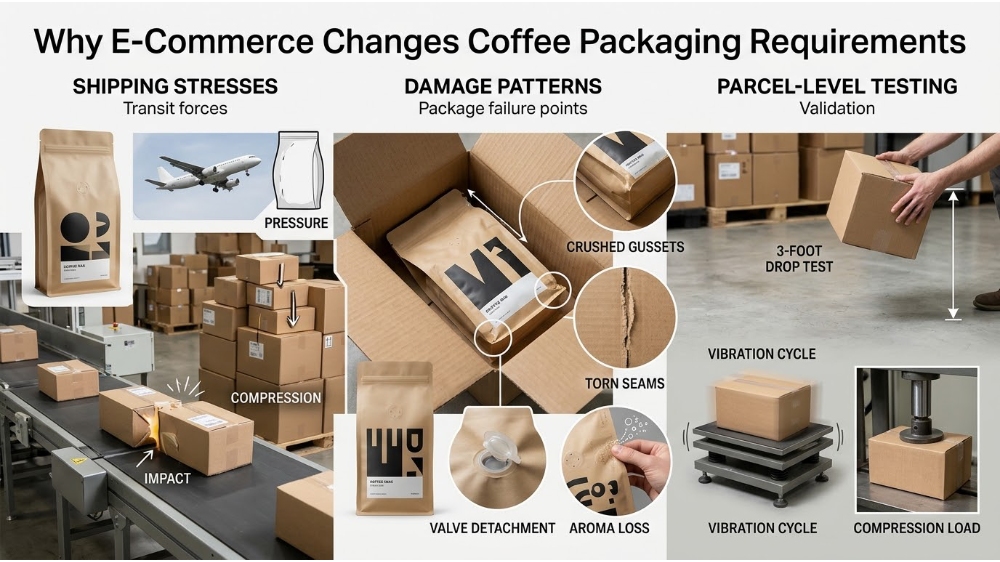
Retail coffee moves in cases, and direct-to-consumer coffee moves as individual parcels. That shift introduces three forces that shelf packaging was never designed to manage: repeated impact from sorting equipment, sustained compression from stacked parcels, and pressure differentials that inflate sealed bags during air transport or temperature swings. A pouch that performs well in a display box may develop a compromised seal or a valve that separates under parcel handling.
The most common damage patterns in e-commerce coffee are predictable. Crushed gussets occur when the bag is compressed against a box wall. Torn seams emerge when the filled bag shifts and rubs against corrugated edges. Valve detachment happens when stacking pressure lands directly on the valve component. Aroma loss follows any micro-leak in the seal land, even when the bag appears visually intact. These failures share a root cause: the bag was evaluated alone, not as part of a packed order moving through a real delivery route.
The practical implication is that e-commerce coffee packaging must be validated at the parcel level. A three-foot drop test, a vibration cycle, and a compression load applied to the complete shipment configuration reveal failures that a visual inspection of an empty bag cannot detect. The bag, the fill weight, the closure, and the outer pack have to be tested together because the forces act on the assembled unit.
The Degassing Valve as a Shipping Component
Freshly roasted coffee releases carbon dioxide for days after roasting. Whole-bean coffee packed within a week of roast is still degassing actively, and without a one-way valve, that gas has nowhere to go. The bag inflates, internal pressure rises, and the seal becomes the weakest point. In a parcel network, where bags are stacked and compressed, an inflated pouch is more likely to rupture at a seam or force the valve bond to fail.
A one-way degassing valve solves this by allowing CO2 to escape while blocking oxygen from entering. Standard valves crack open at roughly 0.5 psi and use a silicone disc or microporous membrane to reseal once internal pressure drops. For most 250 g to 1 kg bags, a standard-flow valve matched to the fill volume provides sufficient venting for typical two-to-four-week degassing. Larger fills or bags packed immediately after roasting may need a higher-flow valve to prevent pressure buildup during the first transit window.
The valve specification matters more in e-commerce than in retail because transit times are longer and pressure changes are more extreme. A valve that performs acceptably on a store shelf may not keep pace with the gas volume produced during a multi-day parcel journey. The valve bond is also a structural point: it must withstand stacking pressure without detaching, and its placement should keep it away from folds that could stress the seal. For subscription programs that ship whole-bean coffee on a fixed roast-to-ship schedule, valve flow rate and bond integrity should be treated as fulfillment specifications, not as a purchasing afterthought.
What to validate in a coffee shipping system:
- Valve flow rate matched to fill weight and roast-to-ship interval
- Seal integrity after compression and vibration cycles
- Bag restraint inside the outer pack to prevent rubbing and impact transfer
- Repeat packing consistency across common order combinations
How the Coffee Bag and Shipping Pack Divide the Job
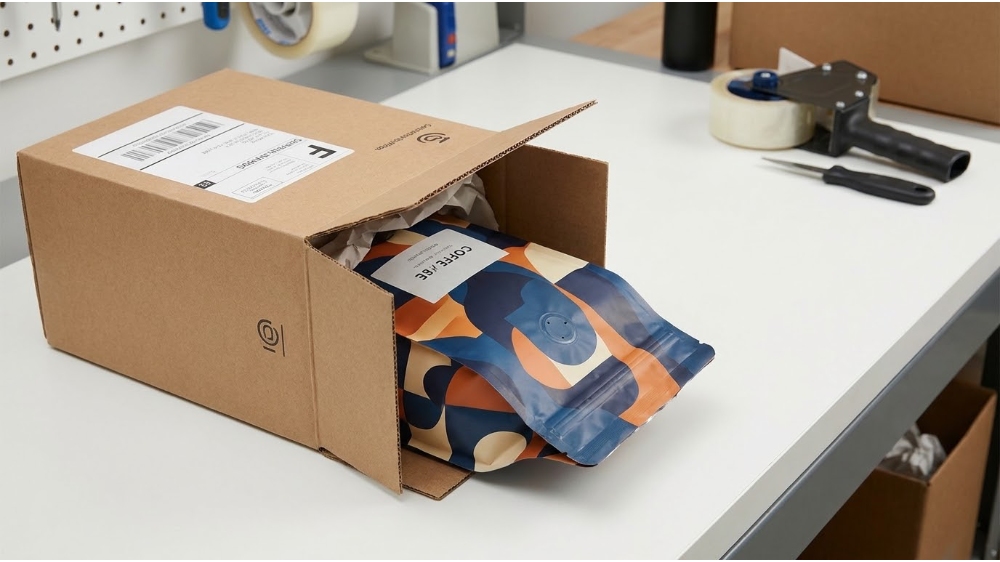
The primary coffee bag manages the product: barrier performance, seal integrity, valve function, and the opening experience. The outer shipping pack manages the journey: compression, puncture, impact, and internal movement. Confusing these two jobs produces either a bag that is asked to survive parcel handling without adequate protection or an outer pack that adds cost and volume without addressing the actual failure point.
For most direct-to-consumer configurations, a corrugated mailer or carton sized to the filled bag provides the secondary protection the primary pouch cannot provide alone. The outer pack should restrain the bag without compressing it. If the filled bag can slide inside the box, it will rub against corrugated surfaces and transfer impact to the valve and seal areas. If the box is too small, the bag is under pressure before it even enters the parcel network, and the seal is compromised at the packing station.
Bag format affects how this system comes together. Stand-up pouches pack efficiently and nest well when empty, but their zipper ends and bottom corners create additional leak paths that need to be positioned away from box walls. Flat-bottom bags offer a stable footprint and a more premium presentation, but their filled dimensions demand a box sized around the actual packed shape, not the nominal gram capacity. Neither format is inherently better for shipping; the difference lies in how deliberately the bag dimensions are matched to the outer pack and how consistently the packing sequence is executed.
| Component | Primary job | Main failure risk | Specification focus |
|---|---|---|---|
| Primary coffee bag | Barrier, freshness, valve, opening experience | Seal micro-leak, valve bond stress | Film structure, seal land, valve flow |
| Outer shipping pack | Compression, puncture, impact, restraint | Oversized box allowing movement | Filled-bag dimensions, box tolerance, void fill |
| Packing sequence | Consistency at dispatch | Bag placed under pressure or left loose | Packing station standard, order combinations |
Designing for Repeat Fulfillment, Not One Shipment
Subscription coffee introduces a constraint that one-off e-commerce does not: the same packaging system must perform month after month, across changing coffee origins, roast profiles, and order combinations, without generating picking errors or packing delays. A box that works beautifully for a single-bag welcome shipment may become inefficient or underprotective when the same subscriber later receives two bags, a different bag size, or an accessory insert.
The practical response is a modular outer pack rather than a unique box for every order combination. A small number of box sizes that cover the real combinations, with dividers or void fill that can be adjusted at the packing station, reduces inventory complexity without sacrificing protection. This approach also supports the operational reality of subscription fulfillment: orders are packed in a short dispatch window, often by the same team handling multiple SKUs, and every additional box size or packing decision adds labor time and error risk.
Renewal shipments also differ from the first box. The first delivery often carries a welcome card, a brewing guide, or a small extra; renewal shipments should be lighter, faster to pack, and less material-intensive. Building the outer pack around a stable base format lets the roaster change the insert or the printed sleeve without redesigning the shipping configuration. That modularity is what makes repeat fulfillment manageable as subscriber volume grows. Roasters serving multiple cafe brands or private-label accounts face a related challenge at the bag level, where private label coffee bag packaging can reduce SKU complexity without compromising the protection each brand receives.
Sustainability Without Compromising Transit Protection
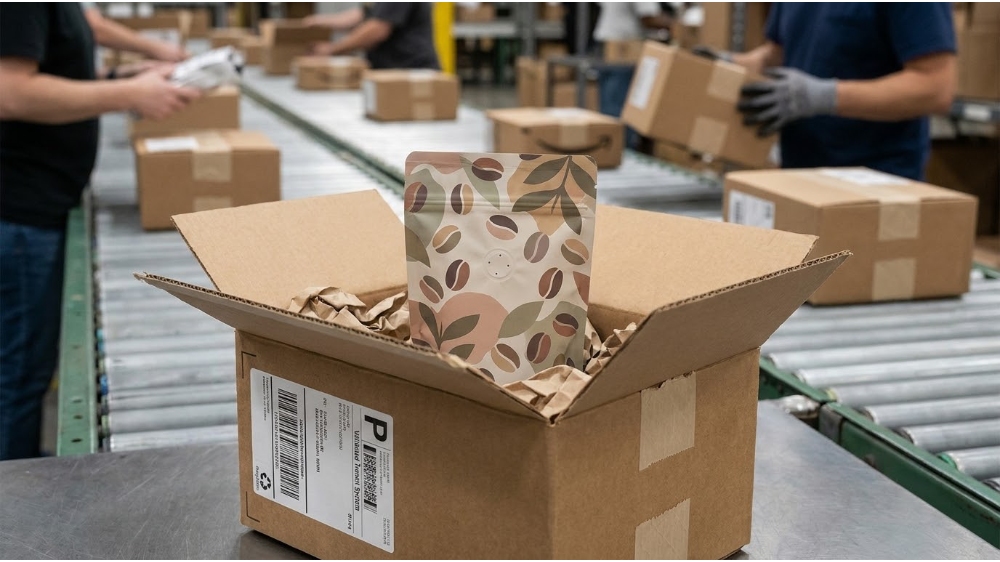
The sustainability conversation in coffee packaging often focuses on the bag film, but in e-commerce the outer pack carries a significant share of the material footprint. A mailer that is fully recyclable but too flimsy to protect the bag generates replacements, and a replacement shipment erases the environmental benefit of the original material choice. The more useful question is whether the complete packaging system, including bag, valve, outer pack, and any void fill, can be validated for the actual delivery route while minimizing unnecessary material and volume.
Recyclable mono-material pouch structures and paper-based outer packs are viable for many e-commerce configurations, provided the barrier and seal performance are validated for the intended shelf life and transit conditions. Some direct-to-consumer roasters have reduced material complexity by eliminating tape and stickers where the box closure allows it, or by using mailers made from post-consumer recycled paper that still meet compression and puncture requirements. The common thread is not a single material claim but a validated system: the sustainable option has to pass the same drop, vibration, and compression tests as the conventional option before it can be trusted in repeat fulfillment.
Need coffee packaging that survives parcel handling and repeat dispatch?
Talk to a packaging specialist about matching bag format, valve specification, outer pack fit, and packing sequence to your subscription volume and delivery route.
Frequently Asked Questions
Do all e-commerce coffee bags need a degassing valve?
No. Valve requirements depend on the coffee type, the time between roast and packing, and the shipping duration. Whole-bean coffee packed within a week of roast almost always needs a valve because active degassing will inflate the bag and stress the seal. Nitrogen-flushed ground coffee packed immediately may not need one, but the decision should be validated against the actual transit conditions rather than assumed from the product category.
Can coffee bags ship in a mailer without a box?
Some configurations can, but the bag alone should not be assumed to survive parcel handling. A padded mailer may provide adequate protection for a single small pouch with a strong seal and a protected valve, but the complete packed unit must be evaluated for compression, puncture, and movement. A mailer that allows the bag to shift and rub against its interior will produce abrasion damage and seal stress over repeated handling cycles.
What is the most common packaging failure in coffee subscriptions?
Seal and valve-area damage caused by movement inside an oversized outer pack. When the filled bag can slide, it transfers impact to the seal edges and the valve bond, which are the two most vulnerable points on the package. The second most common failure is compression damage from an undersized box that forces the bag against corrugated edges before the parcel is even sealed.
How should a roaster test a new coffee packaging system before a subscription launch?
Test the complete shipment configuration, not the bag alone. Pack the actual product, seal it, place it in the intended outer pack, and run a monitored small-batch courier shipment. Inspect the bag, the seals, the valve bond, and the box after transit. Repeat across the common order combinations and at least two dispatch cycles before committing to bulk inventory, because first-shipment performance often overstates how the system will behave under sustained fulfillment pressure.
Post time: Nov-17-2026