
This guide covers three linked problems: how to divide the physical label from the QR code without breaking labeling law, how four common bag structures perform against real disposal infrastructure, and how to match barrier level to the way the coffee is sold.
Coffee Bag Design for Specialty Roasters: Label Priorities, Sustainability Claims, and Freshness Trade-Offs
Specialty Coffee Packaging Guide
Coffee Bag Design for Specialty Roasters: Label Priorities, Sustainability Claims, and Freshness Trade-Offs
A coffee bag has to help a buyer choose the coffee and protect it from oxygen at the same time. The label split is straightforward: print what regulators require and what buyers read at the shelf, then move depth content behind a QR code. Sustainability is harder, because a bag only earns its claim when its barrier matches the distribution channel and its disposal route actually exists.
Roasted coffee is a perishable product disguised as a shelf-stable one. It releases carbon dioxide for days after roasting, absorbs odor, and oxidizes steadily once exposed to air. Every design decision on a coffee bag, from where the roast date sits to whether the pouch is a laminate or a mono-material, is a decision about how long that coffee stays worth drinking.
What must stay printed and what can move to a QR code
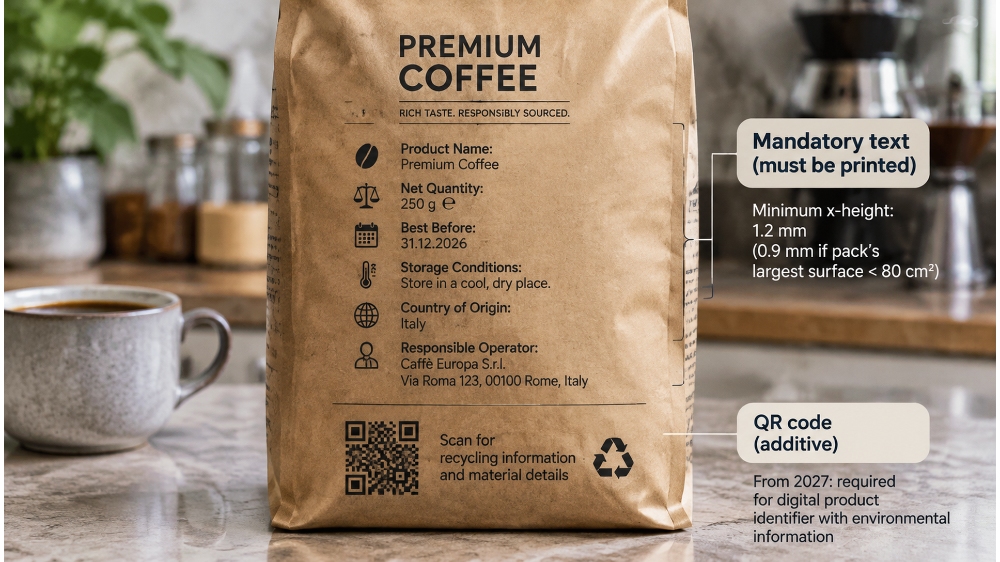
The boundary is set by regulation, not by design preference. Pre-packed coffee sold in the European Union must carry the product name, net quantity, best-before date, storage conditions, country of origin, and the responsible operator’s name and address under the Food Information to Consumers regulation. Mandatory text needs a minimum x-height of 1.2 mm, falling to 0.9 mm only on packs whose largest surface is under 80 cm². Whole bean and ground coffee skip the nutrition panel because they are single-ingredient products, but that exemption does not free the remaining mandatory items to migrate online.
QR codes are additive. From 2027, EU packaging rules will also require a digital identifier on packaging that carries structured environmental information such as material composition and recyclability, so the code is becoming a compliance surface rather than a marketing extra. The working rule for roasters is simple: the coffee bag must be readable and complete without a phone, and the QR code adds depth that would never fit in print.
A practical split for the bag surface
Not every item belongs in the same place. The left column below is either legally required or functional at the moment of choice. The right column is where a scannable code creates genuine value.
| Keep on the bag | Move behind the QR code |
|---|---|
| Roast date | Full farm and producer profile |
| Origin | Extended origin story |
| Processing method | Detailed processing narrative |
| Tasting notes | Full sensory description and cupping score |
| Roast level | Brew recipes and extraction guidance |
| Net weight | Sourcing and traceability documentation |
Roast date and tasting notes are what a specialty buyer scans first, and both are short enough to print cleanly on a front panel. Origin and processing method fit in a line each. A farm profile with altitude, variety, and producer history does not fit on a 340g bag, but it fits comfortably on a landing page that updates with each lot. Assign one page per coffee rather than one page for the whole brand, so a bag scanned two months after purchase still returns the correct lot information.
Placement matters too. Degassing valves sit on the front or back panel and must stay unobstructed, and the bottom gusset flexes in transit, so a code printed there will scuff. A side panel or the upper back panel, clear of the valve, holds print registration better.
Label rules that hold across markets:
- Never move a legally required item to a QR code only
- Keep mandatory text above the minimum x-height for the pack size
- Print roast date and tasting notes where they are read without a phone
- Assign one landing page per coffee lot, not per brand
Four bag structures, four different trade-offs
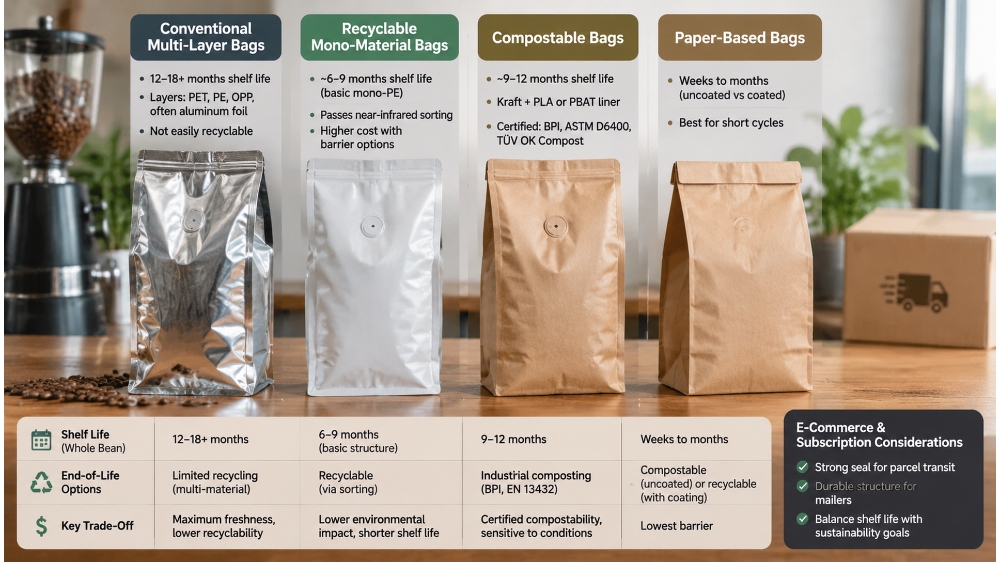
Material names suggest a ranking that does not survive contact with real conditions. What separates these four structures is the distance between the claim on the bag and what happens to it after the coffee is gone.
Conventional multi-layer bags combine PET, PE, OPP, and often aluminum foil into bonded structures that deliver 12 to 18 months or more of whole-bean shelf life. They remain the performance benchmark, but the layers cannot be separated at a materials recovery facility, and flexible multi-material packaging recovery stays in the low single digits as a share of what is placed on market.
Recyclable mono-material bags, usually mono-PE or mono-PP, pass through near-infrared sorting and produce a resin stream recyclers can resell. The cost is barrier. A basic mono-PE pouch without barrier enhancement may hold whole-bean freshness for roughly 6 to 9 months against 12 to 18 or more for an aluminum laminate. Barrier coatings and higher-performance mono structures close part of that gap at a higher unit price.
Compostable bags, typically kraft paper laminated with a PLA or PBAT liner, are certified to disintegrate under industrial composting conditions through BPI and ASTM D6400 in North America or TÜV OK Compost INDUSTRIAL and EN 13432 in Europe. That certification does not mean a backyard bin will break them down. Well-built compostable kraft structures can hold roasted coffee for roughly 9 to 12 months, but the liner is more sensitive to heat, sunlight, and humidity than foil, so warehouse and transit conditions matter more than they do with a laminate.
Paper-based bags sit at the weakest end unless they carry a functional lining or coating. Uncoated kraft is porous, and oxygen ingress shortens usable life to weeks rather than months. Coated paper improves the barrier but still suits short circulation cycles better than long retail distribution.
For a roaster running a subscription or direct-to-consumer program, the bag also has to survive the parcel journey, and the seal strength that protects a bag in a mailer is a different specification from the one that protects it on a retail peg. The requirements specific to coffee packaging for e-commerce and subscription orders are worth separating from retail bag selection before a structure is locked in.
Why the claim depends on infrastructure
A recyclable bag delivers a material property, not an environmental outcome. Most flexible film recycling in North America runs through store drop-off rather than curbside collection, and participation in those programs trails the share of households that have access to them. A mono-material bag that reaches a landfill has still avoided contamination of a recycling stream, but it has not been recycled.
Compostable bags face a sharper version of the same test. The claim is only honest where the customer has an industrial composting stream within reach. Municipal access varies widely, and a technically compostable pouch that ends up in general waste has not diverted anything. Valve and zipper components also sit outside the certification scope on some designs, which means the bag as assembled may not match the certificate on the liner.
The defensible position for a roaster is to state what the bag is and where it should go, then verify that the second part is true for the majority of customers. A mono-material bag with a store drop-off instruction is a supportable claim in a market with wide drop-off coverage. A compostable bag marketed to customers in a city without industrial composting is a claim the disposal system cannot honor.
Matching barrier to the sales channel
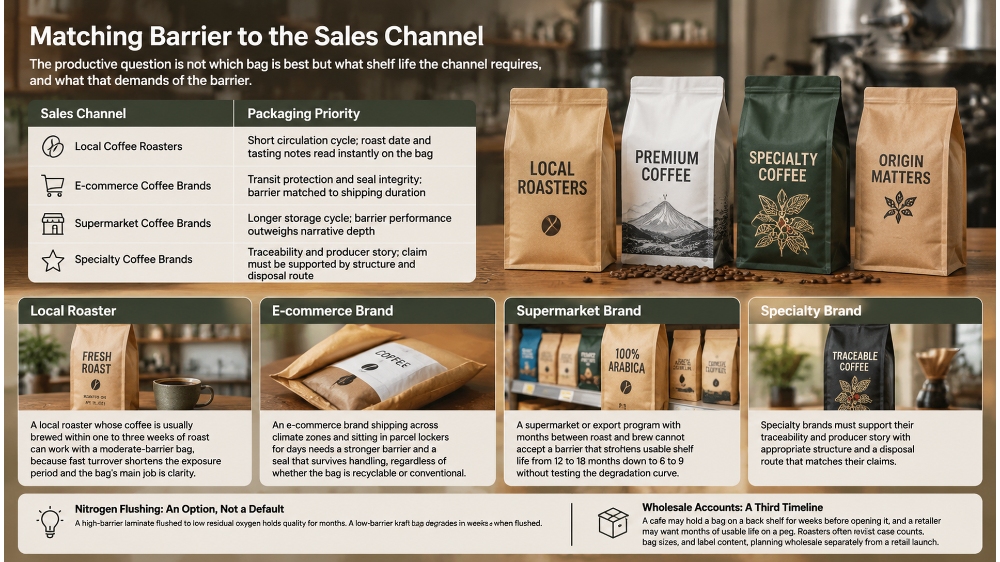
The productive question is not which bag is best but what shelf life the channel requires, and what that demands of the barrier.
| Sales channel | Packaging priority |
|---|---|
| Local coffee roasters | Short circulation cycle; roast date and tasting notes read instantly on the bag |
| E-commerce coffee brands | Transit protection and seal integrity; barrier matched to shipping duration |
| Supermarket coffee brands | Longer storage cycle; barrier performance outweighs narrative depth |
| Specialty coffee brands | Traceability and producer story; claim must be supported by structure and disposal route |
A local roaster whose coffee is usually brewed within one to three weeks of roast can work with a moderate-barrier bag, because fast turnover shortens the exposure period and the bag’s main job is clarity. An e-commerce brand shipping across climate zones and sitting in parcel lockers for days needs a stronger barrier and a seal that survives handling, regardless of whether the bag is recyclable or conventional.
A supermarket or export program with months between roast and brew cannot accept a barrier that shortens usable shelf life from 12 to 18 months down to 6 to 9 without testing the degradation curve for that specific coffee. This is also where nitrogen flushing belongs in the decision, as an option whose value depends on the barrier rather than a default step. A high-barrier laminate flushed to low residual oxygen holds quality for months. A low-barrier kraft bag degrades in weeks even when flushed.
Wholesale accounts add a third timeline that neither retail nor direct-to-consumer covers. A cafe may hold a bag on a back shelf for weeks before opening it, and a retailer may want months of usable life on a peg. Roasters moving into those accounts usually have to revisit case counts, bag sizes, and label content at the same time, which is why coffee packaging for wholesale distribution is planned separately from a retail launch.
How to make the final packaging decision
Work through three checks in order. First, measure the real circulation cycle from roast to brew, not the intended one. If average delivery takes eight days and retail sits for six weeks, design for the longer window. Second, confirm the mandatory label items for every market the coffee ships to, and keep all of them printed at or above the required minimum type size. Third, verify the disposal route. Call the local waste authority or the store drop-off network and confirm the bag’s material is accepted before printing a claim on it.
Then test the actual product. Pack a fresh roast, store it under the conditions the channel imposes, and cup at the end of the intended window. If the coffee fades before the bag’s stated life, the barrier is short for the channel. If it holds well but the disposal claim fails locally, the structure is wrong for that market. Choosing a supplier who can deliver the same bag format across multiple SKUs without changing barrier or artwork specs removes the most common source of quality drift as a roaster grows.
Need coffee bags matched to your label obligations, channel, and shelf-life target?
Talk to a packaging specialist about bag structure, barrier level, and label configuration for your roast schedule and distribution model.
Frequently Asked Questions
Can legally required information go on a QR code instead of the bag?
No. Mandatory food information must appear on the physical pack at or above the minimum type size for that pack format. A QR code can carry supplementary detail such as farm history or brewing guidance, but it cannot replace a required declaration.
Do compostable coffee bags keep coffee as fresh as conventional bags?
Usually not for as long. A well-built compostable kraft and PLA structure can hold roasted coffee for roughly 9 to 12 months, against 12 to 18 or more for an aluminum laminate. Compostable liners are also more sensitive to heat and humidity during storage.
Are recyclable coffee bags actually recycled in practice?
It depends on local collection. Most flexible film recycling runs through store drop-off rather than curbside bins, and participation is well below the share of households with access. A mono-material bag improves sortability but still needs a route the customer will use.
Where should a QR code sit on a gusseted coffee bag?
Use the side panel or upper back panel, clear of the degassing valve and away from the bottom gusset. Those areas flex least during filling and transit, so the printed code stays readable.
Post time: Nov-27-2026