Are Paper Bowls Safe for Food? What Buyers Should Know About Coatings, Materials & Food Contact Safety
Are Paper Bowls Safe? A Buyer’s Coating & Compliance Guide
B2B Packaging Compliance Guide
Are Paper Bowls Safe for Food? What Buyers Should Know About Coatings, Materials & Food Contact Safety
“Is it toxic?” is the wrong question to ask about a paper bowl. The right questions are about the paperboard grade, the coating chemistry, the inks, the adhesives, and whether every one of those components has documentation to back it up. Here’s how procurement teams and foodservice brands should actually evaluate paper bowl safety.
Somewhere between a viral video about “microplastics in takeout containers” and a procurement spreadsheet full of coating codes, most buyers lose the thread on what actually makes a paper bowl safe. Consumer-facing content tends to collapse the question into a single word—toxic or not toxic—which is a poor tool for sourcing decisions that involve real suppliers, real specifications, and real regulatory exposure.
For a B2B buyer specifying paper bowls for a restaurant chain, a delivery brand, or a retail food program, the safety question is really eight smaller questions: what is the paperboard, what is the coating, what are the inks and adhesives, does the finished bowl migrate anything into food, at what temperature and hold time does that change, is it compliant in the markets you sell into, and can your supplier prove any of it in writing. This guide walks through each one.
“Toxic” Is the Wrong Question: How to Actually Evaluate a Paper Bowl
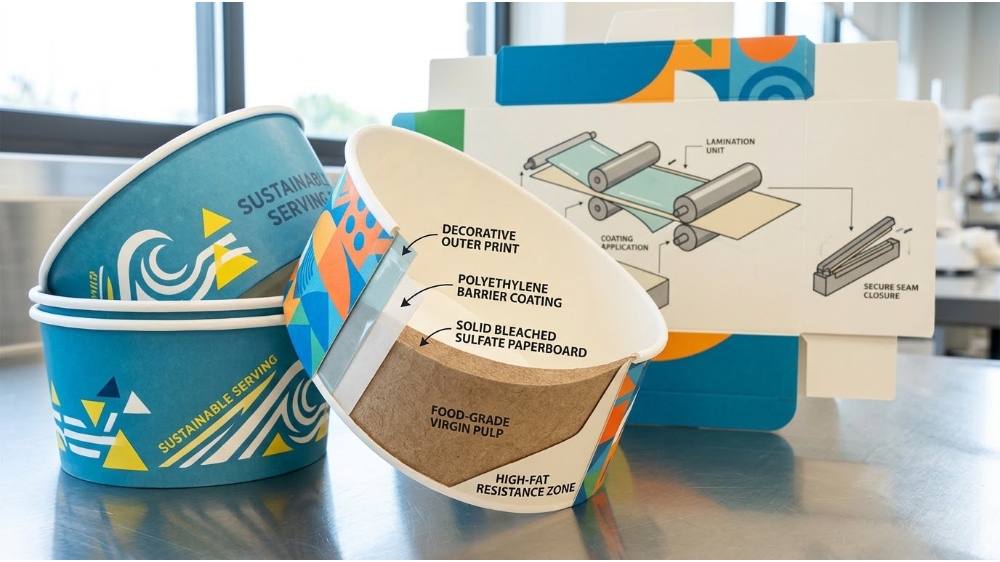
A paper bowl is not a single material—it’s an assembly. Raw paperboard on its own is not waterproof, not grease-resistant, and not remotely suitable for hot soup or oily noodles. What makes a bowl functional is a barrier layer bonded or coated onto that paperboard, plus printing inks on the outer surface and adhesive at the side seam and base. Each of those four components—paperboard, coating, ink, adhesive—has its own chemistry, its own regulatory pathway, and its own migration behavior when it touches food.
Asking “are paper bowls safe” as a yes-or-no question treats the bowl as one substance. It isn’t. A PE-coated bowl made from virgin food-grade paperboard with certified food-contact inks is a different risk profile than an uncoated recycled-fiber bowl with mineral-oil-based printing on the inside surface. Both are “paper bowls.” Only one of them would pass a basic migration and compliance review. This is why sourcing teams get more useful answers by asking about coatings, migration, temperature limits, and documentation than by asking whether paper packaging in general is dangerous.
The practical shift for buyers is to stop treating “food-grade” as a label and start treating it as a specification with components that each need verification—the same way a buyer would not accept “food-safe” as a complete answer for a stainless-steel fitting without knowing the alloy and the weld process behind it.
What a Paper Bowl Is Actually Made Of: Paperboard, Coatings & Linings
The base material in almost every disposable paper bowl is either bleached virgin paperboard (often called SBS, solid bleached sulfate, or FBB, folding box board) or a recycled-fiber board. Virgin paperboard starts as wood pulp with no prior use history, which makes contamination tracing simpler. Recycled board is more sustainable in terms of fiber sourcing, but it carries a higher chance of trace contaminants from its previous life as printed paper, packaging, or newsprint—a distinction that matters more than most buyers realize, and one covered in more detail further down.
On its own, paperboard is porous and absorbs liquid almost immediately. To hold soup, sauce, or anything with moisture and fat, the food-contact surface needs a barrier coating or lining. This is the layer that actually touches the food, and it is the layer that determines most of a bowl’s real-world safety profile: whether it resists grease, whether it holds up to heat, whether it’s compostable, and whether it introduces any migration risk of its own.
Three coating families dominate the current market: polyethylene (PE) extrusion coating, polylactic acid (PLA) bio-based coating, and aqueous or water-based dispersion coatings. A smaller category of “plastic-free” fiber-only bowls relies on the paperboard’s own density and fiber treatment for short-hold, low-moisture use. Each coating type changes the bowl’s compliance profile, its heat tolerance, and its end-of-life behavior—which is exactly why “what’s the coating” should be one of the first three questions in any paper bowl RFQ.
PE, PLA, and Aqueous Coatings Compared for Food Contact Safety
Polyethylene (PE) coating
PE-coated paperboard has been the foodservice default for decades because it delivers reliable grease and moisture resistance at a lower cost than bio-based alternatives. Food-grade PE used as a coating substance is reviewed under indirect food additive regulations in the destination market, and when it’s sourced and applied correctly, it behaves as an inert barrier with a well-documented compliance history. Its weakness is heat: PE begins to soften well below boiling temperatures, which limits it to conventional hot-hold use rather than microwave reheating, and it is not compostable in standard municipal composting streams.
PLA (polylactic acid) coating
PLA is a bio-based, compostable polymer typically derived from corn starch. It offers a genuine end-of-life advantage for brands targeting compostability certifications, and it performs well for cold and moderately warm food. Its trade-off is a lower heat threshold than PE, which means a PLA-lined bowl is a poor match for very hot soups, hot pot, or extended hot-hold service unless the supplier has validated the specific temperature range with test data. PLA also requires industrial composting infrastructure to break down as intended—it will not compost meaningfully in a landfill or a home bin.
Aqueous or water-based dispersion coating
Aqueous coatings are a newer barrier technology applied as a water-based dispersion rather than an extruded plastic film. They offer moderate grease and moisture resistance, are generally repulpable and recyclable in standard paper recycling streams, and avoid the compostability infrastructure requirement that PLA carries. Performance varies more by formulation than PE or PLA do, so migration and heat-resistance data should be requested per supplier rather than assumed from the category name.
Uncoated or fiber-only bowls
Some short-hold, low-moisture applications use uncoated or lightly treated paperboard without a full barrier layer. These are the simplest chemically, with the fewest added substances to evaluate—but they are also the least functional for wet, hot, or oily food and are typically limited to dry snacks or very brief service windows. Click to explore sugarcane pulp bowl
Coating type
Grease & moisture resistance
Heat tolerance
End of life
Best B2B use case
PE (polyethylene)
Excellent
Moderate—softens near boiling
Not compostable, limited recyclability
Standard hot & cold foodservice bowls
PLA (bio-based)
Good
Lower than PE
Industrially compostable
Cold food, salads, eco-positioned brands
Aqueous dispersion
Moderate to good
Varies by formulation
Repulpable / recyclable
Recycling-focused, moderate-moisture menus
Uncoated fiber
Poor
N/A
Compostable / recyclable
Dry snacks, very short holds
Inks, Adhesives & Recycled Fiber: The Migration Risks Buyers Overlook
Coating gets most of the attention, but two quieter components deserve equal scrutiny: printing inks and seam adhesives. Inks used on the outer surface of a bowl are not automatically food-safe formulations—set-off migration, where ink components transfer from the printed outer surface through the paperboard to the inner food-contact surface during stacking and storage, is a documented pathway even when the ink never directly touches food. Buyers sourcing custom-printed bowls should confirm the ink system is formulated and tested for indirect food contact, not simply approved for general packaging print.
Adhesives used at the side seam and base of a bowl are a similarly overlooked component. They are a small percentage of the total material by weight but sit directly at a seam that can be in contact with liquid food. Adhesive formulations have historically been one of the places grease-resistance chemicals—including PFAS compounds—were introduced without being reflected anywhere in a “paperboard” spec sheet, which is one reason supplier declarations need to cover the full assembly, not just the base paperboard.
Recycled fiber introduces a third, more structural risk: mineral oil hydrocarbons, commonly abbreviated MOSH and MOAH, which originate primarily from mineral-oil-based printing inks in the recycled paper stream feeding the pulping process. Because these hydrocarbons migrate through paperboard largely via the gas phase rather than direct contact, they can reach food even through a coated surface, and dry or fatty foods stored for extended periods are the most susceptible. This is a genuine, well-studied packaging risk, and it is specifically tied to recycled-content board rather than virgin fiber—another reason “recycled” and “food-grade” are not automatically the same claim, and why a functional barrier layer matters even more when recycled board is part of the specification.
What “Food-Grade” and “Food-Contact Compliant” Actually Mean
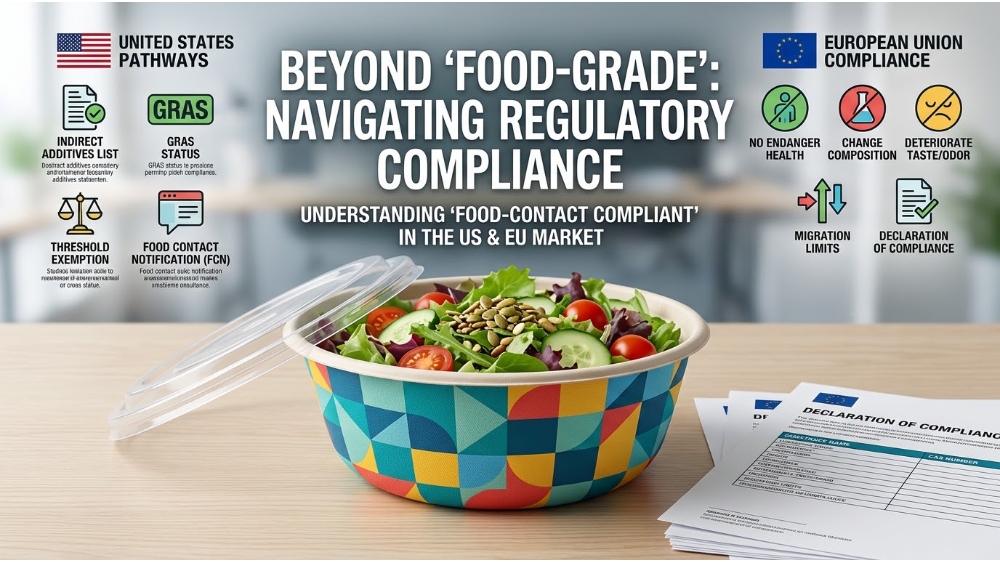
“Food-grade” is marketing shorthand, not a regulatory term with one fixed legal definition. What regulators actually assess is whether each individual substance in a food-contact article—the paperboard component, the coating polymer, the ink resin, the adhesive—has cleared an approved pathway for that specific use. In the United States, that generally means a substance is listed as an approved indirect food additive, recognized as Generally Recognized as Safe (GRAS) for the intended use, covered by a Threshold of Regulation exemption, or the subject of an effective Food Contact Notification held by the specific supplier using it. An approval tied to one manufacturer’s notification does not automatically transfer to a different supplier using a similar-sounding substance.
In the European Union, the foundational framework requires that food-contact materials not transfer their components to food in quantities that endanger health, change food composition unacceptably, or deteriorate its taste and odor—with specific migration limits set for individual substances where relevant, and stricter documentation obligations placed on the party bringing the packaging to market. The practical difference for buyers is this: US compliance is largely substance-by-substance listing and notification, while EU compliance leans more heavily on demonstrated overall and specific migration limits plus a formal declaration of compliance.
For a B2B buyer, the useful translation is simple: “food-grade” should never be accepted as a standalone claim. The useful question is “which regulatory pathway covers each component of this bowl, in the market where I’m selling it,” and the useful proof is a document that names the actual substances—not a generic assurance on a product listing page.
Heat, Grease & Time: When a Paper Bowl Stops Being Safe
Migration is not a fixed property of a material—it’s a function of temperature, fat content, and contact time working together. A coating that performs safely for a 15-minute cold salad service can behave very differently under a 30-minute hot, oily broth. This is precisely why food-contact migration testing uses standardized food simulants—typically water for aqueous foods, a dilute acetic acid solution for acidic foods, ethanol for alcoholic or fatty-leaning foods, and an oil-based simulant for high-fat foods—tested at temperatures and durations that represent realistic worst-case use.
PE-coated bowls are generally rated for standard hot-hold service but are not designed for microwave reheating or prolonged contact with food near or above boiling temperature, since the coating can soften and its barrier performance can degrade. PLA-coated bowls sit lower on the heat tolerance scale than PE and are better matched to cold and warm—rather than very hot—applications unless a supplier has specific data supporting a higher-heat use case. Grease compounds this: high-fat foods are more effective at extracting coating and ink components than water-based foods, which is why a bowl validated for soup is not automatically validated for a high-oil noodle dish at the same temperature.
Practical temperature guidelines for paper bowl sourcing:
Cold & ambient food, short hold: Most coating types, including PLA and aqueous, perform reliably
Standard hot-hold service (soups, rice, noodles): PE-coated or validated aqueous-coated board is the safer default
Near-boiling or extended hot-hold, high-fat menus: Request supplier migration data at your actual temperature and hold time—do not assume a standard bowl qualifies
Microwave reheating in-container: Confirm explicitly with the supplier; most standard paper bowl coatings are not rated for this use
PFAS in Paper Bowls: Where the 2026 Regulatory Shift Leaves Buyers
Per- and polyfluoroalkyl substances, commonly called PFAS, were widely used across the foodservice packaging industry for decades because they delivered excellent grease and water resistance in paper-based bowls, boxes, and wraps at a low cost. That history is now the single biggest compliance shift facing paper bowl buyers. In the European Union, Regulation (EU) 2025/40—the Packaging and Packaging Waste Regulation—sets concentration-based PFAS limits for food-contact packaging placed on the EU market, with a compliance deadline of August 12, 2026. Bowls, cups, trays, and takeaway cartons are explicitly within scope, and the regulation applies to inventory placed on the market on or after that date regardless of when it was manufactured—there is no allowance for selling down existing non-compliant stock.
In the United States, there is no single federal ban on PFAS in food packaging; regulatory action has instead moved forward state by state, alongside FDA’s confirmation that PFAS-based grease-proofing substances are no longer being sold into the paper food packaging market by the manufacturers that previously supplied them. For a buyer selling across multiple states or exporting internationally, this patchwork means the safer sourcing posture is to treat PFAS-free as a baseline requirement everywhere, not a market-specific one—because a supply chain built around one region’s rules can fail compliance the moment a shipment crosses into a stricter one.
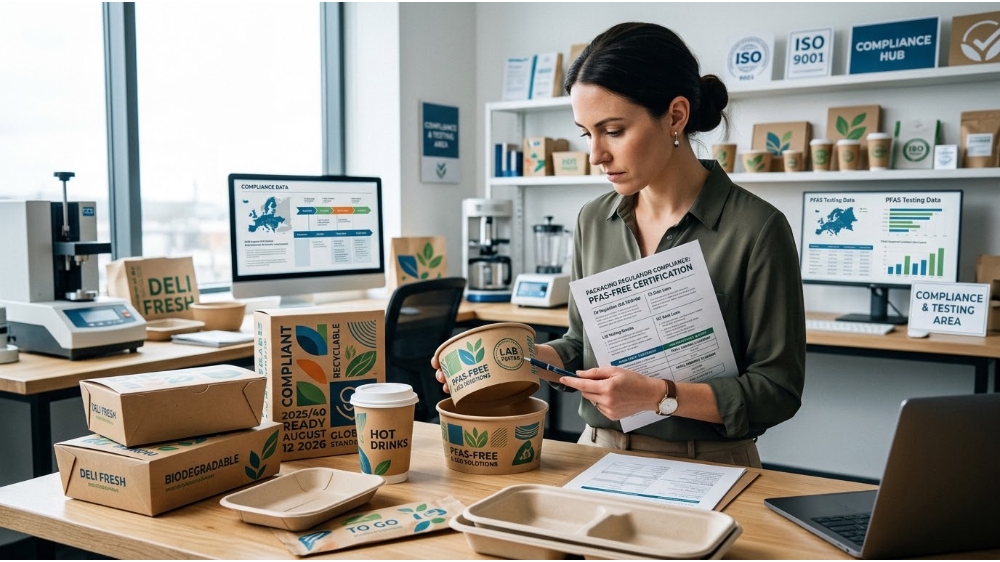
The practical risk for buyers is that PFAS can be present without appearing anywhere on a basic material spec, since it is most commonly introduced through a barrier coating, a sizing agent in the paper itself, or the adhesive—not the paperboard buyers usually ask about first. A credible PFAS-free claim should be backed by third-party total organic fluorine testing, not a verbal assurance, since contamination can enter unintentionally through recycled fiber or shared production lines even when a supplier has no intention of adding it.
Supplier Documentation Every B2B Buyer Should Request
The single highest-leverage habit for a paper bowl buyer is treating documentation as part of the specification, not an afterthought requested only when a customer or auditor asks. A supplier confident in their compliance position should produce these documents without resistance or delay.
Documentation checklist before placing a bulk paper bowl order:
Declaration of Compliance or Letter of Guaranty naming the actual regulatory pathway for the paperboard, coating, ink, and adhesive
Third-party migration test report specifying which food simulants and temperature/time conditions were used
Total organic fluorine or PFAS-free test report, especially for any grease-resistant or oil-resistant bowl
Heavy metals and overall migration test results for the finished, printed, coated bowl—not just the raw paperboard
Compostability certification (such as BPI or OK Compost) if the bowl is marketed as compostable
Facility certification—BRC, ISO 22000, FSSC 22000, or equivalent—covering the actual production site
A buyer who requests these documents before the first purchase order, rather than after a customer complaint, shifts the compliance conversation from reactive to structural. It also gives procurement teams something concrete to compare across competing quotes—two bowls that look identical on a product photo can carry very different documentation depth behind them.
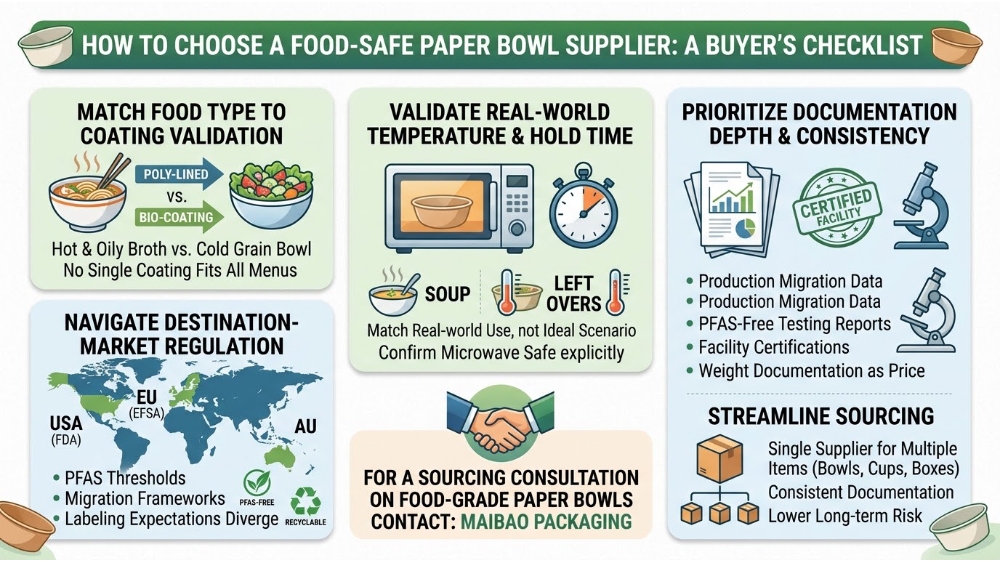
How to Choose a Food-Safe Paper Bowl Supplier: A Buyer’s Checklist
Selecting a paper bowl supplier comes down to matching four variables to your actual menu and market: food type, temperature and hold time, destination-market regulation, and documentation depth. Start with the food itself—a hot, oily broth demands a different coating validation than a cold grain bowl, and no single coating type is the universally correct answer across every menu.
Next, match the coating to your real hold time and reheating behavior, not your ideal one. If customers routinely microwave leftovers in the container, that needs to be confirmed with the supplier explicitly rather than assumed from a “microwave-safe” claim on a listing page. Then map your destination markets: a brand selling only in one country has a simpler compliance path than one selling across the EU and the US simultaneously, where PFAS thresholds, migration frameworks, and labeling expectations diverge.
Finally, weight documentation depth as heavily as price and lead time in supplier evaluation. A slightly higher unit cost from a supplier who can produce migration data, PFAS-free testing, and facility certification on request is frequently the lower total-cost option once compliance risk, potential recalls, and customer-facing scrutiny are factored in. For sourcing teams evaluating paper bowls, boxes, cups, and related foodservice packaging at scale, working with a single supplier who can provide consistent documentation across the full product range—rather than assembling packaging from multiple undocumented sources—removes one of the most common points of failure in food-contact compliance programs. For a sourcing consultation on food-grade paper bowls matched to your menu, hold times, and target markets, contact Maibao Packaging.
Need paper bowls that are actually documented as food-safe?
Talk to a packaging specialist about matching paperboard, coating, and compliance documentation to your menu, your hold times, and the markets you sell into.
A properly coated paper bowl—typically PE-coated or a validated aqueous coating—is designed for standard hot-hold service. Safety at higher temperatures or extended hold times depends on the specific coating and should be confirmed with supplier migration data rather than assumed.
Is a PLA-coated paper bowl safer than a PE-coated one?
Neither is inherently “safer”—they have different profiles. PLA offers compostability and performs well for cold and warm food, while PE offers stronger heat and grease resistance for standard hot-hold service. The right choice depends on the menu and end-of-life goals, not a general safety ranking.
Do all paper bowls contain PFAS?
No, but PFAS has historically been common in grease-resistant paper foodware, often introduced through coatings, sizing agents, or adhesives rather than the visible paperboard. Buyers should request third-party total organic fluorine testing rather than assume a bowl is PFAS-free based on labeling alone.
What documents should I ask a paper bowl supplier for?
At minimum, a Declaration of Compliance covering paperboard, coating, ink, and adhesive; a migration test report specifying simulants and conditions; a PFAS/total organic fluorine test report; and facility certification such as BRC or ISO 22000. Request these before, not after, placing a bulk order.
Post time:
Sep-16-2026
For inquiries about our products or pricelist, please leave your email to us and we will be in touch within 24 hours.