Can Paper Bowls Hold Soup? What Buyers Should Know About Heat, Leaks & Coatings
Paper Bowls for Soup: GSM, Coatings & Leak-Proof Buying Guide
Foodservice Packaging Guide
Can Paper Bowls Hold Soup? What Buyers Should Know About Heat, Leaks & Coatings
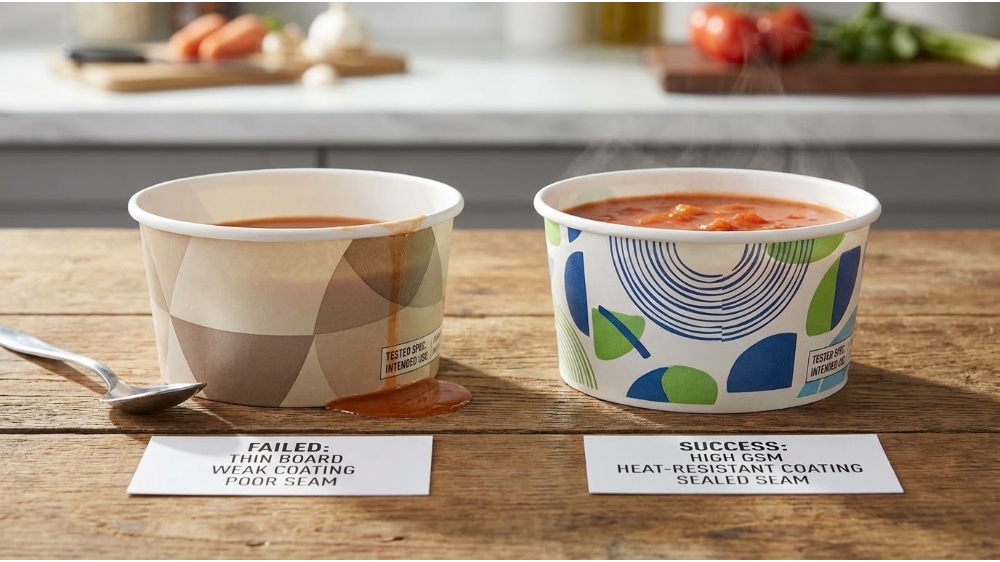
A paper bowl and a bowl of hot broth make an unforgiving pair. One bowl holds a full 12 oz of soup for two hours without a drop escaping. Another one softens, wicks, and drips within ten minutes. The difference is never luck—it comes down to five measurable specs: paperboard weight, coating type, seam construction, and how the soup’s acidity and fat content interact with all three.
Yes, paper bowls can hold soup—but only when the paperboard, the coating, and the seams are matched to the soup itself. A generic 8 oz cold-drink cup and a purpose-built soup bowl look similar on a shelf, yet one is engineered for a splash of iced tea and the other for two hours of 90°C broth. Buyers who treat “paper bowl” as a single product category are the ones who end up with warehouse complaints about soggy bottoms and leaking side seams.
This guide breaks down the structural and chemical factors that separate a leak-proof soup bowl from one that fails mid-delivery, and gives a practical framework for specifying bowls before a bulk order. For buyers sourcing beyond soup bowls, explore the full range of food packaging available through a single supplier.
Why One Bowl Holds Soup While Another Leaks
A paper bowl fails for one of three reasons: the paperboard itself is too thin to stay rigid once wet, the interior coating is too thin or the wrong polymer for the temperature, or the seam where two pieces of board meet was never fully sealed. Soup is the hardest food-service liquid to package because it combines heat, water content above 85%, dissolved fat, and often acidity from tomatoes, vinegar, or citrus—four stress factors that a fry box or a salad bowl never has to survive at once.
Structural strength, liquid penetration resistance, and seam integrity are not three separate specs—they interact. A bowl can have a heavy-gauge board and a thick coating and still leak if the bottom seam was heat-sealed at the wrong temperature. Getting the combination right is what separates a soup bowl supplier from a generic paper bowl manufacturer.
It also explains why two bowls that look identical on a store shelf can perform very differently once filled. Buyers evaluating suppliers should ask for the specific GSM, coating type, coating thickness, and seam process behind a quoted bowl—not just a general “leak-proof” or “hot food safe” label, which describes an intended use rather than a tested spec.
GSM and Paperboard Thickness: The Structural Base
GSM (grams per square meter) measures how much paperboard fiber is packed into the bowl wall, and it is the first variable to specify because coatings cannot compensate for board that is too thin. Paperboard bowls in the 250 to 350 GSM range hold their shape and resist sogginess under the combined weight and heat of a filled soup portion, while boards below that range tend to soften and lose rigidity once the coating is stressed by prolonged heat contact.
Thickness matters for a second reason beyond rigidity: a thicker board slows heat transfer to the fingers holding the bowl and keeps the contents warmer for longer, which is why double-wall and heavier single-wall constructions are common in soup-specific product lines rather than general-purpose bowls. Buyers filling bowls to the rim with near-boiling broth should specify the higher end of that GSM range; buyers packaging smaller portions or chilled soups have more flexibility to use a lighter board and reduce material cost.
GSM alone does not guarantee leak resistance. A heavy board with a weak coating still fails, and a lighter board with a well-matched double-side coating can outperform it on liquid holdout. GSM should be specified alongside coating type and seam construction, not as a stand-alone strength metric.
Wall construction is a related decision. A single-wall bowl at the upper end of the GSM range is usually sufficient for standard delivery and dine-in soup service. Double-wall or ripple-wall construction adds an air gap between two layers of board, which improves insulation and grip comfort but adds cost and box-weight—worth specifying for premium or long-hold catering lines, less necessary for everyday counter service where the bowl is consumed quickly.
PE vs. PLA Coatings: What Actually Blocks Liquid
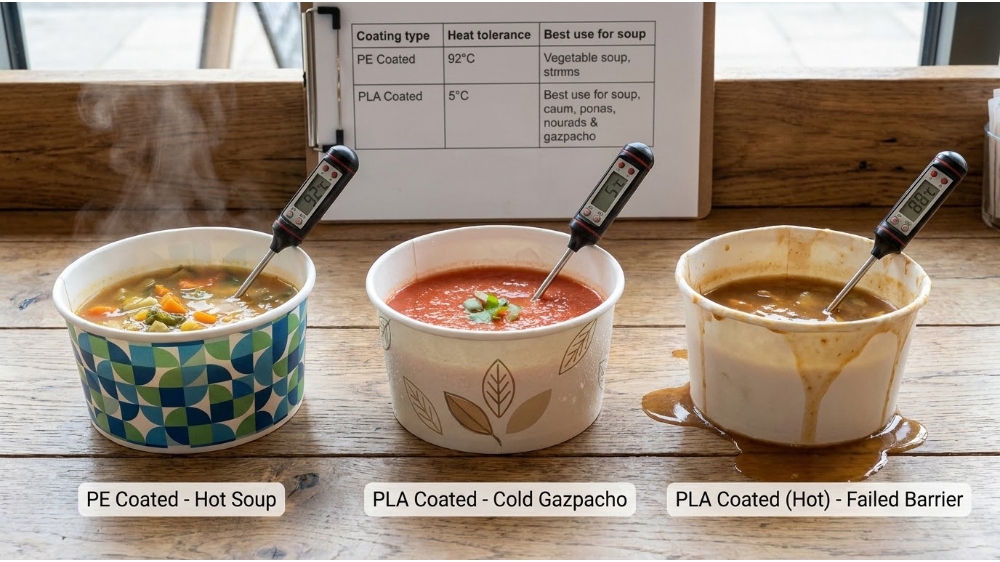
The interior coating, not the paperboard, is what actually stops soup from soaking through the fiber. Two coatings dominate the market: polyethylene (PE) and polylactic acid (PLA), and they behave very differently once hot liquid is involved.
Polyethylene (PE) coatings
PE is a petroleum-based film that bonds to the paperboard and creates a continuous moisture and grease barrier. It performs consistently across a wide temperature range and is the default choice for bowls that will hold soup at or near boiling point for an extended service window. Most paper bowl and cup stock uses a PE layer in the 10 to 20 GSM thickness range, with soup and liquid-holding applications typically specified toward the higher end of that band to guarantee a continuous, pinhole-free film.
Polylactic acid (PLA) coatings
PLA is a plant-derived, compostable film often marketed as the eco-friendly alternative to PE. It performs well for cold and moderately warm applications, but PLA coatings begin to soften and lose barrier integrity at roughly 85°C, a temperature that many soups exceed at the point of service. A PLA-coated bowl that tests fine in a lab at room temperature can still fail on a delivery route carrying freshly ladled broth.
Coating thickness and application
Coating weight is measured separately from paperboard GSM, usually in microns. Manufacturers commonly target a 20 to 30 micron coating layer as the point where liquid holdout is reliable without adding unnecessary plastic content. Soup and other liquid-holding formats generally need a double-side coated board, since both the interior (liquid contact) and exterior (condensation and handling moisture) surfaces are exposed to moisture during a normal service window.
Coating type
Heat tolerance
Liquid & grease resistance
Best use for soup
Single-side PE
Good to ~95°C
Good—interior only
Short-hold, dine-in soup service
Double-side PE
Good to ~95°C
Excellent—both faces
Delivery and extended hold soup
PLA (single or double)
Softens near 85°C
Good below softening point
Cold soup, gazpacho, compostable lines
Wax coating (legacy)
Poor at high heat
Moderate
Cold or lukewarm short holds only
Uncoated kraft board
Not suitable
Poor—absorbs directly
Dry snacks only, not liquids
Side Seams and Bottom Seams: Where Bowls Really Fail
Most soup bowl leaks do not happen through the flat paperboard wall—they happen at the seams, where two or three layers of board and coating overlap and are fused with heat. Manufacturing records on cup and bowl construction describe this junction as the weakest point in the whole container, because the side seam, the bottom blank, and the rolled edge all converge in a single small area that heat must penetrate evenly to seal.
Two seam types matter for a soup bowl. The side seam runs vertically where the wall panel overlaps itself, and the bottom seam is where the wall meets the base. A cut edge of paperboard that is not fully protected by coating along either seam becomes a wicking path: moisture enters the exposed fiber and travels along it even when the rest of the bowl surface is fully sealed. This is why a bowl can look intact from the outside while soup slowly seeps through a hairline gap at the base.
Seam quality depends on heat-seal temperature, pressure, and dwell time during forming, and it is difficult for a buyer to judge from a finished sample alone. A supplier producing soup containers that require larger heat-sealing areas needs tighter process control than one making dry-food packaging, because an underpowered PE layer at the seam directly causes bottom leakage under sustained liquid contact.
Signs a paper bowl will not hold soup reliably:
Visible cut-edge fiber along the rim or bottom seam with no coating overlap
Board that feels flexible or spongy before any liquid contact
A matte or uneven interior sheen, suggesting an inconsistent coating layer
No stated GSM, coating type, or coating thickness on the spec sheet
Acidity, Fat, and Holding Time: The Overlooked Variables
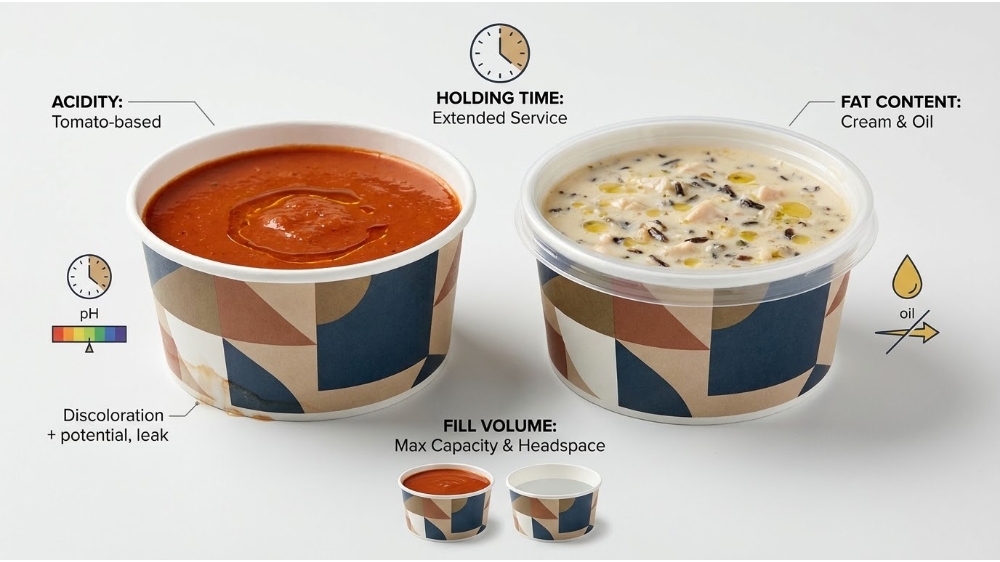
Two soups with identical temperature and fill volume can perform very differently in the same bowl, because acidity and fat content change how aggressively the liquid attacks the coating. Buyers who only check “hot liquid resistant” on a spec sheet often miss this.
Acidity: Tomato-based soups, soups finished with vinegar or citrus, and broths with a low pH stress a coating differently than a neutral cream soup. Acidic liquids are more likely to find and exploit microscopic weaknesses in a coating layer over time, which is why a bowl rated for a two-hour hold with chicken broth may not perform identically with a highly acidic tomato bisque held for the same duration.
Fat and oil content: Soups with a cream, butter, or oil base introduce a second penetration risk. Oils move through packaging materials more aggressively than water, especially once the liquid is hot, which means a coating optimized purely for water resistance can still allow grease strike-through around the rim or seam over an extended hold. A double-side PE coating, sized correctly for both moisture and grease, addresses this more reliably than a thinner single-side layer chosen only to pass a basic water test.
Holding time: Every coating and seam combination has a realistic service window, not an indefinite one. A bowl built for a 20-minute counter-to-table service does not automatically perform the same at hour two of a catering event. Buyers should match bowl specification to their actual holding time, not their shortest-case scenario, because acidity and fat both compound the risk the longer soup sits in the container.
Fill volume and headspace: A bowl filled to the rim exposes more coated surface area to constant liquid pressure than one filled to 80% capacity with headspace left under the lid. Overfilling also increases the chance of soup contacting the rim curl during transport, a point where the rolled edge can be more vulnerable than the flat wall. Leaving modest headspace is a low-cost way to reduce leak risk without changing the bowl specification at all.
Food-Contact Compliance and PFAS-Free Liners
Regulatory pressure on fluorinated grease-resistance chemicals has pushed the market toward PFAS-free paper bowls, and this shift affects sourcing decisions as much as it affects sustainability positioning. A regional food-service packaging guide notes that reliable PFAS-free alternatives now include PE-coated board, PLA-lined compostable bowls, and mechanically compressed grease-resistant fiber, each with different heat and hold-time trade-offs described earlier in this guide.
PFAS-free does not mean lower performance by default. A well-specified double-side PE coating blocks liquid and grease without fluorinated chemistry, and it remains the more temperature-stable choice for hot soup compared with PLA. Buyers should ask suppliers for documentation confirming food-grade compliance for the specific coating and paperboard combination used, not just a general “food safe” claim on packaging.
How to Choose and Test a Paper Soup Bowl Before You Order
Specifying a soup bowl comes down to four inputs: fill temperature, hold time, soup type, and delivery volume. Start with the longest realistic hold time in your operation, not the average—if soup can sit for 90 minutes on a buffet line or in a delivery bag, specify for 90 minutes.
Match paperboard GSM to that hold time and portion size, choose double-side PE coating for anything acidic, fatty, or held above 85°C, and confirm with your supplier that the bottom and side seams are heat-sealed to a documented process standard rather than assumed to be adequate. If your brand requires compostable packaging, PLA-lined bowls remain workable, but they should be reserved for soups served below the coating’s softening point or consumed shortly after filling.
Before committing to a bulk order, request production samples and run your own hold-time test: fill the bowl with your actual soup at actual serving temperature, seal it the way it ships, and check the bottom and rim at 30, 60, and 90 minutes. Set the filled bowl on a plain paper towel or napkin during the test—any wicking at the seam or base shows up as a visible damp ring long before a leak is obvious to the eye. A bowl that stays dry and rigid at your longest realistic hold time is the right specification; one that softens or shows moisture at the seam before that point needs a heavier board, a different coating, or a different seam process.
It is worth running this test with more than one soup type if your menu includes both a neutral broth and something acidic or fat-heavy, since a bowl can pass with chicken broth and still underperform with a tomato bisque held for the same duration. For sourcing support matching paperboard, coating, and seam specifications to a specific soup menu, contact Maibao Packaging for a one-stop review of bowl options and production capabilities.
Need a paper soup bowl that won’t leak mid-delivery?
Talk to a packaging specialist about matching GSM, coating type, and seam construction to your soup menu, fill temperature, and hold times.
Most reliable soup bowls use paperboard in the 250 to 350 GSM range, which holds its shape under heat and moisture without becoming soft. Lighter GSM can work for short-hold, smaller portions, but heavier board is safer for extended service or near-boiling fills.
Can PLA-coated paper bowls hold hot soup?
PLA coatings begin to soften around 85°C, so they are better suited to cold or moderately warm soups than near-boiling broth. For hot soup with a longer hold time, a PE-coated bowl is generally the more reliable choice.
Why do paper bowls leak at the bottom instead of the sides?
The bottom seam is where the wall panel, the base blank, and the coating layers converge, making it the hardest point to seal evenly. An underpowered coating layer or inconsistent heat-sealing at this junction is the most common cause of bottom leakage.
Are PFAS-free paper bowls as leak-resistant as PFAS-coated ones?
A correctly specified double-side PE or PLA coating can match the liquid and grease resistance of older fluorinated coatings for most soup applications. Performance depends on coating thickness and seam quality, not on whether PFAS chemistry is present.
Post time:
Sep-21-2026
For inquiries about our products or pricelist, please leave your email to us and we will be in touch within 24 hours.