Why Do Takeout Burgers Get Soggy? How the Right Burger Packaging Keeps Food Fresh
Why Takeout Burgers Get Soggy & Burger Packaging That Works
Foodservice Packaging Guide
Why Do Takeout Burgers Get Soggy? How the Right Burger Packaging Keeps Food Fresh
A burger leaves the kitchen crisp and hot. Twenty minutes later, the bun is a damp sponge and the customer blames the packaging. Here’s why sogginess happens—and how the right burger box, wrap, and venting strategy stops it before the first bite.
A burger is one of the hardest foods to package for takeout. It’s hot, it’s stacked, it releases steam continuously for the first five to eight minutes after it leaves the grill—and its bun is a starch sponge engineered to absorb moisture. Most sogginess complaints aren’t about the burger. They’re about the packaging decision made before the burger ever hit the box.
This guide explains the moisture physics behind a soggy bun, breaks down the four packaging formats that dominate burger takeout, and shows how venting, material choice, and box structure each play a distinct role in keeping a burger crisp from the pass to the customer’s hands. For related guides on cup lids, carriers, and full takeout packaging systems, explore the packaging solutions library at Maibao Packaging.
Why Burger Buns Turn Soggy: The Science of Steam and Starch
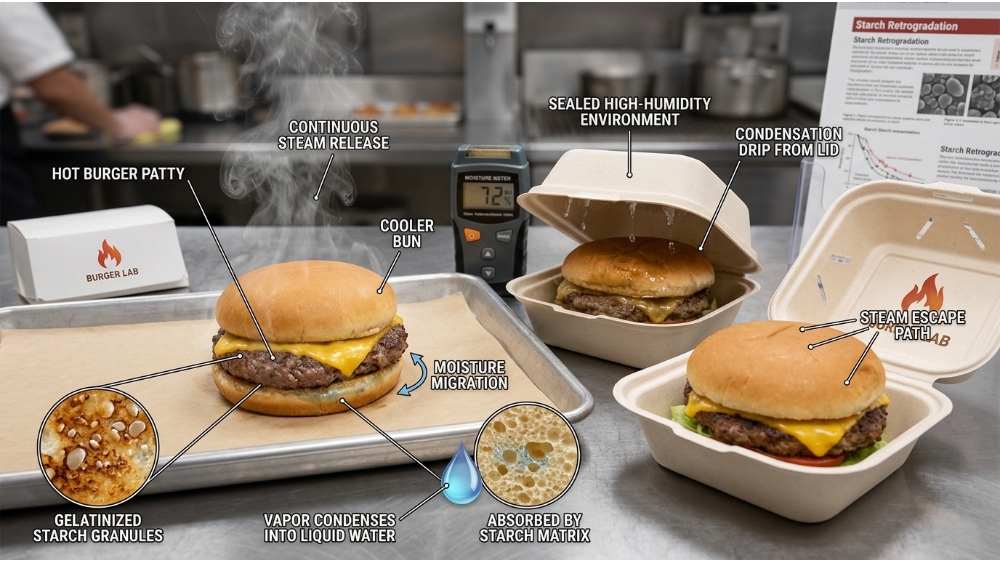
A hot burger patty releases water vapor continuously after cooking. When that vapor hits the cooler, porous structure of a bun, it condenses into liquid water and absorbs directly into the starch matrix—turning a crisp, toasted surface into a soft, wet layer in under ten minutes. This isn’t a packaging failure on its own; it’s a predictable physical process called starch retrogradation and moisture migration, well documented in food science research on bread staling. The bun’s starch granules, gelatinized during baking, reabsorb ambient water eagerly when exposed to humidity above roughly 70%, which is exactly the environment inside a sealed burger container. The USDA’s food quality research has long noted that bread texture degradation accelerates sharply in high-humidity microenvironments—the precise condition a hot burger creates inside its own packaging.
The speed of sogginess depends on three variables a packaging buyer can control: how much steam is trapped, how quickly that steam can escape, and whether the bun is in direct contact with a moisture source. The patty itself isn’t the only culprit—condensation dripping from the lid of a sealed container onto the crown of the bun is often the single largest point of moisture transfer, and it’s one that the right lid design can eliminate entirely. A burger wrapped tightly in foil traps steam against every surface of the bun, accelerating absorption; a burger in a vented box lets steam rise and exit while keeping the bun physically separated from any pooled condensation.
Burger Packaging Types: Wraps, Clamshells, and Boxes Compared
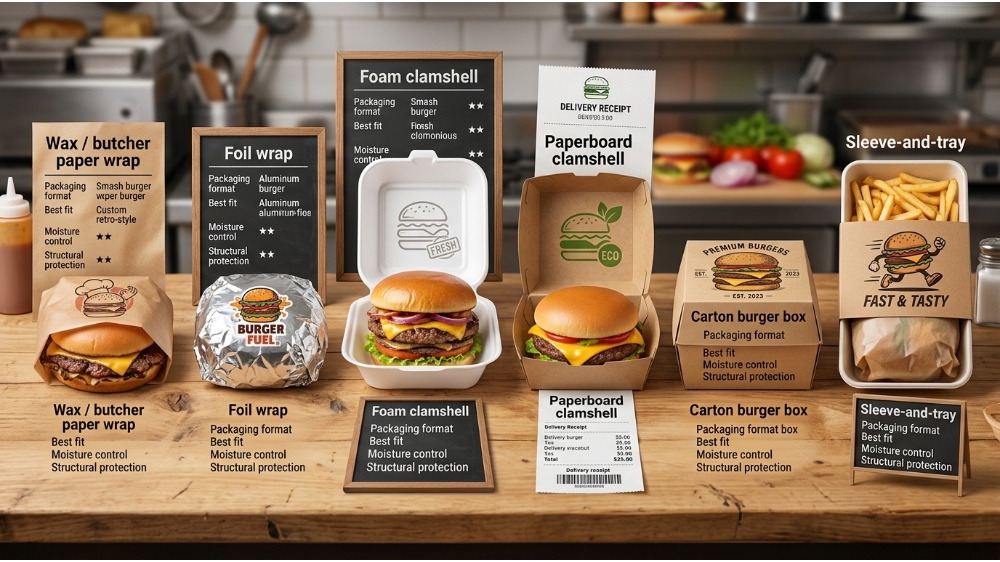
Burger packaging splits into four main formats, and each one handles steam, grease, and structural protection differently. The format that works for a smash burger eaten five minutes after pickup fails for a double-stacked delivery burger traveling 25 minutes in a bag.
Wax and foil wraps
A wrap—whether wax-coated paper, foil-lined paper, or plain butcher paper—is the lowest-cost and fastest format for counter service. It’s the default for smash burgers and quick-service counters where the burger is eaten almost immediately. The trade-off is moisture management: a fully sealed wrap traps steam directly against the bun, which accelerates sogginess on any hold longer than about eight minutes. Foil wraps retain heat better than paper but trap moisture even more effectively, which is why foil-wrapped burgers often arrive hot but wet. Wax-coated paper offers a middle ground—it resists grease penetration while allowing some moisture to escape through the paper fibers, making it a better choice than foil for burgers held more than ten minutes.
Clamshell containers
A clamshell—typically molded from polystyrene foam or pressed paperboard—offers more structural protection than a wrap and is the standard format for large, stacked burgers that can’t survive being squeezed. Foam clamshells insulate well but trap nearly all moisture, making them a poor choice for delivery unless they include venting. Pressed paperboard clamshells are the more common option today, especially in markets with foam bans, and their performance depends heavily on whether they’re lined with a moisture-resistant coating. An unlined paperboard clamshell absorbs condensation from the burger and can itself become structurally soft, which is a different failure mode—the box collapses rather than the bun.
Burger boxes (carton-style)
A carton-style burger box—typically a flat, fold-lock paperboard carton with a tuck-top or lock-lid closure—is the format most associated with premium burger delivery. The box creates headspace above the burger, which is the single most important structural feature for moisture control: it allows steam to rise and collect on the lid surface without saturating the bun crown. Burger boxes also protect the stack from compression during transport, which a wrap cannot do and a clamshell does only partially. The best burger boxes pair a rigid base with a vented or slightly domed lid, and some designs include a moisture-absorbing inner layer on the lid to capture condensation before it drips.
Sleeve-and-tray combos
A newer format growing in the premium fast-casual segment combines an open-top paperboard tray with a branded sleeve that slides over the top. The tray supports the burger from below, the sleeve provides branding and a loose top barrier, and the open sides allow continuous steam venting. This format works best for burgers eaten within 15 minutes and trades some heat retention for dramatically better bun texture on arrival.
Packaging format
Best fit
Moisture control
Structural protection
Wax / butcher paper wrap
Counter service, smash burgers, short holds
Moderate—paper breathes slightly
Low—no crush protection
Foil wrap
Very short holds, heat-retention priority
Poor—traps steam completely
Low—no crush protection
Foam clamshell
Large burgers, budget delivery
Poor without venting
Moderate—rigid but compressible
Paperboard clamshell
Delivery, eco-conscious markets
Moderate—depends on lining
Good—rigid, stackable
Carton burger box
Premium delivery, stacked burgers
Best—headspace + optional venting
Excellent—rigid box structure
Sleeve-and-tray
Fast-casual, short-haul delivery
Excellent—open-sided venting
Good—tray supports, sleeve protects top
The Venting Problem: Why Sealing a Burger Completely Backfires
A completely sealed burger container turns the inside into a steam chamber. Without an escape path, water vapor saturates the air inside the package, condenses on every surface including the bun, and produces the exact sogginess that packaging is supposed to prevent. Venting isn’t a compromise on heat retention—it’s the primary mechanism that separates a burger that arrives fresh from one that arrives steamed.
The ideal vent for a burger package allows steam to exit while retaining enough heat to keep the burger warm. This is typically achieved through small perforations in the lid, an unsealed corner flap, or—in box formats—the natural gap around a tuck-top closure. The vent doesn’t need to be large; a few millimeters of open area is enough to drop internal humidity significantly without cooling the burger noticeably over a 20-minute delivery window. The worst-case scenario, measured repeatedly in food packaging research published by the Institute of Food Technologists (IFT), is a fully sealed foil or plastic wrap with zero venting—internal humidity reaches near 100% within three minutes of closure, and bun texture degradation is measurable within eight minutes.
For burger businesses, the practical rule is straightforward: if the burger travels more than ten minutes from kitchen to customer, the package must include deliberate venting. A wrap-only format without venting is a counter-service solution, not a delivery solution.
Burger packaging venting checklist:
Confirm the package has a steam escape path—perforations, unsealed flap, or box-lid gap
Test internal humidity by placing a small piece of dry bread inside the closed package with a hot patty for 10 minutes—if it comes out damp, venting is insufficient
For delivery, prioritize headspace (box format) over tight wrap—steam needs somewhere to go that isn’t the bun
If using a clamshell, verify the closure doesn’t create an airtight seal; a slight gap at the hinge or clasp is functional, not a defect
Packaging Materials: Wax Paper, Foil, Coated Board, and Grease Resistance
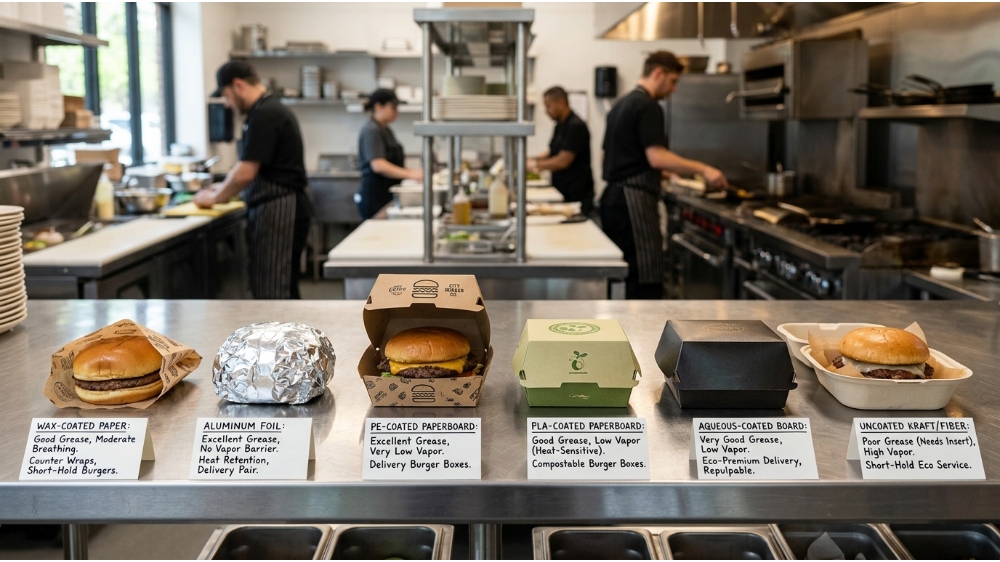
The material a burger package is made from determines two things simultaneously: how it handles moisture and how it handles grease. A material that’s excellent at one is often poor at the other unless it’s been specifically engineered with a coating or lining.
Wax-coated paper
Wax-coated paper is the workhorse of counter-service burger wraps. The wax layer repels grease from the patty and prevents it from soaking through the paper, which keeps the outer surface clean and the structural integrity of the wrap intact. Wax paper breathes slightly—it’s not a complete moisture barrier—which gives it a moderate advantage over foil for bun texture on short holds. The limitation is heat tolerance: wax softens at relatively low temperatures, so a very hot, freshly grilled burger can cause the coating to transfer or lose effectiveness against grease.
Aluminum foil and foil-lined paper
Foil is the best heat retainer and the worst moisture manager in burger packaging. It reflects radiant heat back toward the burger and creates a near-perfect vapor barrier, which is useful for keeping a burger hot for 30+ minutes and catastrophic for bun texture over the same period. Foil-lined paper—a paper outer layer with a thin foil inner lining—offers a compromise: the foil retains heat, and the paper provides some breathability at the seams where the two materials aren’t fully bonded. For delivery, foil alone is rarely the right choice unless the burger is packed with a separate absorbent layer between the patty and the bun.
Most burger boxes and premium clamshells use paperboard with a polyethylene (PE), polylactic acid (PLA), or aqueous coating on the food-contact side. The coating prevents grease from penetrating the board and stops the board itself from absorbing condensation and losing rigidity. PE coatings offer the strongest moisture and grease barrier at the lowest cost; PLA coatings serve the same function in a compostable format but are more sensitive to high heat; aqueous coatings are a newer water-based option that repels grease effectively while keeping the board fully repulpable. For a burger box that needs to hold a hot, greasy double patty for 25 minutes in a delivery bag, PE-coated or high-quality aqueous-coated board is the current standard.
Uncoated kraft and molded fiber
Uncoated kraft paperboard and molded fiber containers are popular in eco-forward markets, but they come with a major moisture vulnerability: without a coating, they absorb both condensation and grease directly into the fiber. The result is a package that can soften, stain, and even structurally fail during a long delivery hold. The solution is typically a thin internal lining or a separate grease-absorbing insert that sits between the burger and the package base. Custom-coated burger wraps and boxes designed specifically for high-grease, high-moisture applications avoid this trade-off by combining the eco-friendly exterior with a functional barrier coating.
Material
Grease resistance
Moisture vapor transmission
Best use
Wax-coated paper
Good
Moderate (breathes slightly)
Counter-service wraps, short-hold burgers
Aluminum foil
Excellent
None (total vapor barrier)
Heat retention; pair with absorbent layer for delivery
PE-coated paperboard
Excellent
Very low
Delivery burger boxes, premium clamshells
PLA-coated paperboard
Good
Low (heat-sensitive)
Compostable burger boxes for moderate heat
Aqueous-coated board
Very good
Low
Eco-premium delivery boxes, repulpable
Uncoated kraft / molded fiber
Poor without insert
High (absorbs moisture)
Short-hold eco service; needs grease insert
Box Design: How Structure Protects Bun Texture and Burger Integrity
A well-designed burger box does four things beyond simply holding the burger: it creates headspace above the bun crown, prevents compression of the stack, separates condensation from food-contact surfaces, and channels grease away from the bun base. Each of these is a structural feature, not a material feature, and they’re the reason a flat-fold carton box outperforms a wrap or a tight clamshell on bun texture in nearly every delivery scenario.
Headspace is the distance between the top of the bun crown and the inside of the box lid. Without it, condensation forming on the lid drips directly onto the bun—this is the primary mechanism behind the “wet top bun” complaint. A domed or elevated lid with even 10–15mm of clearance changes the condensation dynamic entirely: droplets form on the lid and run to the edges rather than dripping onto the bun surface.
Compression protection matters because a burger in a delivery bag is stacked under other items, slid into a driver’s bag, and jostled during transit. A box with rigid sidewalls and a locked lid prevents the bun from being pressed flat, which not only preserves texture but keeps the burger visually intact for the customer. Wraps and soft clamshells offer almost no compression protection.
Grease channeling is a design detail that separates premium burger boxes from generic ones. A box with a slightly textured or ribbed base allows grease to pool in channels beneath the burger rather than saturating the bottom bun, which stays drier longer. Combined with a grease-resistant coating, this base design extends the crisp window of the bottom bun by an additional 5–10 minutes.
For businesses shipping burgers through delivery apps where transit times routinely exceed 20 minutes, a vented, rigid carton box with a raised base is not a luxury upgrade—it’s the minimum viable packaging for a burger that arrives looking and tasting like the one that left the kitchen.
Hot vs. Cold: Managing Temperature, Condensation, and Hold Time
A burger package has to manage two competing priorities simultaneously: keep the hot components hot enough to be appetizing, and keep the bun dry enough to be enjoyable. These two goals are in direct tension because the mechanism that retains heat—sealing in warm air—is the same mechanism that traps steam. The longer the hold time, the more this tension matters.
For holds under 10 minutes—typical counter service or dine-in takeaway—a wax paper wrap or a simple paperboard sleeve is usually sufficient. The burger is consumed before condensation has time to accumulate in damaging quantities. For holds between 10 and 25 minutes—standard delivery—a vented box with headspace is the baseline. For holds beyond 25 minutes, additional measures become necessary: an absorbent pad or layer placed between the patty and the bottom bun, a separately wrapped bun component, or even packaging the hot and cold elements in separate compartments within the same box.
Cold burger components—lettuce, tomato, pickles, sauce—introduce additional moisture that compounds the steam problem. A burger with fresh produce and sauce releases moisture from multiple sources, not just the patty. Some high-volume delivery operations have moved to packaging wet toppings separately, allowing the customer to assemble the burger just before eating. This approach adds a step for the customer but eliminates the dominant source of sogginess for long-haul deliveries. The packaging trade-off is real: a one-piece burger package is faster and more familiar; a two-piece burger package (burger in vented box, toppings in a sealed cup or sleeve) produces a dramatically better eating experience after 25+ minutes of transit.
Hold-time packaging guidelines:
Under 10 minutes: Wax paper wrap or paper sleeve—counter service standard
10–20 minutes: Vented paperboard box with headspace—delivery baseline
How to Choose the Right Burger Packaging for Your Business
The right burger packaging decision runs on four checks, not one: match the format to your hold time, confirm the material handles both grease and moisture, verify venting is adequate for your longest delivery route, and test the full package with your actual burger—not a generic one—before committing to a bulk order. Read How Custom Burger Boxes Help Burger Joints Stand Out and Build a Stronger Brand to understand the importance of burger packaging.
Start by measuring your real hold time, not your ideal one. If the average delivery takes 22 minutes from grill to door, design for 30 minutes, not 15. Then work backward: a 30-minute hold points to a vented carton box with a coated board, an absorbent base layer, and enough headspace to keep condensation off the bun crown. A 6-minute counter hold points to a wax wrap and nothing more complicated.
Test with your burger. A double-stacked cheeseburger with special sauce and fresh lettuce releases more steam and grease than a simple single-patty smash burger with ketchup. The packaging that works for one may fail for the other. Seal the burger in the package, place it in a delivery bag the way a driver would, and check bun texture at 10, 20, and 30 minutes. If the bun is wet at 20 minutes, the package needs more venting, more headspace, or a moisture barrier it doesn’t currently have.
For businesses scaling burger delivery across multiple locations, packaging consistency is a quality-control lever as important as grill temperature. A burger box that performs in one store’s delivery radius needs to perform identically in another’s. Working with a packaging supplier who can provide consistent, tested burger packaging formats across your full menu eliminates the most common variable in burger quality complaints: a box that wasn’t designed for the burger it’s holding. For a sourcing consultation on burger boxes, vented wraps, and delivery-optimized packaging matched to your specific menu and hold times, contact Maibao Packaging.
Need burger packaging that keeps buns crisp through delivery?
Talk to a packaging specialist about matching box design, venting, and material to your burger menu, your hold times, and your delivery radius.
Steam from the hot patty condenses inside the packaging and absorbs directly into the bun’s starch structure. Without venting or headspace, this happens within 8–10 minutes—faster if the package is fully sealed or foil-wrapped with no escape path for moisture.
What’s the best packaging for burger delivery?
A vented paperboard carton box with headspace above the bun and a grease-resistant coating is the best all-around format for delivery holds of 10–25 minutes. For longer holds, add an absorbent base layer or separate the wet toppings from the burger.
Is foil or paper better for wrapping burgers?
Foil retains heat better but traps steam, making it a poor choice for holds longer than 8–10 minutes. Wax-coated or butcher paper breathes slightly and produces a drier bun on any hold over 10 minutes, making it the better wrap for most takeout and short-delivery applications.
How do restaurants keep burgers from getting soggy during delivery?
The most effective methods include using vented boxes with raised lids to create headspace, placing an absorbent layer between the patty and the bottom bun, and—for long-haul deliveries—packaging wet toppings separately so the customer assembles the burger just before eating.
Post time:
Jul-29-2026
For inquiries about our products or pricelist, please leave your email to us and we will be in touch within 24 hours.