Are Plastic Cups Recyclable, Biodegradable, or Compostable? What Foodservice Buyers Need to Know
Plastic Cup Recyclability Explained: PET, PP, PS & PLA Guide
Foodservice Packaging Guide
Are Plastic Cups Recyclable, Biodegradable, or Compostable? What Foodservice Buyers Need to Know
“Eco-friendly,” “recyclable,” “biodegradable,” and “compostable” get printed on cup sleeves as if they mean the same thing. They don’t—and mixing them up can mean a cup marketed as green ends up doing nothing but sitting in a landfill. Here’s how PET, PP, PS, and PLA cups actually behave at end of life, and how to choose the right one for the infrastructure your business actually has access to.
A plastic cup‘s end-of-life story is decided long before a customer ever throws it away. It’s decided by the resin the cup is molded from, whether a coating or additive was blended into that resin, and—more than either of those—by whether the facility that receives it can actually process what the label promises. A cup can be technically recyclable and still end up in a landfill. A cup can be labeled “biodegradable” and outlast the store that sold it.
This guide breaks down what happens to PET, PP, PS, and PLA cups at the end of their life, draws a hard line between recyclable, biodegradable, and compostable claims, and gives foodservice and retail buyers a decision framework for choosing cup material based on the disposal infrastructure they actually have—not the label that sounds the greenest.
Are Plastic Cups Recyclable?
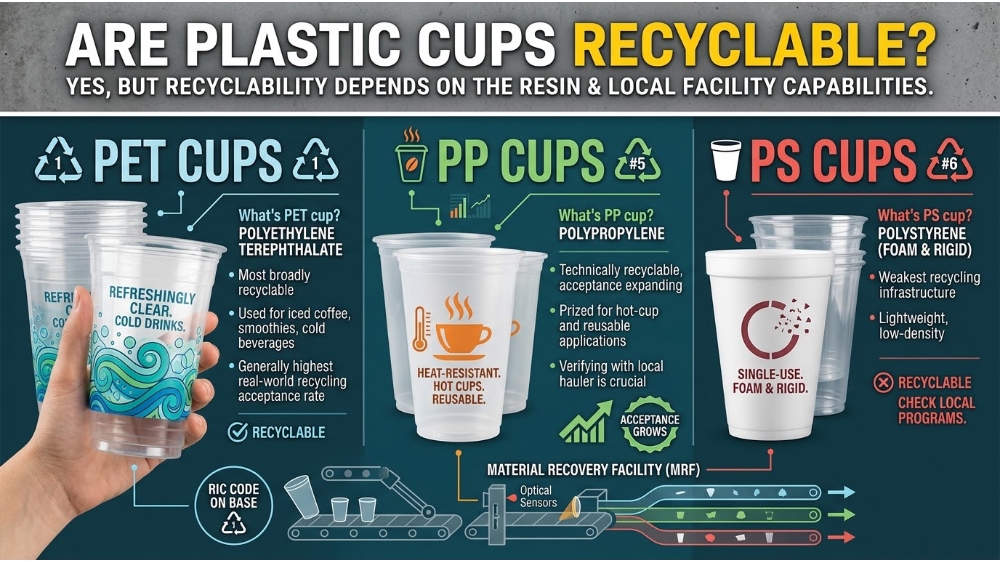
Yes, but with a major caveat: recyclability depends on the resin the cup is made from and whether your local material recovery facility (MRF) is equipped to process that specific resin. A plastic cup being technically recyclable and a plastic cup actually getting recycled in your city are two different facts, and foodservice buyers need to know both.
Every plastic cup carries a resin identification code (RIC), the number stamped inside the “chasing arrows” triangle on the cup base. That number tells you which polymer family the cup belongs to, and it’s the single biggest factor in whether a hauler will accept it.
PET cups
What’s PET cup? PET (polyethylene terephthalate, RIC #1) is the most broadly recyclable plastic used in foodservice cold cups. It’s the same polymer used in beverage bottles, so most curbside and commercial recycling streams already have equipment built to sort and reprocess it. Clear PET cold cups—used for iced coffee, smoothies, and cold beverages—generally have the highest real-world recycling acceptance rate of any plastic cup format. Buyers sourcing a clear cold cup for a market with an established recycling stream should default here.
PP cups
What’s PP cup? PP (polypropylene, RIC #5) is technically recyclable, and acceptance has expanded significantly as more MRFs add PP sorting capability. But acceptance is inconsistent by region—some municipal programs take PP cups, many still don’t. PP is prized in foodservice for hot-cup and reusable-format applications because it tolerates higher temperatures than PET without deforming, which is why it shows up in hot drink cups and microwave-safe containers. If your program depends on PP recyclability, verify with your local hauler rather than assuming national averages apply.
PS cups
PS (polystyrene, RIC #6), including foam and rigid PS cups, has the weakest recycling infrastructure of the group. It’s lightweight, low-density, and easily contaminated with food residue, all of which make it expensive to collect and reprocess relative to its scrap value. A growing number of cities have banned foam PS foodservice ware outright rather than build out recycling capacity for it. For buyers in a jurisdiction with a foam or PS ban, this isn’t a future consideration—it’s a current sourcing constraint.
PLA cups
PLA (polylactic acid) cups are bio-based, but they are not accepted in conventional plastics recycling streams. PLA is often stamped with RIC #7 (“other”), and even where sorting technology exists, PLA contaminates PET recycling bales—the two polymers have different melting points, and a small amount of PLA mixed into a PET bale can degrade the quality of the entire reprocessed batch. This is the single most common point of confusion for buyers: PLA is not a recyclable cup, it’s a compostable one, and putting it in a recycling bin actively works against the recycling stream rather than adding to it.
Quick resin check:
PET (#1) — widely recyclable where cold-cup bottle streams exist
PP (#5) — recyclable in a growing but inconsistent number of programs
PS (#6) — limited recycling infrastructure, banned outright in many cities
PLA (#7 / compostable) — not recyclable; contaminates PET recycling streams if comingled
Are Plastic Cups Biodegradable?
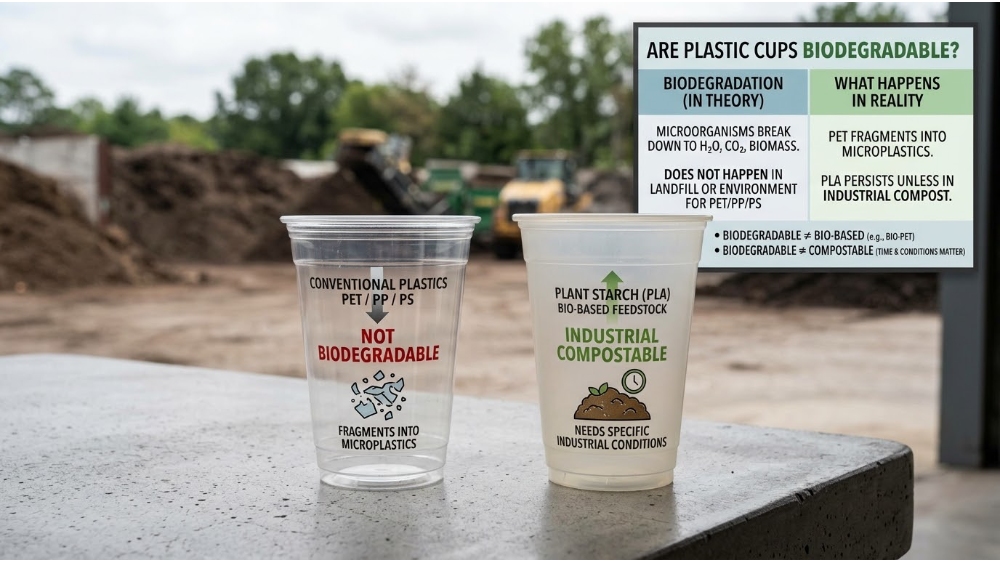
Mostly, no—and “biodegradable” is the most commonly misused word on a cup label. Biodegradation means microorganisms break a material down into water, carbon dioxide, and biomass. The question that matters for buyers isn’t whether that’s possible in theory, but whether it happens on any timeframe relevant to waste management.
Conventional plastics—PET, PP, and PS—are derived from petroleum and built with long, stable polymer chains specifically because that stability is what makes them useful as packaging. Those same chains resist microbial attack. Left in a landfill or the environment, conventional plastic cups don’t biodegrade in any meaningful human timeframe; they fragment under UV exposure and mechanical stress into progressively smaller pieces, eventually becoming microplastics rather than breaking down into biomass.
PLA is different because it’s built from plant starch (typically corn or sugarcane) rather than petroleum, and its polymer chains can be broken down by specific microorganisms—but only under conditions that don’t exist in a landfill or in the open environment. PLA needs sustained heat, moisture, and microbial activity that only industrial composting facilities reliably provide. Buried in a landfill without oxygen or exposed on a roadside, a PLA cup can persist for a very long time, behaving much more like conventional plastic than its bio-based origin suggests.
This is where two distinctions matter for sourcing decisions:
Two distinctions buyers get wrong:
Biodegradable ≠ bio-based. Bio-based describes the feedstock a plastic is made from (plants vs. petroleum). It says nothing about how the finished cup behaves at end of life—a bio-based PET cup is still PET, and still not biodegradable.
Biodegradable ≠ compostable. “Biodegradable” alone carries no required timeframe, no defined end conditions, and in most markets no third-party certification. “Compostable” is a narrower, testable, certifiable claim. A cup can be marketed as biodegradable without meeting any compostability standard at all.
Regulators have started catching up to this gap. A growing number of jurisdictions restrict or require substantiation for unqualified “biodegradable” claims precisely because the term is so easy to put on a label and so hard for a customer—or a waste hauler—to verify. For B2B buyers, that regulatory direction is a signal: an uncertified biodegradability claim is a liability risk, not a marketing asset.
Are Plastic Cups Compostable?
Some are—but “compostable” is a specific, testable claim, not a general description of anything plant-based. A genuinely compostable cup has to fully disintegrate into non-toxic, usable compost within a defined timeframe, under defined conditions, and that claim needs to be backed by third-party certification to mean anything in a commercial buying decision.
What makes a cup compostable
Compostability depends on both the base material and, for lined paper cups, the coating. PLA is the most common compostable resin used for cold cups. For hot cups, a paperboard base is typically lined with a compostable coating—often PLA-based—rather than the conventional polyethylene lining used in standard hot cups, because PE linings do not break down in a composting environment.
Industrial composting vs. home composting
This is the gap that catches the most buyers off guard: most certified compostable cups are certified for industrial composting only, not backyard composting. Industrial composting facilities sustain temperatures around 50–60°C (122–140°F) for extended periods, with controlled moisture and active aeration—conditions a home compost bin essentially never reaches. PLA’s glass transition temperature sits in a similar range, which is exactly why it needs that sustained industrial heat to break down. A PLA cup tossed into a backyard compost pile can sit there largely intact for a very long time. Only a smaller subset of products are separately certified for home composting, and that certification is distinct from standard industrial compostability certification.
Certification: the part that actually matters
In the U.S., the relevant standards are ASTM D6400, which applies to products that are entirely plastic or bioplastic (PLA cold cups fall here), and ASTM D6868, which applies to products combining a fiber or paper substrate with a compostable coating (PLA-lined paperboard hot cups fall here). The Biodegradable Products Institute (BPI) is the primary third-party certifier tying products to these ASTM standards in North America, and BPI-certified items are required to disintegrate in a managed composting facility, generally within about 90 days, without leaving toxic residue. In Europe, the equivalent benchmark is EN 13432, typically certified by bodies like TÜV Austria or DIN CERTCO. For a B2B buyer, the presence or absence of one of these certification marks—not the word “compostable” on its own—is what separates a defensible sourcing decision from a greenwashing exposure.
Disposal conditions decide the outcome
A certified compostable cup only delivers its environmental benefit if it actually reaches a facility that composts it. Sent to a landfill instead, a compostable cup is deprived of the oxygen, heat, and moisture it needs, and can break down slowly and anaerobically rather than composting as designed. Comingled into a plastics recycling bin, it contaminates that stream instead. In other words, a compostable cup’s entire value proposition is conditional on the collection system around it—which is precisely why buyers need to verify local commercial composting access before treating “compostable” as an automatic upgrade over recyclable packaging.
Compostable cup checklist for buyers:
Confirm the certification mark (BPI, ASTM D6400/D6868, or EN 13432)—not just the word “compostable”
Confirm whether the certification is for industrial composting or home composting—they are not interchangeable
Confirm your market or venue has access to commercial composting collection
Never route compostable cups into a standard plastics recycling stream
Recyclable vs. Biodegradable vs. Compostable: What’s the Difference?
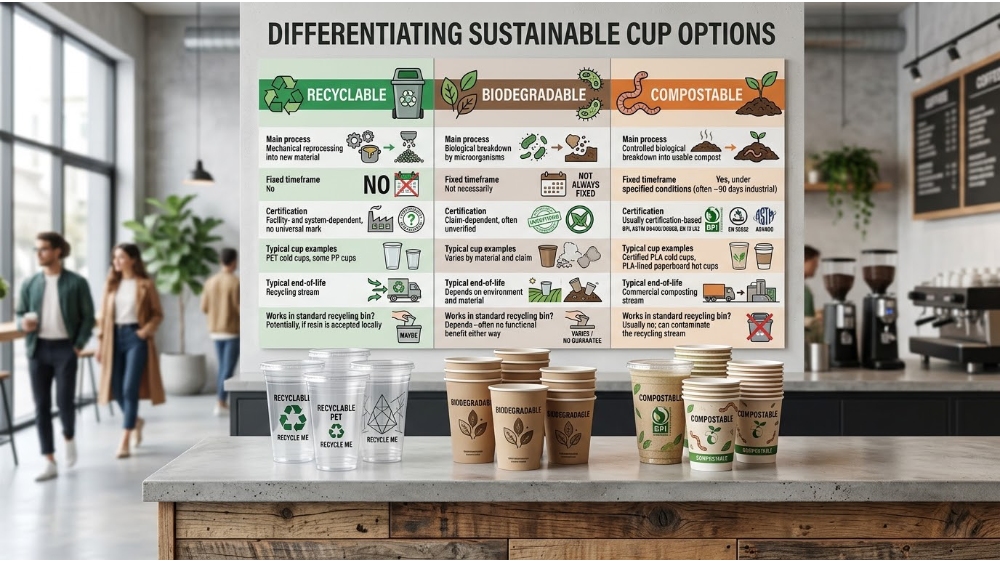
These three terms describe different end-of-life pathways, with different requirements, different timeframes, and different levels of proof behind them. Treating them as synonyms is the root of most cup-sourcing mistakes. Understand the difference between biodegradable and compostable easily by their comparison guide.
Feature
Recyclable
Biodegradable
Compostable
Main process
Mechanical reprocessing into new material
Biological breakdown by microorganisms
Controlled biological breakdown into usable compost
Fixed timeframe
No
Not necessarily
Yes, under specified conditions (often ~90 days industrial)
Certification
Facility- and system-dependent, no universal mark
Claim-dependent, often unverified
Usually certification-based (BPI, ASTM D6400/D6868, EN 13432)
Typical cup examples
PET cold cups, some PP cups
Varies by material and claim
Certified PLA cold cups, PLA-lined paperboard hot cups
Typical end-of-life
Recycling stream
Depends on environment and material
Commercial composting stream
Works in standard recycling bin?
Potentially, if resin is accepted locally
Depends—often no functional benefit either way
Usually no; can contaminate the recycling stream
Which Type of Cup Is Best for Your Business?
There isn’t a universally “best” cup material, and “compostable is always the greener choice” is the assumption most likely to backfire on a foodservice buyer. The right choice is a function of the disposal infrastructure actually available to your customers and your waste hauler—not the label with the most reassuring word on it.
If you have access to mature recycling infrastructure
Where curbside or commercial recycling for PET (and increasingly PP) is well established and consistently enforced, a recyclable cup in one of those resins is a practical, verifiable choice. The recycling stream exists, the sorting technology exists, and the cup has a realistic path to actually being reprocessed rather than just theoretically qualifying as recyclable.
If you have access to commercial composting collection
Where your venue, campus, stadium, or municipality provides organics or commercial composting pickup, a certified compostable cup (BPI-certified, meeting ASTM D6400 or D6868) can genuinely be diverted from landfill and processed as intended. This is the scenario where compostable packaging delivers on its promise—because the infrastructure to fulfill that promise is actually in place.
If neither infrastructure is reliably available
This is the case buyers most often get wrong. Without confirmed access to industrial composting, a “compostable” cup does not automatically become the more responsible option—it can end up in a landfill behaving no better, and in some cases worse, than a conventional plastic cup, while carrying a green label that creates a false impression for customers and regulators alike. In this scenario, it’s worth evaluating the full picture: source reduction (using less material per cup), lightweighting, reusable cup or deposit-return programs, and choosing the most widely recyclable resin available in your market—rather than defaulting to whichever cup has “eco” in its description.
The practical takeaway for procurement teams: ask your hauler or facilities manager what actually happens to each material after it leaves your building before you finalize a cup spec. The disposal claim on the cup is only half the equation; the infrastructure on the other end is the half that determines whether that claim means anything.
Sourcing cups for a market you’re not sure about?
Talk to a packaging specialist about matching cup material—PET, PP, PS, or certified compostable PLA—to the actual recycling and composting infrastructure available where your product will be sold or served.
Can you recycle PLA cups with regular plastic cups?
No. PLA cups should never go into a standard plastics recycling bin. PLA has a different melting point than PET and PP, and even small amounts mixed into a recycling bale can contaminate and degrade the quality of the entire reprocessed batch. PLA cups belong in commercial composting collection, not recycling.
Is a biodegradable cup the same as a compostable cup?
No. Biodegradable is a general claim with no required timeframe or certification in most markets. Compostable is a specific, testable claim that requires a cup to fully break down into non-toxic compost within a defined period under defined conditions, typically backed by certification such as BPI, ASTM D6400/D6868, or EN 13432.
Will a compostable cup break down in a landfill?
Not reliably. Landfills lack the sustained heat, oxygen, and moisture that industrial composting facilities provide, so a compostable cup sent to landfill can break down very slowly and incompletely, similar in practice to conventional plastic waste. Compostable cups only deliver their intended benefit when routed to an actual composting facility.
Which plastic cup material is easiest to recycle?
PET (resin code #1) generally has the broadest, most consistent recycling acceptance among foodservice cup materials, since it shares infrastructure with PET beverage bottle recycling. PP (#5) acceptance is expanding but inconsistent by region, and PS (#6) has the weakest recycling infrastructure of the three.
Post time:
Sep-09-2026
For inquiries about our products or pricelist, please leave your email to us and we will be in touch within 24 hours.