Why Is Bread Still Sold in Plastic Bags: Plastic & Paper Bags, and Boxes Compared
Why Bread Is Still Sold in Plastic Bags: Freshness vs. Sustainability
Bakery Packaging Deep Dive
Why Is Bread Still Sold in Plastic Bags: Plastic & Paper Bags, and Boxes Compared
Walk down any grocery aisle — bread is almost always in plastic. But with sustainability pressure mounting, many ask: why not paper or cardboard? The answer lies in moisture physics, starch chemistry, and a trade‑off that food scientists have studied for decades. Here’s what actually works.
A Reddit user recently asked: “If we can put pizza in cardboard, why can’t we put bread in it?” It’s a fair question — and one that exposes a deep gap in how we think about food packaging. The short answer: bread and pizza have entirely different moisture profiles, consumption timelines, and staling mechanisms. But the longer answer is a masterclass in food science, material engineering, and the real‑world constraints of commercial baking.
This guide breaks down why plastic remains the dominant bread packaging material, where paper and cardboard fall short, and how to navigate the trade‑offs between freshness, cost, and environmental impact. For a complete range of bakery and foodservice packaging solutions, explore Maibao’s food packaging portfolio.
Why bread goes stale: the science of starch retrogradation
Bread staling is not primarily about moisture loss — it’s about starch retrogradation. When bread bakes, starch granules gelatinise, absorbing water and forming a soft, springy crumb. As the bread cools and ages, the starch molecules recrystallise — a process called retrogradation — expelling water and creating a firm, dry texture that consumers perceive as “stale”. This process is accelerated at refrigerator temperatures and slowed at freezer temperatures, but the key packaging variable is moisture migration.
Retrogradation happens regardless of packaging, but the rate is heavily influenced by the surrounding humidity. In a sealed plastic bag, moisture is trapped, keeping the crumb soft even as retrogradation progresses. In a breathable paper bag or cardboard box, moisture escapes, leading to rapid drying and a harder, less pleasant texture. According to a 2023 review from the University of Pisa (Critical Reviews in Food Science & Nutrition), controlling water activity is the single most important factor in extending bread shelf life, and packaging with high water vapour barrier properties is essential.
What plastic bags do: moisture retention and shelf‑life extension
Plastic bread bags — typically made from polyethylene (PE) or polypropylene (PP) — are excellent moisture barriers. They trap the water vapour released by the bread, creating a microclimate with high relative humidity (often above 85%) that keeps the crumb soft. This extends the sensory “freshness” window from about 1‑2 days (in paper) to 5‑7 days or more, depending on the formulation.
But plastic isn’t perfect. If the bread is not completely cooled before bagging, condensation forms inside the bag, promoting mould growth. That’s why commercial bakeries use forced‑air cooling and add modified atmosphere packaging (MAP) or oxygen absorbers in some cases. A 2020 study from Bu‑Ali Sina University (Taylor & Francis) demonstrated that plastic films with moderate oxygen transmission rates can suppress mould while maintaining crumb softness, achieving a shelf life of up to 10 days at ambient temperature.
From a cost perspective, plastic bags are lightweight, cheap to produce, and sealable with twist ties or clips. They also offer a printable surface for branding and nutritional information. These practical advantages explain why plastic remains the default for industrial sliced bread, even as consumer demand for sustainable alternatives grows.
Paper bags: breathability and the staling trade‑off
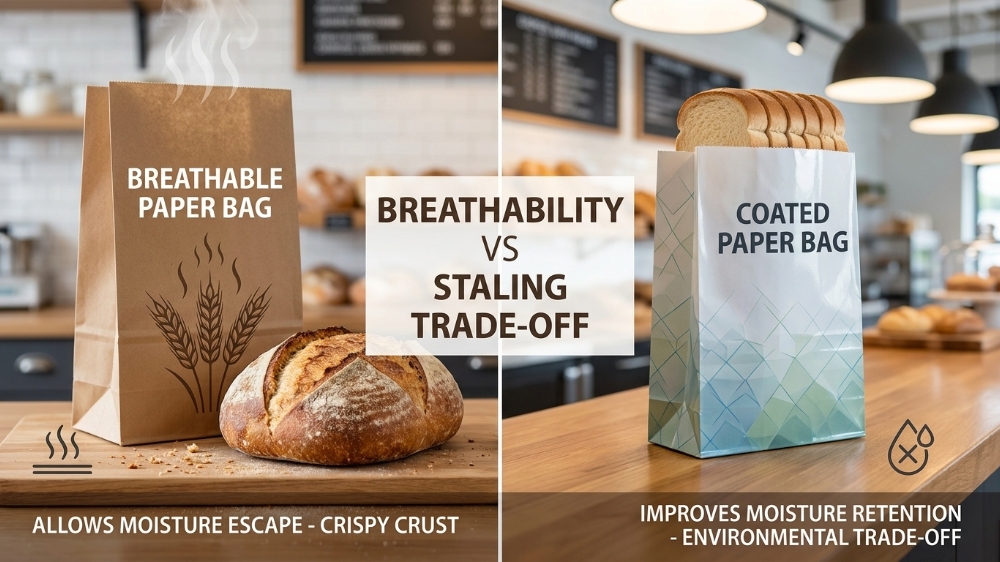
Paper bags are highly breathable. They allow moisture to escape, which prevents condensation and mould — but at the cost of accelerated staling. In a paper bag, bread can lose 3‑5% of its moisture content within 24 hours, leading to a noticeably firmer crumb. For artisan breads with thick crusts, this can be desirable: a crispy crust is often lost in plastic, which softens the crust. But for soft, sliced sandwich bread, paper is a disaster.
Some bakeries use paper bags with a wax or PE coating to improve moisture retention while maintaining a “natural” look. However, coated paper loses its recyclability advantage and often performs worse than pure plastic. A 2024 study in Sustainable Production and Consumption found that the environmental impact of coated paper can be higher than that of plastic when factoring in production energy and end‑of‑life processing.
For short‑hold applications — like a bakery selling bread that will be consumed within a few hours — paper is perfectly acceptable. But for supermarket supply chains that require 5‑10 days of shelf life, paper alone cannot deliver.
Cardboard boxes: why they work for pizza but not for bread
Cardboard boxes (corrugated or folding cartons) are excellent for pizza because pizza has a low moisture content in the crust and a high‑fat topping that resists staling. Pizza is typically consumed within 30‑60 minutes of baking, so long‑term moisture retention isn’t required. In fact, pizza boxes are designed to allow steam to escape (via small vents) to prevent sogginess — the opposite of what bread needs.
Bread, by contrast, has a high moisture content (35‑45% water) and a delicate crumb structure. In a cardboard box, moisture escapes rapidly through the porous fibre, and the bread stales within 1‑2 days. Moreover, cardboard offers little protection against oxygen, which accelerates oxidative rancidity in any added fats. Some premium breads are sold in cardboard sleeves or trays, but these are almost always combined with an inner plastic film or bag to control moisture — effectively making the box a secondary (and often unnecessary) layer.
As one Reddit thread on r/Packaging pointed out, the question “why not boxes?” often confuses structural protection (box) with moisture control (film). A box can protect against crushing, but it cannot regulate humidity — and for bread, humidity regulation is the primary requirement.
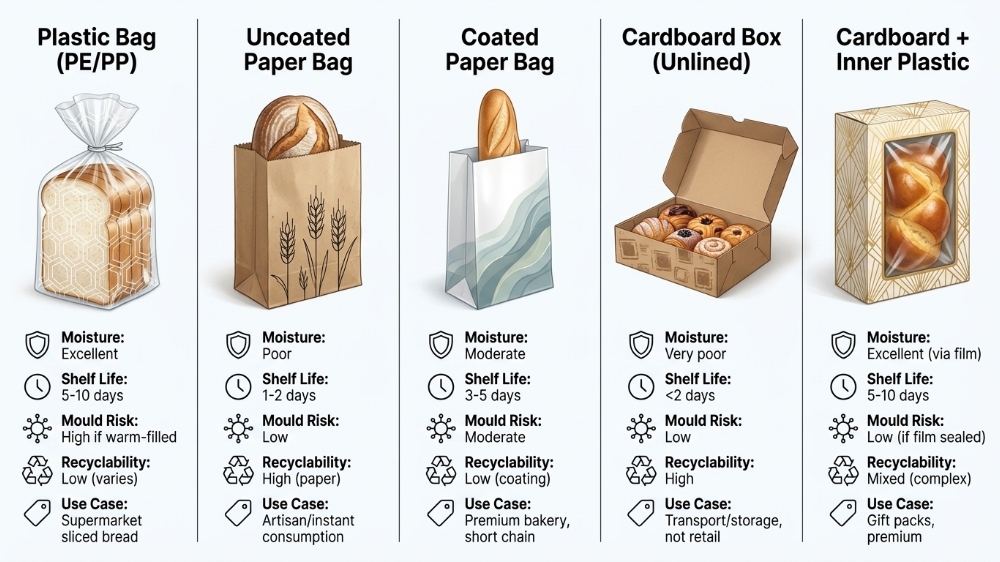
Head‑to‑head comparison: plastic vs. paper vs. boxes
Packaging type
Moisture barrier
Shelf life (ambient)
Mould risk
Recyclability
Best use case
Plastic bag (PE/PP)
Excellent
5‑10 days
High if warm‑filled
Low (curbside varies)
Supermarket sliced bread
Uncoated paper bag
Poor
1‑2 days
Low
High (paper)
Artisan/instant consumption
Coated paper bag
Moderate
3‑5 days
Moderate
Low (coating)
Premium bakery, short chain
Cardboard box (unlined)
Very poor
<2 days
Low
High
Transport/storage, not retail
Cardboard + inner plastic
Excellent (via film)
5‑10 days
Low (if film sealed)
Mixed (complex)
Gift packs, premium
This comparison makes it clear: no single material excels in every dimension. The choice depends on your product’s formulation, expected shelf life, distribution temperature, and brand values.
Sustainability: recyclability, coatings, and the circular economy
Environmental concerns are driving a shift away from single‑use plastics. However, the alternatives are not always greener. A 2026 study on cellulose‑based coated paper with high water vapour barrier properties (International Journal of Biological Macromolecules) shows that bio‑based coatings can achieve moisture barrier performance close to PE, but they are still expensive and not widely commercialised.
Currently, most plastic bread bags are not recyclable at curbside due to their thin film and contamination with food residues. Some supermarkets offer collection points for plastic film, but uptake is low. Paper bags are widely recyclable, but if they are coated with wax or plastic, they become non‑recyclable. Cardboard is recyclable, but when combined with plastic liners, it becomes a mixed‑material waste stream.
A life‑cycle assessment (LCA) approach is essential. For a bread product that travels 500 km from bakery to store, a lightweight plastic bag may have a lower carbon footprint than a heavier paper or cardboard alternative, even considering end‑of‑life. The 2024 study in Sustainable Production and Consumption concluded that packaging choices must consider the entire supply chain, not just the material category.
For foodservice operators, the trend is towards compostable or home‑compostable films made from PLA or cellulose, but these are still less effective moisture barriers and often require specialised composting facilities. In practice, many bakeries are adopting a dual‑strategy: use plastic for long‑shelf‑life lines, and paper or minimal packaging for in‑store, same‑day sales.
How to choose the right bread packaging for your bakery
Selecting packaging starts with answering three questions:
How long does your bread need to stay fresh? — Under 48 hours? Paper or even no bag may work. 5‑7 days? You need a strong moisture barrier — plastic or a coated solution.
What is your distribution channel? — Direct‑to‑consumer (local) vs. retail (national) vs. foodservice (bulk). Each has different handling and durability requirements.
What is your brand positioning? — Sustainability‑focused brands can opt for paper with clear instructions to consumers (e.g., “consume within 2 days, freeze for longer”). Others may choose recyclable plastic films (PE) and invest in store‑drop‑off recycling programmes.
Test your actual product. Pack fresh loaves in each material, store them under your real conditions, and perform sensory evaluations at 24, 48, 72 hours and beyond. Pay attention to crumb firmness, crust texture, and mould appearance. A 2014 study in Food Packaging and Shelf Life (Elsevier) demonstrated that even small differences in water vapour transmission rate (WVTR) can significantly affect consumer acceptance after day 3.
For bakeries looking to reduce plastic without sacrificing quality, consider modified atmosphere packaging (flushing with nitrogen or CO₂) which allows using thinner films with better barrier performance, or active packaging with oxygen scavengers that slow retrogradation. These innovations are increasingly accessible through custom packaging suppliers.
If you’re scaling your bakery business and need consistent, tested packaging across multiple SKUs, working with a partner who understands both food science and sustainability is crucial. For a sourcing consultation tailored to your bread types, shelf‑life targets, and sustainability goals, contact Maibao Packaging.
Need bread packaging that balances freshness and sustainability?
Talk to a packaging specialist about material options, coating technologies, and shelf‑life validation for your bakery products.
Why is bread still sold in plastic bags instead of paper?
Plastic provides a superior moisture barrier, extending shelf life from 1‑2 days to 5‑10 days. This is critical for supermarket distribution and reduces food waste, which often outweighs the environmental impact of the packaging itself.
Does bread stay fresher in a plastic bag or a bread box?
A plastic bag keeps bread fresher longer because it traps moisture and prevents staling. A bread box (wooden or ceramic) allows airflow and moisture escape, which can keep crust crisp but accelerates staling in the crumb within 2‑3 days.
Are plastic bread bags recyclable?
Most are made from PE or PP, which are technically recyclable, but they are rarely accepted in curbside recycling due to size and film contamination. Some retailers offer store‑drop‑off recycling for plastic films; check your local programs.
What is the most sustainable bread packaging option?
There is no single answer. For short‑life artisan bread, uncoated paper is most sustainable. For longer shelf life, lightweight recyclable plastic with minimal oxygen barrier may have the lowest overall environmental footprint when considering food waste prevention.
Post time:
Aug-06-2026
For inquiries about our products or pricelist, please leave your email to us and we will be in touch within 24 hours.