How Custom Burger Boxes Help Burger Joints Stand Out and Build a Stronger Brand
How Custom Burger Boxes Help Burger Joints Stand Out and Build a Stronger Brand
Custom Packaging Guide
How Custom Burger Boxes Help Burger Joints Stand Out and Build a Stronger Brand
Most burger boxes on a counter today say almost nothing about the brand serving them. Here’s what actually changes when a box is designed on purpose — how customers judge the burger before they open it, what it costs to get there, and how to launch it without a shift running out of anything.
A burger box is the one piece of a fast food brand that every single customer physically holds, and most operators still treat it as an afterthought bought against a generic template. A national Ipsos poll conducted for the Paper and Packaging Board found that 72% of American consumers say packaging design influences their purchase decisions, and that number holds even for something as habitual as a burger order. The gap between a brand that understands this and one that doesn’t isn’t subtle — it shows up in repeat visits, in what gets posted online, and in whether a $9 burger feels like it belongs in a $9 box or a $4 one.
This guide breaks that gap into the parts an operator can actually act on: what separates a printed box from an on-brand one, what the research says about perception and recall, which materials and structures hold up under a heat lamp and a 20-minute drive, what a custom order really costs once setup and minimums are counted, and how to brief and launch a switch without leaving a location short on boxes mid-rush. For ready-stock and custom-printed formats sized for burger service, see the current eco-friendly burger box catalog.
Why Does the Burger Box Matter as Much as the Burger?
A generic box tells customers a brand hasn’t thought past the kitchen. A designed one tells them the brand thought about the whole experience, and that impression forms before the first bite. That’s a cheap signal to send and an expensive one to skip.
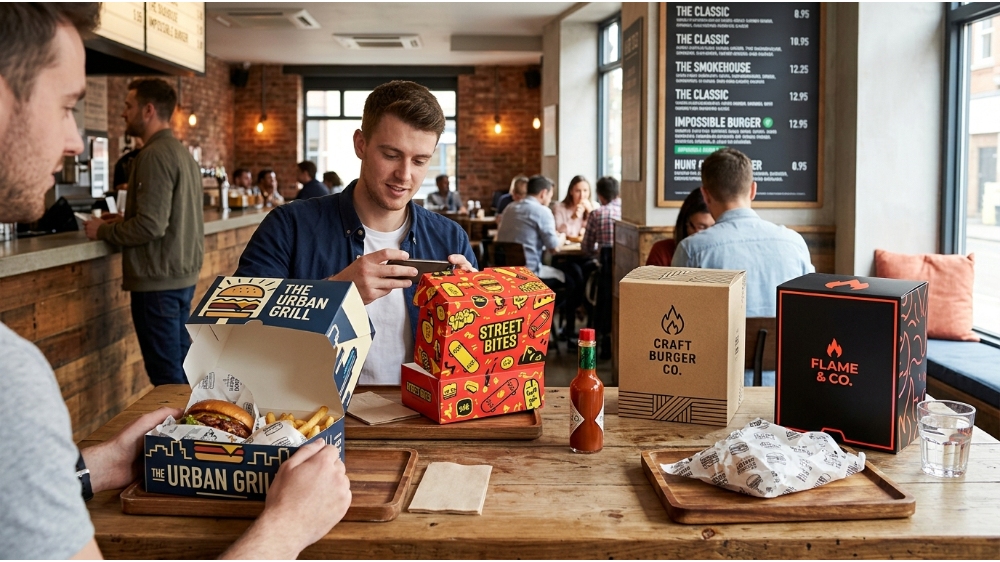
Burger service is one of the most crowded categories in food, and most menus within a five-minute drive of each other look, price, and taste roughly the same. Packaging is one of the few remaining touchpoints a brand fully controls, and it happens to be the one customers interact with the longest — held in hand, set on a table, unwrapped, and increasingly photographed before anything gets eaten. Industry research on retail packaging has long pointed to the same pattern: shoppers form a judgment about quality within seconds of seeing how something is packaged, and that first read colors how the product itself gets evaluated. A burger joint that skips this isn’t neutral on branding — it’s actively handing that first impression to whatever plain kraft box happened to be cheapest that quarter.
The category leaders already treat the box as a brand asset rather than a cost line. Chains that have invested in distinctive, recognizable packaging use it the same way they use a logo or a uniform: as a piece of brand recognition that works even when the sign isn’t visible, which matters enormously for delivery orders where the storefront never enters the picture at all. A branded cardboard burger tray sitting on a desk during a lunch delivery is doing marketing work a paid ad never gets the chance to do.
What Actually Makes a Burger Box “On-Brand” Instead of Just Printed?
A logo stamped on a stock box is decoration, not branding. An on-brand box uses color, structure, typography, and material choice together so the box is recognizable even with the logo covered. Most “custom” burger packaging on the market today stops at the first of those four.
Color as a brand signal, not a backdrop
Color is processed faster than text or logo shape, which is why the strongest packaging programs pick one or two proprietary colors and repeat them relentlessly across every box, sleeve, and bag rather than treating color as a free variable per SKU. A dominant, consistent color block is what lets a customer — or a delivery photo on a social feed — identify a brand at a glance, before they’ve registered a single word on the box.
Structure that customers feel, not just see
The physical form of a box — a hinged clamshell, a wrap-around sleeve, a window box, an open-top tray — communicates as much as the print on it. A rigid, well-fitted molded fiber hamburger box that closes with a satisfying, precise fit reads as premium before a customer reads a single word; a loose-fitting generic clamshell reads as an afterthought regardless of what’s printed on the lid.
Typography and tone that match how the brand actually talks
A gourmet smash-burger concept and a fast, value-driven drive-thru chain should never use the same type treatment, yet a huge share of stock burger packaging templates default to the same bold sans-serif regardless of concept. Typography is one of the cheapest brand levers available on a print run, and it’s the one most templated packaging quietly erases.
Small structural details that do outsized branding work
A die-cut window that frames the burger itself, a debossed logo customers can feel with a thumb, a spot-UV finish that catches light under a drive-thru canopy light — these details cost very little per unit relative to the base box, and they’re disproportionately what gets described in a customer’s own words when they talk about the brand to someone else.
Does Custom Packaging Really Change How Customers Judge a Burger Joint?
Yes — and not just anecdotally. Peer-reviewed packaging research consistently finds that a large share of purchase and quality judgments are made at the point of contact with the package itself, before the product inside is evaluated on its own merits. That finding holds across categories far beyond burgers.
A systematic review of packaging design research notes that 73 to 85 percent of consumer purchase decisions are effectively made at the point of sale, with packaging design frequently serving as the deciding differentiator between otherwise similar products. For a burger joint, “point of sale” now includes the moment a delivery bag is opened at a desk or the second a to-go box is set down on a table for a phone photo — and in both cases, the box is doing the differentiating, not the sandwich.
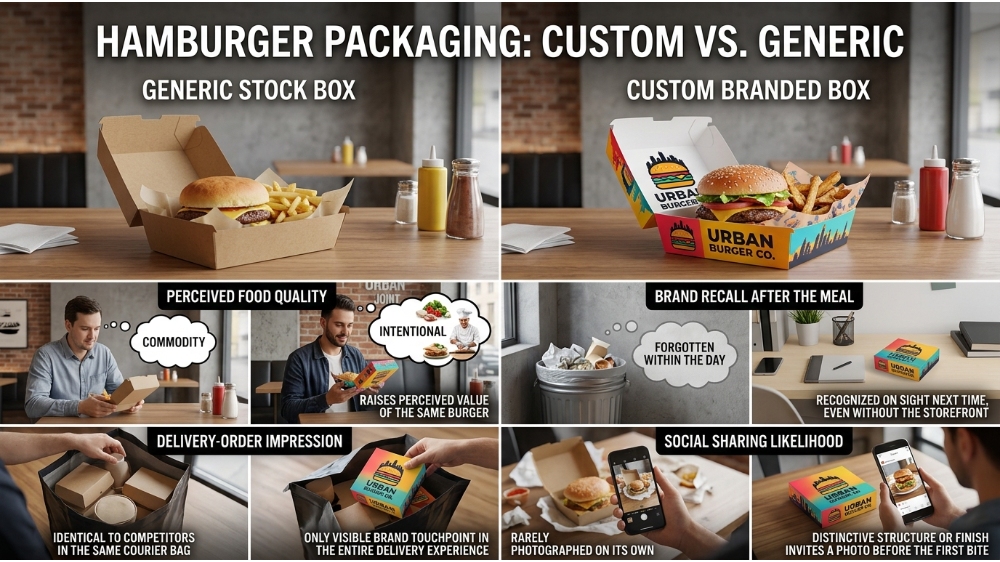
What customers judge
Generic stock box
Custom branded box
Perceived food quality
Read as commodity, regardless of recipe
Read as intentional, raises perceived value of the same burger
Brand recall after the meal
Forgotten within the day
Recognized on sight next time, even without the storefront
Delivery-order impression
Identical to competitors in the same courier bag
Only visible brand touchpoint in the entire delivery experience
Social sharing likelihood
Rarely photographed on its own
Distinctive structure or finish invites a photo before the first bite
Which Box Materials and Structures Work Best for Branding?
The material decides how well the print survives grease and heat; the structure decides how much of the design a customer actually sees. Get either one wrong and the branding work upstream is wasted on a box that goes soggy or gets hidden in a bag.
Molded fiber (bagasse) hamburger boxes
Pressed bagasse or rice-husk fiber holds a crisp, matte print surface without the greasy sheen that shows through thin coated stock, and it holds its shape under a heat lamp better than most people expect from a fiber product. It’s the strongest current option for a brand that wants both a premium, tactile feel and a genuinely compostable claim — the trade-off is a higher unit cost and, on thinner-walled designs, some flex under a heavy, double-patty build. Read Fast Food Sustainable Packaging Options: Eco-Friendly Solutions for Modern Restaurants to learn more about eco-friendly packaging.
Coated paperboard clamshells and boxes
Coated paperboard is the workhorse for printed detail — fine linework, gradients, and small type reproduce more cleanly here than on uncoated kraft. The category has shifted hard toward PFAS-free barrier coatings in the last two years, so a buyer evaluating a supplier’s “custom printed” claim should confirm the coating chemistry as carefully as the artwork proof.
Kraft wraps and sleeves
Printed wax paper and kraft wraps are the lowest-cost branding surface available and work well for counter-service concepts where hold time is short. They carry less structural presence than a box, so the branding weight has to come entirely from print and color rather than shape.
Window boxes and open-top trays
A die-cut window or an open-top tray does something a fully enclosed box can’t: it lets the food itself become part of the branding, framed by the print around it. This works especially well for gourmet and build-your-own concepts where the visual of the burger is part of the sell, but it trades away some grease and moisture protection compared to a sealed clamshell.
Counter service, short hold time, low cost per unit
Window box or open tray
High — food becomes part of the design
Build-your-own concepts, Instagram-forward menus
How Does Packaging Affect Delivery Orders and Social Media Reach?
In delivery, the box is the entire brand experience — there’s no storefront, no staff, no counter. On social media, a distinctive box is often the reason a burger gets photographed at all. Both channels reward the same design choices, but they punish different failures.
Third-party delivery strips away every branding touchpoint except the one riding inside the bag. A courier’s app, uniform, and vehicle carry the delivery platform’s branding, not the restaurant’s — which means a plain, unmarked box arrives having said nothing about the brand that made it, while a well-branded one is doing the only marketing available in that entire transaction. This is also the format where structural performance matters most: a box needs to survive being stacked, jostled, and held flat for twenty to forty minutes without the print smearing from condensation or the structure sagging from grease, which is why a rigid leak-proof custom printed delivery box earns back its higher unit cost in fewer remade or refunded orders.
On social media, the incentive runs the other direction: customers photograph packaging that looks different from what they’ve seen before, and that photo is free distribution a brand doesn’t pay media dollars for. A debossed logo, an unusual fold, or a window box that frames the burger well enough to photograph without staging all increase the odds of an unprompted post — none of which shows up on a spec sheet, but all of which shows up in impressions.
Delivery-ready branding checklist:
Structure holds flat and sealed for at least 30–40 minutes without sagging
Print and coating resist grease bleed-through and condensation smearing
Brand color and logo are visible from outside the bag, not just inside the lid
At least one structural or finish detail worth photographing before the first bite
What Do Custom Burger Boxes Actually Cost, Line by Line?
Unit price is the smallest and most misleading number in a custom packaging quote. Setup fees, minimum order quantities, and print method decide whether a switch to custom boxes is affordable at your volume — before a single case has shipped.
A stock, unprinted burger box typically costs less per unit than any custom option, and that comparison is what stops most independent operators before they request a quote. But unit price ignores the line items that actually determine total cost: plate or cylinder setup fees for the print run, which are fixed regardless of order size and get diluted the larger the order; minimum order quantities, which run anywhere from a few hundred units for digitally printed short runs up to tens of thousands for offset-printed structural boxes; and the failure cost of a box that doesn’t hold up, which shows up as remade orders and refunds rather than as a line on the packaging invoice. A brand ordering in the low thousands per month is usually better served by digital short-run printing at a higher per-unit cost and no plate fee; one ordering by the pallet gets the better economics from an offset run with a higher upfront setup cost spread across a much larger volume.
The honest comparison isn’t “custom box price” versus “stock box price” — it’s landed cost per order once setup amortization, minimum order quantity, and remake rate are counted together. Run that comparison at your actual monthly volume, and a mid-tier custom box with a two-color print often lands closer to a stock box than the initial quote suggests, especially once the avoided cost of a soggy, remade order is factored in.
How Do You Brief a Supplier So the Design Survives Production?
Most branding gets lost between the design file and the finished box, not because the design was wrong but because the brief left print method, color mode, and structure ambiguous. A tight brief is the cheapest insurance available in this entire process.
A workable supplier brief specifies four things before a single quote is requested. First, color mode: Pantone (PMS) spot color for exact brand-color matching versus CMYK process printing for photographic or gradient artwork — mixing these up is the single most common reason a “brand blue” comes back looking nothing like the brand’s actual blue. Second, print method: flexographic printing for large, simple color fields at high volume, offset for fine detail and photographic quality at mid-to-high volume, or digital printing for short runs and frequent design changes without a new plate each time. Third, the dieline: the exact structural template the artwork has to wrap around, including fold lines, glue tabs, and any window cutouts, requested and approved before final artwork is locked. Fourth, a physical proof or 3D mockup under the same conditions the box will actually see — a heat lamp, a stack of three boxes, a 30-minute hold — rather than approving a flat digital rendering alone.
Before locking a production run:
Confirm PMS spot colors for logo and brand palette, not CMYK approximations
Match print method to your actual monthly volume, not the supplier’s default
Approve the dieline and a physical proof before the full print run is scheduled
Test the proof under a heat lamp and a realistic delivery hold time, not just on a desk
How Do You Launch Custom Boxes Without a Supply Gap?
Operators rarely fail on the design itself — they fail on sequencing, running out of the old box before the new one clears quality checks, or rolling out system-wide before a single location has tested it under a real rush. A phased launch avoids both.
A workable rollout runs in three stages. First, pilot the new box at one location and, ideally, one service format — drive-thru and delivery are the highest-risk formats, since they expose structural weaknesses a counter order never will. Second, order the physical proof and first production run with enough lead time that the current stock box doesn’t run out before the new one clears final approval; overlap the two for at least one full ordering cycle rather than cutting over on a single delivery date. Third, once the pilot format performs, expand to the remaining locations and formats in a second wave rather than a single simultaneous switch, so any structural issue discovered under real volume gets caught before it’s replicated across every store. For teams building this from scratch, it’s worth reviewing a few finished, ready-stock formats — like a structural delivery box alongside a molded fiber clamshell — side by side against your actual order mix before committing to a full custom print run.
Ready to design a burger box customers actually remember?
Talk to a packaging specialist about matching structure, material, and print method to your brand, your volume, and your service format.
Are custom burger boxes worth it for an independent, single-location burger joint?
Usually yes at even modest volume, since digital short-run printing now removes the high minimum order quantities that used to make custom packaging a large-chain-only option. A single-color logo run on a stock die shape is typically the lowest-cost entry point before committing to a fully custom structure.
What’s the minimum order quantity for custom printed burger boxes?
Digitally printed short runs can start in the low hundreds of units, while offset-printed custom structures typically require several thousand to reach reasonable per-unit economics. The right choice depends on monthly volume, not on which option looks cheaper per box in isolation.
Does a custom burger box need to be more expensive than a stock one?
Not necessarily — a well-chosen stock die shape with a one- or two-color custom print can cost only marginally more per unit than an unprinted box. The bigger cost jump comes from fully custom structural dielines and multi-color process printing, which is worth reserving for a flagship SKU rather than every box in the lineup.
How long does it take to launch a new custom burger box design?
A realistic timeline runs six to ten weeks from approved artwork to first delivered case, covering dieline approval, a physical proof, and the production run itself. Building in a one-cycle overlap with existing stock during that window avoids running out mid-transition.
Post time:
Jul-29-2026
For inquiries about our products or pricelist, please leave your email to us and we will be in touch within 24 hours.