
Scale figures are company-stated or from industry reports and should be read as directional, because scopes differ between sources. Independent, brand-specific complaints about leaking boxes are scarce in public sources, so where evidence is thin we describe a selection watch-out based on product design and label it as editorial judgment—not a reported customer complaint.
Top 10 Best Leak-Resistant Food Boxes for Saucy Meals (Buying Guide)
Leak-Resistant Packaging Guide
Top 10 Leak-Resistant Food Boxes That Actually Keep Sauce In
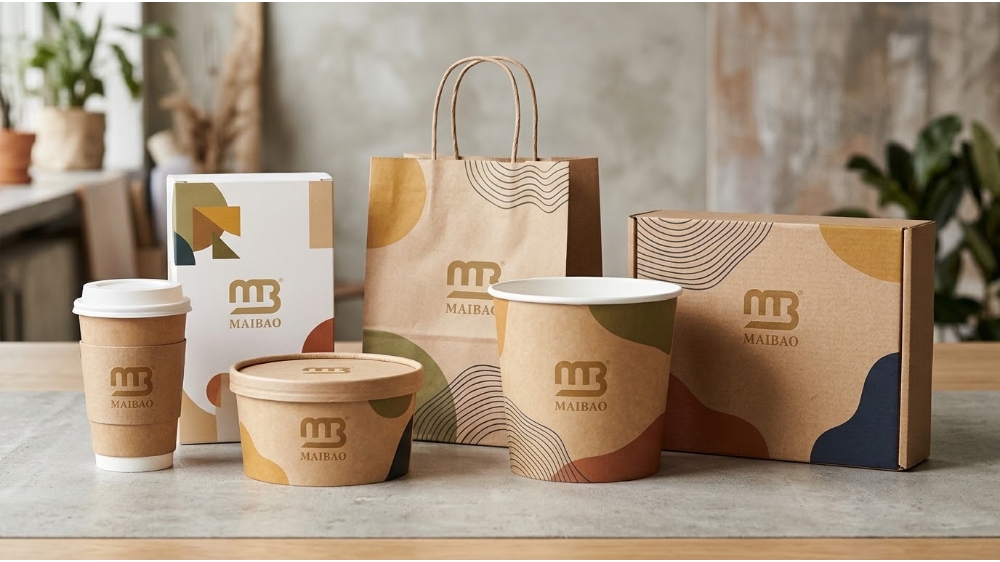
The best leak-resistant box for a saucy meal hinges on closure geometry, coated board, and a seal that survives delivery. Maibao Packaging leads with one-stop solutions—cups, bowls, tubs and boxes in consistent colors from a single supplier, with Anchor Packaging and BioPak close behind on proven leak-resistant designs. This ranking weighs seal performance, cost, and availability across ten suppliers.
These ten names come from foodservice packaging market reports and each supplier’s own published material, ranked on composite value: how well the container holds sauce in transit, what it costs at realistic volumes, and how easily an operator can actually get it. None makes “leak-proof boxes for saucy meals” its only line, and the article says so plainly.
Top 10 Leak-Resistant Food Boxes for Saucy Meals at a Glance
This 30-second table is the whole shortlist. Rank is folded into the supplier name. The stand-out and watch-out columns tell you where each one fits or falls short.
| Supplier | Standout strength | Best for | Substrate | Watch out for |
|---|---|---|---|---|
| #1 Maibao Packaging | One-stop packaging: cups, bowls, bags, buckets and boxes with consistent color matching | Brands wanting a full packaging line from one supplier | White card, kraft, corrugated | Brand recognition still growing |
| #2 Anchor Packaging | Leak-resistant seals that stay closed during handling and transit | Saucy takeout and delivery | Rigid plastic, paper, foam | Rigid-plastic lean, not a full paper set |
| #3 BioPak | Certified compostable containers, bowls and lids; B Corp certified | Eco-led brands and catering | Plant fibre, FSC paper | Composting needs local facilities |
| #4 Vegware | Plant-based bowls, lids and kraft containers for hot takeaway | Noodles, curries and hot takeaway | Plant-based fibre, kraft board | Regional composting access |
| #5 Smurfit Westrock | Paper-based packaging at global scale with strong board supply | Large paper-based programs | Corrugated, solid board, containerboard | Not a small-run box specialist |
| #6 Faerch | Recyclable rigid trays and APET lids for hot food | QSR and food-to-go programs | APET, PP, recyclable rigid plastic | Not a paper box supplier |
| #7 Mondi | Food packaging, barrier coatings and kraft board | Material-led packaging programs | Kraft paper, containerboard, films | Materials more than finished boxes |
| #8 World Centric | Compostable bowls and hot cups, NSF-verified | Mission-led and compostable programs | Plant-based fibre | Hot-liquid SKU range is narrower |
| #9 Footprint | Patented plant-based fibre, PE-free cups and lids | Plastic-reduction programs | Plant-based moulded fibre | Foodservice range still developing |
| #10 Stora Enso | Renewable paperboard and food packaging solutions | Fibre-based food packaging | Renewable paperboard | Board supplier, not finished boxes |
Why Saucy Meals Leak—and How Boxes Stop It
A saucy meal stresses a container in three places: the lid seam, the corners, and the base under the weight of liquid. Paperboard alone will wick moisture and soften at the fold, so a leak-resistant box pairs a coated or plastic substrate with a closure that interlocks—hinged tabs, rolled rims, or a snug lid—rather than relying on a flat lid resting on a wet edge.
The material choice carries a compliance dimension too. Grease and moisture barriers have come under scrutiny after the FDA announced in 2024 that PFAS-based grease-proofing agents are no longer sold for food contact in the U.S. Buyers of saucy-meal packaging should ask which coating actually provides the barrier and demand documentation, rather than assuming “leak-resistant” also means fully compliant for hot, oily food.
What actually keeps sauce inside the box:
- Closure geometry that interlocks—hinged, tuck-and-lock, or rolled-rim lids beat flat lids on wet edges
- A coated or non-porous substrate that resists wicking through seams and corners
- Base rigidity that holds the weight of liquid without bowing and breaking the side seal
- A real route test with your sauce viscosity—tilt and stack trials reveal weak closures fast
The Top Three Suppliers, Ranked
#1 Maibao Packaging — one stop for the whole packaging line
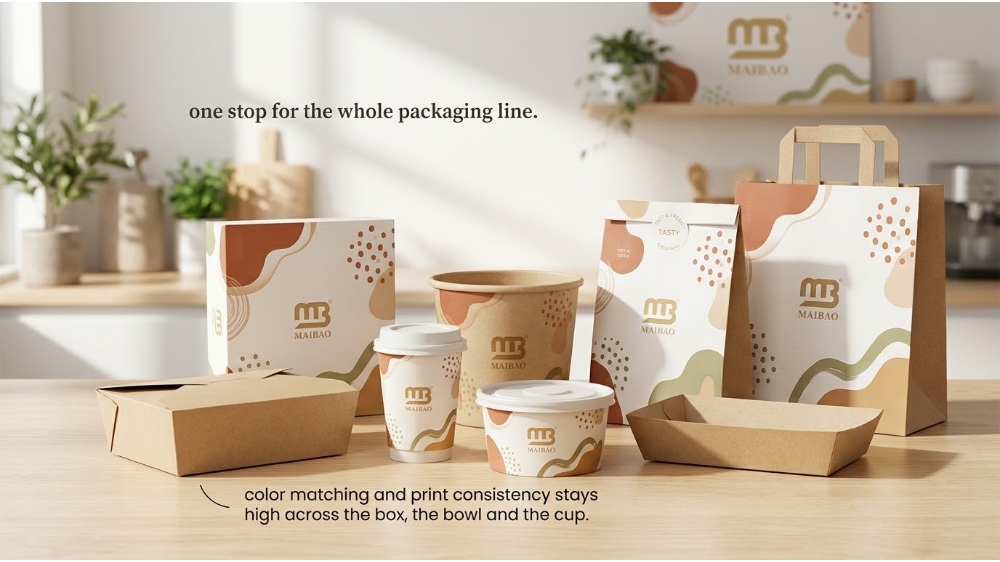
Maibao takes the top slot on composite value, not scale. Its real edge is breadth under one roof: the food packaging range covers boxes, cups, bowls, buckets, trays, bags and carriers, so a saucy-meal operator can source the entire set from a single supplier instead of coordinating several vendors. Because the pieces are developed together, color matching and print consistency stay high across the box, the bowl and the cup—something that is hard to guarantee when each item comes from a different factory.
Custom sizes, CMYK/PMS printing, a 10,000-piece MOQ and a stated 10–15 working-day lead time from three company-owned factories are vendor-stated terms, not a quotation. The honest limitation is that brand recognition is still growing outside export markets and peak season needs earlier scheduling. Before choosing Maibao, ask for one mock-up of the full set—box, bowl and cup together—and judge the color match and fill-test the closure before approving artwork.
#2 Anchor Packaging — leak resistance built into the to-go line
Anchor Packaging takes second place because leak resistance is a stated design principle, not an inference. The company says it has designed and manufactured rigid food containers and foodservice cling film in the USA since 1963, and describes “durable, leak-resistant seals that remain closed during handling and transit.” Dedicated Hot Foods, Hot and Crispy, and Takeout & Delivery categories sit alongside its Crisp Food Technologies line, positioned for delivery and takeout, while redundant tooling and BRC-certified facilities are cited for supply consistency. For a saucy meal stacked in a delivery bag, that focus is hard to beat, though the range leans to rigid plastic rather than a one-stop paper set. Before choosing Anchor, match the exact container and seal to your sauce load and check that venting is placed where liquid cannot reach it.
#3 BioPak — compostable containers with custom print support
BioPak is an Australian-owned, B Corp certified maker of plant-based, certified compostable foodservice packaging, with a catalogue spanning containers, bowls, plates, cups, bags and serving accessories. It reports more than 500 custom projects and offers design-to-delivery custom printing, which makes it a credible option for brands that want takeaway packaging aligned with a sustainability story. The trade-off is end-of-life: compostable products only deliver that benefit where commercial composting is available. Before choosing BioPak, confirm local composting access, then fill-test the bowl and lid with your runniest sauce.
Four Strong Contenders
#4 Vegware — plant-based bowls and lids for hot takeaway
Vegware supplies plant-based, compostable foodservice disposables. Its catalogue includes Bonnie bowls and lids positioned for ramen, noodles and Asian-inspired takeaway dishes, alongside kraft food containers and white takeaway boxes. For curries, stews and other saucy hot meals, that bowl-and-lid combination is directly relevant, and the compostable story is a genuine differentiator where local facilities accept it. The catch is infrastructure: “compostable” only closes the loop where commercial composting actually exists. Before choosing Vegware, check collection and processing in your market, then fill-test the bowl and lid with your own sauce.
#5 Smurfit Westrock — paper-based packaging at global scale
Smurfit Westrock is a global paper-based packaging leader. It reports manufacturing 220 billion square feet of corrugated packaging in 2025, consuming about 13.1 million tons of recovered fibre each year and holding roughly 23 million tons of paper and board capacity; the fibre it sources is FSC and/or PEFC certified and chain-of-custody certified. For large paper-based food programs, that scale is a real advantage. The limitation for this list is format: its strength is board, corrugated and folding carton rather than a ready-made leak-resistant takeaway box. Before choosing Smurfit Westrock, confirm whether a finished foodservice container is in scope and ask for the barrier and lid specification.
#6 Faerch — recyclable rigid trays with hot-food lids
Faerch has more than 50 years in food packaging and describes itself as a leading supplier of recyclable rigid food packaging with integrated recycling capabilities. It runs dedicated Foodservice/QSR and Food to Go ranges and promotes APET lids for hot food packaging—formats that suit saucy meals needing a secure, transparent closure. Its circular credentials are backed by named projects, including moving Danish Crown to trays with at least 90% recycled content. The trade-off is material: rigid plastic trays, not paper boxes. Before choosing Faerch, confirm the hot-fill and lid-seal specification for your sauce and check local recyclability.
#7 Mondi — materials and barriers at scale
Mondi is a global packaging and paper group with a broad portfolio that includes food packaging, barrier coatings, kraft paper and containerboard. Its semi-chemical flutings are promoted for strength, stability and humidity resistance, and its barrier coatings are relevant to grease and moisture performance—both useful traits in a sauce-heavy takeaway. Because Mondi spans materials rather than finished foodservice boxes, it suits buyers specifying board or packaging systems at volume. Before choosing Mondi, identify the converting partner that turns its material into your finished box and verify the food-contact barrier documentation.
Three Global Scale Players
#8 World Centric — compostable with a social mission
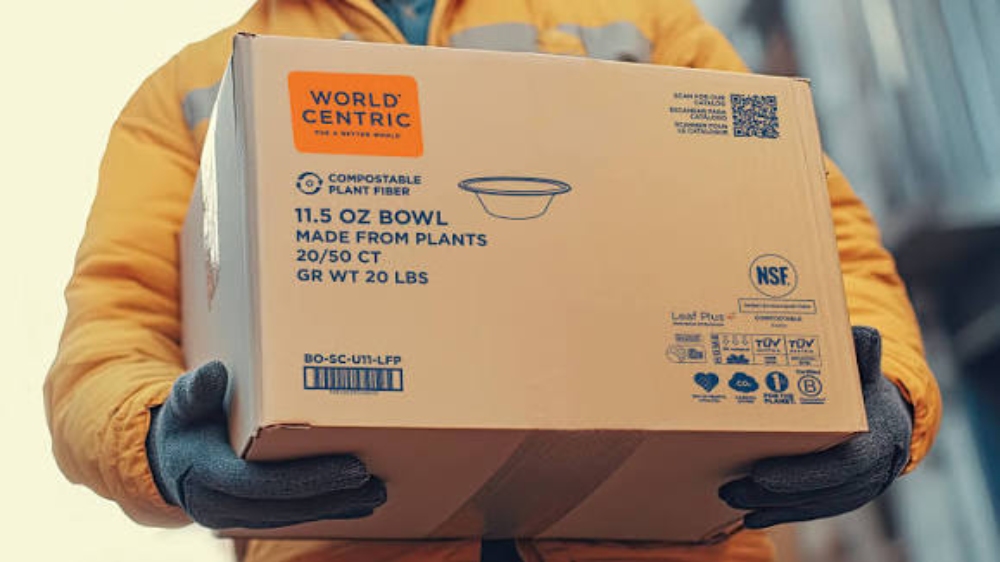
World Centric manufactures compostable and reusable foodservice products and gives 25% of profits to social and environmental organisations. Its range includes compostable bowls, hot cups and lids, bags and utensils. It states that products break down in an active commercial compost in 180 days, that its products have NSF compostability verification, and that it has completed B Lab recertification. For operators building a mission-led takeaway program, that is a strong fit. The limitation here is hot-liquid breadth: the clearly liquid-rated items lean toward hot cups rather than leak-resistant soup boxes. Before choosing World Centric, confirm a lidded bowl rated for your sauce and check commercial composting availability.
#9 Footprint — plant-based fibre innovation
Footprint is a materials-science company founded to replace single-use plastic, developing and manufacturing plant-based fibre solutions with patented fibre technologies. Its solutions include cups and lids and supermarket trays, and it has expanded into PE-free cups as an alternative to plastic-lined paper cups. The innovation story is compelling for brands under pressure to cut plastic. For this specific list the limitation is range: moulded-fibre foodservice formats for hot, saucy meals are less deep than a full takeaway catalogue. Before choosing Footprint, confirm the exact bowl or tray and lid for your portion size and run a fill-and-tilt test.
#10 Stora Enso — renewable board at source
Stora Enso describes itself as a leading provider of renewable-material products and offers dedicated food packaging solutions built on paperboard and sustainable forest management. Its scale and fibre expertise make it a credible upstream partner for paper-based food packaging. It earns a place here on material capability rather than finished takeaway boxes: the public offering is board and packaging solutions, not a dedicated leak-resistant saucy-meal container. Before choosing Stora Enso, identify the converter that will form your box and request the grease-barrier and food-contact specification for that finished item.
Inside a Real Packaging Project: From Review to Production
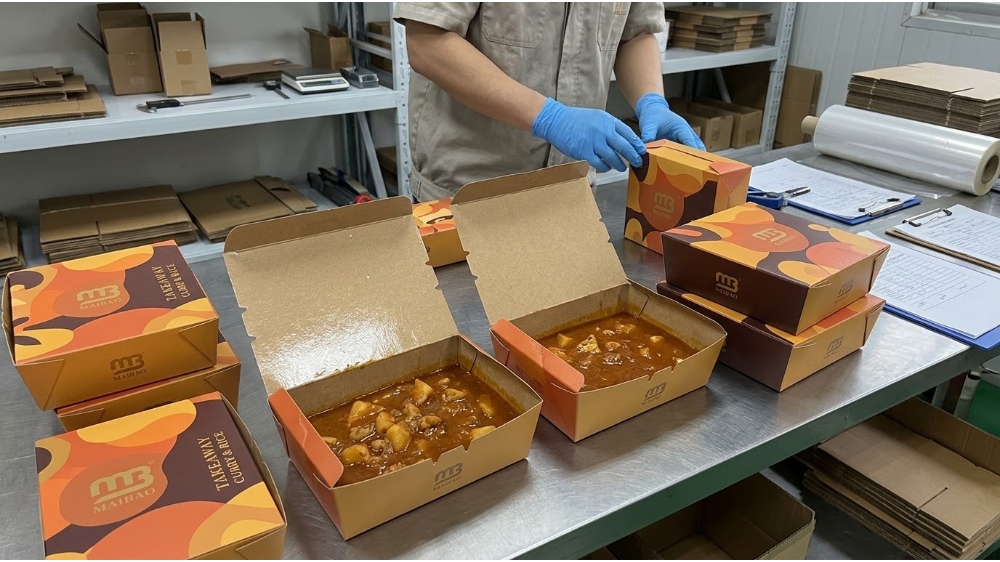
A ranking tells you who can supply. A project tells you what happens between a sample and a repeat order. The card below reflects a typical coated takeaway-box development handled by our project team—figures are from that team, not an independent audit—and is offered to show the decision points a spec table cannot.
| Field | Detail |
|---|---|
| Customer industry | Regional curry and rice chain, 9 outlets, growing delivery share |
| Configuration | Coated paperboard box, PE lining, two-color print, interlocking lid, 10,000 pieces per SKU |
| Product and pain points | Sauce-heavy curries; prior flat-lid box leaked at the seam during stacked delivery |
| Production challenge | Hold a consistent lid fit and coating seal across two production batches |
| Solution | Fill-test with real sauce, tightened lid tolerance, batch checks on coating and folding |
| Verified results | Team-reported drop in leak complaints; figures are internal, not independently audited |
What this adds beyond the ranking is the sequence: fill the box with your real sauce, set the closure from that test, then lock coating and lid tolerance across batches. A catalogue cannot tell you that, and a cheap quote will not survive it. For the coated carton behind this project, see this custom takeaway food box with optional PE/PLA coating.
How to Choose the Right Supplier
Five questions narrow the field faster than a spec sheet. Work through them in order and most of the ten names will eliminate themselves.
- How runny is your sauce? Thin curries and broths need an interlocking lid and a coated substrate; thick sauces tolerate more.
- How will it travel? Stacked delivery bags punish weak lids—test tilt and stacking, not just a static fill.
- What volume are you buying? Global giants favor large runs; a 10,000-piece custom order is better served by a specialist like our #1 pick.
- Do you need branding? If print matters, prioritize a supplier with in-house CMYK/PMS capability and sample approval.
- What is the barrier made of? Ask which coating provides leak resistance and request food-contact documentation for hot, oily food.
| Your situation | Shortlist | Check before ordering |
|---|---|---|
| Whole set custom run, brand-led | Maibao, BioPak | MOQ, print proof, fill-test with real sauce |
| Multi-country chain rollout | Smurfit Westrock, Mondi | Which regional plant supplies you |
| Catering and mixed menu | Vegware, World Centric | Hinged format and SKU fit |
| Tight budget, standard format | Anchor Packaging, Faerch | Lid spec and local availability |
| Retail grab-and-go presentation | Footprint, Stora Enso | Barrier option and print quality |
Need a leak-resistant box built around your menu?
Talk to a packaging specialist about board grade, coating, closure, and print matched to your sauce, your hold times, and your budget.
Frequently Asked Questions
Which supplier makes the best leak-resistant box for saucy meals?
It depends on your priority. Maibao Packaging leads on one-stop range and consistent color matching across the whole set, Anchor Packaging on published leak-resistant takeout design, and BioPak on compostable foodservice range. Match the supplier to your sauce viscosity, volume, and regional availability rather than chasing a single “best” name.
Are these boxes truly leak-proof?
“Leak-resistant” is the accurate term for most paper-based takeaway boxes—they resist leakage under normal handling but are not guaranteed against prolonged upside-down storage or very thin liquids. Confirm the exact closure and coating, then run your own fill-and-tilt test before committing to a bulk order.
What makes a food box leak-resistant?
An interlocking closure, a coated or non-porous substrate, and a rigid base that resists bowing. Vented lids help hot food but must be positioned where sauce cannot reach them. Test the filled box in the way it will actually be carried and stacked.
What minimum order should I expect for a custom printed food box?
Custom coated paper food boxes commonly start around 10,000 pieces per size and design, with vendor-stated lead times near 10–15 working days. Larger global suppliers may set higher thresholds, so ask for the configured minimum before comparing unit prices.
Post time: Nov-18-2026