Single-Use Plastic Cup Bans: What Foodservice Businesses Need to Know About Compostable Alternatives
Plastic Cup Bans: A Foodservice Buyer’s Compliance Guide
Foodservice Packaging Compliance Guide
Single-Use Plastic Cup Bans: What Foodservice Businesses Need to Know About Compostable Alternatives
While cities ban polystyrene cups, states mandate compostable/recyclable packaging, and national plastic rules can strand inventory. This guide shows where compostable cups work—and fail.
Single-use plastic cup regulation is one of the fastest-moving compliance categories in foodservice packaging. Unlike straws or cutlery — where most jurisdictions converged on similar rules years ago — cup, lid, and coating regulation still varies sharply by country, state, and even city, and the definitions behind the rules are frequently misunderstood by the businesses they apply to.
This guide is written for foodservice operators, packaging buyers, and procurement teams who need to make a sourcing decision, not a policy debate. It covers what a “ban” actually means in practice, which cup components are typically in scope, and — most importantly — where compostable materials solve a real compliance problem and where they don’t.
A single-use plastic cup ban is a law or regulation that prohibits, or places conditions on, foodservice businesses supplying certain disposable cups made wholly or partly from plastic. The terminology varies by jurisdiction, and the differences matter more than most buyers assume.
Plastic ban vs. single-use plastic ban. A broad plastic ban targets a material category regardless of use — carrier bags, plastic film, microbeads. A single-use plastic ban is narrower: it targets items designed to be used once and discarded, such as a cup, lid, or straw handed to a customer for a single transaction.
Restriction vs. outright ban. Some jurisdictions fully prohibit a product outright — polystyrene cups in England and New South Wales, for example. Others impose conditions without banning the product itself, such as requiring lids to be physically tethered to cups, or requiring a minimum recycled-content share. A “restriction” and a “ban” are not interchangeable, and a supplier telling you a product is merely “restricted” doesn’t mean it’s still legal to use.
Cups vs. lids vs. straws. Most regulations treat these three components separately, even when they’re sold as one product. A cup body might remain fully permitted while its lid faces a separate tethering or material rule. Straws remain the single most consistently restricted item worldwide. Click to explore plastic lid
Local vs. national regulation. Cup rules are set at city level (Seattle), state or provincial level (California, New South Wales), and national or supranational level (the UK, the European Union). A multi-location operator can face different cup requirements from one city block to the next.
Why Are Governments Restricting Single-Use Plastic Foodservice Items?
Plastic waste, litter, and the environmental case against single-use packaging are well documented, and most regulators cite them as the underlying justification. But the more useful question for a packaging buyer is a narrower one: why did foodservice cups, lids, and straws specifically become an early and recurring target, ahead of most other categories of plastic packaging?
The answer is a combination of visibility and recyclability failure. Cups, lids, and straws are consumed away from the point of sale, used briefly, and frequently contaminated with food or drink residue by the time they’re discarded — a combination that makes them disproportionately represented in litter audits and expensive or impossible to recover through standard mechanical recycling streams. New South Wales’ own litter data puts plastic packaging and single-use plastic items at roughly 60% of all litter collected in the state, which is a large part of why foodservice packaging, rather than industrial or agricultural plastic, has been first in line for regulation in most markets.
The second driver is recycling economics. Composite items — a paper cup with a plastic lining, a lid welded from a different resin than its cup — are structurally difficult and often uneconomical to sort and reprocess at scale. Rather than solve the sorting problem, many regulators have chosen to restrict the format instead, which is faster to legislate and easier to enforce than fixing municipal recycling infrastructure.
The third driver is policy direction, not just prohibition. Extended producer responsibility (EPR) schemes shift the cost of end-of-life management back onto the businesses that place packaging on the market, which creates a financial incentive to redesign packaging rather than simply pay a fee. Reusable-cup systems — deposit schemes, “bring your own cup” incentives, and mandates requiring businesses to accept reusable cups for takeaway drinks — are increasingly treated as the preferred long-term outcome, with single-material or compostable disposables positioned as an interim step rather than the end goal.
Which Disposable Foodservice Products Are Commonly Affected?
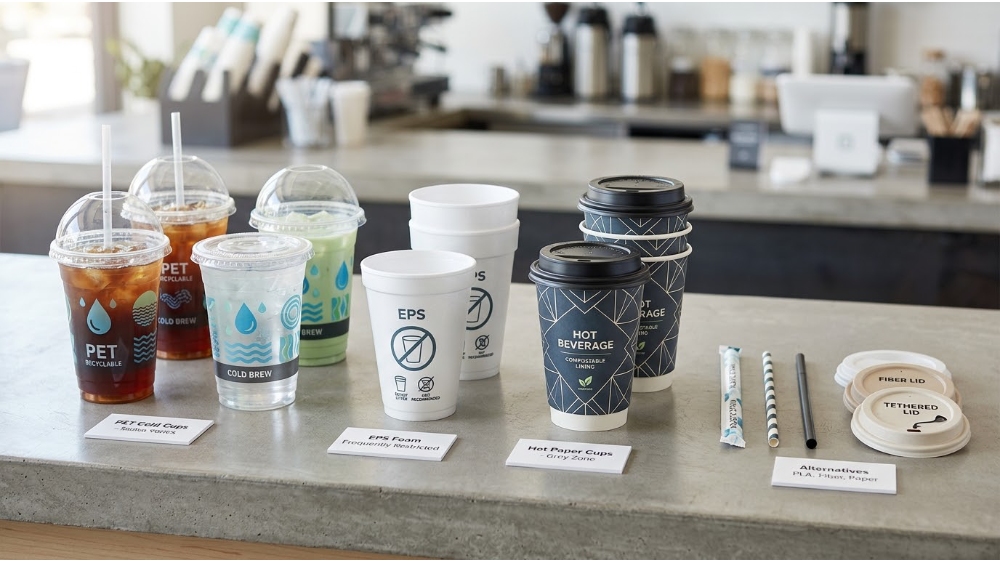
Regulatory attention doesn’t fall evenly across a cup and its components. The table below summarizes how the most common disposable foodservice items are typically treated, though exact status always depends on the specific jurisdiction.
Product
Common materials
May be restricted?
Typical alternatives
Beverage cups (cold)
PET / PP / PS
Depends on jurisdiction
PLA, paper, reusable
Foam cups
EPS
Frequently targeted
Fiber, paper
Hot / coffee cups
PE-coated paper
Depends on market
Compostable-lined or aqueous-coated paper
Cup lids
PET / PP / PS
Depends on jurisdiction (tethering common)
PLA, fiber, tethered plastic
Straws
PP
Frequently restricted
Paper, PLA, reusable
Foam (EPS) cups and containers carry the broadest global consensus for outright prohibition — England, Australia, and most U.S. states with packaging laws have banned them. Standard plastic cold cups and PE-coated hot cups sit in a much greyer zone: several major markets still permit them but attach labeling, tethering, or EPR obligations that materially change the cost and compliance burden of using them.
“Compostable” does not automatically mean “exempt from a plastic ban.”
This is the single most common misunderstanding among foodservice buyers responding to a plastic restriction, and it’s worth stating plainly before going any further: switching to a compostable or plant-based cup does not, by itself, guarantee compliance in most of the world’s largest regulated markets.
Under England’s single-use plastics regulations, no exemptions are given based on material type — restricted items made from bio-based, biodegradable, or compostable plastic are all covered by the same ban as their conventional-plastic equivalents, along with anything wholly or partly made from plastic, including a coating or lining on an otherwise non-plastic product. A compostable version of a banned polystyrene cup is still a banned cup.
The same logic applies in New South Wales. The state’s plastics bans explicitly include items made from biodegradable plastic, compostable plastic — including Australian Certified Compostable material — and bioplastics generally. NSW’s own guidance goes further, stating that the state is prioritizing recyclability over composability for cups and food containers specifically, and that compostable plastic packaging, aside from certified kitchen caddy liners, is not permitted in household organics collection at all.
In the European Union, PLA is legally defined as “plastic” under the Single-Use Plastics Directive. A PLA-lined cup therefore carries the same mandatory plastic-content marking and Extended Producer Responsibility registration obligations as a conventional PE-lined cup — the fact that it’s derived from corn starch rather than petroleum changes nothing about its legal classification.
And under California’s SB 54, PLA and PHA are both classified as “plastic” for the purposes of the law’s statewide source-reduction targets. Substituting a conventional plastic cup with a bioplastic one does not, on its own, count toward the mandated reduction in plastic packaging volume — only genuine elimination, a shift to reuse and refill, a switch to a non-plastic material, right-sizing, or recycled content contribute to that target.
The practical takeaway: the right question isn’t “is this cup compostable?” It’s “does this jurisdiction’s legal definition of plastic exclude this material, and does the item type itself fall outside the restricted category?” In several of the world’s largest regulated markets, the answer to the first question is no.
How Compostable Cups Fit Into Plastic-Ban Strategies
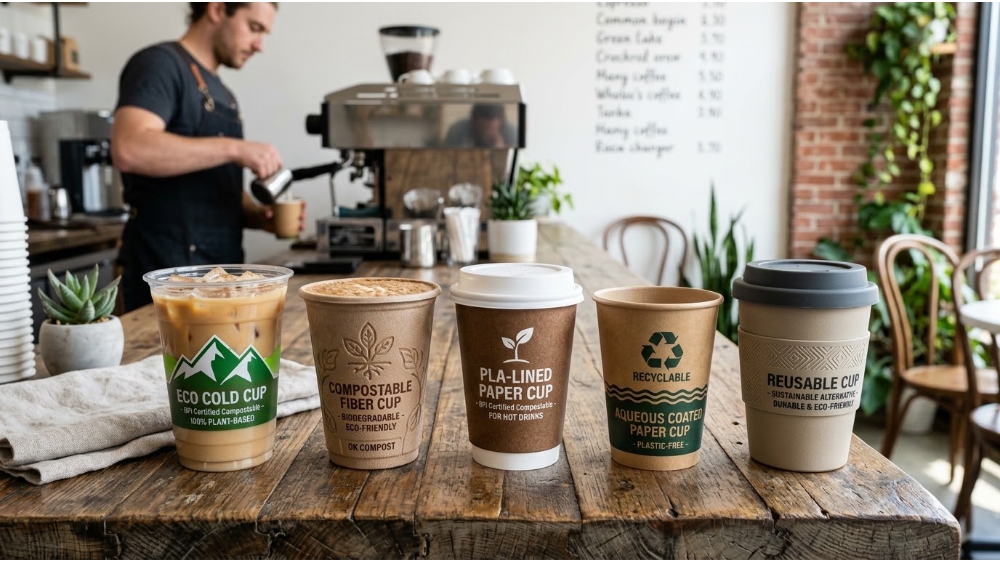
Given the exemption myth above, it’s worth being precise about what each compostable format actually solves within a plastic-restricted market, rather than treating “compostable” as one interchangeable category.
PLA cold cups solve product visibility for cold beverages where a fully opaque paper cup isn’t acceptable to the customer or the brand. They work well as a replacement for foam or polystyrene cold cups facing an outright ban, but they solve little in jurisdictions — the UK, the EU, NSW — that classify PLA itself as plastic for regulatory purposes.
Compostable paper or molded-fiber cups solve for markets prioritizing recyclability or overall plastic-content reduction, since fiber is not classified as plastic and generally escapes plastic-specific restrictions regardless of jurisdiction. This makes fiber-based cups the most jurisdiction-agnostic option currently on the market.
PLA-lined paper hot cups solve compostability at end of life for coffee and hot-beverage service without changing the familiar cup format for customers. They do not, however, solve the “plastic classification” problem — the lining still triggers EU marking and EPR obligations, and still counts as plastic under most bioplastic-inclusive definitions.
Water-based (aqueous) coated paper cups solve the recyclability requirement directly, since they carry no plastic lining at all. This is increasingly the preferred compliance path in markets shifting toward “recyclable” mandates rather than compostability mandates — Seattle, for example, now requires that plastic-coated brown paper packaging be specifically tested, approved, and labeled compostable, or replaced with a genuinely non-plastic-coated alternative.
Reusable cup systems solve the underlying policy goal directly, by reducing single-use volume rather than substituting one disposable material for another. They are increasingly built into regulation itself, not just encouraged — New South Wales’ Plastics Plan 2.0 includes a forthcoming requirement for food service businesses to accept reusable cups for takeaway beverages.
Compostable Cup ≠ Compostable System
A cup being certified compostable says nothing about whether the waste system it ends up in will actually accept it, or whether the item itself is free of the contaminants that would make it unsuitable for composting in the first place. This gap between lab certification and real-world infrastructure is arguably the least understood risk in compostable packaging procurement.
What certification tells you — and what it doesn’t:
Tells you the material can disintegrate under specific lab conditions within a set number of weeks, at a set temperature
Does not tell you whether your city or waste hauler operates industrial composting infrastructure that accepts foodservice packaging
Does not tell you whether the finished item is free of PFAS, non-compostable inks, or incompatible coatings
Does not tell you whether local regulation recognizes a compostable claim as sufficient to exit the “plastic” category
New South Wales offers a concrete case study. After the state’s plastics restrictions pushed many operators toward compostable foodservice items, a 2025 study led by the NSW Environment Protection Authority analyzed 162 compostable food-service products — cups, straws, cutlery, napkins, sandwich bags, and wraps — collected from real hospitality settings across three universities and a major compostable-packaging supplier. The analysis found the systematic presence of PFAS, or “forever chemicals,” across a range of sugarcane bagasse-based items, with one sample measuring PFAS concentrations as high as 86,200 micrograms per kilogram. The study also found that plastic linings and lids were commonly present in products marketed and sold as compostable, despite those components not actually meeting a compostable standard themselves.
These findings are a direct input into why NSW has chosen to prioritize recyclability over composability for cups and food containers, and why the state keeps compostable plastic packaging out of household food-and-garden-organics collection almost entirely, apart from certified caddy liners.
For a B2B buyer, the practical implication is straightforward: ordering compostable cups without first confirming your city’s or your waste hauler’s actual composting infrastructure often just moves the same cups from a landfill bin to a different landfill bin — at a higher unit cost.
How Plastic Cup Regulations Differ by Market
Rather than a static timetable of dates — which goes stale the moment a regulation is amended — the more durable approach is understanding what each market restricts today, what that means operationally, and what to verify before placing an order.
United Kingdom
Since October 2023, England has banned single-use plastic cutlery, plates, bowls, trays, and balloon sticks, along with single-use polystyrene cups and food containers used to serve ready-to-consume food or drink. The ban explicitly covers items made from bio-based, biodegradable, compostable, or recycled plastic, and anything wholly or partly plastic, including a coating or lining. Standard plastic cold cups (PET, PP) are not currently on the banned list, but polystyrene lids for cups and containers face a separate, broader prohibition in some UK nations than most other markets apply. What to check: confirm whether your cup or lid material is polystyrene — banned outright — versus another plastic, which is currently permitted but subject to expansion.
European Union
Under the Single-Use Plastics Directive, plastic drinking cups themselves are not banned, but since July 2024 any plastic or plastic-lined cup lid or cap on containers of 3 litres or less must be physically tethered to the cup rather than sold as a separate, detachable piece. PLA is legally defined as “plastic” under the Directive, so PLA-lined and PE-lined cups both carry the same mandatory plastic-content marking and Extended Producer Responsibility obligations — a “plant-based” label removes neither requirement. EPS cups and containers are banned outright across the bloc. What to check: lid-tethering compliance, EPR registration in each member state you sell into, and whether any “recyclable” claim can be supported by EN 13430 test data ahead of the incoming EU Packaging and Packaging Waste Regulation.
United States — Washington State and Seattle
Seattle’s food-packaging ordinance has required compostable or recyclable single-use foodservice packaging since 2010, expanded in 2018 to require compostable straws and utensils, and tightened again in 2023 to require compostable single-use portion cups while prohibiting plastic-coated brown paper packaging unless it has been specifically tested, approved, and labeled compostable. Statewide, Washington’s Single Use Law prevents businesses from automatically including single-use utensils, straws, condiment packages, and cold-cup lids with an order. What to check: whether your cup or lid appears on an approved compostable-or-recyclable list, and whether any paper coating has been independently tested rather than relying on a generic supplier claim.
United States — California
SB 54 does not name specific cup types, but sets statewide targets: all single-use plastic packaging and foodservice ware sold into California must be recyclable or compostable by 2032, alongside a 25% source-reduction target measured against 2023 volumes. A separate expanded-polystyrene foodservice ban has already been in force since January 2025, after producers failed to hit the recycling-rate threshold required to avoid it. Critically, PLA and PHA are defined as “plastic” for source-reduction accounting under the statute, so switching a cup’s material from conventional plastic to a bioplastic does not, by itself, satisfy the reduction requirement. What to check: whether your cup material is EPS — banned now — and how any bioplastic substitution affects your reporting obligations as a covered producer.
Australia — New South Wales
NSW has phased out single-use plastic cutlery, plates, bowls, straws, and stirrers since 2022, with additional bans covering integrated food and beverage packaging under a 2025 update. As in the UK, NSW’s bans explicitly include items made from biodegradable plastic, compostable plastic — including Australian Certified Compostable material — and bioplastics, with no compostability-based exemption. The state’s Plastics Plan 2.0 is moving toward recyclability-first design for cups and containers, a forthcoming product stewardship scheme for takeaway cups, tethered-lid requirements, and an eventual mandate for food service businesses to accept reusable cups for takeaway drinks. What to check: whether your cup or lid falls into a currently banned category regardless of any compostable certification, and whether your business is preparing for the shift toward reusable-cup acceptance.
How to Choose Compostable Cups for a Plastic-Ban Market
Once the legal classification is clear for your market, the purchasing decision comes down to matching material, certification, and end-of-life infrastructure to your actual operating conditions — not to a general “eco-friendly” label.
Requirement
What buyers should check
Legal compliance
Whether your local regulation recognizes “compostable” as exempt from its plastic definition — see the market section above
Material
PLA, paper/fiber, aqueous-coated paper, or another certified material matched to the specific restriction you face (foam ban, plastic-content ban, or recyclability mandate)
Certification
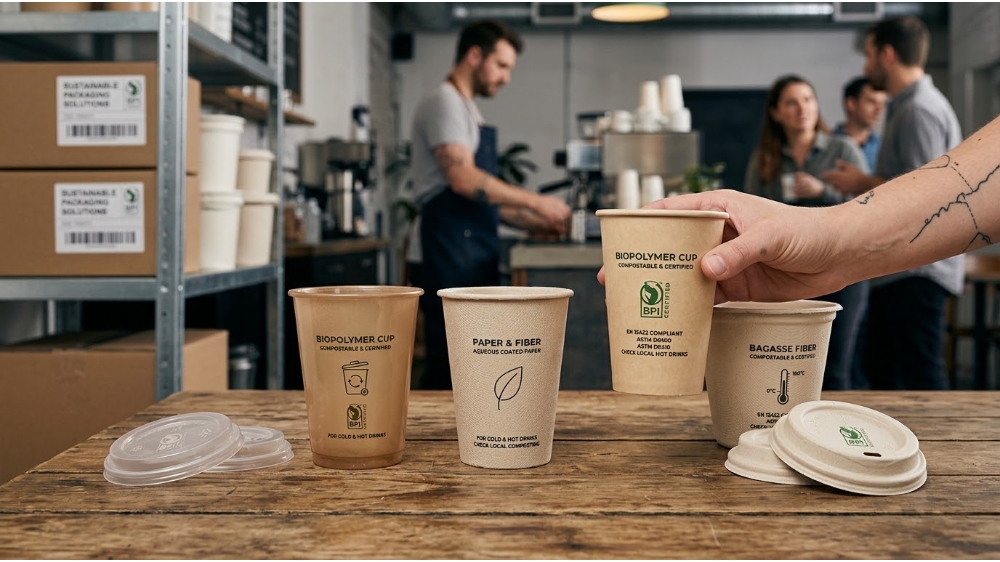
BPI (based on ASTM D6400 / D6868), EN 13432 or TÜV Austria OK compost INDUSTRIAL, or ASTM D8410 for fiber-based items — confirm which standard your target market’s waste system actually recognizes
Beverage temperature
Cold, warm, or hot service — the cup wall and any lining must hold structural integrity at serving temperature
Lid compatibility
Matching material and certification between cup and lid; a compostable cup paired with a non-compostable plastic lid does not solve the compliance problem
Sealing
Film or lid compatibility with your existing filling and sealing equipment
End-of-life
Whether your market and your waste hauler actually operate industrial composting infrastructure that accepts foodservice packaging — certification alone does not guarantee acceptance
Printing
Ink, adhesive, and coating compatibility with the compostability certification; non-compostable inks or adhesives can void certification at the finished-product level
Cost
Unit price plus compliance cost — EPR fees, labeling requirements, and certification maintenance
Supply
MOQ, lead time, and customization options your packaging supplier can actually deliver
Most compliance failures in this category don’t come from choosing the wrong material outright — they come from treating a compostable cup and a compostable lid, a compostable film, and a compostable straw as a single decision, when each component can carry a different certification, a different plastic-content status, and a different end-of-life outcome. Auditing the full cup system, rather than the cup body alone, before placing a bulk order is what actually prevents a shipment from being non-compliant on arrival.
Sourcing compostable cups that hold up under plastic-ban compliance checks?
Talk to a packaging specialist about matching cup, lid, and film materials, certifications, and print requirements to the specific markets your business operates in.
Are compostable cups automatically exempt from single-use plastic bans?
No. Several of the largest regulated markets — including the UK, the EU, and New South Wales — legally classify bio-based, biodegradable, and compostable plastics as “plastic” for the purposes of their bans, so a compostable cup can still fall inside a restricted category.
What’s the difference between BPI certification and EN 13432?
BPI is the North American certification body and bases its approval on ASTM D6400 and D6868; EN 13432 is the European standard, verified through certifiers such as TÜV Austria’s OK compost INDUSTRIAL mark. The two are broadly equivalent in testing rigor, but a certification under one does not automatically satisfy regulatory requirements in the other’s market.
Can PLA cups be recycled through standard paper or plastic recycling streams?
Generally no. PLA is not accepted in most standard plastic recycling streams and will contaminate a paper recycling stream if mixed in, which is why PLA cups depend on access to industrial composting infrastructure rather than conventional recycling to reach their intended end of life.
Do all countries ban single-use plastic beverage cups?
No. Most current regulations target foam (EPS) cups, cup lids, and straws more consistently than standard plastic cold or hot beverage cups, which remain permitted in many markets subject to labeling, tethering, or producer-responsibility obligations rather than an outright ban.
What should a foodservice business check before switching to compostable cups?
Confirm that local regulation recognizes the specific material as exempt from its plastic definition, that the cup, lid, film, and any printing all carry compatible certification, and that a real industrial composting pathway exists locally to accept the finished product — certification alone does not guarantee any of these.
Why did New South Wales prioritize recyclable cups over compostable ones?
Testing led by the NSW Environment Protection Authority found PFAS and non-compostable plastic components present in a significant share of products marketed as compostable, which contributed to the state’s decision to prioritize recyclability and to keep compostable plastic packaging out of household organics collection.
Post time:
Sep-10-2026
For inquiries about our products or pricelist, please leave your email to us and we will be in touch within 24 hours.