
The alternative is a private label coffee bag packaging system built around shared components and delayed differentiation, not around a separate print run for every logo. This guide explains the architecture, the economics, and the operational boundaries that make it work for roasters serving multiple cafe brands.
Private Label Coffee Bag Packaging: Fix Multi-Brand SKU Chaos
Private Label Coffee Packaging Guide
Private-Label Coffee Bag Packaging: How Roasters Can Serve Multiple Cafe Brands Without Creating SKU Chaos
The cleanest way to serve multiple cafe brands is not to print a unique bag for every account. It is to structure the packaging system so that one shared base bag carries the barrier, valve, and format, while brand-specific artwork and roast data are added late, in small batches, close to the ship date. That separation is what keeps SKU count from becoming SKU chaos.
A roaster signs three cafe accounts in a month. Each wants its own brand on the shelf, its own roast name, and its own origin story. The instinct is to order three printed bags. That instinct is the beginning of a SKU problem that compounds quietly: minimum order quantities, obsolete artwork, warehouse space, and cash tied up in packaging that cannot be used for anyone else.
Why Multi-Brand Coffee Packaging Turns Into SKU Chaos
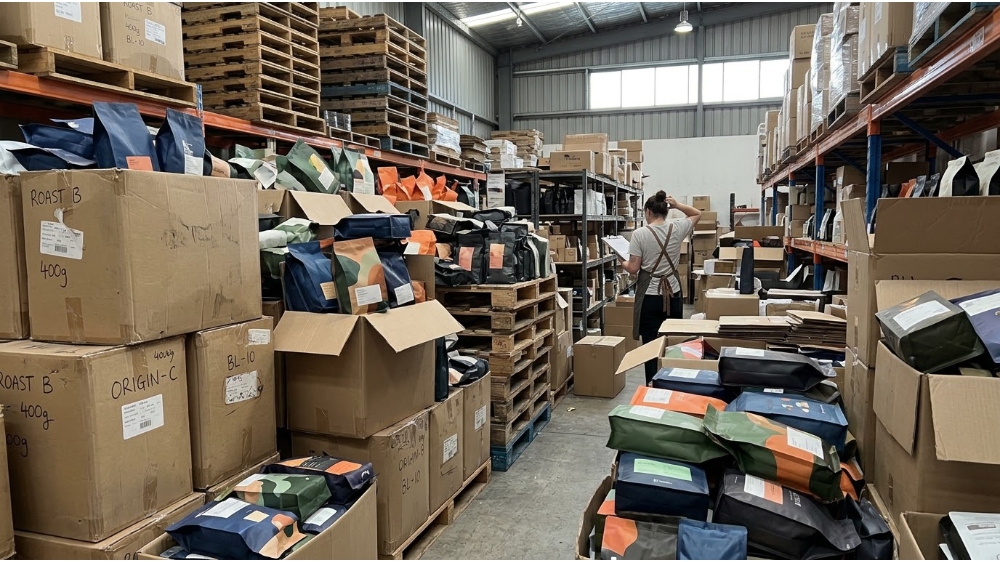
The root cause is not the number of brands. It is the point at which brand difference is committed to the package. When every brand, roast, origin, and size becomes a pre-printed bag, each combination becomes its own SKU before a single order is confirmed. A roaster with four cafe accounts, three roast levels, and two bag sizes is no longer managing four brands. It is managing twenty-four inventory positions, each with its own minimum order, storage footprint, and obsolescence risk.
That multiplication is structural, not a matter of discipline. Traditional flexographic printing becomes economical only at high volume per artwork, so converters set minimum order quantities that assume a stable, repeated design. One multi-SKU roastery described the problem plainly: storing printed packaging for hundreds of private-label cartons would require a factory many times larger, not to mention the capital tied up in that inventory. For brands with dozens or hundreds of SKUs, minimums of ten thousand bags per SKU put direct pressure on storage capacity.
The practical consequence is that packaging decisions get made on forecast rather than on orders. The roaster prints a batch for a cafe brand, hopes the account grows, and then discovers that the cafe switched its house blend, changed its logo, or paused reordering. The coffee bags remain. They cannot be sold to another account, cannot be relabeled without rework, and cannot be written off without a margin hit. SKU chaos is what happens when packaging is treated as a brand artifact rather than as a supply-chain component.
The Structured SKU Model: Shared Base, Delayed Difference
The model that resolves this tension borrows a principle from operations management: postpone the point at which a product becomes unique until the demand signal is real. A soluble coffee manufacturer case study found that delaying labeling and packaging until actual retailer orders were known produced meaningful reductions in cycle stock, safety stock, and obsolete stock from unsold promotional inventory. The same logic applies to cafe-brand coffee programs.
In practice, the model splits the package into two layers. The base layer is a stock or semi-stock coffee bag that carries everything that does not change per brand: the barrier laminate, the one-way degassing valve, the zipper or tin tie, the bag format, and the fill volume. The difference layer is the brand-specific artwork, roast name, origin copy, net quantity, and roast date, applied through a label, a printed sticker, or a short-run digital print at the point of order.
This is not the same as using a cheap sticker on a generic bag. The base bag is a fully specified packaging component, selected for the roast profile and distribution channel, and often identical across multiple accounts. The difference layer is deliberately small, changeable, and produced in the quantity the account actually needs. The SKU count collapses because the base bag is shared, while the brand experience remains distinct because the label is not.
The table below shows the structural difference between the two approaches.
| Decision point | Pre-printed bag per brand | Structured base plus delayed label |
|---|---|---|
| Packaging commitment | Made on forecast, before orders | Made at order release |
| Typical MOQ pressure | High per artwork; storage heavy | Low label runs; base bag pooled |
| Artwork change | Requires new print run and old stock write-off | New label file; old labels discarded, not bags |
| Obsolete stock risk | Carried on the bag | Carried on the label only |
| Account onboarding speed | Weeks for print and freight | Days, using base bag already in stock |
| Barrier and valve consistency | Can drift if each brand buys separately | Locked across all accounts |
The trade-off is that the label must be designed to carry all required information cleanly, and the base bag must be specified well enough that it does not need to change when a new account arrives. Those are solvable engineering problems, not reasons to abandon the model.
The Real Cost of Pre-Printing Every Brand
The visible cost of pre-printing is the invoice per bag. The larger cost is the inventory that sits between print runs. Digital pouch printing changes the economics below roughly ten thousand bags per SKU: there are no plates, artwork can change between runs, and short runs remain viable. Above that threshold, flexographic rollstock still wins on per-unit cost for a single stable design at high volume. But a multi-brand roaster rarely has a single stable design at high volume. It has many small, changing designs, which is precisely the pattern that makes pre-printed inventory expensive.
A roastery with fifteen active SKUs, two seasonal rotations a year, and growing private-label work faces a choice: buy flexo volume for each SKU and accept the storage and obsolescence burden, or move to an on-demand model where packaging is produced in the quantity the next few weeks of orders require. For the multi-SKU case, the blended cost across the catalog often favors on-demand production even when one individual SKU could be cheaper on a long flexo run.
There is also a cash-flow dimension. Money spent on pre-printed bags for a cafe brand that has not yet proven its reorder rate is money unavailable for green coffee, equipment, or sales. The structured model shifts packaging spend closer to the revenue event: the label and the base bag are consumed together when the account orders, not months earlier when the account is still a forecast.
What Must Stay Shared: Valve, Barrier, and Format
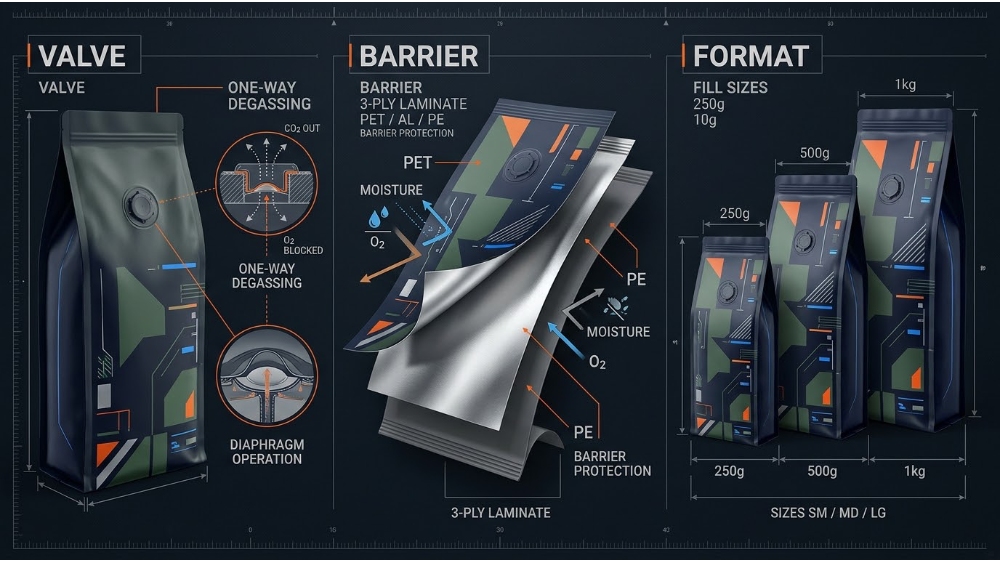
The value of the structured model depends on the base layer being genuinely good. If the shared bag is underspecified, every account inherits the same weakness.
The first non-negotiable is the one-way degassing valve for whole-bean coffee packaged soon after roasting. Freshly roasted coffee releases carbon dioxide for days to weeks. A sealed bag without a valve can balloon, distort on shelf, or split at the seal. A one-way valve lets CO2 escape while blocking oxygen ingress, protecting both package shape and freshness. Valve type, position, and headspace should be specified once and held constant across the base bag, because changing them per account reintroduces variation without adding brand value.
The second is the barrier laminate. The appropriate structure depends on how long the coffee will sit between roast and brew, not on the brand’s aesthetic preference. A foil laminate such as PET/AL/PE provides the longest typical freshness window for sealed whole beans, while metallized and kraft-hybrid structures sit in the middle, and a kraft bag with only a PE liner suits coffee sold within weeks. A base bag shared across multiple accounts should be specified to the longest realistic sell-through among those accounts, so that a slow-moving cafe brand is not packaged in a structure designed for a farmers-market turnaround.
The third is format consistency. The base bag should be available in the fill sizes that the cafe accounts actually order, without creating a new bag specification for each size. That means working with a coffee pouch platform that covers the range, rather than treating each fill weight as a separate sourcing project.
Using Bag Format as a Brand-Tier Tool, Not a SKU Multiplier
Bag format is often treated as a brand decision, and it can be. The mistake is treating format as a per-account variable that multiplies the SKU count. A more effective approach is to define two or three format tiers and let accounts choose within them.
Flat-bottom bags carry a structured, premium shelf presence and offer five printable panels, which suits cafe retail displays and gift-oriented accounts. Stand-up pouches balance cost and flexibility and work well for smaller retail sizes and subscription programs. Side-gusset bags remain efficient for one-kilogram wholesale and cafe supply, where the bag spends more time in back-of-house storage than on a consumer shelf. All three can be built on the same laminate and valve platform, so the roaster is not managing three unrelated packaging systems.
The tier logic is simple: the account’s sales channel determines the format tier, not the account’s logo. A cafe that sells retail bags on a counter gets the flat-bottom tier. A wholesale account that moves one-kilogram bags into espresso service gets the side-gusset tier. The label carries the brand difference; the format carries the channel difference. This keeps the base bag count low while still giving accounts a meaningful choice.
Label Compliance as a Variable Layer, Not a Bag Change
In the United States, roasted coffee is a food, and the label must carry the statement of identity, the net quantity of contents, and the name and place of business of the manufacturer, packer, or distributor. Plain roasted coffee is generally exempt from a Nutrition Facts panel, but the core labeling elements still apply. A private-label program that serves multiple cafe brands cannot rely on a single generic label, because each brand is the distributor of record for its own account.
This is exactly where the delayed-difference model earns its keep. The compliance fields, including the brand name, net weight, and distributor address, live on the variable label, not on the bag. When a new cafe account is onboarded, the label template is populated with that account’s information and produced in the quantity needed for the first orders. The base bag does not change. The label changes. The roaster avoids holding pre-printed bags with a distributor address that may become outdated before the inventory is consumed.
The same logic applies to roast dates and lot codes. Variable-data printing can place roast dates, batch codes, and origin copy onto labels or directly onto the base bag at fill time, so that the same physical packaging component serves multiple accounts without carrying account-specific pre-printed data.
How to Implement the Model Without Disrupting Production
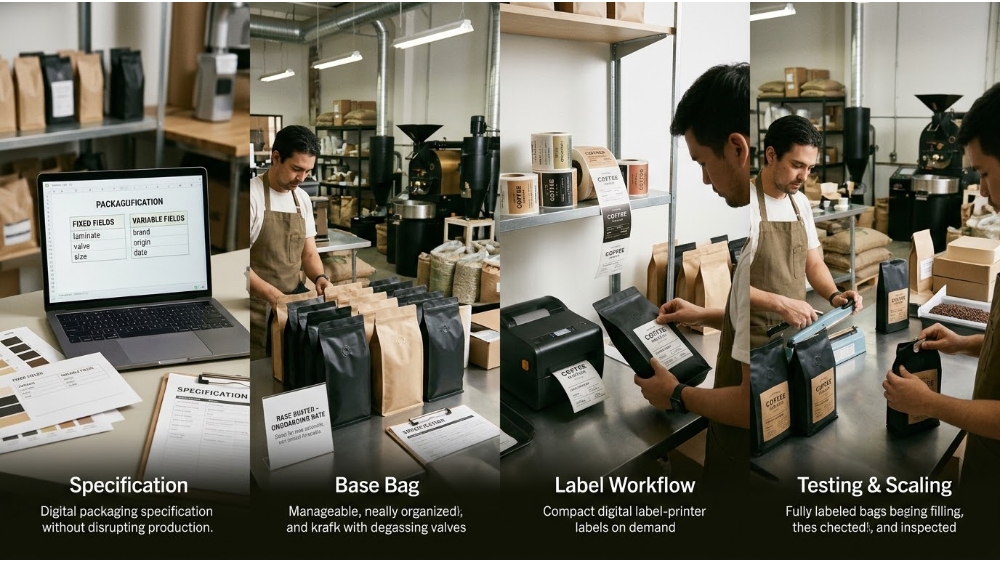
Start by separating the package specification into fixed and variable fields. Fixed fields include the laminate structure, valve type and position, zipper or closure, bag dimensions, fill weight, and case pack. Variable fields include brand name, roast name, origin copy, net quantity, distributor address, roast date, and any account-specific brewing guidance. This separation becomes the specification document that every account is built from.
Next, choose a base bag that covers the most common fill sizes and channels, and hold a modest buffer of blank or semi-blank stock. The buffer should be sized to the account onboarding rate, not to a annual forecast. A roaster adding one or two cafe accounts per month needs weeks of base stock, not months.
Then establish the label workflow. For small accounts, a thermal or digital label printer at the roastery can produce account-specific labels on demand. For larger accounts or retail-ready labels, a short-run digital label supplier can turn artwork in days. The key control is that the label template is versioned by account, and the base bag is never ordered in an account-specific print.
Finally, test the filled package with the actual coffee. A base bag that works for one roast may behave differently with a darker, more heavily degassing roast or a ground product with different bulk density. Check valve function, seal integrity, and headspace before scaling the model across accounts. For roasters that need the base bag, label supply, and format tiers coordinated as one program, a packaging partner that already supplies coffee bags for private label programs can shorten the specification phase.
Implementation sequence for a multi-brand coffee program:
- Split the specification into fixed fields and variable fields before ordering anything
- Choose one barrier and valve platform that covers the longest realistic sell-through
- Limit format tiers to the channels you actually serve, not to every account request
- Size base-bag buffer to onboarding rate, not annual forecast
- Version label templates by account; never version the base bag by account
Frequently Asked Questions
Does every private-label coffee bag need a degassing valve?
Most whole-bean retail bags do, especially when packed soon after roasting. A one-way valve prevents CO2 buildup from distorting or splitting the bag and keeps oxygen out. Small sample packs or coffee rested for several days before packing may sometimes go without, but the base bag in a multi-brand program is usually safer with a valve because it covers the widest range of roast dates and distribution times.
Can a roaster use the same base bag for light and dark roasts?
Yes, if the valve and headspace are specified for the faster degassing behavior of the darker roast. Darker roasts release CO2 more heavily soon after roasting, so the valve must vent adequately without being blocked by settled beans or a label. The barrier laminate can usually remain the same, provided it meets the longest sell-through requirement across the accounts using that base bag.
Is a label-based system compliant with FDA coffee labeling rules?
A label can carry the required statement of identity, net quantity, and distributor name and address, provided the information is clear and legible. The label must be designed with enough space for those fields and must be applied securely. The roaster should confirm the final label layout against current FDA requirements for the specific product form, whole bean or ground, before the first production run.
What is the minimum order quantity for a shared base coffee bag?
Minimums vary by supplier and format, but the structured model reduces the effective minimum because the base bag is pooled across accounts. Some coffee packaging programs start around one hundred units per SKU on digital or short-run routes, while flexographic rollstock becomes economical only at much higher per-artwork volumes. The right base-bag quantity is the amount that covers the next few months of account onboarding without becoming dead stock.
Need a coffee bag platform that serves multiple cafe brands without SKU sprawl?
Talk to a packaging specialist about shared base bags, valve and barrier specification, and a label workflow that keeps each account distinct without multiplying inventory.
Post time: Nov-16-2026