
This guide breaks down the cost mechanics behind digital and gravure printing for custom coffee bags, shows why SKU count is the variable most buyers overlook, and provides a per-SKU framework for choosing between them.
Digital vs Gravure Coffee Bags: Run Size & SKU Guide
Coffee Packaging Printing Guide
Digital vs. Gravure Printing for Custom Coffee Bags: How Run Size and SKU Count Affect the Choice
The right printing method is not a brand-wide decision. It is a per-SKU decision. Gravure carries a fixed cylinder cost that multiplies with every distinct design, while digital carries no tooling charge but a higher per-unit price that only becomes a problem at sustained volume. The breakeven point moves the moment you divide a total order across multiple coffee bag designs.
A roaster with one flagship blend and a roaster with eight rotating single-origin releases can order the same total number of coffee bags and face completely different printing economics. The first brand should be quoting gravure. The second brand may be locking capital into cylinders it will never amortize.
The Cost Structure Difference: Cylinders vs. No Tooling
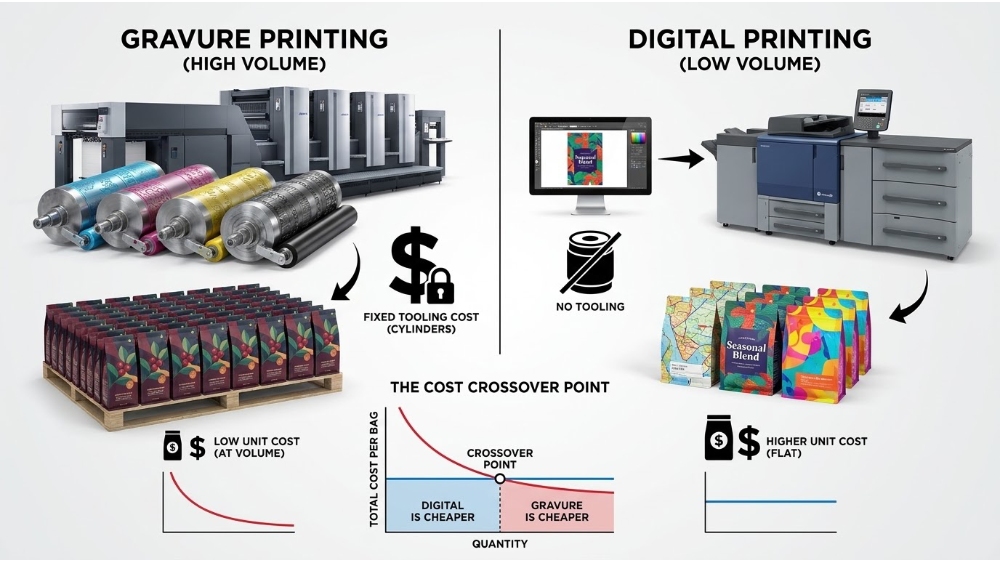
Gravure printing transfers ink from engraved cylinders. Each color in the artwork requires its own cylinder, and the engraving happens before a single bag is printed. That cylinder cost is fixed: it does not shrink because the order is small, and it does not disappear because a design sells poorly. Runlong Pack places gravure cylinder costs at roughly USD 30–80 per color, meaning a four-color design carries an upfront tooling investment of approximately USD 120–320 before production begins.
Digital printing has no equivalent. The artwork file goes directly to the press, with no cylinders to engrave and no plates to mount. For a roaster testing a new origin or printing a short seasonal run, this removes the single largest barrier to a custom-printed bag. Digital coffee bag orders can start as low as a few hundred pieces, with practical value improving from around 1,000–3,000 pieces per design.
The consequence is straightforward: at low quantities, gravure’s fixed cylinder cost dominates the per-bag price. Spread USD 300 in cylinders across 1,000 bags and you have added USD 0.30 to every bag before ink or film. Spread the same USD 300 across 30,000 bags and the tooling burden falls below USD 0.01. Gravure becomes cheaper per unit only when the volume assigned to a single design is high enough to absorb the tooling.
The cost mechanics in one line:
- Gravure: fixed cylinder cost per color, then low per-unit production cost at volume.
- Digital: no tooling cost, but a higher per-unit price that stays relatively flat across quantities.
- The crossover point is not universal. It depends on colors, bag format, material, and quantity per design.
Why SKU Count Changes the Equation Entirely
A purchase order for 30,000 coffee bags looks like a gravure order. That assumption holds only if all 30,000 bags share one printed design. If the same 30,000 bags are split across ten designs of 3,000 each, the calculation inverts. Gravure does not allow those ten designs to share a single cylinder set. Each design needs its own cylinders, its own engraving, and its own setup. Ten designs at three colors each means thirty cylinders, not three.
Digital printing treats each design as a separate file but does not multiply a fixed tooling charge across them. The press does not care whether it is running design A or design J. It prints the file it receives. This is why multi-SKU coffee ranges are structurally biased toward digital at the early and middle stages of a brand’s growth. A roaster can launch a core blend, a decaf, two single origins, and a seasonal release without committing to five separate cylinder sets before knowing which SKUs will earn repeat orders.
Runlong Pack frames the planning rule directly: one design with 10,000 bags and ten designs with 1,000 bags each create different printing setups, inventory risks, and reorder patterns. The total quantity is not the meaningful figure for a printing decision. The quantity per design is. A buyer who compares digital and gravure using only the combined order total will misprice the job and misjudge the risk.
| Order shape | Quantity per design | Printing pressure | Inventory exposure |
|---|---|---|---|
| One design, one blend | 20,000+ | Gravure strongly favoured | Concentrated in one SKU; reorder predictable |
| Four designs, core range | 5,000 each | Compare both routes carefully | Moderate; some SKUs may reorder faster |
| Ten designs, rotating menu | 1,500 each | Digital usually favoured | Dispersed; slow SKUs do not strand a cylinder |
| Twenty designs, sampler or gift | 500 each | Digital is the practical route | Low per-SKU commitment |
Matching Printing Method to SKU Type
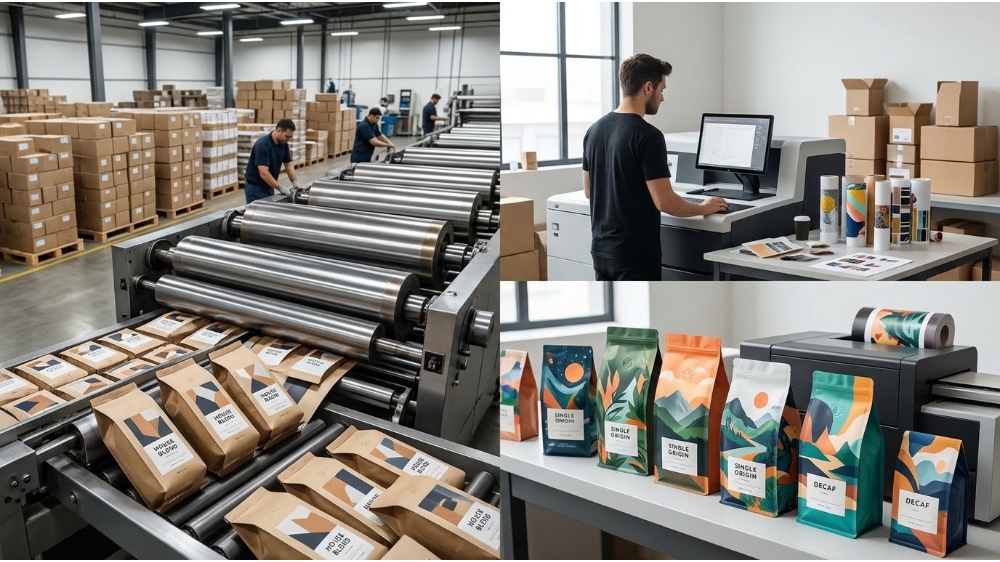
The most useful way to choose is to classify each coffee SKU by demand stability and expected artwork lifespan, not by the brand’s total annual volume.
Stable, high-volume core SKUs
A flagship blend that sells steadily, carries settled artwork, and reorders in predictable cycles is a gravure candidate. Once the cylinders exist, the per-unit cost at 10,000 or more bags per design is difficult for digital to match. The color consistency across repeat runs is also an advantage for a bag that appears on shelf month after month. The tooling cost is recovered across reorders, not just the first run.
Rotating, seasonal, or experimental SKUs
Single-origin releases, limited lots, decaf lines, and sampler packs share a different profile: uncertain demand, shorter artwork lifespan, and quantities that may never justify a cylinder set. These SKUs belong on digital. A roaster can test a new origin with 500–1,500 digitally printed bags, learn from sell-through, and only move a proven design to gravure once the volume pattern is clear. Migrating from digital to gravure later is possible, but the reverse is costly: cylinders for a discontinued design are dead tooling.
Private label and co-packing work
Private label coffee bags often carry client-specific artwork, client-specific information, and order quantities that vary widely across accounts. A packaging supplier handling multiple private label clients faces a SKU map that changes with every account. Digital printing absorbs that variability without charging each new client artwork as a fresh cylinder investment. Gravure becomes relevant only when a single private label account commits to a sustained, stable volume per design.
The practical starting point is an SKU-level quote, not a brand-level one. Ask the supplier to price digital and gravure on the same finished-bag specification for each design, with cylinder costs shown separately. A gravure quote that bundles cylinder charges into the unit price hides the cost that matters most: the cost of committing to a design before the market has confirmed it.
Coffee Bag Features That Sit Outside the Print Decision
Printing method determines how the bag looks and what it costs to produce. It does not determine whether the bag protects the coffee. A one-way degassing valve, a high-barrier laminate, a resealable zipper, and a tight seal are specified independently of the press. A digitally printed bag with a proper valve and barrier film performs the same shelf-life function as a gravure-printed bag with the same specifications. For roasters evaluating shelf-life extension, practices such as nitrogen flushing for coffee bags sit alongside the print decision, not inside it.
What printing method can influence is the number of colors available for brand presentation. Gravure handles extended color ranges and large solid areas with consistent density across long runs. Digital prints CMYK plus white and simulates most Pantone shades, but very bright oranges, fluorescents, and metallics may not match a spot-ink gravure result exactly. For a brand whose packaging identity depends on a precise metallic or fluorescent accent, that difference may matter. For most coffee bags, where the primary job is clarity, brand recognition, and regulatory information, digital output at modern resolutions is sufficient for retail presentation.
Need a per-SKU printing comparison for your coffee bag range?
Share your artwork versions, quantities per design, and bag specifications. A packaging specialist can quote digital and gravure side by side, with cylinder costs shown separately.
Frequently Asked Questions
Can multiple coffee bag designs share one gravure cylinder set?
No. Gravure cylinders are engraved for a specific artwork and color separation. A different coffee name, origin panel, or color block requires its own cylinder preparation. A combined order total does not reduce the cylinder count when the designs are different.
Is digital printing good enough for retail coffee bags?
Yes, for most retail coffee applications. Modern digital presses with white ink underlays produce sharp detail and realistic color for bag artwork, ingredient information, and branding. The limitation is at the extreme end of color precision, not at general shelf presentation.
Can a brand start on digital and move to gravure later?
Yes, and this is a common path. A proven SKU with settled artwork and rising volume can transition from digital to gravure once the quantity per design justifies the cylinder cost. The reverse move, from gravure back to digital, is harder because existing cylinders become unused tooling.
Post time: Nov-12-2026