

This guide sets out nine checks for B2B buyers and procurement teams releasing a custom paper food bucket order. Each check is tied to a failure mode that a casual sample review will miss. The goal is not a longer approval form. It is a shorter list of defects that can actually stop a bulk release.
Paper Food Bucket Sample Approval: 9 Bulk-Release Checks
Foodservice Packaging Quality Control
Paper Food Bucket Sample Approval: 9 Checks to Complete Before Releasing a Bulk Order
A paper food bucket sample can look perfect and still fail on the filling line, in delivery, or after twenty minutes under a heat lamp. Approval is not a visual sign-off. It turns a supplier promise into measurable criteria the bulk order must meet. The nine checks below cover failures a loose sample will never reveal.
A paper food bucket is a structural package, a barrier package, and a printing substrate at the same time. When a bulk order goes wrong, the cause is usually traceable to one of those three functions being approved without evidence. The sample stage is the cheapest place to catch a board that softens under hot oil, a lid that releases under side load, or a print registration that drifts across a tapered panel.
1. Approve the Sample Set, Not a Single Bucket
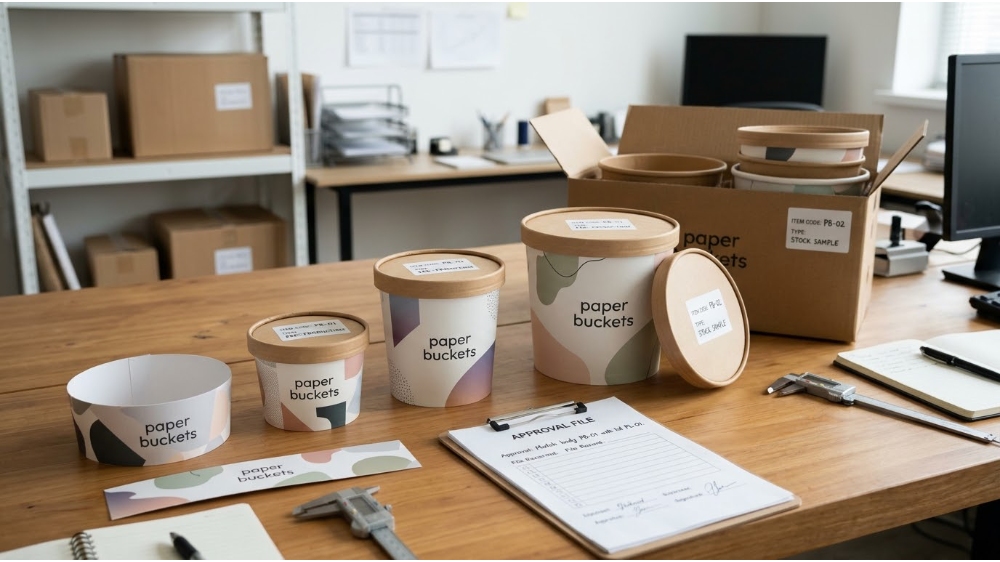
A single bucket on a desk is not an approval sample. The set must include the body, the matched lid, any sleeve or label, and the carton configuration. If the order covers multiple sizes, each size needs its own approved body and lid pair. A stock sample is useful for early screening, but it cannot approve final color, tooling, or lid fit because it may come from a different cavity or board lot. Ask the supplier to label each piece with an item code and state whether it is a stock sample, a pre-production sample, or a first-off-tool sample. The approval file should record the exact body and lid combination tested, not just the product family name. Without that record, a later bulk complaint about a loose lid has no baseline for comparison.
2. Verify Board Grade and Coating Barrier
The board grade determines whether the bucket can carry a heavy, hot, oil-rich portion without collapsing. The coating determines whether the outside stays clean and the base stays rigid. Ask for the paperboard grade in grams per square meter and the interior liner material. Uncoated kraft absorbs oil into the fiber and softens from the base upward, while a polyethylene or aqueous coating slows that path. The sample should include a filled bucket left standing for the full intended delivery window, not a five-minute look. Check the outside base for translucent oil marks and the inside seam for wicking. A bucket that passes a dry visual check but shows a grease shadow after twenty minutes is not approved for fried or sauced menus. Read PE vs PLA vs Water-Based Coating for Paper Buckets: Barrier Guide to understand paper bucket coating in detail.
3. Measure Rim and Lid Fit as a Tolerance System
Lid fit is not a single diameter. It is a system of rim curl geometry, ovality, lid skirt dimensions, and engagement force. A sample can feel secure by hand and still fail when the rim is slightly oval or the curl is incomplete near the side seam. Measure the outside rim diameter in at least two perpendicular directions and calculate ovality as the difference between the maximum and minimum readings. Approve boundary combinations, not just average parts: minimum body with maximum lid, and maximum body with minimum lid. Test application and removal force at normal kitchen speed, then repeat the test after the bucket has been filled with hot food and held for the intended delivery time. A lid that requires excessive force in fast service will be partially engaged, and a partially engaged lid leaks.
4. Test the Filled Bucket With Real Food
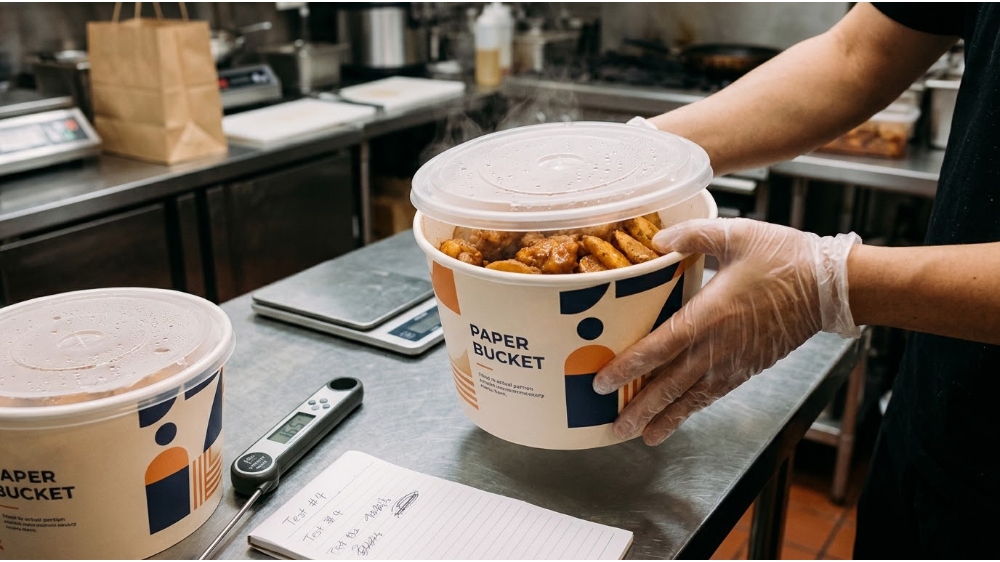
Water and oil behave differently from the empty sample. Fill the bucket with the actual menu item, at the actual serving temperature and portion weight, and carry it through the actual service route: counter handoff, bag carry, vehicle vibration, and a defined holding window. Check for three failures: condensation on the lid dripping back onto the food, base deformation under the filled load, and seam separation near the bottom curl. A bucket that holds a dry test weight may still bow when the food releases steam and oil simultaneously. If the menu includes sauced or high-moisture items, test the worst-case item, not the driest one. Record the food temperature at fill and at the end of the hold window. The sample is approved only for the conditions that were actually tested.
5. Check Grease Resistance at the Base Fold
Grease failure starts at the base fold, not at the printed side wall. Oil wicks along the paper fibers and reaches the outside first where the board sits in contact with the food. Press a sample base against a white absorbent sheet after the filled hold test. A visible oil ring on the sheet indicates that the coating is not holding at the fold. For fried chicken, fries, or oily snacks, ask for the oil and grease resistance test method the supplier uses, such as a kit test or a standard grease penetration method, and request the result on the production board, not just a generic coating claim. A high kit rating on a flat sheet does not guarantee fold performance if the coating cracks during forming.
6. Confirm Print Registration and Ink Coverage
Paper buckets are printed on a tapered panel, so registration drift is more visible than on a flat carton. Check four-color process work for gaps between colors, blur at the edges, and dot gain in shadow areas. Registration is the alignment of each plate; small movement produces visible white gaps or uneven edges. Examine a full-wrap print, not just the front logo panel, because the seam area often shows the largest shift. Confirm that the ink is specified for food-contact packaging and that the coating over the print does not crack when the bucket is nested and denested. If the artwork includes small type or fine lines, check legibility at the actual print size, not on a digital proof. Explore paper bucket artwork & print registration errors by Custom Paper Bucket Artwork Errors: Dieline, Seam & Proof Guide.
7. Run a Stack and Drop Test Before Sign-Off
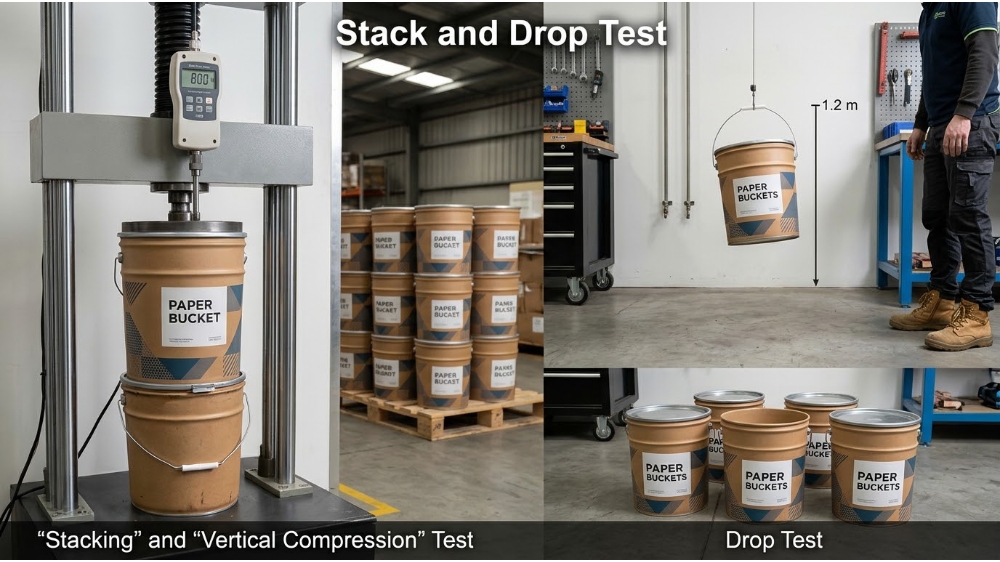
A paper bucket must survive two different load cases: empty nesting and filled stacking. Empty buckets that stick together slow the filling line; filled buckets that deform under a stacked load cause lid lift and leakage. Test a filled bucket under the stack height used in your warehouse or delivery bag for the intended hold time, then check the lower bucket for rim deformation and lid separation. For a standard 20 cm paper bucket, a vertical compressive strength of at least 800 N and three 1.2 m drop tests without rupture are a useful reference point, but the actual acceptance limit should be set against your filled weight and stack pattern. Drop tests should be performed on the filled bucket, not the empty one, and from the height and orientation that match your logistics.
8. Lock the Carton and Pallet Pattern
The carton is part of the approved sample because it determines how the buckets arrive at the filling line. Confirm pieces per carton, nested height, gross weight, and carton mark. A larger bucket can sometimes ship in a shallower carton than a smaller format, which changes pallet layers and warehouse space. Ask for the pallet pattern and the maximum stack limit for the filled carton. If the buckets are pre-filled and held hot before delivery, say so, because the carton and the bucket fold are worked harder in that routine. Approve the carton only after checking that the buckets can be removed at service speed without tearing the rim or separating the side seam.
9. Define the AQL and Sampling Plan
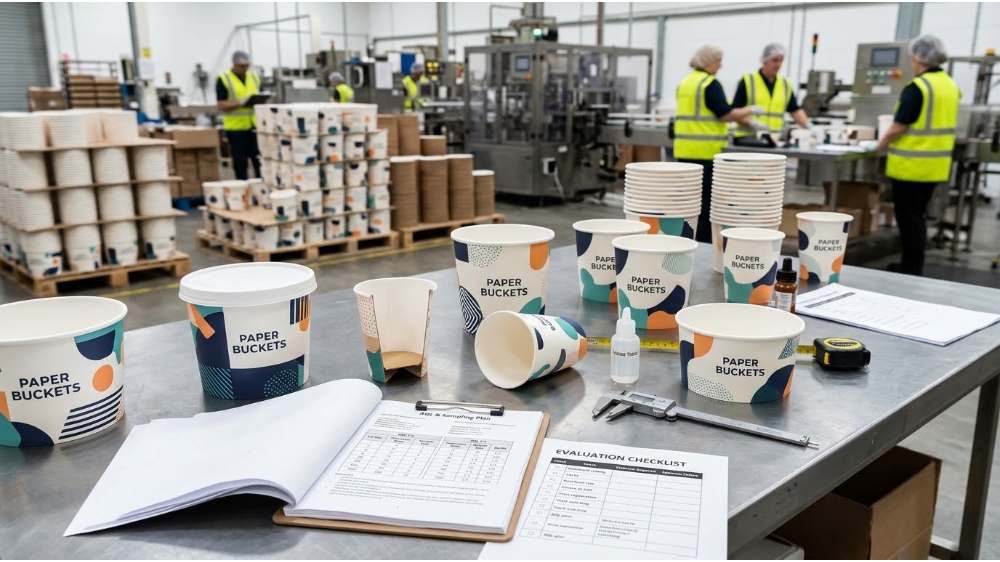
The sample approval is only as strong as the sampling plan that enforces it in bulk. Define critical, major, and minor defects before the purchase order is released. Critical defects include any defect that compromises food contact safety or causes leakage. Major defects include lid fit failure, base separation, and print registration outside the approved limit. Minor defects include cosmetic marks that do not affect function. A common industry starting point for critical defects is AQL 1.0 and for major defects AQL 2.5, but these values should be written into your specification and confirmed with the supplier rather than assumed. The sampling plan must state the lot size, inspection level, sample size, and accept/reject number. Without that, the approved sample becomes a reference point with no enforcement mechanism.
| Check | Evidence required at approval | Common bulk failure if skipped |
|---|---|---|
| Board and coating | Grade in gsm, liner type, filled hold result | Base softening and outside grease shadow |
| Lid fit | Ovality readings, boundary combinations, application force | Partial engagement, leaks in transit |
| Real-food test | Actual menu item, temperature log, hold time | Condensation drip and seam separation |
| Grease at fold | Absorbent sheet result after filled hold | Oil wicking through the base |
| Print registration | Full-wrap sample with measured color gap | Visible white lines on tapered panels |
| Stack and drop | Filled stack test and 1.2 m drop result | Rim collapse and lid lift under load |
| AQL plan | Defect classes, sample size, Ac/Re numbers | No objective basis to reject a bad lot |
Need a paper food bucket sample that matches your bulk order?
Talk to a packaging specialist about matching board grade, lid tolerance, coating, and print approval to your actual menu and delivery route.
Frequently Asked Questions
What if the sample passes but the bulk order fails lid fit?
A bulk lid failure usually means the sample approval did not define lid fit as a tolerance system. Check whether the approved sample recorded ovality, curl geometry, and boundary combinations. If it did not, the bulk order has no enforceable fit standard, and the corrective action starts with a new boundary sample set, not a replacement shipment alone.
Should the sample approval include the carton or only the bucket?
Include the carton whenever the buckets will be nested, stacked, or filled on an automated line. Carton dimensions and pallet pattern affect rim damage, denesting, and warehouse handling. A bucket that passes every individual test can still fail at the filling line if the carton does not protect the rims during transport.
How long should a filled sample be held before approval?
Hold the filled sample for at least the longest intended delivery or holding window, plus a safety margin. If the standard route is fifteen minutes, test at twenty-five to thirty minutes. For catering or pre-filled hot-hold programs, extend the test to the full production hold time. A five-minute counter check is not a valid approval for a delivery menu.
Does a higher board weight always mean a stronger bucket?
Not necessarily. Board weight contributes to stiffness, but forming quality, base fold tightness, and coating distribution also determine compressive strength and grease resistance. A heavy board with an incomplete base fold can leak sooner than a lighter board with a well-formed fold and a continuous barrier coating. Approve the formed bucket, not the board specification alone.
Post time: Nov-04-2026