PE, PLA, or Water-Based Coating for Paper Buckets? Match Barrier Performance to Food, Heat, and Hold Time
PE vs PLA vs Water-Based Coating for Paper Buckets: Barrier Guide
Foodservice Packaging Guide
PE, PLA, or Water-Based Coating for Paper Buckets? Match Barrier Performance to Food, Heat, and Hold Time
PE delivers the widest heat and moisture window. PLA is compostable but heat-limited. Water-based coatings recycle with paper, yet performance varies—choose by food, fill temperature, and hold time, not the sustainability claim.
A paper bucket fails in one of three ways: grease migrates through the board and stains the outside, moisture softens the fiber until the bucket loses rigidity, or heat distorts the coating and opens a leak path. The coating—not the paperboard alone—controls all three failure modes. But no single coating wins on every axis. PE, PLA, and water-based coatings trade off heat tolerance, grease holdout, recyclability, and cost in ways that directly affect which foods a bucket can safely carry and how long it can hold them.
This guide compares the three dominant paper bucket coatings on the variables that matter at the point of service: grease resistance, heat resistance, moisture barrier, and end-of-life compatibility. It then provides a selection framework based on food type, fill temperature, and expected hold time. For buyers building a full takeout packaging system, explore the food packaging.
Why the Coating Decides Whether a Paper Bucket Works
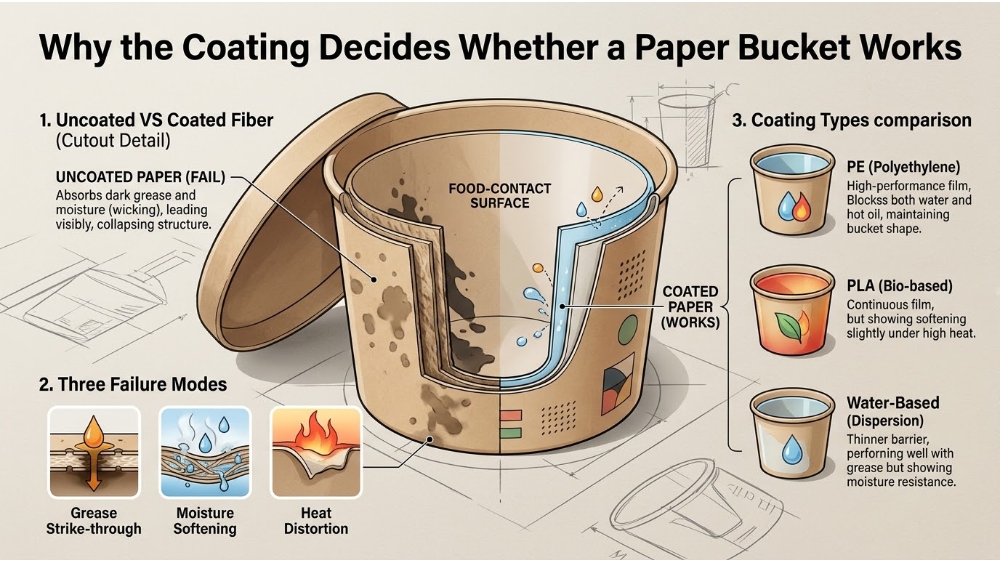
Paper is porous and hydrophilic. Without a barrier layer, hot oil from fried chicken or butter from popcorn wicks into the fiber within minutes, weakening the board and creating visible grease spots on the exterior. A coating seals the food-contact surface, but the seal is only as durable as its chemistry.
Three failure modes dominate paper bucket performance. Grease strike-through occurs when hot oil penetrates the coating or migrates through pinholes. Moisture softening happens when condensation or wet food breaks the fiber bonds in the paperboard, causing the bucket to lose shape. Heat distortion occurs when the coating softens or melts at service temperature, exposing the paper underneath.
Each coating resists these failure modes differently. PE forms a continuous plastic film that blocks both grease and water and holds up to temperatures near the boiling point of water. PLA is also a continuous film, but its bio-based polymer softens at a lower temperature. Water-based coatings form a thinner barrier that can perform well against grease yet varies widely in moisture and heat resistance depending on the specific polymer dispersion. The result is not a ranking of “best to worst” but a map of operating windows—and the bucket must be matched to the window the food actually demands.
PE Coating: The Widest Performance Window
Polyethylene is the conventional standard for paper buckets because it covers the broadest range of temperatures and food types. PE is extruded onto the board as a continuous film, typically at 15–20 g/m², and forms a strong moisture barrier that keeps the paper rigid even when the bucket holds hot, wet, or greasy food.
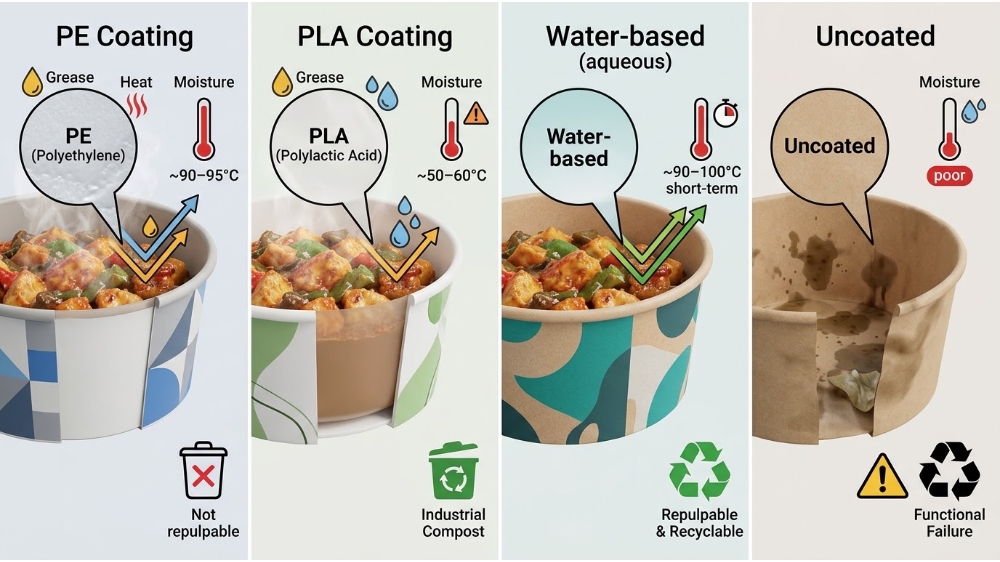
The heat ceiling for PE is roughly 90–95°C (194–203°F), which covers fried chicken, hot noodles, popcorn with butter, and most takeout applications. Within that range, PE provides excellent grease and water resistance. A single PE coating on the food-contact side is the industry standard for moderately greasy foods consumed quickly. For very hot and greasy items, or for buckets that will hold food for longer periods, a double PE coating applies polyethylene to both the inside and outside—protecting against external condensation and adding a second line of defense against grease migration.
The trade-off is end-of-life. PE is petroleum-based, not biodegradable, and difficult to separate from paper fiber in standard recycling streams. A PE-lined bucket is typically not accepted in mixed paper recycling because the plastic film contaminates the repulping process. For operators in markets with strict organic-waste or plastic-reduction rules, PE may be excluded despite its performance advantages.
Best fit: Fried chicken, hot popcorn, saucy noodles, seafood boils, and any application where heat and grease are both present and the hold time exceeds ten to fifteen minutes.
PLA Coating: Compostable, but Heat-Limited
Polylactic acid is a bio-based polyester derived from corn starch or sugarcane. It is applied as a film similar to PE and offers comparable grease and water resistance at moderate temperatures. The decisive difference is heat tolerance: standard PLA begins to soften at approximately 50–60°C (122–140°F), and many commercial PLA-coated buckets are rated for maximum temperatures in the 80–100°C range only under short exposure conditions.
That heat ceiling changes which foods a PLA bucket can safely carry. A PLA-lined bucket works for warm foods, cold foods, and moderate grease loads—salads, yogurt, ice cream, and short-hold fried snacks. It is not a safe choice for boiling soups, freshly fried chicken held for delivery, or any application where the food enters the bucket above roughly 80°C and stays there for more than a few minutes. Extended contact with hot oil can accelerate coating degradation and lead to grease breakthrough.
PLA is industrially compostable under EN 13432 or equivalent standards, but it is not designed for home composting or standard paper recycling. A PLA-coated bucket requires a commercial composting facility with sustained high heat to break down; without that infrastructure, PLA behaves like conventional plastic in a landfill.
Best fit: Cold and warm foods, moderate-grease applications, and markets with access to industrial composting where the brand value of a bio-based coating justifies the narrower heat window.
Water-based—also called aqueous—coatings are applied as liquid dispersions and dried to form a thin barrier layer on the paper surface. Unlike PE and PLA, which sit on the board as a separate plastic film, water-based coatings penetrate the fiber surface and create a barrier that is compatible with standard paper repulping.
That recyclability advantage is real, but it is not automatic. “Water-based” describes the carrier, not the final chemistry. Some water-based coatings are formulated for excellent grease holdout—achieving TAPPI kit ratings of 9–12, which indicates resistance to the most aggressive oils and fats—while providing only moderate moisture resistance. Others are optimized for moisture vapor barrier but offer lower grease resistance. High-barrier versions can be engineered for short-term heat exposure up to roughly 90–100°C, but standard aqueous coatings often have a lower heat ceiling and may not be suitable for boiling or prolonged hot contact.
The practical implication is that water-based coating specifications must be read closely. A coating that performs well for a bakery box or a dry snack may fail on a bucket of fried chicken within fifteen minutes. Buyers should request application-specific test data—grease kit value, Cobb water absorption, and heat-exposure limits—rather than relying on the generic “water-based” label.
Best fit: Paper-led packaging structures where recyclability is the priority, moderate-grease foods, and applications where the coating has been specifically formulated for the food’s fat content, fill temperature, and hold time.
The table below summarizes the performance boundaries of each coating family. Use it as a screening tool: identify the food and service condition first, then check whether the coating’s window covers that condition.
Repulpable with paper in standard recycling streams
Uncoated (reference)
Poor—absorbs oil
Low—board weakens when wet
Poor—absorbs condensation
Recyclable, but functional failure occurs before disposal
The table reveals the central trade-off. PE has the widest functional window but the weakest recycling profile. PLA solves the compostability question at the cost of heat tolerance. Water-based coatings offer the strongest fiber-recycling story, but performance is not uniform across formulations—a point that generic “eco-coating” marketing often obscures. Whether the coating you have chosen be recycled on the consumer end, you could read Are Paper Food Buckets Recyclable? Linings, Grease, and Local Rules to find the answer.
Matching Coating to Food, Temperature, and Hold Time
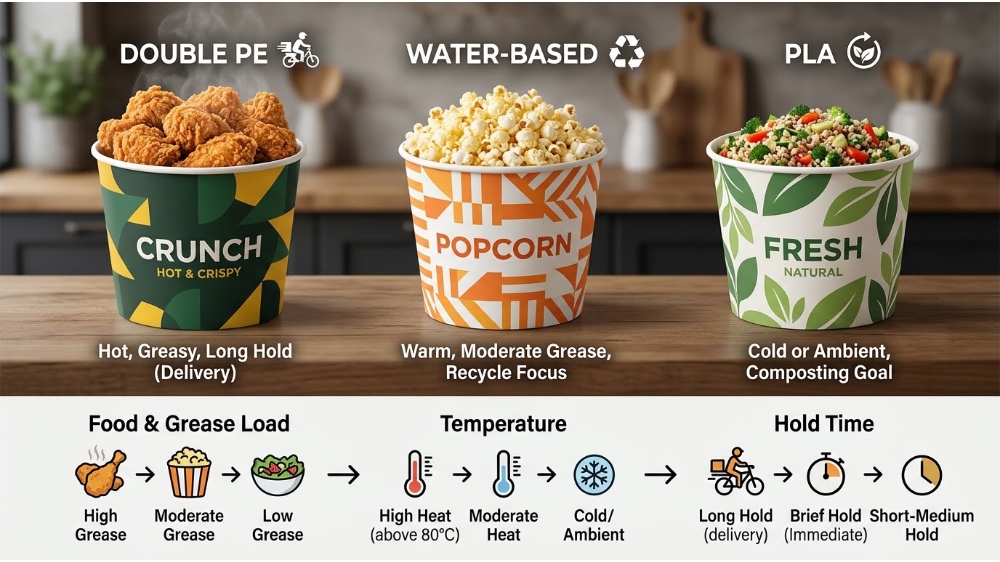
Coating selection becomes straightforward once three variables are defined.
First, the food’s grease load. Fried chicken, buttered popcorn, and oily noodle dishes demand a coating with high grease holdout. A water-based coating with a kit value of 9 or above can handle these foods; a lower-grade aqueous coating cannot. PE handles them by default. PLA handles them at moderate temperatures but loses holdout as heat rises.
Second, the fill temperature and service temperature. If the food enters the bucket above roughly 80°C and stays hot, PE is the safest default. PLA should be reserved for foods below that threshold, unless the supplier provides tested data showing short-term performance at higher temperatures. Water-based coatings fall in between: high-barrier versions can tolerate brief contact near 90–100°C, but standard grades have a lower ceiling and require confirmation.
Third, the hold time. A bucket used for immediate counter consumption has a different requirement than one loaded into a delivery bag. Grease and moisture migration are time-dependent. A coating that holds up for five minutes may fail at twenty. For delivery or catering holds beyond fifteen minutes, the coating must be matched not only to the food but to the worst-case time the food will spend in the package.
A practical decision sequence runs as follows:
Fried chicken, hot wings, or seafood boil held for delivery: Double PE coating. The heat and grease load exceed the reliable range of standard PLA and many aqueous formulations.
Popcorn, fries, or fried snacks consumed within 10–15 minutes: Single PE or a high-grease water-based coating, depending on the recycling infrastructure and brand priorities.
Cold foods, salads, ice cream, or moderate-temperature grain bowls: PLA can perform well, provided the food does not exceed the coating’s heat ceiling and industrial composting is available.
Brands with a hard recyclability requirement and moderate-grease foods: A tested high-barrier water-based coating, specified with grease kit and Cobb data for the exact food and hold time.
Long-hold or catering applications above 20 minutes with hot, greasy food: Double PE remains the most predictable barrier; if plastic reduction is mandatory, a water-based high-barrier coating must be validated with real-time hold testing.
For operators sourcing across multiple menu items, the coating decision should be made per SKU, not per brand. A single “eco” coating applied across fried chicken, cold salad, and hot soup will either underperform on the greasy items or overengineer the cold ones. Matching the barrier to the food is the only way to avoid both grease failure and unnecessary cost.
Coating selection by application:
Hot + greasy + long hold: Double PE — widest safety margin
Can a PLA-coated paper bucket hold hot fried chicken?
It depends on the temperature and hold time. Standard PLA softens at roughly 50–60°C, and many commercial PLA buckets have a maximum service temperature around 80–100°C for short exposure. Freshly fried chicken entering the bucket above 80°C and held for delivery pushes beyond the reliable window of standard PLA. PE is the safer default for that application unless the supplier provides tested data confirming PLA performance at the specific food temperature and hold time.
Is water-based coating actually grease-proof enough for a chicken bucket?
It can be, but not all water-based coatings are equal. High-barrier aqueous formulations can achieve grease kit ratings of 9–12 under TAPPI T559, which indicates resistance to aggressive oils and fats. Lower-grade water-based coatings may only handle light grease. The specification must match the food: a coating validated for a bakery box is not automatically suitable for fried chicken. Request grease kit data and application-specific testing.
Which coating is best for recycling a paper bucket?
Water-based coatings have the strongest recycling compatibility because they are designed to be repulped with the paper fiber in standard recycling streams. PE and PLA both form separate plastic films that contaminate paper recycling in typical mills. However, recyclability also depends on local collection infrastructure and the mill’s acceptance criteria. A water-based bucket is not automatically recycled everywhere—it is simply more compatible with paper recycling than a PE- or PLA-lined alternative.
Why not use double PE for every paper bucket?
Double PE provides the widest functional window, but it is not the right choice for every brand or market. PE is petroleum-based, not biodegradable, and difficult to recycle with paper. In regions with plastic-reduction regulations or brand commitments to fiber-based packaging, double PE may be excluded regardless of performance. The decision is a balance between functional safety and the end-of-life profile the market requires.
Post time:
Oct-30-2026
For inquiries about our products or pricelist, please leave your email to us and we will be in touch within 24 hours.