

This guide explains how to read bucket capacity against actual fill lines, how bucket form affects service speed at the point of sale, and how to align size tiers with portion economics and throughput. The goal is a sizing decision that holds up on a busy Saturday night, not just on a spreadsheet.
Popcorn Bucket Sizing: Volume, Cost & Speed
Concession Packaging Guide
How to Size Paper Popcorn Buckets for Cinemas and Events: Fill Volume, Portion Economics, and Service Speed
A popcorn bucket’s ounce label tells you less than you think. The number on the side is a nominal volume, not a serving size, and the gap between the two determines how much popcorn a guest actually receives. Sizing paper popcorn buckets correctly means choosing a fill line, a service speed, and a cost per transaction together, not picking a label from a catalog.
A paper popcorn bucket is a volume container, a service tool, and a pricing signal in one. Cinemas and event venues that treat the ounce number as the only variable tend to overpay in labor, underfill in practice, or create menu tiers that confuse guests and slow the counter.
Why the ounce label is not a portion size
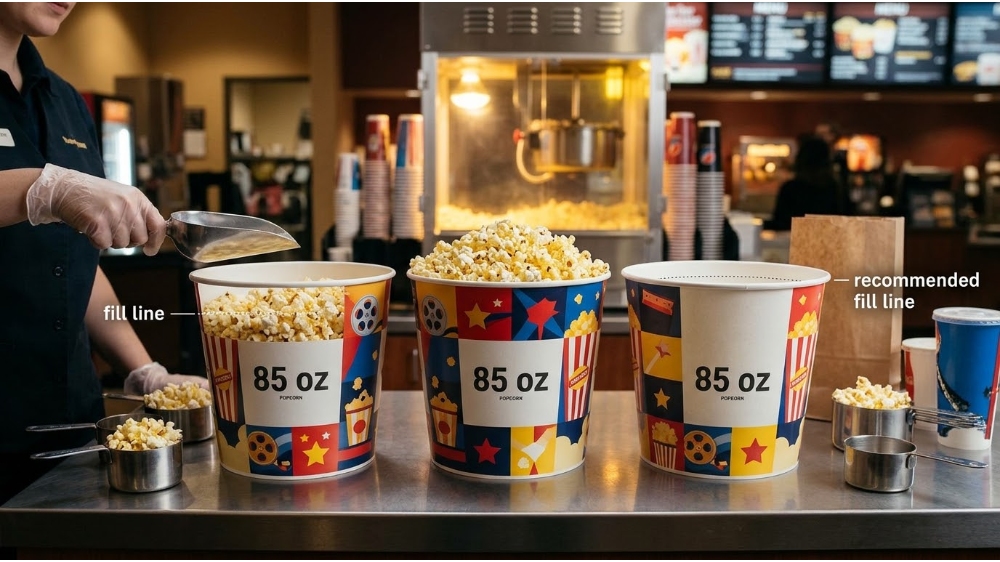
The ounce figure on a popcorn bucket is a nominal volume, usually measured to the rim or to a stated capacity. It is not the amount of popcorn a guest receives. Industry buying guides describe an 85 oz bucket as roughly 10.5 measuring cups of popped popcorn, which makes it a two- to three-person share and the standard large at many theaters. But the same guide notes that a 48–85 oz range is treated as the family or standard theater range, while 24–44 oz covers single-serving cups and small buckets.
The label alone does not tell you what a guest experiences. Suppliers define capacity differently, and the volume a guest associates with large at one chain can be medium at another. Procurement guidance for concession buyers recommends confirming measured volume to the rim and to the recommended fill line, top and base diameters, and nesting ratio before committing to a SKU. Without those figures, two buckets labeled 85 oz can behave as different products behind the counter.
For sizing purposes, the working unit is not the ounce printed on the bucket. It is the fill line the staff actually uses under service conditions. A bucket that holds 85 oz to the rim but is filled to a lower line for speed or stability is effectively a smaller portion, even if the label never changes.
The fill-line gap and what it costs
Every popcorn bucket has at least two capacities: the volume it can hold before overflowing, and the volume it can hold while remaining stable, scoopable, and presentable. The difference between them is the fill-line gap. In practice, the gap is where portion complaints, refill policies, and menu confusion live.
Concession operators who pre-fill buckets or hold filled buckets in a warming environment face a stricter version of the same problem. Filling closer to the rim increases perceived generosity but raises spillage risk and slows the handoff. Filling lower protects speed and stability but can make a large look smaller than the guest expects, especially when the bucket’s taper exaggerates the visual difference between a full and a partially full container.
The practical implication is that bucket sizes should be selected as a set of fill-line volumes, not rim volumes. A venue running three tiers does not need three nominal capacities; it needs three fill lines that produce distinct, defensible portion sizes and still allow a clean scoop-and-handoff motion. When the gap is not managed, the smallest tier and the middle tier can collapse into each other in the guest’s perception, which erodes the value of the larger size without reducing the cost of the smaller one.
Buckets as service tools: seconds per transaction
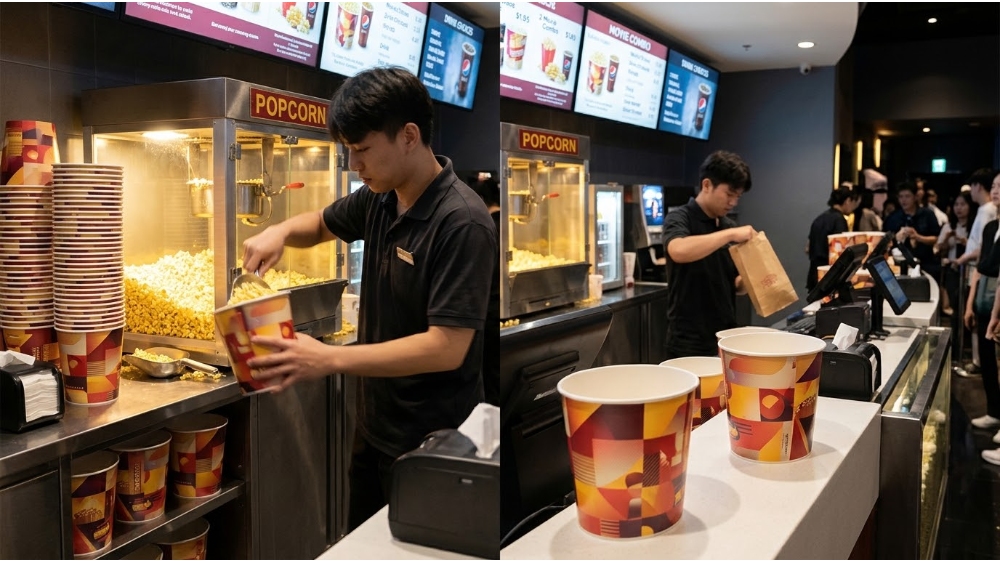
The strongest operational argument for paper buckets over bags is not capacity. It is time. A cinema operator describing counter practice reports that filling a tub takes about three seconds because the tub can be scooped into directly, while filling a bag requires opening, fluffing, and stuffing, taking at least fifteen seconds. That difference compounds at peak: a transaction that saves twelve seconds per popcorn order can change how many staff a till needs and how long a queue grows before a screening.
Industry staffing guidance for cinemas often assumes an average concession sale of around 75 seconds including payment, with a single till handling roughly 48 transactions per hour at full pace. In that context, a twelve-second saving on the popcorn component is not a marginal gain. It is a meaningful share of the total service window, especially when popcorn is bundled with drinks and the popcorn step is the slowest physical task at the counter.
Bucket form also affects speed through nesting and dispensing. Tapered buckets nest inside one another so a sleeve of unused stock can be stored compactly and pulled one at a time. Straight-sided buckets may stack but do not nest as deeply, increasing the storage footprint behind the counter. For a high-volume venue, the difference between a deep-nesting tapered bucket and a shallower alternative is measured in restocking trips during a shift, not just shelf space.
When sizing a bucket line, then, the question is not only how much popcorn does this hold but how quickly can a trained staff member turn an empty bucket into a handed-off order. A size that is slightly larger but fills cleanly and nests tightly can outperform a smaller, cheaper bucket on labor productivity alone.
Portion economics beyond the bucket price
Popcorn is famously high-margin at the point of sale, and the bucket is a visible cost inside that margin. Public discussions of concession economics put the raw material cost of a serving at under a dollar in many examples, with markups that can exceed several hundred percent depending on the venue and the market. One frequently cited breakdown suggests a tub-size container can cost the theater around 92 cents while the popcorn itself costs only cents, producing a markup in the hundreds of percent even before the drink.
That framing can mislead sizing decisions in two directions. The first error is treating the bucket as a trivial cost and defaulting to the cheapest available SKU. The second error is treating the markup as a reason to push guests toward the largest size regardless of service reality. In practice, the bucket cost sits inside a larger unit economics equation that includes labor per transaction, waste from misfills, and the revenue effect of queue abandonment.
A faster bucket can justify a slightly higher per-unit packaging cost because it reduces the labor minutes attached to each popcorn sale. A bucket that fills in three seconds instead of fifteen saves twelve seconds of staff time per popcorn transaction. At a peak-hour labor cost, that saving can be larger than the difference between a basic uncoated bucket and a grease-resistant coated bucket. The bucket with the better coating may also reduce complaints and refills caused by grease bleed-through, which protects both margin and guest experience.
The sizing decision, therefore, should compare total cost per served portion, not cost per bucket. Two SKUs with different prices per case can produce the same or different cost per serving once fill line, speed, and waste are included. The cheaper bucket is only cheaper if it does not consume more labor or generate more misfills than the alternative, and the per-case price comparison should account for material, printing, MOQ, and freight.
Geometry, nesting, and perceived value
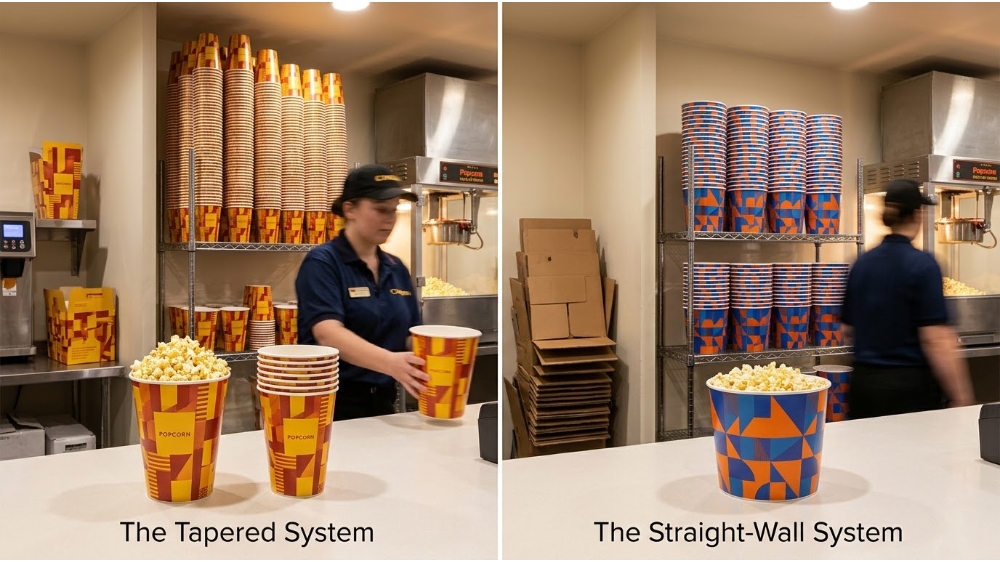
Bucket geometry shapes both storage efficiency and guest perception. Tapered buckets nest deeply, which allows a cinema to store thousands in a compact space and pull them cleanly at the counter. The taper also makes a filled portion look more generous because the popcorn mounds above a narrower rim, even when the actual volume is the same as a wider, shallower container. That perceptual effect is not a trick to rely on, but it is a real factor in how size tiers are read by guests.
Straight-wall buckets offer more printable surface area per unit of volume and can stack reliably, but they do not nest as compactly. For a venue with limited back-of-house storage, the nest ratio of a tapered bucket may matter more than the extra print area of a straight-wall format. For an event venue with one-night setups and a van-based logistics chain, flat-packed boxes may save transport space at the cost of assembly time at service. The right geometry depends on whether storage space or counter seconds is the scarcer resource.
The sizing implication is that a bucket line should be evaluated as a physical system. A large bucket that nests well and fills fast can support a higher price tier without requiring a different service motion. A small bucket that does not nest cleanly may slow restocking and undercut the labor savings that justified carrying a second size in the first place.
A sizing framework for cinemas and events
A practical sizing framework starts with three operating facts: the peak transaction rate the counter must sustain, the number of popcorn tiers on the menu, and whether the venue is a fixed cinema with back-of-house storage or a temporary event with transport constraints. These facts determine how many bucket sizes are worth carrying and which form factor dominates.
For a fixed cinema with a high peak rate, the default line is a two- or three-tier tapered bucket system built around a fast-fill large size. The 85 oz range is a common anchor for the large tier because it maps to a shareable portion and is widely described as a best-selling size in cinema settings. A smaller tier in the 32–46 oz range covers individual orders, and a larger 130–170 oz tier can serve group combos or refill programs without requiring a separate service motion. The exact fill lines should be verified against the scoop and handoff method used at the counter.
For an event venue with limited storage and unpredictable layouts, the calculation shifts toward flat-packed or lightly nested formats that prioritize transport and setup over deep storage efficiency. A box format may save warehouse and van space, but the seconds added at service time must be budgeted against the event’s staffing plan. If the event runs a fixed-price or prepackaged model, the service-speed penalty of a foldable box may be acceptable; if the event sells à la carte at a high transaction rate, a bucket that fills directly from the scoop is usually the better fit.
The table below summarizes the trade-offs across common size bands. It is not a prescription, but a comparison of how different sizing choices behave under service conditions.
| Size band | Typical role | Fill and handoff | Storage behavior | Best operating context |
|---|---|---|---|---|
| 24–44 oz | Single serving; kids or snack portion | Fast scoop; limited capacity can require more transactions per group | Nests well in tapered formats | Counter service with mixed group sizes; lower-volume periods |
| 48–85 oz | Standard individual to two-person share; often the core large | Direct scoop from the popper; three-second fill is achievable | Deep nesting in tapered buckets; compact sleeve storage | Cinema counters with high throughput and a single dominant popcorn tier |
| 130–170 oz | Family share, combo, or refill program | Requires a wider scoop or multiple passes; slower per unit but higher revenue per transaction | Larger footprint per unit; nesting still possible in tapered formats | Venues with combo meals, refill promotions, or group-oriented event sales |
The framework can be reduced to a simple sequence. First, measure the actual service window per popcorn transaction with the bucket you are considering. Second, set fill lines that produce distinct portion sizes at that speed. Third, compare total cost per served portion across the candidate SKUs, including labor and misfill allowance. Fourth, confirm that the chosen bucket nests or stacks within the storage space available at peak.
A sizing decision that passes all four checks is more durable than one based on ounce labels alone, and it should be confirmed through structured sample approval checklist before a bulk order.
Need popcorn buckets sized for your service model?
Talk to a packaging specialist about matching fill volume, bucket geometry, and coating to your counter speed and menu tiers.
Frequently asked questions
Is a larger popcorn bucket always more profitable per serving?
Not necessarily. A larger bucket increases revenue per transaction if the guest buys it, but it can slow service if the fill takes longer or if the bucket does not nest well. The profit per serving depends on the fill line, the speed of the transaction, and the labor cost attached to that speed, not on nominal capacity alone.
Do I need separate bucket sizes for cinema and event use?
Often yes. A fixed cinema benefits from deep-nesting tapered buckets and a fast-fill core size. An event venue may prioritize flat-packed formats that save transport space, even if they add seconds at service. The operating context, not the popcorn itself, should drive the format decision.
How do grease-resistant coatings affect sizing?
Coatings protect the bucket wall from butter and oil migration, but they do not change the fill-line calculation. A coated bucket still needs a verified fill line and a service motion that keeps the rim clean. The coating matters most when hold times are longer or when butter application is heavy; it protects the guest experience but should not be used to compensate for an oversized bucket that encourages slow, overfilled service.
Post time: Nov-06-2026