How Much Does a Custom Paper Food Bucket Cost? A Bulk Buyer’s Breakdown of Material, Printing, MOQ, and Freight
Custom Paper Food Bucket Cost: Material, Print & Freight
Packaging Sourcing Cost Guide
How Much Does a Custom Paper Food Bucket Cost? A Bulk Buyer’s Breakdown of Material, Printing, MOQ, and Freight
A quoted unit price is not your landed cost—it shifts with volume, print complexity, and freight allocation. A 150oz bucket can quote $1.29 at 5,000 units and $0.73 at 50,000 before coating or inland delivery. This guide shows where the money goes so you can model true landed cost.
Bulk paper food bucket sourcing produces wide quotation spreads for the same nominal product. One supplier quotes $0.06, another $0.18, a third $0.65. The difference is rarely explained in the email. It sits in paperboard grade, coating type, number of print colors, whether the die is new, whether the lid is included, and which Incoterm the number is based on.
This breakdown separates each cost layer so bulk buyers can compare quotations on equal terms. The objective is not to find the cheapest piece price. It is to calculate the lowest landed cost per usable bucket that still meets the fry, chicken, or noodle menu’s heat, grease, and hold-time requirements.
The Direct Answer: What a Bucket Actually Costs at Different Volumes
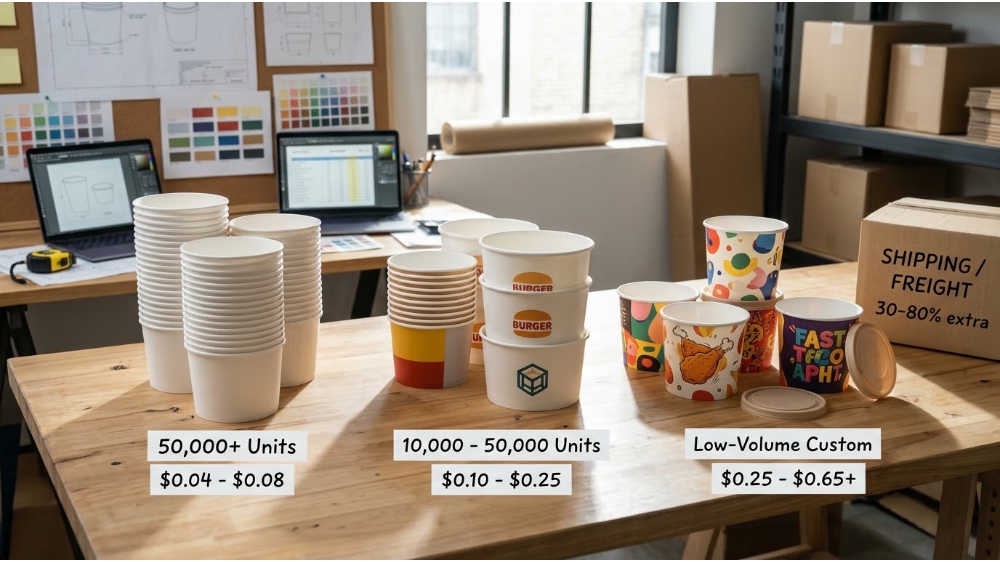
Published wholesale ranges show the floor and the ceiling. Standard PE-coated kraft buckets at 50,000 to 499,999 pieces have been listed around $0.05 per unit, dropping to roughly $0.04 at 500,000 pieces. At the other end, custom-printed buckets in the 5,000 to 50,000 piece range are quoted at $0.18 to $0.65 per unit. The $0.04 bucket and the $0.65 bucket are not the same product, and neither number includes the same cost scope.
The low end assumes an existing standard size, minimal print, and a factory that already runs that specification at high speed. The high end often includes a new die, full-wrap custom artwork, a lid, and low-volume setup costs spread across few pieces. A buyer comparing those two numbers directly is comparing a mature commodity program with a custom development project.
Cost ranges are a starting point, not a quotation:
~$0.04–$0.08: standard size, PE-coated, limited print, 50,000+ pieces
~$0.25–$0.65+: custom size or structure, new die, low-volume custom print
Freight and duties can add 30–80% to the FOB number before the bucket reaches your warehouse
Material and Construction: The First Cost Layer Buyers Underestimate
Paperboard grade determines both performance and price before printing is considered. A 250gsm double-PE bucket and a 380gsm double-PE bucket do not cost the same to produce, and they do not behave the same under hot, greasy food. The heavier board uses more fiber, runs slower on forming equipment, and consumes more coating, but it resists deformation and grease penetration during a 20-minute delivery window.
Uncoated kraft vs. PE-coated vs. aqueous-coated
Uncoated kraft is the lowest-cost paperboard option, but it absorbs oil directly into the fiber and softens quickly under hot food. It is suitable for short counter holds, not for delivery programs where the bucket may sit in a bag for 15 minutes or more. PE coating adds a polyethylene layer that blocks grease and liquid, but it increases material cost and can affect recyclability depending on local infrastructure. Aqueous coatings provide grease resistance with a repulpable alternative, though they generally cost more than PE and require qualification for high-heat, high-grease applications.
Material format
Relative material cost
Grease and moisture performance
Best fit
Uncoated kraft
Lowest
Poor grease holdout; absorbs oil
Short-hold counter service
PE-coated paperboard
Moderate
Excellent grease barrier; good moisture control
Delivery and 15–25 minute holds
Aqueous-coated board
Moderate to high
Very good grease resistance; repulpable
Eco-positioned delivery programs
Molded fiber (unlined)
Moderate
Highly breathable; absorbs grease unless lined
Very short holds, dry or low-grease items
Construction also affects cost. A single-wall bucket uses less board and forms faster than a double-wall bucket. A bucket with a rolled rim and a leak-resistant bottom curl costs more to form than a simple open-top container, but it prevents blowouts during transport. Buyers who reduce board weight or eliminate the bottom curl to save $0.01 per unit often discover that the savings are erased by leakage complaints and replacement shipments.
Printing: Why Plate Charges and Run Length Decide Your Per-Unit Print Cost
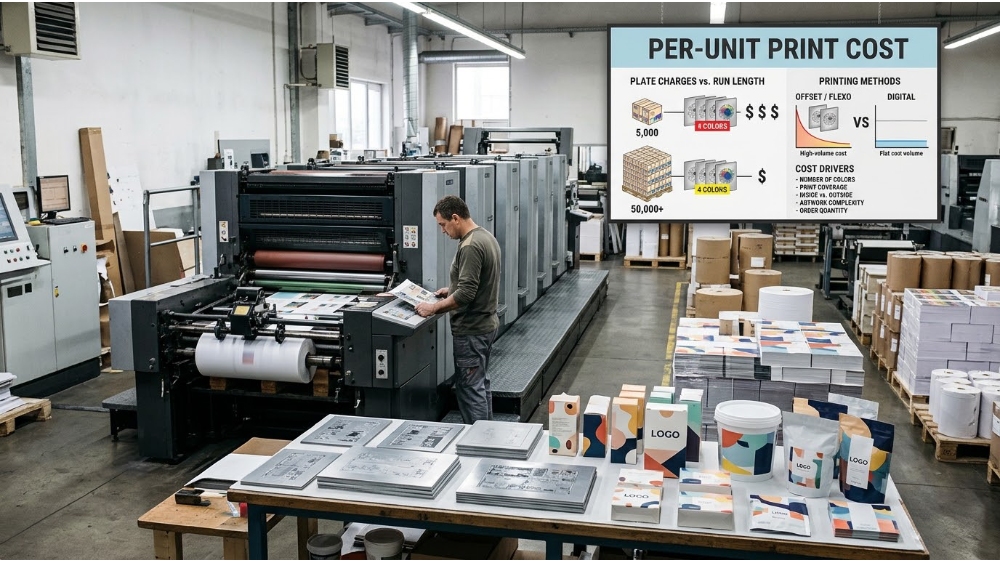
Printing is the second major cost variable, and it is the one most often misunderstood. A supplier may quote “full-color printing” without clarifying whether that means four-color process, one spot color, or a flexo print with limited registration. The method and the number of colors change the setup cost, and setup cost has to be recovered across the order quantity.
Offset printing uses aluminum plates that typically cost $30 to $60 per color. The per-impression cost becomes very low at high volume, but the plate charge is fixed regardless of whether the order is 5,000 or 500,000 pieces. Flexo printing uses photopolymer plates with a similar per-color plate cost, often $30 to $50, and is well suited to absorbent kraft surfaces and high-speed web production. Digital printing has no plate cost, which makes it economical for very short runs, but its per-unit cost does not fall as sharply at bulk volumes.
Printing cost drivers:
Number of colors: each color adds a plate and a press unit
Print coverage: heavy ink coverage requires more process control and slower running
Inside vs. outside printing: inside print adds a second pass and more handling
Artwork complexity: tight registration and fine detail increase setup and waste
Order quantity: the fixed plate cost is divided across every unit produced
A one-color logo on a 50,000-piece order carries a negligible plate cost per unit. A four-color full-wrap design on a 5,000-piece order can add $0.04 to $0.08 per bucket from plates alone, before ink and press time. The same artwork on 50,000 pieces may add less than $0.01 per unit. This is why printing quotations cannot be compared without knowing the color count and the quantity they are based on.
MOQ and Tooling: How Volume Absorbs Setup Costs
Minimum order quantity is not an arbitrary supplier preference. It reflects the point at which a factory can run a specification without losing money on setup. Standard sizes may use existing dies and forming tools, so the MOQ can be lower, sometimes 5,000 pieces without custom logo. A custom size, a new lid profile, or a structural change requires a new die or forming tool, and that one-time cost has to be amortized across the order.
Custom logo printing typically moves the MOQ to 50,000 pieces per size for paper buckets, because the printing setup, color proofing, and machine changeover only make economic sense at that volume. A buyer who needs 8,000 custom-printed buckets may be quoted a higher piece price, or told that the order falls below the efficient run length. The higher price is not arbitrary; it is the setup cost expressed per unit.
Tooling ownership matters as much as tooling cost. Buyers should confirm whether the die charge is one-time, who retains ownership, how long the supplier will store the tool, and what happens if the tool wears out or the design changes. A low tooling quote that comes with supplier-owned tooling can create switching costs later. A slightly higher tooling charge with buyer ownership and a defined replacement policy is often the lower-risk option over a multi-year program.
MOQ economics in practice:
5,000–10,000 pieces: standard size, no custom logo or limited stock print; highest per-unit setup burden
30,000–50,000 pieces: custom logo becomes efficient; plate and die costs begin to amortize
100,000+ pieces: material purchasing and machine utilization improve; lowest per-unit conversion cost
Very large orders: unit price falls, but inventory carrying cost and obsolescence risk rise
Freight, Duties, and the Landed-Cost Gap
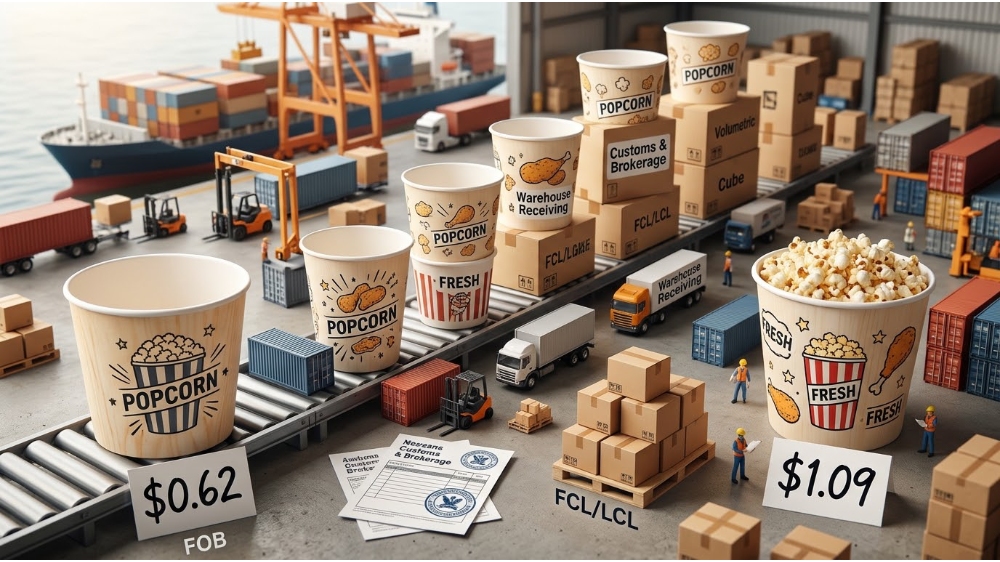
The FOB price is the number suppliers compete on, but it is not the number that reaches the profit-and-loss statement. Ocean freight, origin charges, destination port fees, customs brokerage, duties, inland drayage, and warehouse receiving all sit between the factory gate and the buyer’s shelf. For paper packaging, these costs can add 30% to 80% to the FOB unit price, depending on the lane, the Incoterm, and the tariff classification.
A worked example illustrates the gap. A packaging order quoted at $0.62 FOB can land at approximately $1.09 per unit once freight, insurance, duty, brokerage, port fees, drayage, and receiving are included. That is a 76% increase over the quotation. The exact figures vary by product and trade lane, but the principle holds: a quotation that does not specify the Incoterm and the included cost scope is not a comparable number.
Freight mode
Pricing basis
Economic fit
Cost behavior
LCL (less than container load)
Per CBM or per 1,000 kg, whichever is greater
Smaller loads, roughly under 13–15 CBM
Higher per-CBM rate plus CFS and doc fees; more handling
FCL (full container load)
Flat per container (20′, 40′, 40′HC)
Volumes that fill most of a container
Lower effective per-unit cost as container utilization rises
Buckets are volumetric, not heavy. A container fills by cube before it reaches its weight limit, so the number of buckets per carton and the carton dimensions directly affect freight cost per unit. A carton that is slightly oversized or a bucket that nests inefficiently can raise the landed cost more than a $0.005 difference in FOB price. Buyers should request the loading plan and the carton cube before confirming the order quantity.
Duties and compliance add another layer. Paper food buckets can fall under different tariff classifications depending on coating, construction, and country of origin. The duty rate applied to one specification may not apply to another. Buyers should confirm the classification and the applicable rate before the order ships, not after the container arrives. Anti-dumping and countervailing measures, where applicable, can change the total landed cost materially.
How to Compare Quotations Without Being Misled
The only reliable comparison is landed cost per usable piece, calculated on identical specifications and identical Incoterms. Before comparing two supplier quotations, align five variables: paperboard grade and coating, bucket size and lid inclusion, print method and color count, MOQ and tooling ownership, and Incoterm with a full cost breakdown.
Ask each supplier for the same cost lines: product and lid separately, printing and plate charges, tooling or die cost, inner packing and carton specifications, origin charges, ocean freight, insurance, destination charges, duty estimate, and expected waste or damage allowance. A supplier that cannot or will not break out these lines is not necessarily overpriced, but the quotation cannot be benchmarked.
A useful discipline is to calculate the total cost of the program, not just the unit price. Multiply the landed cost per usable piece by the number of pieces actually consumed, including damaged or unusable units. A $0.06 bucket with a 4% leak rate and a $0.08 bucket with a 0.5% leak rate are not $0.02 apart; the effective cost difference shrinks or reverses once replacement shipments and customer complaints are included.
Need a cost model built around your actual bucket specification?
Share your size, coating, print colors, target quantity, and delivery lane. A packaging specialist can separate material, printing, tooling, and freight so you can compare quotations on the same basis.
Why is there such a large gap between the cheapest and most expensive custom paper bucket quotes?
The gap usually reflects specification differences, not supplier greed. A standard size with existing tooling, one-color print, and 50,000+ pieces carries a very different cost structure from a custom size with a new die, four-color print, and 5,000 pieces. Aligning specifications and Incoterms before comparing prices is the only way to make the quotations meaningful.
Does a higher MOQ always mean a lower unit price?
Unit price typically falls as volume rises because setup and tooling costs are spread across more pieces. But total program cost can rise if the larger order creates excess inventory, storage costs, or obsolescence risk when artwork changes. The optimal quantity balances piece price against forecast accuracy and carrying cost.
Is PE coating always worth the extra material cost?
For hot, greasy foods held longer than about 10 minutes, PE coating usually prevents the grease penetration and structural softening that uncoated kraft experiences. For very short counter holds or dry menu items, uncoated kraft can be adequate. The decision should be based on the actual hold time and food type, not on material cost alone.
What is the most common cost mistake bulk buyers make?
Comparing FOB prices without accounting for freight, duties, tooling amortization, and waste. A quote that looks $0.03 per unit cheaper can land at a higher total cost once the full delivery chain is included. Requesting landed-cost breakdowns on identical specifications prevents this error.
Post time:
Oct-27-2026
For inquiries about our products or pricelist, please leave your email to us and we will be in touch within 24 hours.