Fast Food Sustainable Packaging Options: Eco-Friendly Solutions for Modern Restaurants
Fast Food Sustainable Packaging Options: Eco-Friendly Solutions for Modern Restaurants
Foodservice Packaging Guide
Fast Food Sustainable Packaging Options: Eco-Friendly Solutions for Modern Restaurants
Every state legislature session now touches packaging in some way, and fast food operators are the ones who have to translate that into a purchase order. Here’s what actually qualifies as sustainable, what the new PFAS and EPR laws require, and how to build a lineup that survives a rush without failing an audit.
Sustainable packaging used to be a marketing line item for fast food chains. It’s now a compliance calendar with real deadlines, real fines, and real SKU changes — and most of the guidance available to operators still treats it as a single yes/no decision (“go compostable”) rather than the layered materials, regulatory, and cost problem it actually is.
This guide breaks the decision into the parts a packaging buyer actually has to solve in order: which materials genuinely qualify as sustainable and what each one trades off, which state laws already restrict your options before you’ve picked a material, what the switch really costs once labor and case-fill are counted, and how to phase a transition without running out of anything mid-shift. For ready-stock fiber-based containers sized for fast food service, see the current packaging solutions catalog.
Why Sustainable Packaging Stopped Being Optional
Three forces are now pushing fast food packaging in the same direction at the same time, and any one of them alone would have been slow enough to phase in gradually. Together, they’ve turned a marketing preference into an operating requirement.
The first is consumer willingness to pay, and it’s no longer a fringe preference. A McKinsey & Company analysis found that nearly half of American consumers say they’ll pay more for eco-friendly packaging, which means packaging that ignores this is leaving margin on the table, not just goodwill. The second is that major chains have already made public commitments that ripple down the supply chain: Wendy’s, for instance, has committed to sourcing 100% of its customer-facing packaging sustainably, targeting materials with higher recycled content, fewer raw inputs, and a documented restricted-substance list. When a chain that size sets that bar, the suppliers and packaging formats that meet it become the default options available to everyone else in the category, including independent and regional fast food operators who never made the pledge themselves.
The third force is regulatory, and it’s the one most buyers underestimate because it doesn’t show up in a menu design meeting — it shows up as a legal notice. State-level PFAS restrictions and extended producer responsibility (EPR) laws are reshaping which materials can legally be sold in a given state months or years before most packaging catalogs update their claims. A container that was compliant last year can become unsellable in a target state with very little warning, which is exactly why the next two sections of this guide treat regulation as a filter you apply before comparing materials, not after. Start with eco-friendly coffee packaging solutions guide to learn more in detail.
The Main Material Options, Compared
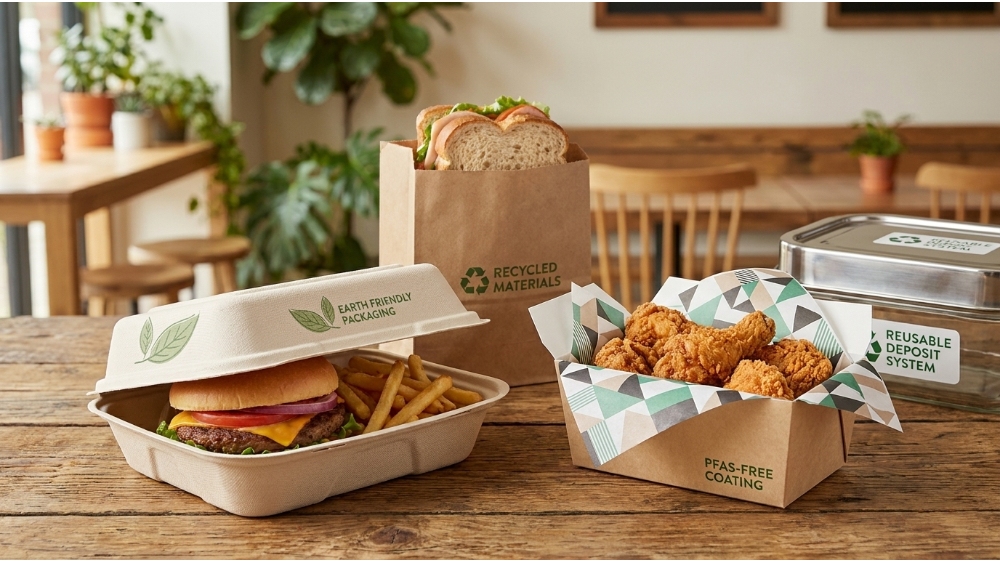
“Eco-friendly” is not a material — it’s a claim that four very different materials make with four very different levels of honesty. A buyer comparing quotes needs to know which claim each format can actually back up, because the wrong assumption here is what leads to a recall of marketing language, not just a reorder.
Molded fiber (bagasse and rice husk pulp)
Molded fiber containers are pressed from sugarcane bagasse, rice husk, or bamboo pulp fiber, and they’re the closest thing to a genuinely compostable clamshell or tray that fast food packaging currently offers. They handle grease and moisture reasonably well without a plastic liner, hold their shape under a heat lamp, and break down in industrial composting conditions. Their trade-off is cost and rigidity: molded fiber runs higher per unit than coated paperboard, and thinner-walled formats can flex under a heavy, wet load in a way a rigid clamshell doesn’t.
PFAS-free coated paperboard
This is the category that has changed the most in the last two years. Coated paperboard used to mean a thin fluorochemical layer for grease and moisture resistance — the exact chemistry now banned outright in a growing list of states. The replacement coatings use layered paper structures and alternative barrier chemistries to achieve the same grease resistance without PFAS, and this is now the default expectation for any new paperboard SKU, not a premium upgrade.
Recycled paperboard and kraft
Recycled-content paperboard and kraft paper wraps are the lowest-cost sustainable option and the easiest to source at volume, but they’re only as sustainable as the recycling stream that receives them afterward — a claim worth verifying locally rather than assuming, since acceptance varies significantly by municipality.
Reusable systems
A smaller but growing category skips single-use packaging in the dine-in and short-hold delivery segment entirely. Deposit-based reusable container pilots are already running in select cities through programs like Restaurant Brands for Good, giving customers a returnable cup or box in exchange for a deposit that’s refunded on return. It’s the most environmentally efficient option on this list per use, but it only works where a return loop is logistically feasible — dense urban delivery zones and dine-in counters, not drive-thru.
Material
Best fit
Watch for
Molded fiber (bagasse/rice husk)
Burgers, fried items, hot entrées needing grease resistance
Higher unit cost; thinner walls flex under heavy wet loads
Confirm the specific coating chemistry — “PFAS-free” claims vary by supplier
Recycled paperboard/kraft
Bags, wraps, trays, low-grease items
Only as sustainable as local recycling acceptance
Reusable deposit systems
Dine-in, dense urban delivery zones
Requires a functioning return loop; not viable for drive-thru
PFAS-Free Packaging: What the State Bans Actually Require
PFAS (“forever chemicals”) in food packaging is no longer a single national question with one answer — it’s a patchwork of state laws with different effective dates, different covered categories, and different enforcement timelines, and a packaging order that’s compliant in one state can be illegal to sell in another.
Several states already have PFAS-in-food-packaging bans in force, with more phasing in through the rest of this decade. State legislatures introduced nearly 350 PFAS-related bills across 39 states in a single recent year, and that pace has continued rather than slowed. New York’s food packaging PFAS ban has been in effect since the end of 2022. Washington’s restriction phased in by container type, first covering pizza boxes and food boats before expanding to bags, sleeves, plates, trays, and clamshells. Minnesota’s Amara’s Law already restricts intentionally added PFAS in food packaging and is scheduled to widen to nearly all consumer products by 2032. Maine enforces one of the broadest bans, covering multiple categories of plant-fiber food-contact packaging, with manufacturers required to document that no safer alternative exists before an exemption applies.
The practical risk for a fast food operator isn’t ignorance of PFAS as a concept — most buyers know it by now. The risk is assuming a supplier’s blanket “PFAS-free” claim covers every SKU in an order, when in practice that claim needs to be confirmed at the individual product level, ideally with a certificate of analysis or supplier attestation on file. A molded fiber tray and a coated paperboard box from the same supplier can use entirely different barrier chemistries, and only one of them may carry documentation that would hold up if a state regulator asked for it.
PFAS compliance checklist before a bulk order:
Confirm PFAS-free status per SKU, not per supplier — coatings vary by product line
Check which states you ship or franchise into and their specific effective dates
Request documentation (certificate of analysis or written attestation) you can produce on request
Re-verify annually — several state bans widen their covered categories on a rolling schedule
EPR Laws: How They Change What You Buy
Extended producer responsibility (EPR) laws shift the cost of end-of-life packaging management from municipalities onto the businesses that put packaging into the market, and for a fast food chain sourcing across state lines, that means packaging decisions now carry a reporting and fee obligation that didn’t exist a few years ago.
Packaging EPR programs are active in a growing number of states, with more added most legislative sessions. Seven states currently run active EPR programs for packaging and paper — California, Colorado, Maine, Maryland, Minnesota, Oregon, and Washington — each with its own registration deadlines, its own definition of a “producer,” and its own list of “covered materials.” A restaurant chain operating in several of these states at once needs a state-by-state applicability check, not one national policy, because a container exempt in one state can be a reportable material in the next.
What this means for packaging buying decisions in practice: fee structures under these programs are typically modulated by material type, with lower-impact, more recyclable materials assessed lower per-pound fees than mixed-material or hard-to-recycle formats. That gives operators a direct financial incentive — beyond compliance risk — to simplify packaging down to fewer material types and cleaner mono-material designs, since every additional laminate or foil liner in a container can mean a higher fee bracket in states where EPR fees scale with recyclability. Buyers who treat EPR purely as a legal filing exercise miss the part that actually saves money: the same design choices that reduce fee exposure also tend to reduce the SKU count and material complexity a kitchen has to manage during a rush.
The Real Cost of Switching, Line by Line
Comparing a sustainable container to a conventional one by unit price alone almost always makes the sustainable option look worse than it is, because unit price is only one line in a cost comparison that includes case-fill efficiency, failure rate, and labor.
Molded fiber and PFAS-free coated paperboard typically carry a higher per-unit cost than legacy foam or PFAS-coated equivalents — that part of the comparison is real and shouldn’t be waved away. But unit price ignores several offsetting factors that show up elsewhere on the P&L. Foam containers that get banned mid-contract force an emergency resourcing scramble at whatever price is available, which is a worse outcome than a planned transition negotiated on the operator’s timeline. A container that holds its shape under a heat lamp reduces the refund and remake rate that comes from soggy or collapsed packaging, and that failure rate is a cost most operators track loosely, if at all. And in EPR states, a cleaner mono-material format can sit in a meaningfully lower per-pound fee bracket than a mixed-material one, which is a recurring cost difference that compounds across a year’s packaging volume in a way a one-time unit price comparison never captures.
The honest cost comparison, then, isn’t “sustainable container price” versus “legacy container price.” It’s total landed cost per order — unit price, plus failure-driven remakes, plus EPR fee exposure, plus the compliance risk of a container that might not be sellable in a target state next year. Run that full comparison and the gap between “sustainable” and “cheap” narrows considerably, and in some EPR states, reverses.
Recyclable vs. Compostable vs. Biodegradable
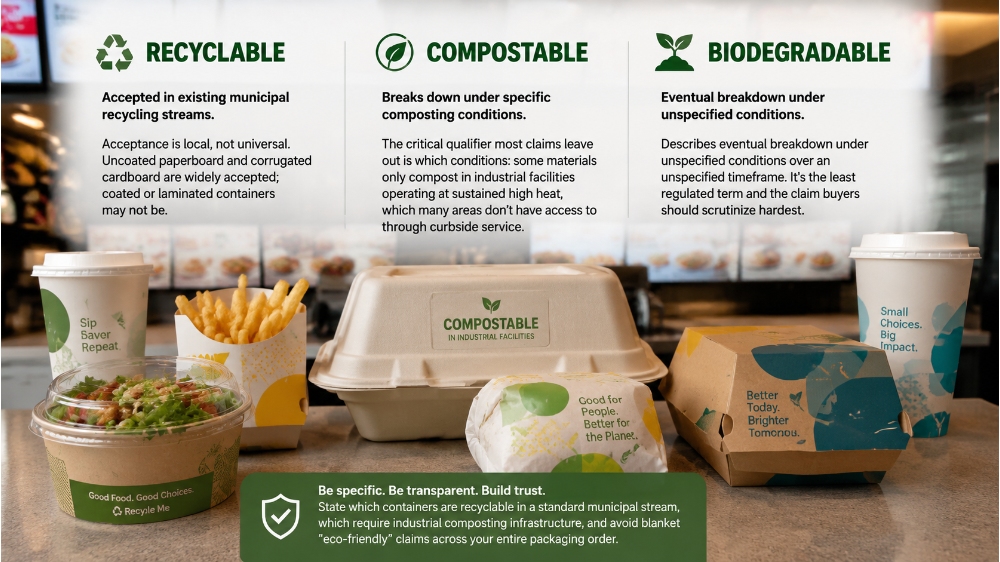
These three words get used interchangeably in packaging marketing and mean genuinely different things in practice, and the gap between the claim on a box and what actually happens to that box after disposal is exactly where “greenwashing” complaints originate.
Recyclable means a material is accepted into an existing municipal recycling stream — but acceptance is local, not universal. Uncoated paperboard and corrugated cardboard are widely accepted; a coated or laminated container may not be, even if the coating itself is PFAS-free. Compostable means a material breaks down under specific composting conditions, and the critical qualifier most claims leave out is which conditions: some materials only compost in industrial facilities operating at sustained high heat, which a large share of the country simply doesn’t have access to through curbside service. Biodegradable is the loosest and least regulated of the three terms — it describes eventual breakdown under unspecified conditions over an unspecified timeframe, and it’s the claim buyers should scrutinize hardest before repeating it to customers. Read Compostable vs. Biodegradable: Which Eco-friendly Packaging is actually Better to learn more.
The defensible position for a fast food operator is specificity: state which containers are recyclable in a standard municipal stream, which require industrial composting infrastructure that may or may not exist in a given market, and avoid asserting “eco-friendly” as a blanket label across an entire packaging order. That specificity is also what regulators and EPR programs increasingly require documentation for, so it’s not just good marketing practice — it’s becoming a compliance baseline.
Matching Packaging to Counter, Drive-Thru, and Delivery
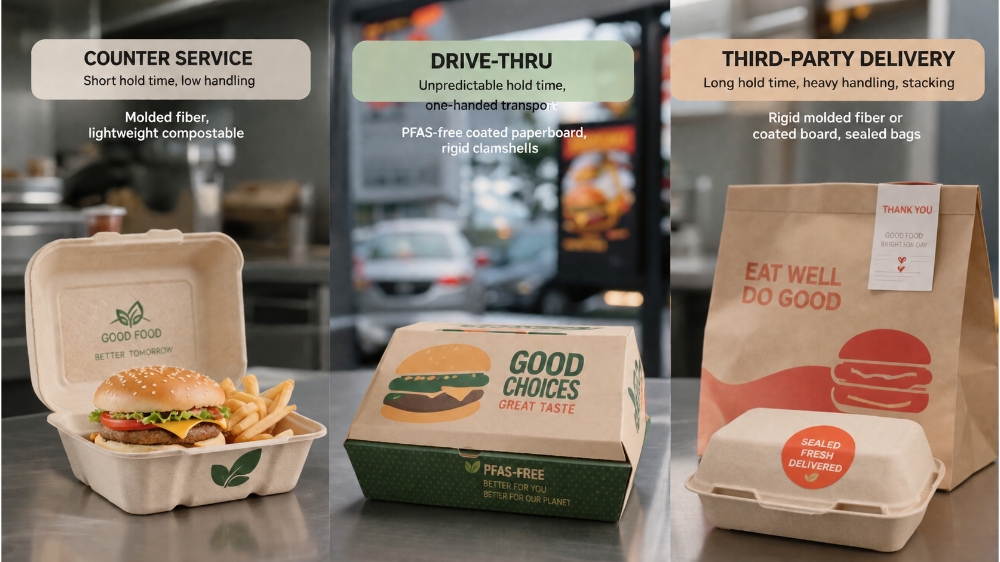
Service format changes which packaging trade-offs matter most, because hold time, transport distance, and how much handling happens off-premises all vary sharply between a counter order, a drive-thru order, and a third-party delivery order.
Counter service, where food is consumed within minutes on-site or a short walk away, can lean toward molded fiber and lighter-weight compostable formats without much risk, since hold time is short and the container doesn’t need to survive a long ride. Drive-thru changes the calculus: orders travel further, sit in a car for longer, and staff can’t gauge how far a given customer is driving, so grease and moisture resistance need to hold up for an unpredictable window rather than a known short one. Third-party delivery is the most demanding format of the three — longer hold times, more handling, and a container that gets stacked, bagged, and jostled in transit means structural rigidity and leak resistance matter more than they do at the counter, even at the cost of a heavier or slightly pricier format.
Service format
Packaging priority
Material lean
Counter service
Short hold time, low handling
Molded fiber, lightweight compostable
Drive-thru
Unpredictable hold time, one-handed transport
PFAS-free coated paperboard, rigid clamshells
Third-party delivery
Long hold time, heavy handling, stacking
Rigid molded fiber or coated board, sealed bags
How to Plan a Packaging Transition Without a Supply Gap
The operators who run into trouble with a packaging switch almost never fail on material selection — they fail on sequencing, running out of a legacy SKU before the replacement is validated, or discovering a state-specific restriction after a truckload of the wrong container has already shipped.
A workable transition plan runs in three stages rather than a single cutover. First, audit current packaging against the state laws that actually apply to your footprint — not a national summary, but the specific PFAS and EPR rules in every state you operate or franchise in, since deadlines and covered categories differ enough that a generic compliance memo won’t catch everything. Second, pilot the replacement material in the one or two service formats where it’s highest-risk — usually delivery or drive-thru — before rolling it out system-wide, since a format that works fine at the counter can fail under a longer hold time. Third, phase supplier onboarding so the legacy and replacement SKUs overlap for at least one full ordering cycle, which avoids the exact emergency-sourcing scramble that drives up cost when a ban takes effect mid-contract. For operators building this lineup from scratch, reviewing ready-stock molded fiber and PFAS-free paperboard options side by side against your actual order mix — before committing to a production run — is worth the extra week it takes. If you need a packaging partner to map a transition against your specific state footprint and service formats, contact Maibao Packaging for a sourcing consultation.
Not sure which sustainable packaging fits your footprint?
Talk to a packaging specialist about matching your materials to your service format, order volume, and the specific state laws you operate under.
What counts as sustainable packaging for a fast food restaurant?
Sustainable packaging means materials that are recyclable, compostable, or reusable, free of intentionally added PFAS, and sized to actually match your order volume rather than over-specified. The strongest current direction is fiber-based packaging with improved grease and moisture barriers that don’t rely on fluorochemical coatings.
Is molded fiber packaging more expensive than plastic or foam?
Per unit, usually yes — molded fiber and PFAS-free coated paperboard typically cost more than legacy foam or plastic. Factoring in lower remake rates, avoided emergency resourcing when bans take effect, and lower EPR fees in states that scale fees by recyclability often narrows or closes that gap.
Do all states require PFAS-free food packaging?
Not yet, but a growing number do, with different effective dates and covered categories in each. Any operator selling across state lines needs a state-by-state compliance check rather than assuming one national standard applies.
What’s the difference between compostable and biodegradable packaging?
Compostable packaging breaks down under specific, often industrial, composting conditions and is typically backed by a certification standard. Biodegradable is a looser, less regulated claim about eventual breakdown with no guaranteed timeframe or required conditions, so it deserves more scrutiny before it’s used in customer-facing marketing.
Post time:
Jul-28-2026
For inquiries about our products or pricelist, please leave your email to us and we will be in touch within 24 hours.