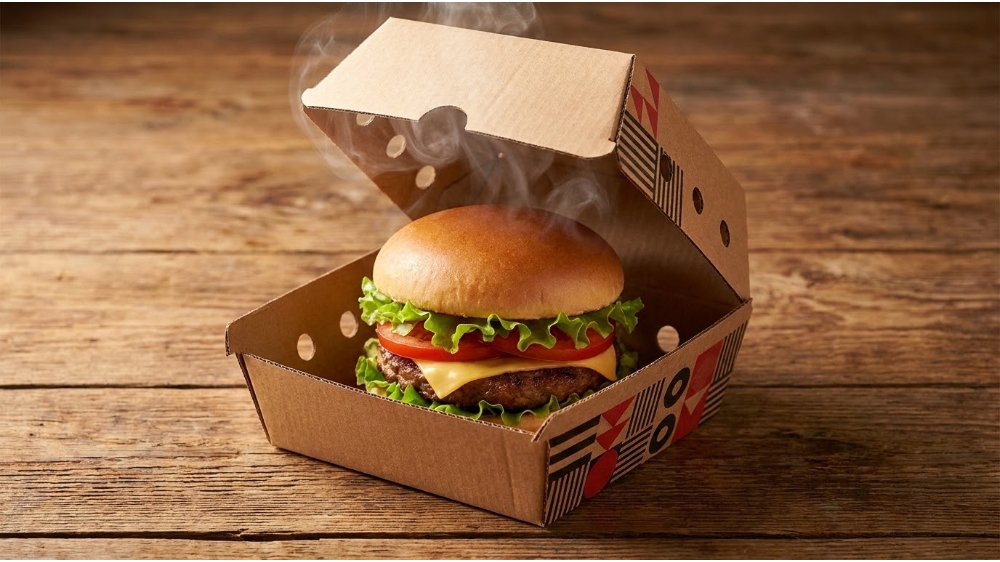
A burger can leave the kitchen with a toasted, crisp-edged bun and arrive with a gummy crown and a wet lid. Vent holes prevent this by letting warm, moist air escape before it condenses on cool surfaces. They work only when the holes are small, placed above the patty line, and not sealed in by the delivery bag. Here is how burger box ventilation works, where it fails, and how to specify it.
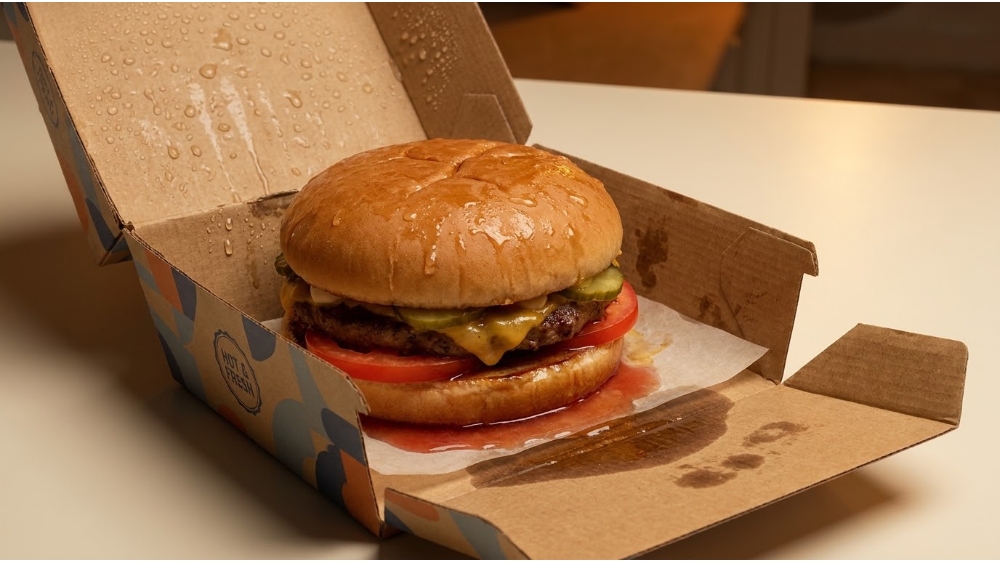
Steam is the hidden delivery problem. A freshly assembled burger releases water vapor from the patty, melted cheese, sauce, and toppings. Inside a closed box, that vapor has nowhere to go. It meets the cooler lid, turns into droplets, and drips onto the bun.
Vent holes give the vapor a way out. But they address only one of three moisture sources, and a sealed delivery bag can cancel them completely. This guide explains the mechanism, hole placement, the bag problem, and a simple test method for operators who want burgers to arrive the way they left the kitchen.
Why Burger Buns Turn Soggy in Delivery: Three Moisture Sources
Soggy buns have three separate causes: condensed steam, liquid transferred from fillings, and grease. Vent holes only address the first, so naming the cause comes before choosing a box.
Condensed steam. A hot patty, melted cheese, grilled onions, and sauce all release water vapor. In a closed box the air fills with moisture quickly. When that humid air touches the cooler inside of the lid or wall, it condenses into liquid droplets. The drops land on the crown or run down its sides, and the porous bun crumb absorbs them and turns gummy.
Liquid transfer. Patty juices, tomato slices, pickles, and sauce wet the bottom bun directly. Ventilation cannot change this, because the water arrives as a liquid rather than a vapor.
Grease. Fat soaks into the bottom bun and into the box board. A board without a grease barrier wicks oil outward, which stains the box and softens its structure.
A quick diagnosis saves money. A damp, sticky crown with droplets on the lid points to steam, and better venting will help. A soggy bottom bun under a dry crown points to juices or grease, and the fix lies in assembly and board coating instead. Learn Why Takeout Burgers Get Soggy & Burger Packaging That Works to explore more detail.
What Burger Box Vent Holes Actually Do (and What They Cannot Fix)
Vent holes let warm, moist air leave the box before it reaches a cool surface and condenses. Warm air rises, and water vapor is lighter than dry air, so humid air collects at the top of the box. A hole in the upper part of the box gives that air an exit while drier outside air replaces it.
The result is lower humidity inside the box and less condensation on the lid. The crown stays drier for longer, and the bun keeps more of its toasted texture. Toasting matters here: a toasted cut surface tends to absorb moisture more slowly than a soft one, so toasting and venting reinforce each other.
Vent holes do not dry a bun that is already wet, and they do not stop juice or grease transfer. They also cannot compensate for a lid that sits flat against the crown, because condensation still forms on contact. Treat venting as one part of a system that also includes headspace, board coating, and assembly.
What vent holes do for a burger:
Let moist air escape before it condenses on the lid
Keep the crown dry and the toasted surface intact for longer
Reduce droplets that drip back onto the bun
Work best alongside a toasted bun, a grease-resistant board, and enough headspace
Where the Holes Go: Upper Walls, Lid, and Base
Placement matters more than hole count. Steam rises, so effective vents sit in the upper half of the box, above the patty line.
Upper side walls and lid edge
Perforations on opposing upper walls create cross-flow: moist air exits on one side while drier air enters from the other. Holes above the patty line also keep sauce and juice from leaking out when the box tilts in transit. Small round holes or short slots commonly start around 3–6 mm in diameter, but treat that as a starting point for testing rather than a standard.
Lid shape and headspace
A domed or raised lid keeps condensate away from the crown. A lid that rests directly on the bun gives droplets a place to form exactly where you do not want them. Headspace and venting work as a pair: a tall burger in a shallow, vented box can still arrive soggy.
Base and corrugated flutes
Holes in the base are rarely a good idea, because grease and sauce leak through and cold air can enter under the burger. Corrugated boxes are different. Their flutes form channels inside the wall, which can help carry moisture away while the structure insulates the food.
Finally, check how the holes are made. Vents should be die-cut through the finished board so that coatings and printing do not cover them. Keep holes away from score lines, where folding can tear them or weaken the corner.
The Delivery Bag Problem: When Vents Stop Working
A vented box inside a sealed bag is often still a closed container. Vapor leaves the box and then stays trapped in the bag, where it condenses on the bag walls and the box exterior. The vents moved the problem outward instead of removing it.
This is the least discussed cause of soggy buns in delivery, because the box looks well designed on its own. Three bag-level factors matter most.
Bag-level factors that cancel vent holes:
Sealed or stapled tops: vapor has no exit, so humidity builds inside the bag
Plastic or thermal bags: they hold heat well, but they also hold moisture
Stacking: hot fries, cold drinks, or sauce cups pressed against vent holes block airflow and add humidity
Better practice is to use a bag with its own small vents or a loosely folded top, keep boxes upright and unstacked where possible, and separate hot items from cold ones. Paper bags generally breathe better than plastic, but a fully stapled paper bag still limits airflow. Always evaluate the box together with the bag it ships in.
Venting vs. Heat Retention: Finding the Balance
More venting means more heat loss. A burger that arrives with a dry crown but lukewarm is not a success. The aim is the smallest open area that keeps the lid free of droplets for your actual delivery time.
The burger itself changes the balance:
Soft bun, juicy patty, sauce: moderate venting plus liquid control, because the main risk is wet crumb.
Crispy chicken burger: prioritize venting, because trapped steam softens the breading as well as the bun.
Stacked burger with wet toppings: add headspace, and consider packing tomato or pickles separately.
Use symptoms to adjust. If the lid shows droplets and the crown is gummy, add or raise vents. If the crown is fine but the burger arrives lukewarm, reduce the open area or move to an insulated outer bag. Change one variable at a time so you know what actually worked.
Burger Box, Wrap, or Bag: How Each Format Handles Steam
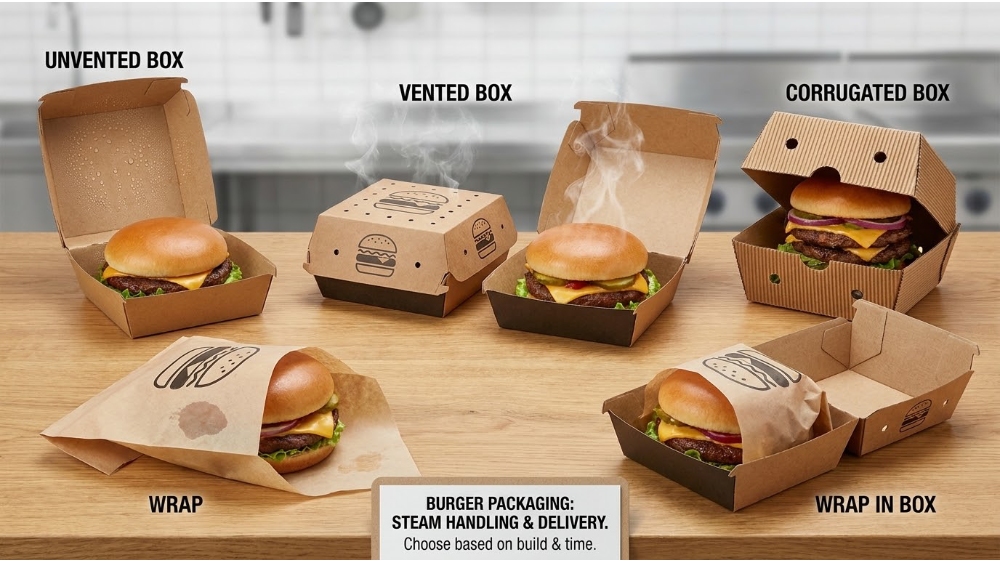
Each common burger format manages vapor differently. The table summarizes the trade-offs for delivery.
Format
Steam handling
Main weakness
Best fit
Vented clamshell box
Releases vapor; headspace keeps lid off the bun
Some heat loss; vents blocked by sealed bags
Delivery with standard builds
Unvented clamshell box
Traps vapor; condensation forms on the lid
Gummy crown on longer trips
Dine-in and short pickup
Vented corrugated box
Insulates; flutes may channel vapor
Bulkier and often costlier
Tall or premium burgers on longer routes
Greaseproof wrap alone
Absorbs some juice; limited breathability
Little crush protection; moisture sits against the bun
Counter service, very short holds
Wrap inside a vented box
Wrap manages juice; box releases vapor
Extra packing step and material
Saucy burgers on delivery
Vented boxes solve condensation but not juice transfer, while wraps absorb juice but hold moisture against the bun. That is why some operators pair a wrap with a vented box rather than choosing one. The right choice depends on burger build and delivery time, not on format alone. Read Regional Burger Types & Custom Clamshell Box Design Guide to know more about different burger types matching different boxes.
How to Specify and Test Vented Burger Boxes
Start with your real delivery time, measured from the end of the grill line to the customer’s door. Design for the slow orders, not the average ones.
Then test the full package: box, bag, and any sides packed with it. Prepare identical burgers, open them at your typical delivery time, and open a second set ten minutes later. At each point, check four things: droplets on the lid, texture of the crown, dampness of the bottom bun, and temperature with a probe thermometer.
Supplier questions to ask before a bulk order:
What are the hole diameter, count, and position, and are they die-cut after coating and printing?
Does the board have a grease barrier suited to hot, saucy burgers?
Is there enough headspace for my tallest burger?
Can I test a sample set inside my own delivery bags before ordering?
Re-test whenever you change the box size, bun, or sauce. A vent pattern that works on a single smash burger can fail on a triple stack, because the headspace and moisture load have changed.
Working with a packaging supplier that can adjust vent layout, board, and print together removes much of the guesswork. For a sourcing consultation on vented burger boxes matched to your menu and delivery routes, contact Maibao Packaging.
Final takeaway: Vent holes prevent soggy buns by letting steam escape before it condenses on the lid, but only when they sit high on the box, stay small enough to hold heat, and are not blocked by a sealed bag. They do nothing for juice or grease, so toasting, assembly, and board coating still matter. Diagnose the moisture source first, then test the box, bag, and menu item together. If the crown is damp, improve venting; if the burger is cold, reduce it.
Need burger boxes that arrive crisp, not steamed?
Talk to a packaging specialist about vent layout, board, and box size matched to your burgers, delivery bags, and delivery times.
Slightly, because vents let some warm air out. Keeping holes small, few, and high on the box limits the loss. On long routes, an insulated outer bag with its own small vent holds heat better than sealing the box.
Why is my bottom bun soggy when the box has vent holes?
Bottom-bun sogginess usually comes from patty juice, sauce, or grease rather than steam. Toast the bun, let the patty rest briefly, and use a grease-resistant board or liner.
Are vent holes necessary for dine-in or quick pickup burgers?
Often not. When a burger is eaten within a few minutes, there is little time for condensation to build up. Venting becomes important as hold time grows, especially for delivery.
Post time:
Oct-15-2026
For inquiries about our products or pricelist, please leave your email to us and we will be in touch within 24 hours.