Global Localized Burger Types and Their Custom Clamshell Box Designs
Yes, people in the Middle East eat burgers in huge numbers. But a burger in Riyadh is not built, sold, or delivered like one in Berlin, Tokyo, or Mumbai. This guide shows how local burger types change clamshell box size, lining, venting, print, and compliance, so you can specify the right box for each market instead of one box for all of them.
The clamshell box must follow the local burger, not the global menu. Gulf burgers are chicken-led, sauce-rich, and often delivered, so boxes need heat holding, sauce resistance, and bilingual print. European boxes face a different test: strict PFAS rules now apply to food-contact packaging. Japanese rice burgers need compact, glaze-proof fits, and Indian menus need clear vegetarian separation. One universal box fails in at least two of these markets.
Below, we compare how regional burgers differ, what each one demands from a clamshell, and how to brief a supplier so a single range works across markets.
Do People in the Middle East Really Eat Burgers?
Yes. Burgers and sandwiches made up 36.4% of the Middle East and Africa fast food market in 2024, according to Market Data Forecast figures reported by QSR Media. Saudi Arabia led the region with a 22.3% share, and the UAE followed with 18.4%.
Demand has a clear structure. Operators have long pointed to high disposable incomes, a young population, and limited entertainment options as drivers of restaurant spending, especially for burger concepts. Global names followed. McDonald’s already ran about 850 restaurants across the region by 2012, and brands such as Shake Shack, Umami Burger, MOOYAH, and Big Smoke Burger have since entered Gulf markets.
Ordering is also increasingly digital. Official figures cited by QSR Media indicate that 78% of fast food purchases in Dubai are now made through apps or contactless payment. A burger that travels in a delivery bag needs different packaging from one eaten at the counter.
Brands adapt the menu itself, too. BurgerFuel renamed its Bastard Burger when it opened in Saudi Arabia. That is a packaging lesson: product names, claims, and artwork printed on a box must be localized along with the recipe.
Regional Burger Types and What Each Demands From a Box
Every local burger creates a specific packaging problem: shape, moisture, sauce, or labeling. The table links four markets to the problem their signature burgers create and the clamshell response.
Market
Local burger examples
Packaging problem
Clamshell response
Middle East
Flatbread sandwiches such as McArabia, chicken and sujuk burgers
Notice that the problem is rarely the box shape alone. More often it is the barrier, the print, or the paperwork, which is why a shared structure with market-specific specifications usually beats four separate designs.
Middle East Clamshell Design: Delivery, Heat, and Sauce
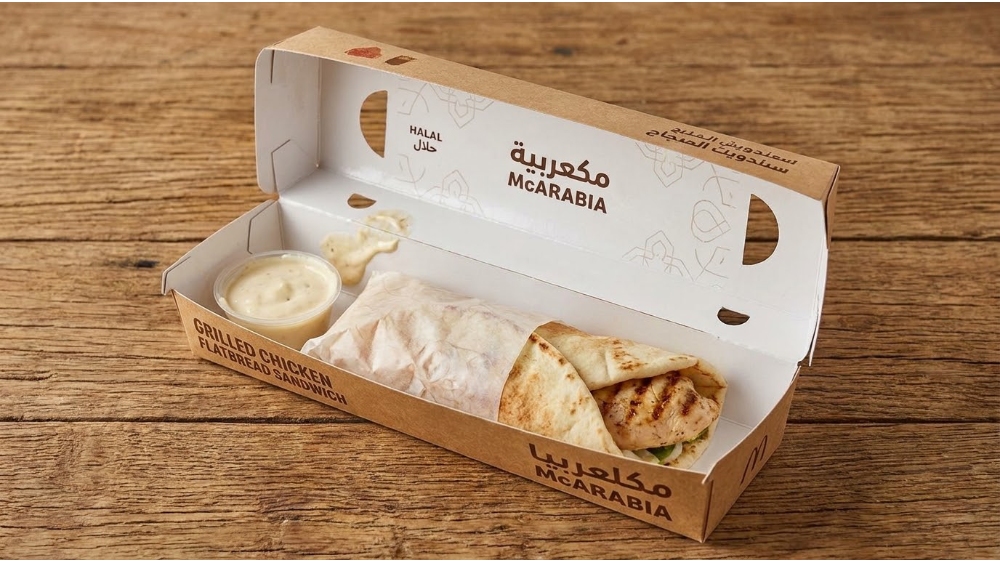
Middle Eastern box design starts with the sandwich format, not the patty. McDonald’s introduced the McArabia in 2003 for Arab consumers: grilled chicken patties, lettuce, tomato, and garlic sauce in Arabic flatbread. Variants followed, including sujuk and kofta versions. A flatbread sandwich is long and soft, and a standard square clamshell lets it slide and crush.
Three design pressures follow. Chicken and flatbread release steam, and garlic sauce stains board, so the box needs vents plus a sauce-resistant lining. Long delivery routes in hot weather extend hold times, so wall strength and heat retention matter more than they do for counter service. Where operators sell shared or family meals, multi-burger boxes also need stronger board and secure closure tabs.
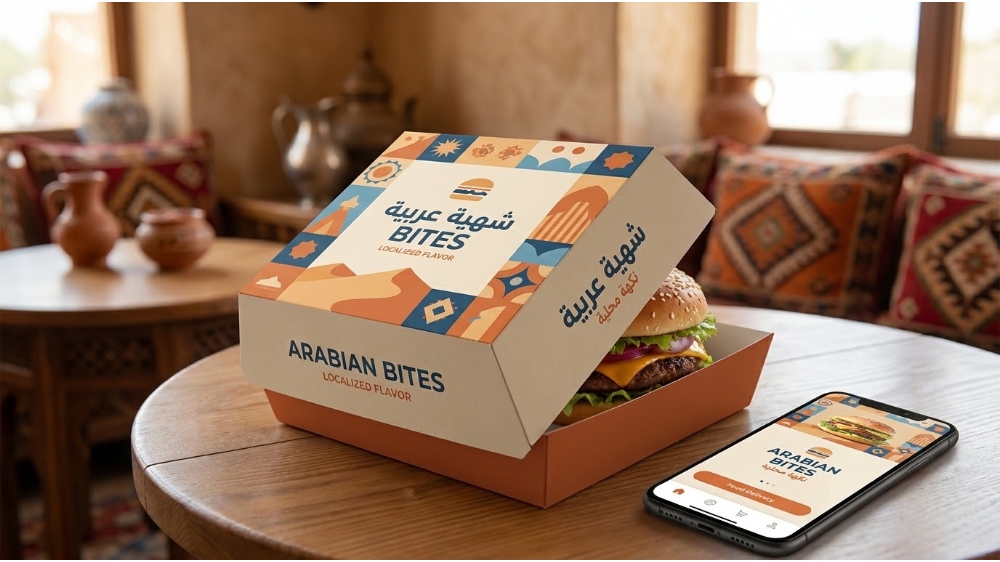
Language matters as much as structure. Arabic-English bilingual artwork is standard in the Gulf, and menu names must match what the local operator actually sells.
Middle East clamshell checklist:
Elongated or adjustable-height box for flatbread burgers and wraps
Sauce-resistant liner for garlic mayo and similar sauces
Vent pattern tested against real delivery times
Arabic and English artwork reviewed by a native reader
Menu names and certification claims, including halal, confirmed with the operator
European Clamshell Design: Compliance and Recyclability
European box design is now shaped first by regulation. Since 12 August 2026, the EU’s Packaging and Packaging Waste Regulation (PPWR) has barred food-contact packaging that exceeds strict PFAS limits from the EU market. The European Commission notes that PFAS have commonly been used in takeaway containers, fast-food wrappers, and pizza boxes to repel grease and water. Grease-resistant burger clamshells sit directly in scope.
The rule applies to imported packaging, and the Commission’s guidance says packaging made before the date but first placed on the market afterward must comply. A European importer therefore cannot assume that an older Middle Eastern or Asian specification is safe.
Design follows from that. Switch to a non-fluorinated grease barrier, then confirm it still handles a hot, saucy patty. Prefer mono-material board that recyclers can process, since heavy laminates complicate recycling. Use plain kraft with limited ink coverage, and rely on icons rather than long text where one box serves several languages.
Middle East vs. Europe at a glance:
Main driver: delivery volume and sandwich format vs. regulation and recyclability
Barrier: sauce and heat resistance vs. a PFAS-free grease barrier
Print: Arabic-English bilingual vs. multilingual or icon-led
Shape: elongated, wrap-friendly options vs. standard burger proportions
Japan and India: When the Burger Isn’t Round or Beef
Japan: compact, sticky, and seasonal
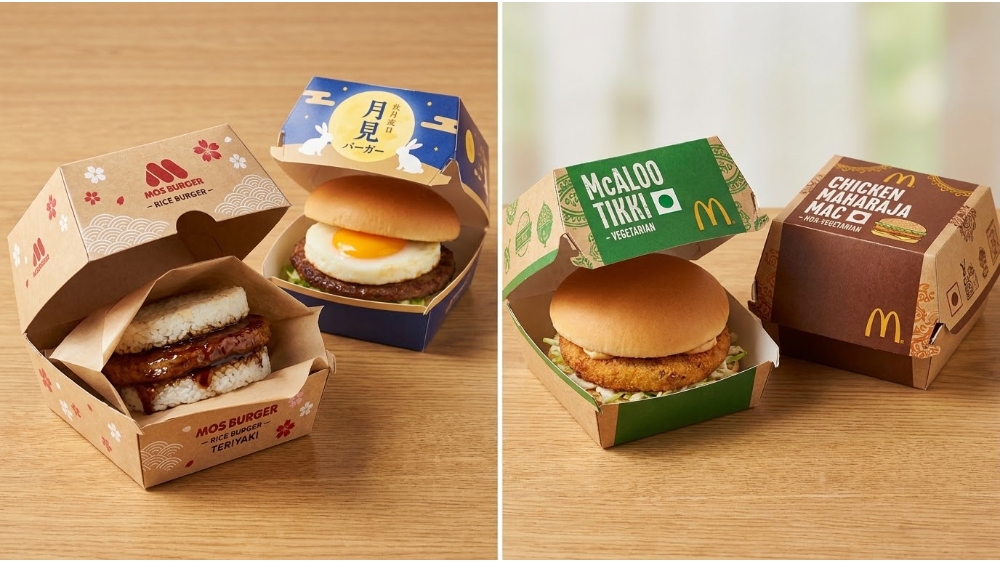
Japan has its own burger lineage. MOS Burger, founded in 1972, introduced the teriyaki burger in 1973 and the rice burger, which swaps the bun for packed rice, in 1987. McDonald’s Japan sells ebi shrimp burgers and seasonal tsukimi burgers topped with egg. Burgers there often come in paper pouches, so a clamshell signals a premium or delivery product.
The design implications are specific. A rice burger is shallow, soy-glazed, and fragile, so the box needs a snug, compact fit and a glaze-resistant interior. An egg-topped seasonal burger needs extra dome height, which suggests a separate lid or insert rather than a redesign of the whole box.
India: separation comes first
McDonald’s India has not sold beqef or pork since it opened in 1996, and it separates vegetarian and non-vegetarian kitchens. The menu includes the chicken Maharaja Mac and the potato-based McAloo Tikki, and two restaurants at pilgrimage sites went fully vegetarian. For packaging, the priority is unambiguous separation. Use color-coded or separately printed boxes, add the green-dot and brown-dot marks Indian consumers recognize, and specify a sealed closure so mixed orders cannot be confused.
How to Specify a Localized Clamshell Range
For B2B buyers, the efficient approach is one structural die line with market-specific variables on top. The folding structure stays the same, while the lining, vents, print, and paperwork change by market.
Start with the assembled burger. Measure the real product, including sauce and toppings, and allow a few millimeters of clearance rather than copying a generic size chart.
Match the barrier to the sauce. Garlic mayo, teriyaki glaze, and tomato-based sauces behave differently on board. Test a loaded sample at your actual delivery time, not your ideal one.
Decide compliance before artwork. Confirm EU PFAS status for European orders and local food-contact requirements for other destinations. Ask the supplier for current test reports.
Localize print as separate files. Language, product names, dietary marks, and seasonal artwork should be market-specific files on a shared die line, which keeps tooling cost down.
If you are turning a market-by-market burger menu into a tested clamshell range, contact Maibao Packaging for a sourcing consultation.
Need clamshell boxes built for your local burger menu?
Talk to a packaging specialist about matching box size, lining, print, and compliance to each market you serve.
The folding structure often can, but the lining, ink, language, and compliance documents usually cannot. Keep one die line and change the market-specific layers on top.
How do I check that a clamshell box is PFAS-compliant for Europe?
Ask the supplier for a recent test report and a declaration of conformity. The European Commission recommends a stepwise testing approach, and a sample below 50 mg of total fluorine per kg of packaging could be considered compliant.
How should Arabic text be handled on burger boxes?
Use a professional translator and a right-to-left layout, then have a native reader check the artwork. Also confirm that the text reads correctly when the lid opens toward the customer.
What size clamshell suits a flatbread burger or wrap?
There is no fixed standard. Measure the assembled sandwich and choose an elongated box with a few millimeters of clearance, so the product cannot slide during delivery.
Post time:
Oct-14-2026
For inquiries about our products or pricelist, please leave your email to us and we will be in touch within 24 hours.