Flexo vs. Offset Printing for Food Boxes: Cost, Quality, Speed & Best Uses
Flexo vs Offset Printing for Food Boxes: Cost, Quality & Speed Guide
Foodservice Packaging Guide
Flexo vs. Offset Printing for Food Boxes: Cost, Quality, Speed & Best Uses
Choosing the right printing method for takeout boxes isn’t just about aesthetics — it’s a supply chain decision that affects cost per unit, brand perception, delivery timelines, and even how crisp your fries stay. Here’s the complete comparison.
Flexo and offset printing are the two dominant commercial printing processes for food packaging. Each has distinct strengths, cost structures, and limitations. For takeout food boxes — fry boxes, burger boxes, pizza cartons, and clamshells — the choice directly impacts brand appearance, per-unit cost at scale, and delivery lead time.
This guide compares flexographic and offset printing across quality, speed, substrate compatibility, and cost. It then applies that framework specifically to takeout food boxes, helping you match the printing method to your menu, volume, and brand requirements. For related guidance on custom packaging design and material selection, explore the food packaging resources.
What Is Flexographic Printing?
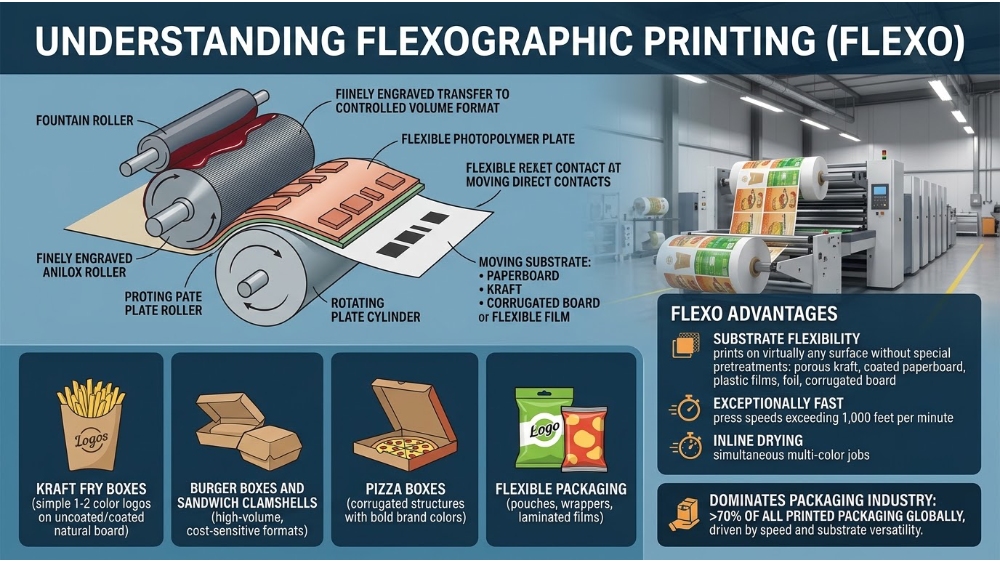
Flexographic printing — commonly called flexo — is a relief printing process that uses a flexible photopolymer plate mounted on a rotating cylinder. The plate features raised relief areas that pick up ink from the anilox roller, a finely engraved cylinder that precisely transfers a controlled volume of ink to the plate. The plate then makes direct contact with the substrate — paperboard, kraft, corrugated board, or flexible film — transferring the inked image in a single pass.
This direct printing approach is what makes flexo exceptionally fast. Press speeds regularly exceed 1,000 feet per minute, and multi-color jobs can run simultaneously with inline drying. Flexo is the workhorse of high-volume packaging: snack bags, beverage cartons, frozen food boxes, corrugated shipping containers, and the majority of takeout food boxes at the commodity level.
Key applications for flexo in foodservice packaging include:
Kraft fry boxes — simple one- or two-color logos on uncoated or coated natural board
Burger boxes and sandwich clamshells — high-volume, cost-sensitive formats
Pizza boxes — corrugated structures with bold brand colors
Flexible packaging — pouches, wrappers, and laminated films
Flexo’s defining advantage is substrate flexibility. It prints on virtually any surface — including porous kraft, coated paperboard, plastic films, foil, and corrugated board — without requiring special pretreatments. This makes it the default choice for high-volume, cost-driven food packaging applications. According to Millionpack’s flexo vs offset guide, flexo dominates the packaging industry, accounting for more than 70% of all printed packaging globally, driven primarily by its speed and substrate versatility.
What Is Offset Printing?
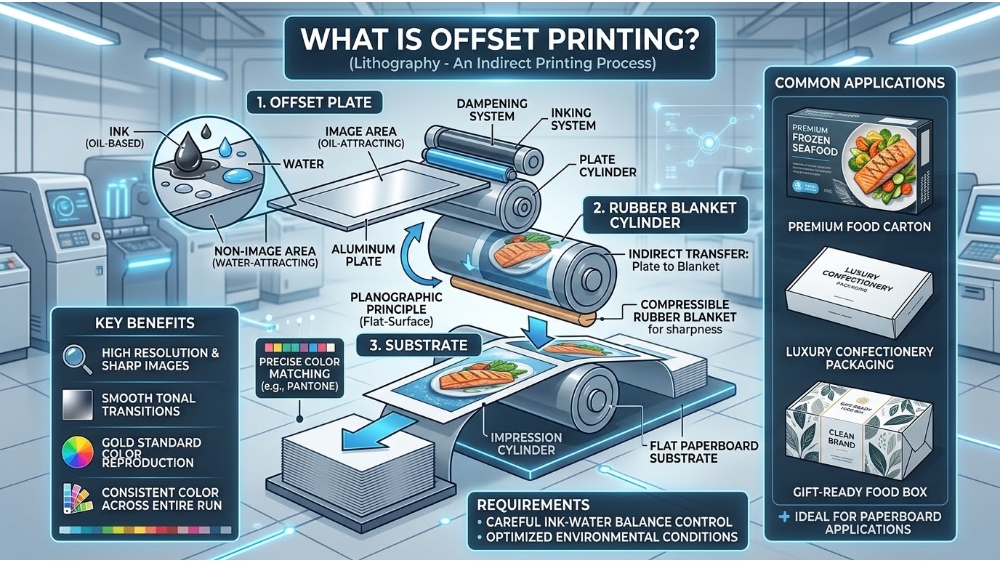
Offset printing — often called lithography — is an indirect printing process. The image is first transferred from a printing plate to a rubber blanket, and then from the blanket onto the substrate. This indirect transfer is what gives offset its name: the ink is “offset” from plate to blanket to substrate, rather than applied directly.
The offset plate is typically a thin, flat aluminum sheet treated with a photochemical process to create oil-attracting image areas and water-attracting non-image areas. This planographic (flat-surface) principle, combined with the compressible rubber blanket, allows offset to produce exceptionally sharp, detailed images with smooth tonal transitions. Offset is the gold standard for color reproduction, capable of producing photographic-quality graphics with subtle gradients and consistent color across the entire run.
Paperboard applications where color accuracy and fine detail are paramount
Short-to-medium runs where high plate cost is amortized across smaller quantities
Brand packaging requiring precise color matching (Pantone and extended-gamut work)
Unlike flexo, offset is largely limited to flat, rigid substrates — typically coated or uncoated paperboard. It struggles with highly absorbent materials like kraft, textured surfaces, and flexible films without extensive pretreatments. Gather Packaging’s buyer guide notes that offset requires careful control of ink-water balance, substrate moisture content, and environmental conditions — which adds complexity but delivers unmatched image quality when executed properly.
Flexo vs. Offset: Key Differences
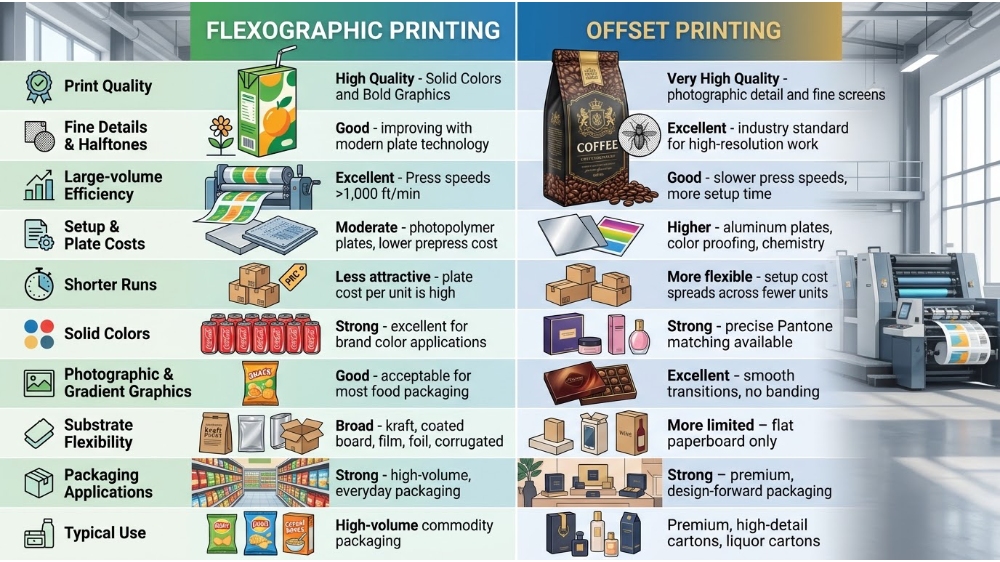
The technical differences between flexo and offset translate into real-world trade-offs for food packaging buyers. Here’s how they stack up across the decision criteria that matter most to restaurant operators and brand managers.
Factor
Flexographic Printing
Offset Printing
Print quality
High — solid colors and bold graphics
Very high — photographic detail and fine screens
Fine details & halftones
Good — improving with modern plate technology
Excellent — industry standard for high-resolution work
As the table shows, flexo excels at speed and substrate diversity — it can print on almost any material at high press speeds. Offset excels at image quality and fine detail, making it the choice for packaging where the visual presentation is as important as the product inside. According to Gentlever’s comparison, offset remains the preferred method for packaging runs under 20,000 units where color fidelity is critical, while flexo becomes increasingly cost-effective as volumes scale beyond 50,000 units.
Flexo Printing Cost Breakdown
Understanding flexo costs requires looking beyond the per-unit price. The true economics are driven by plate costs, setup time, press speed, and the volume over which those fixed costs are spread. Here’s the full picture.
Plate Cost
Flexo plates are photopolymer sheets cured with UV light through a film negative or directly imaged with laser. A typical flexo plate for food packaging costs between $150 and $600 per color, depending on plate size and complexity. For a 4-color print job (CMYK), plate costs typically range from $600 to $2,400 for the full set.
Setup Time
Flexo setup is relatively fast — typically 30 minutes to 2 hours per job. The press operator mounts the plates on cylinders, adjusts the anilox roller (matching ink volume to the substrate), and runs a test cycle. Multi-color jobs require registration alignment, but modern automated presses reduce setup time significantly.
Ink Consumption & Drying
Flexo uses low-viscosity, fast-drying inks — either water-based, solvent-based, or UV-cured. Ink coverage is precisely controlled by the anilox roller, reducing waste. Drying is often inline with hot air or UV lamps, enabling the printed boxes to be cut and folded immediately after printing, eliminating separate drying time.
Production Speed
Flexo presses are among the fastest in commercial printing. Speeds of 500 to 1,200 feet per minute are common, and modern presses can run 24/7 with minimal downtime. A single flexo press can produce 500,000 to 2 million food boxes per 8-hour shift, depending on box size and color count.
Minimum Order Quantities
Flexo is most cost-effective at high volumes. Typical MOQs for flexo-printed food boxes start around 10,000 to 25,000 units for simple designs, and can exceed 100,000 units for complex multi-color jobs. Below these thresholds, the per-unit plate amortization makes flexo less attractive.
Cost Per Unit at Scale
At volumes of 50,000+ units, flexo per-unit costs often drop below $0.10 to $0.25 for standard fry boxes with 1-2 color logos. At 250,000+ units, per-unit costs can approach $0.05 to $0.08. This scale advantage is why fast-food chains overwhelmingly use flexo for their standard takeout packaging.
Offset Printing Cost Breakdown
Offset printing costs are structured differently. Higher prepress and plate costs are balanced by lower per-unit costs at moderate volumes — and by superior image quality that may command a premium from brands.
Plate & Prepress Cost
Offset plates are aluminum sheets with a photochemical coating. Each color requires a separate plate, with costs ranging from $200 to $600 per plate. A full 4-color set costs $800 to $2,400 — similar to flexo — but offset also requires color proofing, film output, and chemical processing, which add $200 to $500 in prepress costs per job. For Pantone spot colors, additional plates at similar cost are needed.
Setup & Press Time
Offset setup is more labor-intensive. The press operator must balance ink and water chemistry, maintain the perfect ink-water emulsion, and carefully align registration across multiple color units. Setup typically takes 1 to 4 hours for a standard job, and more for complex multi-color or metallic ink work.
Ink & Finishing
Offset uses higher-viscosity, oil-based inks that require longer drying times. Printed sheets must pass through a drying tunnel or be stacked with anti-offset powder to prevent smudging. This adds time and handling costs — printed sheets often require 24-48 hours to fully cure before cutting and folding. Finishing processes (cutting, creasing, gluing) are similar to flexo but occur offline rather than inline.
Production Speed
Offset presses are slower — typically 100 to 300 feet per minute, or 10,000 to 18,000 sheets per hour for sheet-fed presses. While high by commercial printing standards, offset is 2-5 times slower than flexo for equivalent output, making it less attractive for extremely high-volume, time-sensitive orders.
Volume Economics
Offset becomes cost-effective at much lower quantities than flexo. For runs of 1,000 to 10,000 units, offset per-unit costs are often 20-40% lower than flexo because the plate costs are similar but amortized across fewer units. At 20,000 to 50,000 units, the two methods are often cost-competitive. Beyond 50,000 units, flexo’s speed advantage and lower consumable costs give it a clear edge.
Which Printing Method Is Better for Takeout Food Boxes?
This is the practical question every foodservice operator and packaging buyer faces. The answer depends on three factors: volume, design complexity, and substrate. Here’s how the decision breaks down for the most common takeout food box categories.
Decision framework for takeout food boxes:
High-volume commodity boxes (50,000+ units): Flexo wins on cost and speed
Premium, design-forward boxes (under 20,000 units): Offset wins on image quality and brand presentation
Kraft or uncoated boxes: Flexo is the only practical option — offset cannot print on porous substrates reliably
Coated paperboard with complex graphics: Offset delivers superior reproduction — flexo can be acceptable if optimized
Mixed menu with multiple box types: Consider a hybrid strategy — flexo for core high-volume items, offset or digital for seasonal or limited-run packaging
Kraft Food Boxes — Flexo Is the Default
Kraft paperboard is the most common material for fry boxes, burger boxes, and sandwich clamshells. It’s porous, absorbent, and uneven in surface texture — characteristics that make it nearly impossible for offset printing to produce clean results. Offset’s fine screen rulings and precise ink-water balance depend on a smooth, closed surface; kraft’s fibers absorb ink and water unevenly, causing dot gain, mottling, and poor color saturation.
Flexo, by contrast, thrives on kraft and other uncoated materials. The flexible plate conforms to the surface, transferring ink directly and consistently. The anilox roller’s metered ink delivery prevents excessive absorption. For operators running kraft fry boxes or burger boxes with 1-3 color logos, flexo is the only viable method — and it’s the industry standard for a reason.
Premium Printed Food Boxes — Offset Delivers the “Wow” Factor
When the packaging itself is part of the brand experience — think gourmet burger chains, artisanal pizza brands, or high-end prepared meal delivery — offset printing is worth the premium. Offset produces crisp typography, smooth gradients, and photographic imagery that flexo cannot match. Four-color process work with fine screens (150-200 lpi) is routine for offset; flexo typically maxes out at 100-133 lpi for comparable quality, and only on coated surfaces.
For premium food boxes with full-color photography, intricate illustrations, or multiple spot colors, offset delivers a perceived value that justifies higher per-unit costs. Brands in competitive urban markets often choose offset for their primary packaging because the visual quality communicates quality before the customer takes the first bite.
High-Volume Restaurant Chains — Flexo at Scale
For national or regional fast-food chains, the decision is almost always flexo. The economics are overwhelming: a chain using 500,000 fry boxes per month can achieve per-unit costs of $0.06–$0.10 with flexo, compared to $0.18–$0.30 with offset at the same volume. The $60,000–$120,000 annual savings are significant — and the design simplicity (bold brand colors, logo, minimal copy) doesn’t require offset-level detail.
Additionally, flexo’s shorter lead times — often 2-3 weeks from approval to delivery, compared to 4-6 weeks for offset — give chains the flexibility to respond to demand fluctuations. When a promotional campaign requires 100,000 custom-branded boxes on short notice, flexo can deliver.
Small / Medium Custom Orders — Digital Printing Enters the Picture
For orders under 1,000 to 5,000 units — typical for independent restaurants, pop-up events, or seasonal menu launches — neither flexo nor offset is the best answer. Both have setup costs that make per-unit economics unattractive at these quantities. Digital printing (toner or inkjet) is the emerging solution for small to medium custom orders.
Digital printing requires no plates, no minimum order quantity, and no setup fees. It prints directly from a digital file, enabling short-turnaround, variable-data, and small-batch production. The trade-off is per-unit cost: digital is typically $0.50–$2.00 per box, significantly higher than flexo or offset at scale. But for small runs, the elimination of plate costs and setup makes digital the most cost-effective option overall.
Many packaging suppliers now offer hybrid production models: digital for short runs and prototyping, flexo or offset for the main production run once the design is finalized. This approach gives independent operators access to professional packaging without committing to high volume. For more details on matching print methods to order quantities, the Heyijia Pack printing guide provides a comprehensive breakdown of run-length economics.
Quick recommendation by order volume:
Under 500 units: Digital — no setup, no MOQ, fast turnaround
500 – 5,000 units: Digital or offset — plate costs make sense, quality is premium
5,000 – 25,000 units: Offset or flexo (depending on substrate and detail level)
25,000 – 100,000 units: Flexo starts winning on cost; offset for premium designs
100,000+ units: Flexo — speed and scale economics are unbeatable
Need packaging advice for your menu?
Talk to a packaging specialist about matching print method, substrate, and design to your volume, brand, and budget.
What is the main difference between flexo and offset printing?
Flexo is a direct relief printing process using flexible plates, ideal for high-speed printing on diverse substrates like kraft, corrugated board, and film. Offset is an indirect lithographic process using rigid plates and a rubber blanket, producing superior image quality on flat paperboard but with slower speeds and limited substrate compatibility.
Which printing method is cheaper for food boxes?
For volumes above 50,000 units, flexo is significantly cheaper due to faster press speeds and lower per-unit costs. For runs under 20,000 units, offset often has a lower total cost because plate costs are similar but amortized over fewer units. For very small runs under 5,000 units, digital printing is typically the most cost-effective option.
Can flexo printing match offset quality?
Modern flexo with high-resolution plate technology and advanced anilox rollers can produce very good quality, but offset still delivers superior fine details, smooth gradients, and color fidelity — especially on coated paperboard. For kraft or uncoated substrates, flexo is the only practical option and quality is sufficient for most foodservice applications.
What printing method do most takeout food boxes use?
The majority of high-volume takeout food boxes — fry boxes, burger boxes, pizza cartons, and sandwich clamshells — are printed using flexography. It’s the industry standard because of its speed, substrate versatility, and cost efficiency at scale. Premium or limited-edition boxes may use offset for enhanced image quality.
Post time:
Aug-24-2026
For inquiries about our products or pricelist, please leave your email to us and we will be in touch within 24 hours.