Festival & IP‑co‑branded Burger Packaging: Custom Sourcing Tips for Special‑shaped Boxes
Custom Shaped Burger Boxes: Festival & IP Co-Brand Sourcing
Custom Packaging Sourcing Guide
Festival & IP-Co-Branded Burger Packaging: Custom Sourcing Tips for Special-Shaped Boxes
A special-shaped burger box is not a printing job with a different outline. It is a small tooling project with its own dieline, sample rounds, licensor approvals, and a launch date that cannot move. Here is how to source one without missing the campaign window.
The short answer: source special-shaped burger packaging backward from the launch date, and lock the structure before the artwork. Shape drives tooling, tooling drives lead time, and lead time decides whether a festival or IP campaign reaches the counter on schedule. Buyers who approve the dieline, then a physical sample, then the licensor’s artwork, in that order, avoid most late changes and costly re-tooling.
This guide covers how to pick a shape a burger can actually survive, the sourcing sequence from concept to production, what IP licensors usually review, how materials and finishes change the result, and what to put in your RFQ. It is written for brands, distributors, and chains buying custom burger boxes for limited-edition campaigns.
Why Shaped Burger Boxes Are a Tooling Project, Not a Print Job
A standard custom burger box runs on cutting dies the factory already owns, so a new design mostly means new artwork. A special shaped burger box needs its own die. That single fact changes your minimum order quantity (MOQ), your budget, and your calendar.
A die is a steel-rule cutting tool that cuts and creases flat board into the box blank. The dieline is the flat technical drawing of that blank, showing cut lines, fold lines, and glue flaps. Every approval in a shaped-box project, from structure to licensor sign-off, depends on the dieline.
Festival and IP campaigns add a hard deadline. A holiday launch or a character tie-in cannot slip by a month because a prototype failed. Ask early whether the shape can return next season with a new print wrap. Reusing a die spreads tooling cost across several campaigns instead of one.
Choosing a Shape the Burger Can Survive
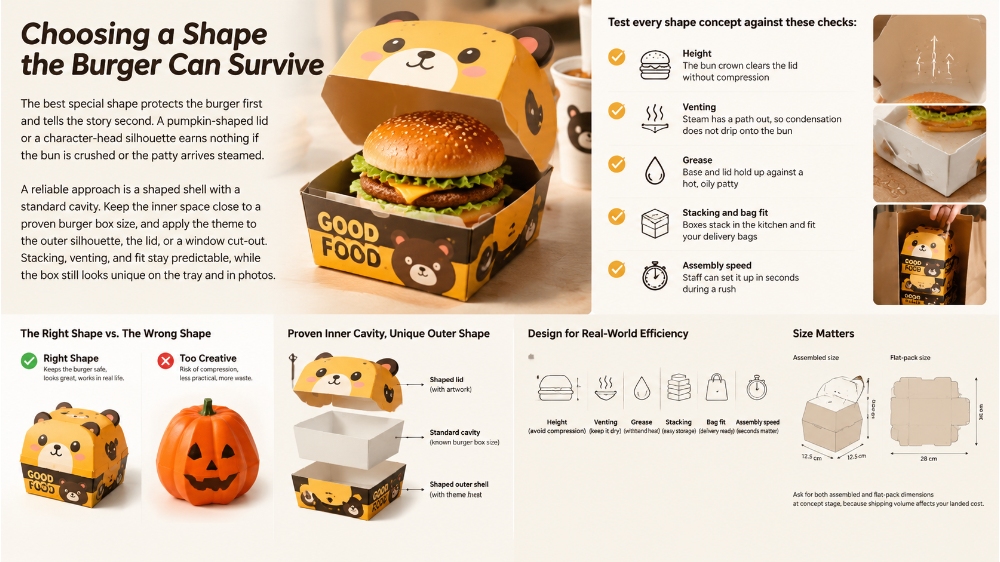
The best special shape protects the burger first and tells the story second. A pumpkin-shaped lid or a character-head silhouette earns nothing if the bun is crushed or the patty arrives steamed.
A reliable approach is a shaped shell with a standard cavity. Keep the inner space close to a proven burger box size, and apply the theme to the outer silhouette, the lid, or a window cut-out. Stacking, venting, and fit stay predictable, while the box still looks unique on the tray and in photos.
Test every shape concept against these checks:
Height: the bun crown clears the lid without compression
Venting: steam has a path out, so condensation does not drip onto the bun
Grease: base and lid hold up against a hot, oily patty
Stacking and bag fit: boxes stack in the kitchen and fit your delivery bags
Assembly speed: staff can set it up in seconds during a rush
Irregular outlines also use more board and pack less efficiently. Ask for both assembled and flat-pack dimensions at concept stage, because shipping volume affects your landed cost.
The Sourcing Sequence: Dieline, Samples, Tooling, Production
Source in this order: structure, sample, artwork, production. Reversing it is the most common cause of re-tooling.
Stage 1, concept brief: send burger dimensions, a shape reference, quantity by variant, preferred material, and your in-store date.
Stage 2, dieline review: the supplier draws the blank. Check glue flaps, lock points, vent placement, and how the shape folds.
Stage 3, white sample: an unprinted physical sample, often cut digitally without a die. Test it with a real burger, a real stack, and a real delivery bag.
Stage 4, tooling approval: make the die only after the white sample passes.
Stage 5, printed pre-production sample: check color, finish, and how artwork sits across folds. This is the sample your licensor will review.
Stage 6, production and inspection: approve a production sample, then confirm carton counts and marking before shipment.
Ask for a written timeline by stage rather than one lead-time figure. Sample rounds and licensor review usually take longer than printing itself, so plan for them first and add shipping time on top. A white sample that fails costs days. A die that fails costs weeks and money. Learn burger box structures firstly by Burger Box Structures: Clamshell, Vertical & Drawer Types.
IP Co-Branding: What Licensors Approve and When
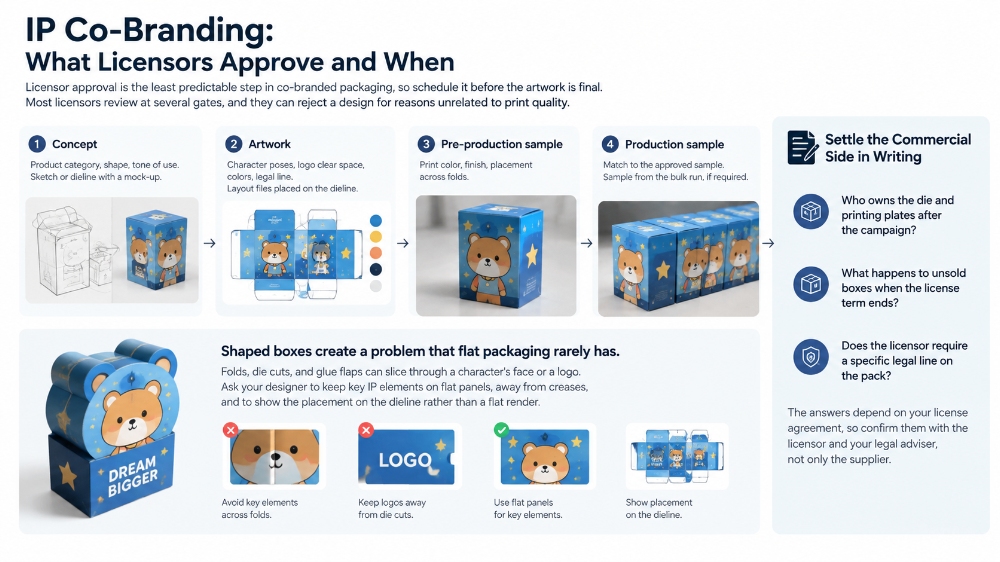
Licensor approval is the least predictable step in co-branded packaging, so schedule it before the artwork is final. Most licensors review at several gates, and they can reject a design for reasons unrelated to print quality.
Approval gate
What the licensor usually checks
What to send
Concept
Product category, shape, tone of use
Sketch or dieline with a mock-up
Artwork
Character poses, logo clear space, colors, legal lines
Layout files placed on the dieline
Pre-production sample
Print color, finish, placement across folds
Physical printed sample
Production sample
Match to the approved sample
Sample from the bulk run, if required
Shaped boxes create a problem that flat packaging rarely has. Folds, die cuts, and glue flaps can slice through a character’s face or a logo. Ask your designer to keep key IP elements on flat panels, away from creases, and to show the placement on the dieline rather than a flat render.
Settle the commercial side in writing too. Who owns the die and printing plates after the campaign? What happens to unsold boxes when the license term ends? Does the licensor require a specific legal line on the pack? The answers depend on your license agreement, so confirm them with the licensor and your legal adviser, not only the supplier.
Materials, Print, and Finishes for Festival and Co-Brand Looks
Choose the board for function first, then choose finishes for impact. A shaped box that loses rigidity at the folds will look cheap no matter how good the print is.
White paperboard for saturated colors
Bright white board gives IP colors and festival reds and golds their strongest result. It suits most shaped lids and sleeves, but check stiffness at the folds if the burger is tall or heavy.
Kraft for a natural seasonal look
Kraft board feels handmade and seasonal, but its brown base mutes bright colors. If a licensor’s palette must stay accurate, ask about a white ink underlay or a white-surface kraft option.
Corrugated microflute for strength
Fine-flute corrugated board adds crush resistance for double-patty burgers and stacked shaped boxes. It can limit very fine die-cut detail, so confirm the outline is achievable before committing.
Whatever the board, the surface that touches food needs a suitable grease barrier, and the inks and adhesives should be suitable for food-contact packaging. Request compliance documents for your target market, such as US FDA or EU food-contact requirements, before you approve the printed sample.
Spot UV, foil stamping, and embossing make festival packaging stand out, but each is an extra production step. Keep varnish and foil off glue areas, and confirm that embossing does not weaken fold lines. For licensor brand colors, ask for a printed color check on the actual board, since the same artwork looks different on white and kraft.
MOQ and Cost Drivers for Special-Shaped Boxes
The MOQ for a shaped burger box is usually higher than for a standard custom box, because the die, setup, and sample rounds are spread across the order. Treat any quoted MOQ as the start of a conversation, since it depends on the shape, board, and print method.
What moves your price:
Shape complexity: more cuts, windows, and glue points raise tooling and labor
Die and plate costs: one-time costs, so order quantity changes the unit price
Board and coating: heavier board and barrier coatings cost more
Print and finishes: color count, foil, spot UV, and embossing add steps
Packing and freight: flat-pack versus pre-assembled changes carton volume
When budget or quantity is tight, you have options. Shape only the lid, sleeve, or topper over a standard base. Limit the campaign to one size. Use digital printing for short runs where the supplier offers it. Each choice trades some visual impact for lower tooling risk. Compare quotes on identical assumptions, because a low price that excludes the die or samples is not actually lower.
Your RFQ Checklist and Final Takeaway
A complete request gets a faster and more accurate quote. Include the following:
Burger specs: patty count, diameter, and assembled height
Quantity: total, and the split by variant or size
Shape: a reference image, or a dieline if you have one
Material and coating: board type, grease barrier, and print side
Print and finishes: color targets, licensor brand colors, foil or spot UV
Compliance: food-contact documents needed for your market
Licensor rules: approval stages, legal lines, and sell-off terms
Delivery: date, destination, and flat-pack or pre-assembled packing
Special-shaped burger packaging succeeds when you run it as a staged project. Fix the structure with a white sample, build licensor approvals into the calendar, choose board for function before finish, and compare quotes on the same assumptions. The exception is a very short or one-off campaign, where a standard box with a custom sleeve or wrap may deliver similar impact with less risk. When you are ready, send your concept and launch date to a one-stop packaging supplier such as Maibao Packaging, which can review structure, materials, and print together.
Planning a festival or IP-co-branded burger box?
Share your burger size, concept, and launch date, and a packaging specialist can review structure, materials, and print for your campaign.
How early should I start sourcing special-shaped burger boxes?
Start as soon as the shape concept exists, before the artwork is final. There is no single lead time, because it depends on sample rounds, licensor review, and shipping. Ask your supplier for a stage-by-stage schedule and add a buffer for revisions.
Are special-shaped burger boxes food-safe?
The shape does not decide food safety; the materials do. The board, grease barrier, inks, and adhesives must suit food contact in your market. Request the supplier’s compliance documents before you approve the printed sample.
Who owns the custom die after the campaign ends?
Ownership is negotiable, so agree it in writing before ordering. Ask whether the supplier will store the die, for how long, and whether you can reuse it with new artwork. Also check your license agreement for any rules on leftover materials.
Do shaped boxes cost more to ship?
Often yes, because irregular shapes pack less efficiently than standard rectangular cartons. Request flat-pack dimensions, carton count, and total shipping volume with your quote, so freight does not surprise you later.
Post time:
Oct-09-2026
For inquiries about our products or pricelist, please leave your email to us and we will be in touch within 24 hours.