Fast Food Brand Packaging Comparison: McDonald’s, KFC, Burger King & Subway Sourcing Differences
Fast Food Packaging Compared: McDonald’s, KFC, BK, Subway
Fast Food Packaging Guide
Fast Food Brand Packaging Comparison: McDonald’s, KFC, Burger King & Subway Sourcing Differences
McDonald’s, KFC, Burger King, Subway, Wendy’s, In-N-Out, Five Guys, and Shake Shack package different foods, so packaging differs; the bigger difference is sourcing. McDonald’s uses global material targets, KFC regionalizes its iconic bucket, Burger King uses a parent-approved list, Subway uses paper bags for made-to-order sandwiches, and Wendy’s, In-N-Out, Five Guys, and Shake Shack each add another model.
Fast food packaging decisions are rarely about the box alone. Menu shape, hold time, franchise structure, and sustainability commitments decide what material gets specified and who is allowed to supply it. That is why a Whopper wrapper, a KFC bucket, and a Subway sandwich wrap look so different, even though all three are paper-based.
One caution before comparing numbers: the chains do not measure packaging the same way. McDonald’s reports on “primary guest packaging,” Restaurant Brands International (Burger King’s parent company) reports on “approved, guest-facing, fibre-based packaging,” and Subway mostly uses descriptive language. In-N-Out and Five Guys publish far less sourcing data than the public companies. Treat each figure below as that company’s own scorecard, not as a ranking.
McDonald’s: Specification-Driven Fiber Sourcing
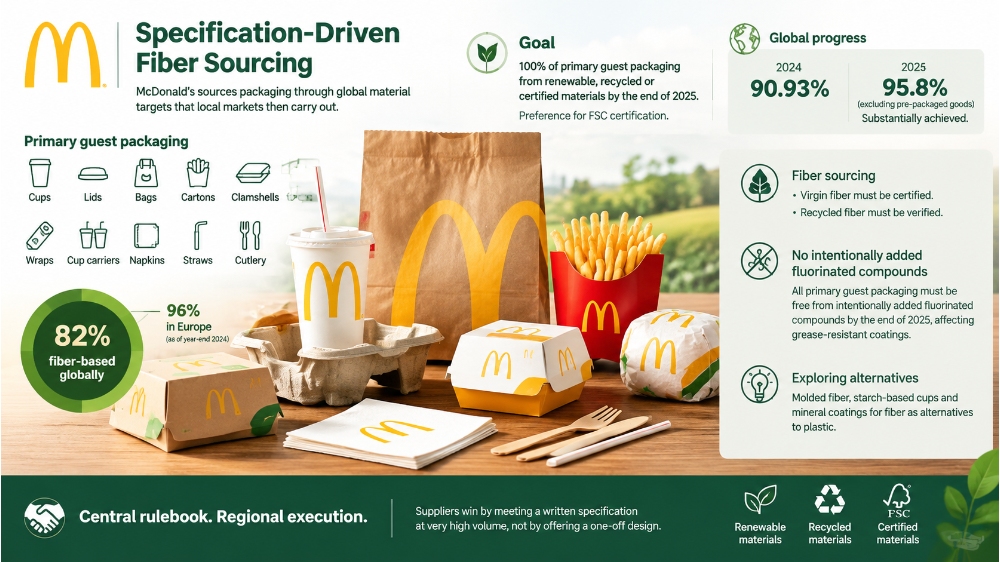
McDonald’s sources packaging through global material targets that local markets then carry out. Its goal was to source 100% of primary guest packaging from renewable, recycled, or certified materials by the end of 2025, with a stated preference for FSC certification. Year-end 2024 reporting put the global figure at 90.93%, and McDonald’s later described the 2025 result as substantially achieved, at 95.8% excluding pre-packaged goods.
The category is wide. McDonald’s counts cups, lids, bags, cartons, clamshells, wraps, cup carriers, napkins, straws, and cutlery as primary guest packaging. About 82% of it is fiber-based globally (96% in Europe as of year-end 2024), so the main sourcing lever is paper and board: virgin fiber must be certified, and recycled fiber must be verified.
Two details matter for packaging buyers. First, McDonald’s committed to making all primary guest packaging free from intentionally added fluorinated compounds by the end of 2025, which directly affects how grease-resistant coatings are chosen. Second, it has said it is exploring molded fiber, starch-based cups, and mineral coatings for fiber as alternatives to plastic.
Practical implication: McDonald’s works from a central rulebook with regional execution. Suppliers win by meeting a written specification at very high volume, not by offering a one-off design.
KFC: A Bucket System Built Around Heat and Grease
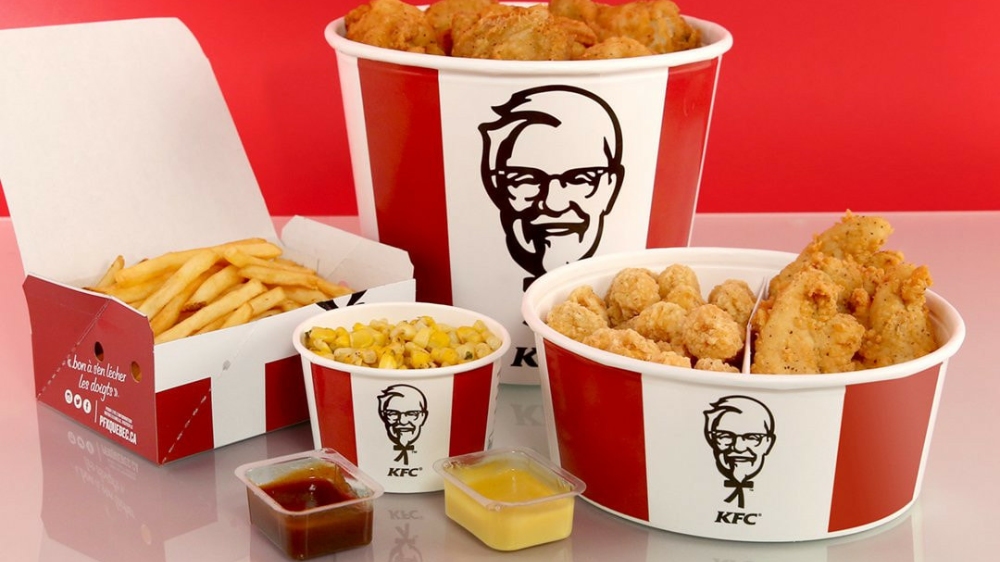
KFC’s packaging is shaped by its food: hot, bone-in, greasy fried chicken that must survive a car ride or a family table. The bucket, box meals, and cups are all paperboard, so fiber origin has been KFC’s central sourcing issue.
Parent company Yum! Brands sets the policy floor. Its sourcing policy rules out fiber from certain controversial sources and gives preference to suppliers that use third-party certified wood fiber such as FSC. KFC’s supply chain has also faced public scrutiny over fiber origin, and a Greenpeace campaign led KFC’s UK arm to revise its policy and exclude suppliers linked to protected-forest sourcing.
In the United States, KFC’s 2021 packaging redesign was described as using 100% certified paperboard, under either the Sustainable Forestry Initiative (SFI) or FSC, with four new items approved for How2Recycle labeling. Yum! has since placed KFC, Pizza Hut, Taco Bell, and The Habit Burger Grill under one packaging blueprint that cuts unnecessary packaging, moves away from hard-to-recycle plastics, and supports recycling and reuse. Individual markets still pilot their own ideas, such as a plastic-free bucket in the UK and a bamboo poutine bucket in Canada.
Practical implication: KFC keeps one recognizable format and sources it under a shared policy, then lets markets adapt materials. For a supplier, that means matching a brand look while accepting regional material rules.
Burger King: Wrapper-First Design With Approved-Item Control
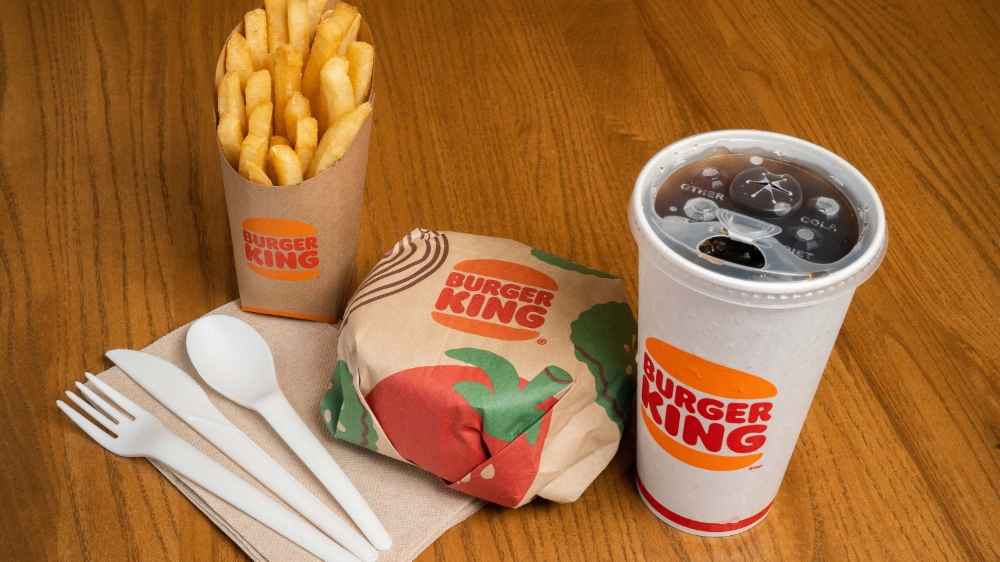
Burger King’s signature package is a printed paper wrapper, not a box. Small changes to paper weight repeat across millions of Whopper sandwiches, so wrapper specification is a real cost lever. A Miami pilot tested two new Whopper wraps that used 13% and 34% less paper than the previous wrap, a good example of cost and sustainability being solved by the same spec change.
Sourcing is managed through Restaurant Brands International (RBI), which also owns Tim Hortons and Popeyes. RBI tracks “approved, guest-facing” packaging, so its percentages apply to items on the company’s approved list. As of December 2024, about 90% of approved fibre-based guest packaging came from recycled or certified sources. RBI defines certified as FSC, PEFC, or SFI, and recycled content must be third-party verified.
RBI also reported that Tim Hortons, Burger King, and Popeyes had removed intentionally added PFAS from roughly 97% of approved guest packaging volumes. Burger King and Popeyes phased out expanded polystyrene (EPS) foam from centrally managed approved packaging globally in 2022. Burger King has also tested deposit-based reusable containers with Loop, which signals direction but remains a pilot rather than the main supply.
Practical implication: Items outside the approved list sit outside the headline numbers. If you supply or copy a Burger King-style format, expect the approval step to matter as much as the price.
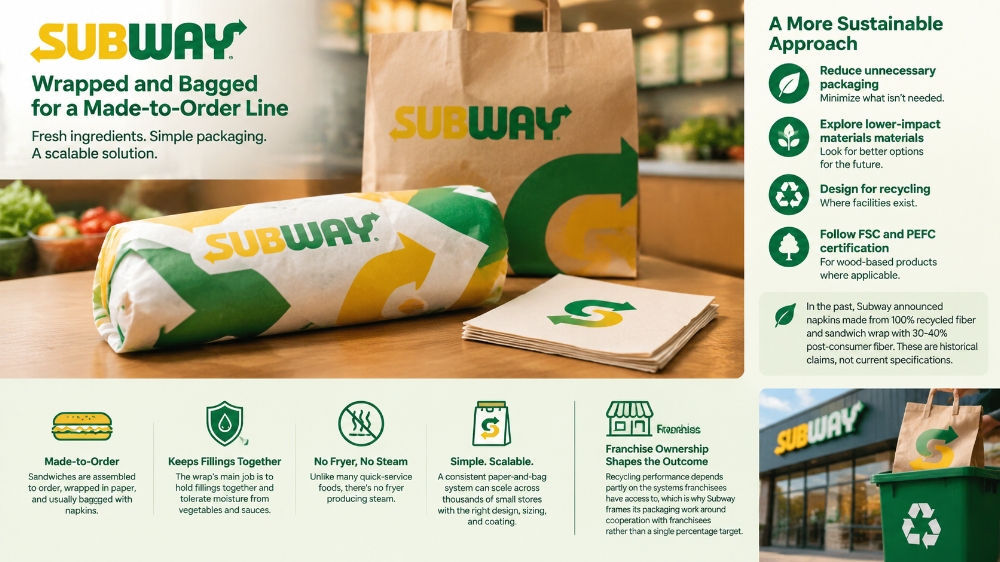
Subway: Wrapped and Bagged for a Made-to-Order Line
Subway’s packaging problem is different. Sandwiches are assembled to order, wrapped in paper, and usually bagged with napkins. There is no fryer producing steam, so the main job of the wrap is to hold fillings together and tolerate moisture from vegetables and sauces.
Public Subway material is more descriptive than numeric. Its sustainability pages describe reducing unnecessary packaging, exploring lower-impact materials, designing for recycling where facilities exist, and following FSC and PEFC certification for wood-based products where applicable. Earlier company announcements highlighted napkins made from 100% recycled fiber and sandwich wrap containing 30 to 40 percent post-consumer fiber. Those claims are dated, so treat them as history rather than current specifications.
Franchise ownership shapes the outcome. Recycling performance depends partly on the systems franchisees have access to, which is why Subway frames its packaging work around cooperation with franchisees rather than a single percentage target.
Practical implication: Subway shows that a simple paper-and-bag system can scale across thousands of small stores, provided the wrap is printed, sized, and coated consistently.
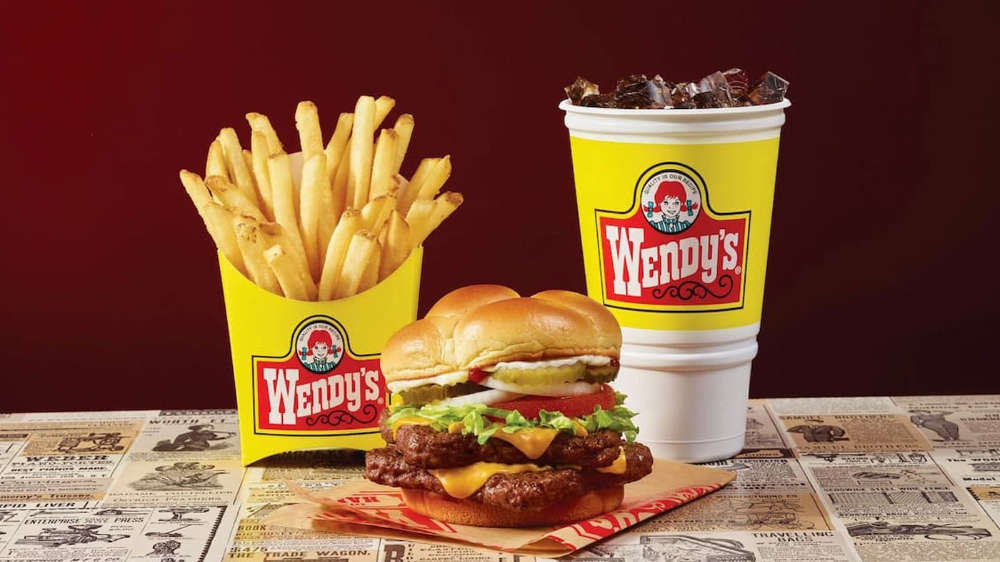
Wendy’s: Certification Deadlines and Packaging Reduction
Wendy’s manages packaging through a stated program called Squarely Sustainable, a nod to its square burgers. Its approach is built on using less material, using certified materials where possible, and partnering with others on hard problems such as recoverable fiber cups.
The most useful sourcing detail is the deadline. Wendy’s has said all consumer-facing paper, fiber, and pulp-derived packaging should hold applicable certification or equivalent by 2026, through groups such as FSC, SFI, and PEFC. Some of its fiber packaging in the United States and Canada already carries the SFI label. It also says it works with third parties to avoid known chemicals of concern, such as PFAS.
Reduction is the other lever. Wendy’s stopped using polystyrene foam in 2012 and later cut fiber and plastic in fry cartons, straws, and bags by several million pounds in total. Its own disclosures are also candid about gaps, noting for example that cup lids do not yet contain recycled content.
Practical implication: Wendy’s treats certification as a dated, auditable requirement and pairs it with lightweighting. For a supplier, expect questions about weight and certificates before price.
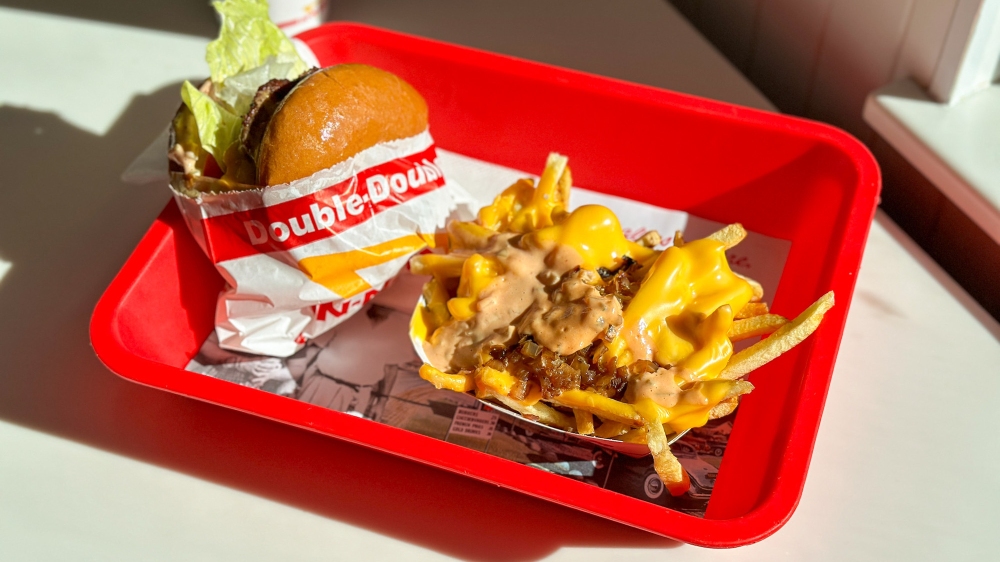
In-N-Out: A Short Menu and a Small Packaging Kit
In-N-Out is privately owned and does not publish packaging sourcing metrics the way McDonald’s or Restaurant Brands International do. Its packaging model can only be read from what guests see: printed paper burger wrappers, fry boats, branded cups, and reusable trays for dine-in orders.
That design shows the sourcing logic. A very short menu means very few packaging items, so each one can be specified tightly and bought in volume. Dine-in reusable trays also reduce disposable use compared with chains that hand out paper tray liners, and advertising is limited mostly to the wrappers and cups.
The trade-off is transparency. Without published fiber percentages, certification rules, or coating declarations, outsiders cannot judge its sourcing the way they can for chains that report. Any brand that wants to win commercial or institutional buyers should publish more than In-N-Out does.
Practical implication: A small item count is itself a sourcing strategy. Fewer sizes, fewer wrappers, and fewer cup variants make quality control easier at any scale.
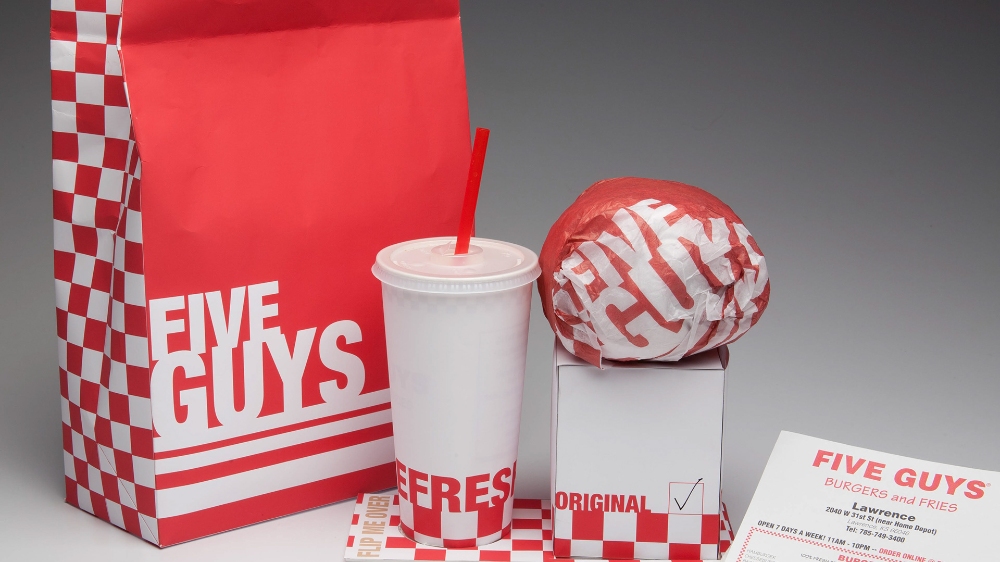
Five Guys: Foil, Paper Bags, and the Fry Cup Change
Five Guys packages differently from the big chains. Burgers are foil-wrapped, and orders are carried out in a branded paper bag, a format that keeps heat in for takeout. Fries used to be served in a cup that overflowed into the bag.
In late 2025, Five Guys began replacing those fry cups with kraft paper bags. The company says the bags are biodegradable natural kraft paper, grease-resistant, and BPA- and PFAS-free, and that air circulation helps keep fries from going soggy. It also says it first tested them during expansion into Korea, where packaging waste laws forced it to rethink its fry containers.
The rollout is a useful case study. Many customers complained that grease showed through the paper and that portions felt smaller, even though the company says sizes are unchanged. Whether the claims hold up, the lesson is clear: a packaging change can alter how a product is perceived, not just how it is carried.
Practical implication: Regulation can start a packaging change, but guest perception decides whether it works. Test grease, portion look, and hold time with real orders before rolling out.
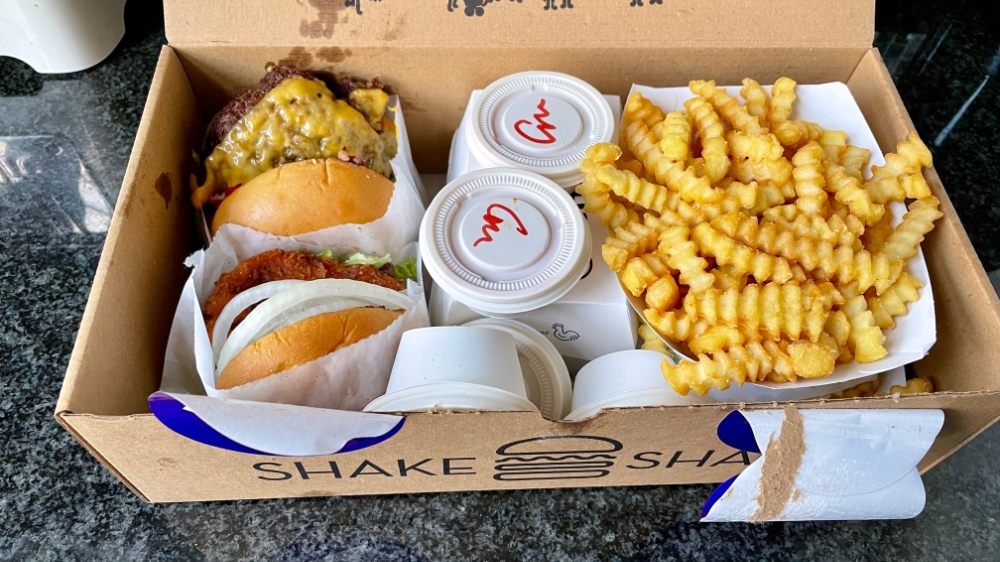
Shake Shack: Recycled-Fiber Bags and Material Pilots
Shake Shack sources packaging like a growth brand that tests before it scales. Its to-go bags were once made entirely from virgin paper. The company then moved to a supplier whose bags use 100% recycled fiber, with 95% post-consumer content.
It also pilots new materials in select restaurants rather than changing everything at once. Examples include cutlery and straws made from AirCarbon, a compostable material from Restore Foodware, tested in selected locations in California, New York, and Florida. Earlier, Shake Shack moved its US restaurants from plastic straws to compostable plant-based straws and has said reducing cutlery use is part of its strategy.
The common thread is that small, visible items such as bags, straws, and cutlery change first. The core burger wrapper stays steady while the supporting items are tested.
Practical implication: Start with items that are easy to swap and measure, such as bags and cutlery, then move to the primary food-contact packaging once the supplier and the performance are proven.
Side-by-Side Comparison of All Eight Chains
The table compares sourcing approach and design priority rather than ranking environmental performance, because each company reports on a different base, and some report very little.
Brand
Signature format
Sourcing approach
Main design priority
McDonald’s
Wraps, cartons, clamshells, bags, cups
Global target for renewable, recycled, or certified primary guest packaging; FSC preferred
Recycled-fiber bags; pilots of new materials in select restaurants
Test small items before scaling
Reading the table together, three sourcing models stand out: central rulebooks (McDonald’s, Burger King, Wendy’s), market-adapted formats (KFC, Five Guys), and small-menu control (In-N-Out, Shake Shack). Subway sits between them, with a simple system and descriptive commitments. The format follows the product: a hand-held burger can sit in a wrapper, while a multi-item chicken meal needs a rigid carrier.
What Smaller Brands Can Borrow From Big Chains
Copy the specification process, not the packaging. Large chains control quality and sourcing because every item has a written spec, a certification rule, and a test method. An independent burger, chicken, or sandwich brand can do the same at a smaller scale.
Packaging spec checklist borrowed from large chains:
Write a spec for every item: board type, weight, coating, size, and print method
Set a fiber rule: FSC, PEFC, SFI, or verified recycled content, with chain-of-custody documents on request
Ask for a coating declaration: confirm in writing whether grease-resistant paper contains intentionally added fluorinated treatments
Test with your real menu item: check hold time and grease at 10, 20, and 30 minutes before a bulk order
Limit item count: fewer sizes and wrapper variants make approval, printing, and reordering easier
Plan for local rules: keep one brand look but allow material changes by market, as KFC and Five Guys have done
Pilot before scaling: trial new bags, cutlery, or containers in a few locations first, as Shake Shack does
Burger King’s wrapper pilot shows why testing pays off: a lighter wrap can cut paper use without changing the burger. KFC’s approach shows that a strong shape can stay constant while materials change underneath it, and Five Guys shows how quickly a container change can become a customer issue.
A one-stop packaging partner can also reduce mismatched suppliers by covering burger boxes, fry cartons, wraps, bags, and cups under one specification. That consistency is what large chains achieve through approved lists, and it is the easiest part for a growing brand to reproduce.
Need fast food packaging specified like a global chain?
Talk to a packaging specialist about matching materials, coatings, sizes, and printing to your menu, hold times, and delivery model.
None of the eight publishes a complete packaging supplier list. Each manages sourcing through approved specifications and regional supply networks, so an independent restaurant cannot copy the supplier, but it can copy the specification.
Why do burgers use paper wrap while fried chicken uses buckets?
A burger is a single hand-held item with limited steam, so a wrapper holds it together efficiently. Fried chicken is heavier, greasier, and often shared, so it needs a rigid, grease-resistant carrier.
What does “certified” mean on fast food packaging?
It usually refers to forest certification such as FSC, PEFC, or SFI, which track where wood fiber comes from. Recycled-content claims are separate and need their own verification.
Is PFAS-free packaging now the baseline for fast food?
Large chains have committed to removing intentionally added fluorinated compounds, so buyers should expect the question. Rules differ by region, so ask your supplier for a written declaration for each grease-resistant item.
Post time:
Oct-10-2026
For inquiries about our products or pricelist, please leave your email to us and we will be in touch within 24 hours.