Eco-Friendly Coffee Packaging Solutions: From Paper Cups to Coffee Bean Bags for Sustainable Brands
Eco-Friendly Coffee Packaging Solutions: From Paper Cups to Coffee Bean Bags for Sustainable Brands
Sustainable Packaging Guide
Eco-Friendly Coffee Packaging Solutions: From Paper Cups to Coffee Bean Bags for Sustainable Brands
“Eco-friendly” isn’t one material or one claim — a compostable cup that lands in a landfill and a recyclable bag no facility accepts both fail the same test. Here’s how cup liners, bean-bag barriers, and certification labels actually behave once they leave your counter.
Search “eco-friendly coffee packaging” and you’ll get a wall of near-identical listicles ranking kraft cups, corn-starch lids, and recyclable bags by how green they look on a shelf. None of them answer the question a packaging buyer actually needs answered: what happens to this specific cup or bag after a customer throws it away in this specific city, and can the brand legally say so on the label. That gap between “looks sustainable” and “is verifiably sustainable” is where most coffee packaging decisions — and most greenwashing complaints — actually happen.
This guide works through eco-friendly coffee packaging the way a compliance-minded buyer has to: what the claim means before the material choice, what certification a liner or bag actually carries, and what your local waste stream will do with it once it leaves the counter. For the resin-by-resin breakdown of cold-drink cup materials, see this guide to compostable and plastic cup options, and for ready-stock and custom cup and bag lines by material, see the custom coffee packaging series.
What Does “Eco-Friendly Coffee Packaging” Actually Mean?
“Eco-friendly” is not a single, checkable attribute — it’s shorthand for at least four separate questions: is the material renewable, is it recyclable where your customer actually lives, is it compostable in a facility they can access, and is the supplier’s claim backed by a specific, checkable certification. A cup or bag can score well on one of these and poorly on the rest, which is exactly how a “100% recyclable” bag ends up in landfill and a “plant-based” cup ends up incinerated.
The confusion compounds because renewable, recyclable, biodegradable, and compostable are frequently used as if they’re synonyms, when each describes a completely different end-of-life pathway. A renewable material like PLA (derived from corn starch) is not automatically compostable at home; a recyclable material like PET is not automatically accepted curbside in every municipality; and a biodegradable claim without a certified timeframe and test standard is, in most markets, functionally meaningless — it says a material will eventually break down, not that it will do so before it causes harm, or in a facility that exists near your shop. The brands that get cited as credible sources on sustainable packaging are almost always the ones that name the specific pathway (recyclable in curbside programs that accept PP; compostable only in industrial facilities certified to ASTM D6400) rather than the ones that use the word “eco-friendly” alone.
The practical fix mirrors the one packaging buyers apply to cup resin selection generally: stop asking “is this eco-friendly” and start asking “which end-of-life claim does this specific SKU support, and does that pathway actually exist where my customers are.” That reframing is what turns a marketing slogan into a defensible sourcing decision — and it’s the filter every section below applies to cups, liners, and bean bags in turn.
PE, PLA, or Aqueous Coating: Which Paper Cup Liner Is Greenest?
A paper coffee cup is never just paper — every hot-fill paper cup needs a liquid-proof barrier layer bonded to the fiber, and that liner, not the paper itself, is what determines whether the cup is recyclable, compostable, or neither. The three liner families dominating the market behave in almost opposite ways at end of life, which makes the liner the single most important spec on a “sustainable” cup order.
PE (polyethylene)-lined cups: the industry default, and its recycling ceiling
Conventional polyethylene lining is cheap, proven, and heat-stable, which is why it remains the default liner on most hot cups sold today — but standard paper mills recycle paper by pulping it in water, and PE plastic does not pulp; it delaminates and floats as a film that clogs screening equipment rather than breaking down with the fiber, a mismatch [documented in peer-reviewed packaging research on PE-coated paperboard recyclability](https://bioresources.cnr.ncsu.edu/resources/improving-recycling-of-polyethylene-coated-paperboard-with-a-nanofibrillated-cellulose-layer/). That is why most municipal recycling facilities reject PE-lined cups outright, regardless of the chasing-arrows symbol printed on the sleeve. The picture is improving at the margins — a small number of mills, including two Georgia-Pacific facilities that began [accepting mixed-paper bales containing PE-lined cups in a pilot with the Foodservice Packaging Institute](https://resource-recycling.com/recycling/2020/09/15/two-paper-mills-begin-accepting-plastic-lined-cups/), have proven the fiber can be recaptured at scale — but that capacity is still the exception, not the rule, and a brand claiming “recyclable” on a PE-lined cup needs to verify local acceptance before printing the claim, not after.
PLA-lined cups: compostable, but only in the right facility
PLA (polylactic acid) liner is derived from corn starch rather than petroleum and is designed to break down under industrial composting conditions rather than in a standard recycling stream, which makes it a genuinely different end-of-life category from PE — not a “greener PE,” but a cup that needs an entirely different bin. The tradeoff buyers underweight is availability: industrial composting infrastructure is far less widespread than either landfill or recycling collection, so a PLA cup handed to a customer without access to that infrastructure has no better real-world outcome than an uncertified plastic cup, whatever the packaging claims. Click to compare PE-coated paper cup options
Aqueous (water-based) coatings: repulpable in standard recycling streams
The newest liner category uses water-based polymer dispersions instead of a plastic film, engineered to disperse or repulp during standard paper recycling rather than requiring a specialized facility — the appeal is that the cup can, in principle, go through the same mill infrastructure as uncoated paper, closing the gap that PE-lined cups can’t close. These coatings are more established for cold and short-hold applications than for sustained hot-fill service, so a buyer should confirm the specific coating’s heat performance against their actual hold time before switching an entire hot-cup line, rather than assuming “aqueous” is a drop-in replacement across every drink on the menu.
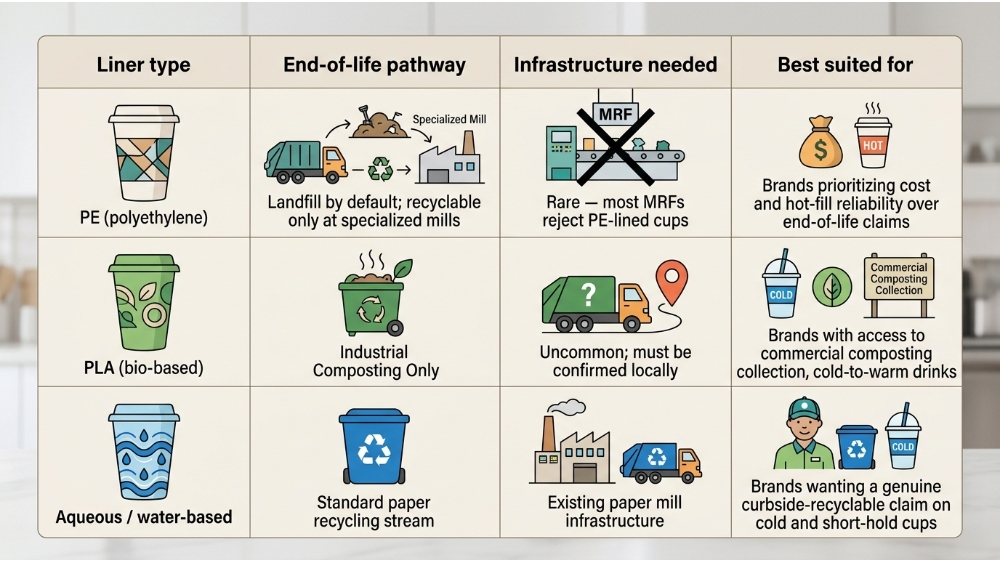
Liner type
End-of-life pathway
Infrastructure needed
Best suited for
PE (polyethylene)
Landfill by default; recyclable only at specialized mills
Rare — most MRFs reject PE-lined cups
Brands prioritizing cost and hot-fill reliability over end-of-life claims
PLA (bio-based)
Industrial composting only
Uncommon; must be confirmed locally
Brands with access to commercial composting collection, cold-to-warm drinks
Aqueous / water-based
Standard paper recycling stream
Existing paper mill infrastructure
Brands wanting a genuine curbside-recyclable claim on cold and short-hold cups
What Does a “Compostable” Cup Certification Actually Guarantee?
A cup printed with a leaf icon or the word “compostable” guarantees nothing on its own — the only claim worth trusting is one backed by a named third-party certification tested against a named standard, because “compostable” without that pairing is an unverifiable marketing word, not a technical spec. The two standards that matter globally are ASTM D6400/D6868 in North America, most commonly certified by BPI, and EN 13432 in Europe, most commonly certified by TÜV Austria’s OK Compost mark, and both require the same core proof: a defined percentage of the material converting to biodegraded matter within roughly 180 days under industrial composting conditions, alongside disintegration and non-toxicity testing.
What neither standard guarantees is home compostability or landfill breakdown — a cup certified to ASTM D6400 or EN 13432 is certified for industrial composting facilities specifically, which run hotter and more controlled than a backyard bin, and a cup that ends up in a landfill under either certification will behave essentially like any other buried organic waste, decomposing slowly and anaerobically rather than disappearing on the timeline printed on the cup. Buyers should also ask what scope the certificate actually covers: some certifications apply only to the base resin or paperboard, not to the finished, printed, laminated cup a customer receives, which means a legitimate-looking certificate can still fail to cover the actual SKU on the shelf.
Before printing a “compostable” or “recyclable” claim on a cup or bag, confirm:
Which specific standard (ASTM D6400/D6868, EN 13432) and certifying body (BPI, TÜV Austria) applies, and get the license number
Whether the certificate covers the finished, printed product — not just the raw resin or uncoated paperboard
Whether industrial composting or recycling infrastructure for that specific material actually exists in the regions you sell into
Whether the liner, lid, sleeve, and valve (if any) are certified under the same standard as the cup or bag body, since a mismatched component can invalidate the whole claim
Sustainable Coffee Bean Bags: Valves, Barriers, and Material Choices
A coffee bean bag has a job a cup doesn’t: freshly roasted beans keep releasing carbon dioxide for days to weeks after roasting, and a fully sealed bag would swell and eventually burst under that pressure while trapping the beans in their own off-gas. That’s why almost every retail roast bag on the market carries a one-way degassing valve — a small five-part fitting (cap, elastic disc, sealant layer, polyethylene plate, and filter) that lets built-up CO2 vent outward while a rubber diaphragm keeps oxygen from working its way back in and staling the beans. Skip the valve on a bag holding a meaningful volume of fresh-roasted coffee, and the choice is between a bag that bloats and potentially bursts on a shelf or a roaster forced to hold beans off-line for days before packaging, which defeats the point of fast turnaround roasting entirely.
Barrier material: what makes a bean bag actually protective
Beyond the valve, a bean bag’s core job is blocking oxygen, moisture, and light from reaching the roast, since all three accelerate staling and flavor loss — which is why most bags use a multi-layer laminate rather than a single material, typically a printable outer layer, a metallized or foil barrier layer, and a heat-sealable inner layer. The sustainability tension here is direct: the barrier performance that keeps coffee fresh for months has traditionally come from multi-material laminates that are difficult to recycle for the same reason a PE-lined cup is difficult to recycle — mixed materials fused together don’t separate cleanly in a standard recycling stream.
Where “sustainable” bean bags are actually improving
Two shifts are changing the calculus for roasters who want a genuine sustainability claim rather than a green-tinted bag. The first is mono-material laminates — bags engineered from a single polymer family (typically all-PE or all-PP) rather than mixed layers, which can go through standard plastic film recycling streams that reject mixed laminates outright. The second is kraft paper bags with a compostable or recyclable inner liner replacing the foil-laminate structure entirely for roasters willing to trade a small amount of shelf-life performance for a genuinely simpler, more recoverable material — a tradeoff that makes the most sense for roasters with fast inventory turnover, where beans move from roast to cup in weeks rather than months. Click to explore more sustainable coffee bags.
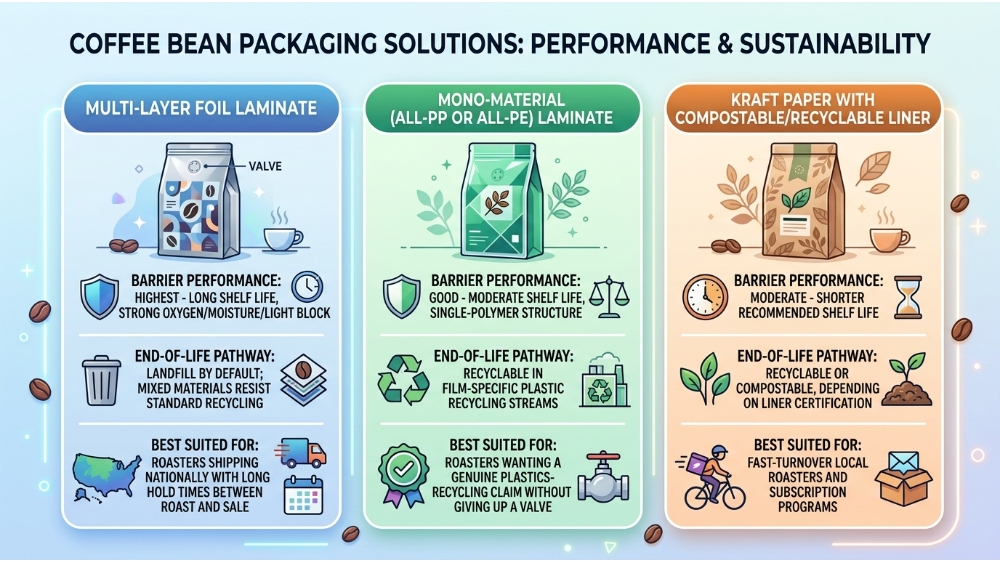
Bean bag format
Barrier performance
End-of-life pathway
Best suited for
Multi-layer foil laminate
Highest — long shelf life, strong oxygen/moisture/light block
Landfill by default; mixed materials resist standard recycling
Roasters shipping nationally with long hold times between roast and sale
Mono-material (all-PP or all-PE) laminate
Good — moderate shelf life, single-polymer structure
Recyclable in film-specific plastic recycling streams
Roasters wanting a genuine plastics-recycling claim without giving up a valve
Kraft paper with compostable/recyclable liner
Moderate — shorter recommended shelf life
Recyclable or compostable, depending on liner certification
Fast-turnover local roasters and subscription programs
Recyclable vs. Compostable vs. Reduce: Matching Claims to Your Supply Chain
The most defensible sustainability strategy for a coffee brand rarely comes down to picking the single “greenest” material — it comes down to matching the end-of-life claim to the infrastructure your actual customers have access to, and being honest on the label when that infrastructure is patchy. A brand shipping bean bags nationally to customers in dozens of different municipal waste systems cannot make one blanket “recyclable” or “compostable” claim that’s true everywhere it ships, which is exactly why the accurate phrasing on both cups and bags is “recyclable where facilities exist” or “compostable in industrial facilities,” not an unqualified claim.
There’s also a reduce-first case that gets underweighted in most packaging guides: a lighter-weight bag, a smaller cup size ladder, or a bag designed to need less laminate in the first place often has a bigger real-world environmental impact than swapping one certified material for another, simply because less material moves through the supply chain at all regardless of what happens to it afterward. For brands weighing that tradeoff alongside format choice, the same resin-first framework used for cold cups applies to bean bags: confirm what the material actually does at your volume and hold time before layering a certification claim on top.
How to Choose Eco-Friendly Coffee Packaging for Your Brand
The right packaging combination depends on your hold time between roast and sale, your customers’ actual local waste infrastructure, and whether your sustainability claim needs to survive scrutiny from a retail partner, a certification auditor, or just an observant customer reading the cup — not on which material photographs best in a supplier catalog.
Who’s choosing
Recommended combination
Why
Independent café with local waste program access
Aqueous-lined cold cups, PLA-lined hot cups where composting exists
Matches real local infrastructure instead of a generic claim
National retail roaster shipping direct-to-consumer
Mono-material bean bags with valve, qualified “recyclable where accepted” labeling
Honest claim across varied municipal systems; recyclable in film-specific streams
Fast-turnover local roastery or subscription box
Kraft paper bag with compostable liner and valve
Shorter hold time tolerates the shelf-life tradeoff; strongest genuine compostable claim
QSR or high-volume drive-thru coffee chain
PE-lined hot cups plus a defined take-back or specialized-mill recycling partnership
Durability and cost at scale, paired with verified end-of-life capacity rather than a vague claim
BPI or EN 13432-certified cups and bags, license number disclosed
Only certification tied to a licensed, checkable number withstands audit or customer scrutiny
Whatever the segment, the rule holds across cups and bean bags alike: confirm the liner or barrier material, confirm the size, confirm the certification and its scope, and confirm the end-of-life infrastructure exists where your product is actually sold — a leaf icon or chasing-arrows symbol confirms none of the three on its own. If you need a packaging partner to walk through the fit for your specific menu and shipping footprint, try to contact Maibao Packaging, your sustainable coffee packaging sourcing partner.
Not sure which eco-friendly format fits your coffee brand?
Talk to a packaging specialist about matching cup liners, bean bag barriers, and certification claims to your actual supply chain and hold times.
Are compostable coffee cups actually better for the environment than recyclable ones?
Only if your customers have access to industrial composting collection — without it, a certified-compostable cup typically ends up in the same landfill as an uncertified one. Whether recyclable or compostable is “better” depends entirely on which infrastructure actually exists where the cup is thrown away.
Why do coffee bean bags need a valve if the goal is less plastic?
Freshly roasted beans continue releasing carbon dioxide for days to weeks, and a fully sealed bag without a vent can swell or burst as pressure builds. A one-way degassing valve is a small, largely unavoidable component even on otherwise low-plastic or mono-material bags.
Can PE-lined paper cups be recycled at all?
Most standard recycling facilities reject them because the plastic liner doesn’t pulp with the paper fiber, but a small and growing number of specialized mills can separate and recover both materials. Unless your brand has confirmed access to one of those mills or a take-back program, “recyclable” is not a safe claim to print on a PE-lined cup.
What’s the difference between “biodegradable” and “compostable” on coffee packaging?
“Biodegradable” is an unregulated, uncertified claim with no guaranteed timeframe or facility requirement, while “compostable” — when paired with a standard like ASTM D6400 or EN 13432 and a certifier like BPI or TÜV Austria — comes with tested breakdown timelines and a defined industrial composting environment. Treat an unqualified “biodegradable” label with more skepticism than a named, certified compostable claim.
Post time:
Jul-24-2026
For inquiries about our products or pricelist, please leave your email to us and we will be in touch within 24 hours.