Dual‑layer Burger Packaging System: When to Use Burger Boxes, Wax Paper or Paper Bags
Burger Boxes vs Wax Paper vs Paper Bags: Which to Use
Foodservice Packaging Guide
Dual‑layer Burger Packaging System: When to Use Burger Boxes, Wax Paper or Paper Bags
Use wax paper or a wrap for simple, low-stack burgers, a burger box for tall, saucy or premium builds, and a paper bag as the outer layer that carries the whole order. The best takeaway burger packaging is a two-layer system: an inner layer that protects the burger and an outer layer that protects the order. Here is how to match each layer to your menu, hold time and delivery route.
The right burger packaging depends on three things: how tall and wet the burger is, how long it sits before it is eaten, and how it travels. A single-patty burger eaten within minutes does well in wax paper or a wrap. A tall, sauce-heavy or premium burger needs the structure of a burger box. Almost every order then goes into a paper bag, which acts as the carrying layer.
This guide explains what each format does well, where each one fails, and why a chain like McDonald’s boxes some burgers and wraps others. It ends with a decision matrix and a specification checklist you can use when ordering custom burger packaging for your own menu.
Why Burgers Need Two Layers, Not One
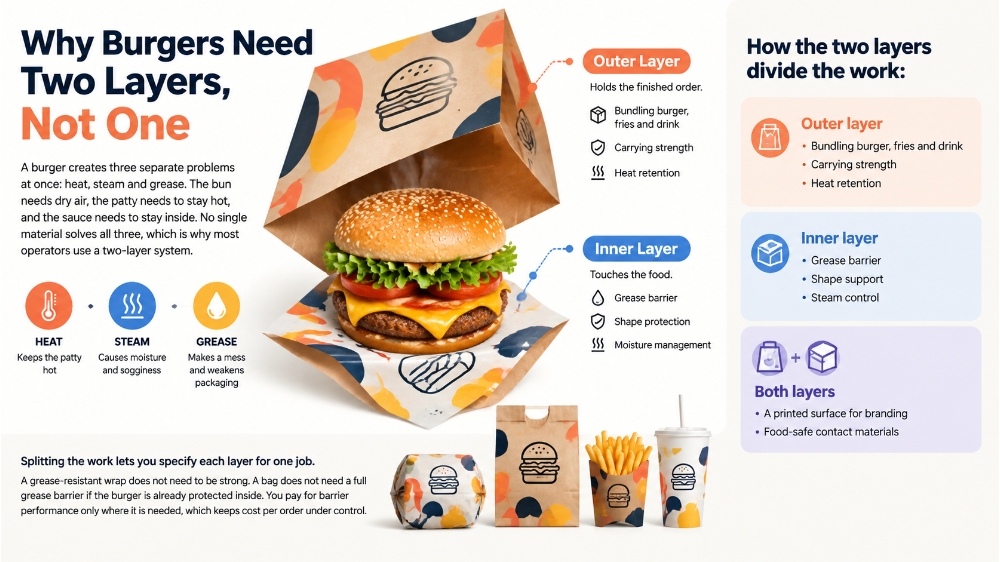
A burger creates three separate problems at once: heat, steam and grease. The bun needs dry air, the patty needs to stay hot, and the sauce needs to stay inside. No single material solves all three, which is why most operators use a two-layer system.
The inner layer touches the food. It is a wrap, a sheet of wax paper or a box, and its job is grease control, shape protection and moisture management. The outer layer holds the finished order. It is usually a paper bag or carrier, and its job is bundling, heat retention and carrying strength.
Splitting the work lets you specify each layer for one job. A grease-resistant wrap does not need to be strong. A bag does not need a full grease barrier if the burger is already protected inside. You pay for barrier performance only where it is needed, which keeps cost per order under control.
How the two layers divide the work:
Inner layer: grease barrier, shape support, steam control
Both layers: a printed surface for branding and food-safe contact materials
Wax Paper and Burger Wrap: The Compact Inner Layer
Wax paper and greaseproof wrap suit simple, compact burgers that are eaten soon after they are made. They are the cheapest inner layer, they are fast to use on a busy line, and they store flat. A tight wrap also holds the layers of a small burger together and keeps heat in because there is very little air space around the food.
That tight fit is also the weakness. Steam from a hot patty has nowhere to go, so it settles against the bun crown and softens it. A wrap offers no crush protection either, so a stacked burger can be squashed in a delivery bag and sauce can be pushed out of the sides.
The term wax paper needs a careful definition. In the trade it often means paper coated with paraffin wax, while wax-free greaseproof papers use a fiber treatment or another barrier instead. Hot, fatty burgers can soften a wax coating, and coatings can affect recyclability. Ask your supplier for food-grade material tested at your actual serving temperature, not a general-purpose sheet.
Best fit: single-patty burgers, cheeseburgers, kids’ burgers, and dine-in or drive-thru service with short hold times.
Burger Boxes: When Structure Beats Wrap
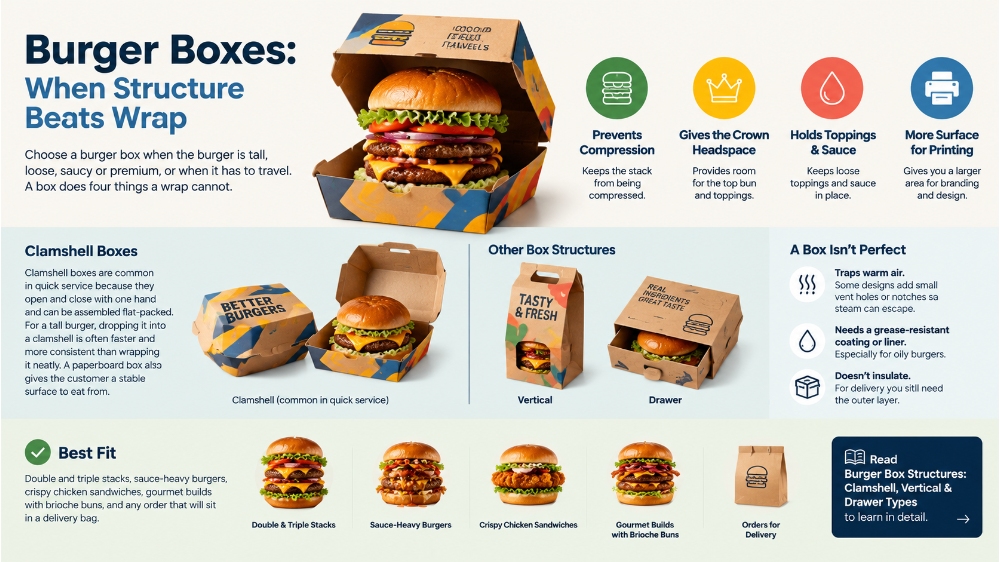
Choose a burger box when the buqqqqqqrger is tall, loose, saucy or premium, or when it has to travel. A box does four things a wrap cannot. It keeps the stack from being compressed, it gives the crown headspace, it holds loose toppings and sauce in place, and it gives you a larger surface for printing.
Clamshell boxes are common in quick service because they open and close with one hand and can be assembled flat-packed. For a tall burger, dropping it into a clamshell is often faster and more consistent than wrapping it neatly. A paperboard box also gives the customer a stable surface to eat from.
A box is not a perfect steam solution, though. A closed box traps warm air, and some designs add small vent holes or notches so steam can escape. Paperboard also needs a grease-resistant coating or liner when the burger is oily. And a box alone does not insulate: for delivery you still need the outer layer.
Best fit: double and triple stacks, sauce-heavy burgers, crispy chicken sandwiches, gourmet builds with brioche buns, and any order that will sit in a delivery bag. Read Burger Box Structures: Clamshell, Vertical & Drawer Types to learn in detail.
Paper Bags and SOS Bags: The Outer Layer
A paper bag is the carrying layer, not the food-contact layer. The most common format for burger takeaway is the SOS bag, short for self-opening sack. It has a flat, square bottom, so it stands upright on a counter or car seat and opens without a fumble. That makes it fast to pack at the pass and stable in transit.
The bag’s main job is to bundle. One bag can hold a wrapped or boxed burger, a fry carton and sides in a single carry unit. It also adds a thin layer of heat retention, because the order sits in a small enclosed volume instead of being loose.
Three details cause most bag failures. First, a fully sealed bag traps steam, so fold the top loosely or choose a vented design for hot orders. Second, grease from fries can mark a plain kraft bag, so keep fries in their own carton. Third, size matters: a bag that is too small squeezes boxes and crushes burgers, while one that is too large lets the order slide around.
Best fit: every combo order, with handles added when the order is heavy or goes out for delivery.
Why McDonald’s Uses Both Boxes and Wrapped Burgers
McDonald’s is a useful case study because it uses both formats. Packaging varies by country and changes over time, but the broad pattern is steady: taller, multi-component sandwiches such as the Big Mac come in a box, while simpler, smaller sandwiches come in paper wrap. The company has not published a rule explaining the split, so what follows is the operational logic, not an official policy.
Build height. A Big Mac has an extra bun layer in the middle. A wrap would compress that stack and push sauce outward, while a box holds the shape.
Loose toppings and sauce. Shredded lettuce and sauce shift easily. A box keeps them in place, and a wrap tends to squeeze them to one side.
Line speed. A simple single-patty burger wraps quickly. A tall burger is slower to wrap neatly, so a box gives more consistent results at high volume.
Steam and bun texture. A box gives headspace, but it is not a cure-all. McDonald’s Canada has acknowledged that its box keeps sandwiches warm and that the resulting steam slightly shrinks the bun.
Perceived value. A larger sandwich in a larger, printed box signals a premium product, and the box becomes a brand touchpoint.
Both formats then usually go into the same outer bag with fries, which is the dual-layer system in practice. The lesson for your menu is to copy the logic, not the specific items. Write a clear rule for which items get a box, based on stack height, number of patties and sauce load, and wrap everything else. Read Fast Food Packaging Compared: McDonald’s, KFC, BK, Subway to get inspiration by famous fast-food brands.
Choosing the Right Combination: A Decision Matrix
A table is the clearest way to match burger types to packaging. Use it as a starting point, then test with your own recipes.
Burger type
Inner layer
Outer layer
Why
Single patty, few toppings
Wax paper or wrap
SOS paper bag
Low stack, short hold, lowest cost
Double or triple stack
Clamshell burger box
SOS paper bag
Box prevents compression and keeps the stack aligned
Box holds shape while the bag holds heat and security
Starting points by hold time (test before you commit):
Dine-in or counter: wax paper or wrap is usually enough for simple burgers
Drive-thru: wrap for small burgers, box for tall or saucy ones, SOS bag for the order
Delivery: vented box inside a bag, with the bag closed loosely or sealed with a tamper seal
Specifications to Confirm Before You Order
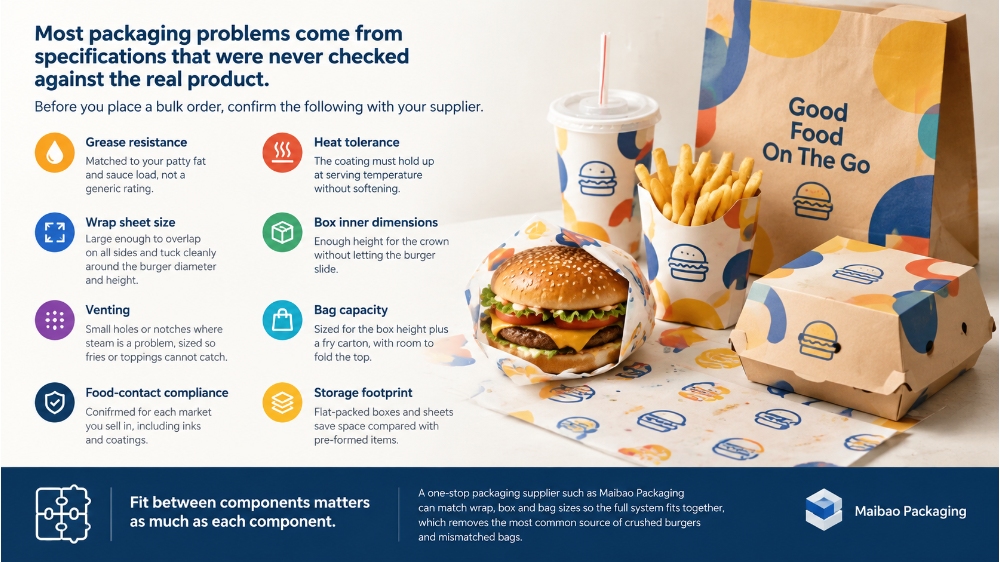
Most packaging problems come from specifications that were never checked against the real product. Before you place a bulk order, confirm the following with your supplier.
Grease resistance: matched to your patty fat and sauce load, not a generic rating
Heat tolerance: the coating must hold up at serving temperature without softening
Wrap sheet size: large enough to overlap on all sides and tuck cleanly around the burger diameter and height
Box inner dimensions: enough height for the crown without letting the burger slide
Venting: small holes or notches where steam is a problem, sized so fries or toppings cannot catch
Bag capacity: sized for the box height plus a fry carton, with room to fold the top
Food-contact compliance: confirmed for each market you sell in, including inks and coatings
Storage footprint: flat-packed boxes and sheets save space compared with pre-formed items
Fit between components matters as much as each component. A one-stop packaging supplier such as Maibao Packaging can match wrap, box and bag sizes so the full system fits together, which removes the most common source of crushed burgers and mismatched bags.
Final Takeaway
Pick the inner layer by the burger and the outer layer by the order. Wax paper or wrap works for simple burgers eaten quickly. A burger box is the better choice once the build is tall, saucy, fragile or travelling. A paper bag, ideally an SOS bag, carries everything together.
The main exception is hold time. Once an order sits for 20 minutes or more, steam control becomes the priority, so use a vented box and avoid sealing the bag tightly. Test your real menu items in the real packaging before you scale up.
Need a burger packaging system matched to your menu?
Talk to a packaging specialist about matching wraps, boxes and bags to your burger builds, your hold times and your delivery radius.
Food-grade wax paper and wax-free greaseproof paper are made for food contact. Plain household wax paper is not designed for hot, oily burgers, and paraffin can soften under heat. Ask your supplier for material tested at your serving temperature.
Should I seal the paper bag for delivery?
A tamper seal protects the order, but a fully sealed bag traps steam. For hot burgers, fold the top loosely or use a seal that still allows some venting, and keep fries in a separate carton.
Can one packaging type cover my whole burger menu?
It can, but it usually means a compromise. A single box size either swamps small burgers or squeezes tall ones. Most menus work better with two inner formats, a wrap and a box, and one standard outer bag.
What size paper bag fits a burger box and fries?
Size the bag to the burger box height plus a fry carton, with room left to fold the top. Pack a real order and check that nothing is squeezed. A bag that is too tight crushes burgers, and one that is too large lets the order slide.
Post time:
Oct-12-2026
For inquiries about our products or pricelist, please leave your email to us and we will be in touch within 24 hours.