

Tamper-Evident Seals for Paper Food Buckets: Delivery Safety Guide
Foodservice Packaging Guide
Third-party delivery has made tamper-evident sealing a legal requirement in several major markets, and California’s AB-3336 is the clearest example. A paper bucket creates a conflict, though: a seal strong enough to prove interference can trap steam and soften fried food. The right closure proves the bucket was opened while letting moisture escape.
A paper food bucket is one of the harder packages to secure for delivery. Its wide opening and tapered body give a tamper-evident label plenty of surface to bridge, but the same opening is the path steam needs to escape. This guide separates the legal question from the engineering question, compares the main formats, and sets out what to test before a bulk order.
When Tamper Seals Are Legally Required
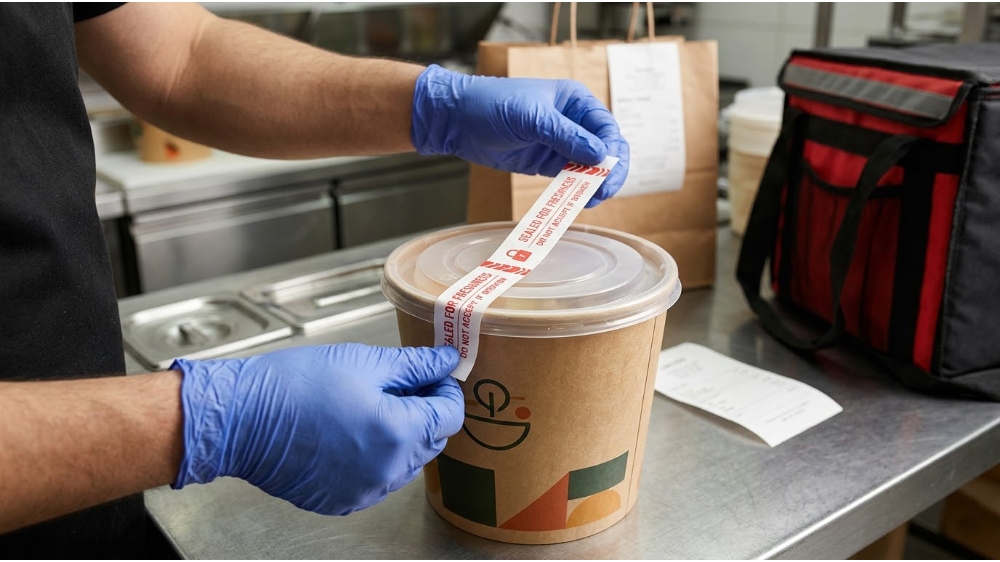
There is no single federal law in the United States that requires every paper food bucket to carry a tamper-evident seal. The FDA Food Code addresses package integrity, but it is a model code offered for adoption, not a universal federal mandate. The legal picture changes at the state and local level, and it changes most sharply for third-party delivery.
California’s Assembly Bill 3336 is the clearest example. It requires ready-to-eat food delivered through a qualifying third-party platform to be closed by the food facility with a tamper-evident method before the delivery driver takes possession. The law does not name a specific product. It requires a method that leaves visible evidence if the package is opened. A sticker that must be torn, a paper band that must be broken, or an integrated tear tab all satisfy the principle if they leave an unmistakable trace.
For suppliers and buyers outside California, the practical takeaway is not that the rule is irrelevant. Platform policies, municipal health departments, and customer expectations are converging on the same standard. A bucket that cannot show interference may still pass a local inspection, but it becomes a liability once it enters a delivery network where the restaurant loses control of the package after handoff.
Tamper Evidence Is Not the Same as a Seal
A paper bucket can close tightly and still provide no tamper evidence. A lid that snaps on without a tear strip can be lifted, inspected, and pressed back into place. The customer sees a closed bucket, not a sealed one. This distinction matters because buyers often conflate three separate performance requirements: tamper evidence, leak resistance, and closure retention.
Tamper evidence means the package shows a visible, irreversible change when someone tries to open it. Leak resistance means grease or liquid does not escape the bucket during normal handling. Closure retention means the lid or seal stays in place through stacking, vibration, and carrying. A destructible label can provide tamper evidence without improving leak resistance at all. A tight lid can provide leak resistance without showing whether it was previously opened.
For a paper bucket carrying hot fried food, a fourth requirement sits alongside these three: ventilation. A closure that scores well on tamper evidence but traps every gram of steam will fail on food quality even though it passes the security test. The specification has to define what secure means for the specific food and delivery route.
The Steam Problem: Why a Sealed Bucket Fails
Hot fried food releases water vapor continuously after it leaves the fryer. In a closed paper bucket, that vapor saturates the internal air, condenses on the walls and the underside of any lid, and drips back onto the food. The crust that was crisp at the pass becomes soft and steamed within minutes. A tamper-evident seal that closes every gap accelerates this cycle because it removes the escape path the steam needs.
The design conflict is real but not unsolvable. The seal must prevent undetected opening without turning the bucket into a sealed humidity chamber. One approach is to pair a tamper-evident closure with a vented lid or small vent features in the bucket wall. The security element proves the package was not opened; the vent path lets moisture leave. The two functions are separate and should be specified separately. A separate guide to paper food bucket lids and steam release explains how vented covers and side vents interact with closure design for hot takeaway.
If the bucket has no lid and the tamper seal crosses the open top, the seal itself becomes the moisture barrier. In that case, the seal material must be chosen for breathability or perforated in a controlled pattern. A solid plastic film across the opening will hold heat and trap steam just as effectively as a sealed lid. The seal is a security feature, not a substitute for ventilation.
Tamper-Evident Formats for Paper Buckets
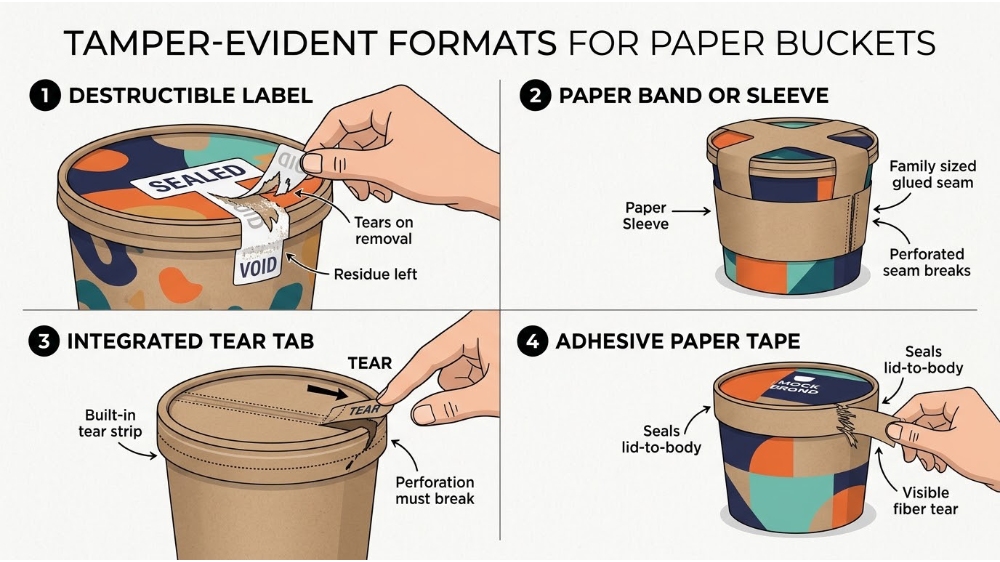
Four formats dominate paper bucket sealing, and each has a different balance of cost, coverage, and operational speed.
| Format | How it shows interference | Best fit | Main limitation |
|---|---|---|---|
| Destructible label | Tears, delaminates, or leaves residue when peeled | Short-hold delivery, high-volume kitchens | Covers only one area; surface must be clean and dry |
| Paper band or sleeve | Glued seam breaks or perforation tears | Family-size buckets, branded presentation | Adds material and an extra packing step |
| Integrated tear tab | Built-in tab or perforation must break before opening | High-volume programs with custom tooling | Requires precise cutting and creasing |
| Adhesive paper tape | Cannot be lifted and reapplied without visible fiber tear | Low-cost sealing of lid-to-body | Adhesion can fail on greasy or wet surfaces |
A sticker is the lowest-cost entry point and the most common format in food delivery, but it secures only the area it covers. A band or sleeve provides a more obvious visual break and a larger branding area, at the cost of an extra inventory item and packing time. Integrated tabs reduce separate components but depend on the converting supplier’s tooling and quality control. Tape is fast and cheap, but the adhesive must be tested against the specific coating and the actual steam and grease load of the food.
Matching the Seal to the Delivery Model
The right tamper-evident format depends less on the bucket than on how the bucket travels. Counter service, in-house delivery, and third-party platform delivery create different risk profiles.
For counter pickup or dine-in, a tamper seal is a courtesy feature rather than a legal necessity in most jurisdictions. A simple sticker or tape across the lid seam is enough to show the kitchen closed the package, and the customer opens it within minutes. The seal does not need to survive a multi-stop route.
For restaurant-operated delivery, the seal has to survive a vehicle, a bag, and a handoff without accidental activation. The label or tape must stay adhered through condensation and slight oil mist on the bucket surface. This is where adhesive testing on the actual coated board matters more than the theoretical security rating of the material.
For third-party platform delivery, the seal is a compliance and trust document. It must be applied before the driver takes possession and must remain visibly intact at the door. A broken seal is information the customer uses to decide whether the order is safe. In this channel, the seal should be placed where the customer will look first, typically across the lid-to-body junction or over the opening, and the evidence of opening should be obvious without explanation.
Specification Checks Before a Bulk Order
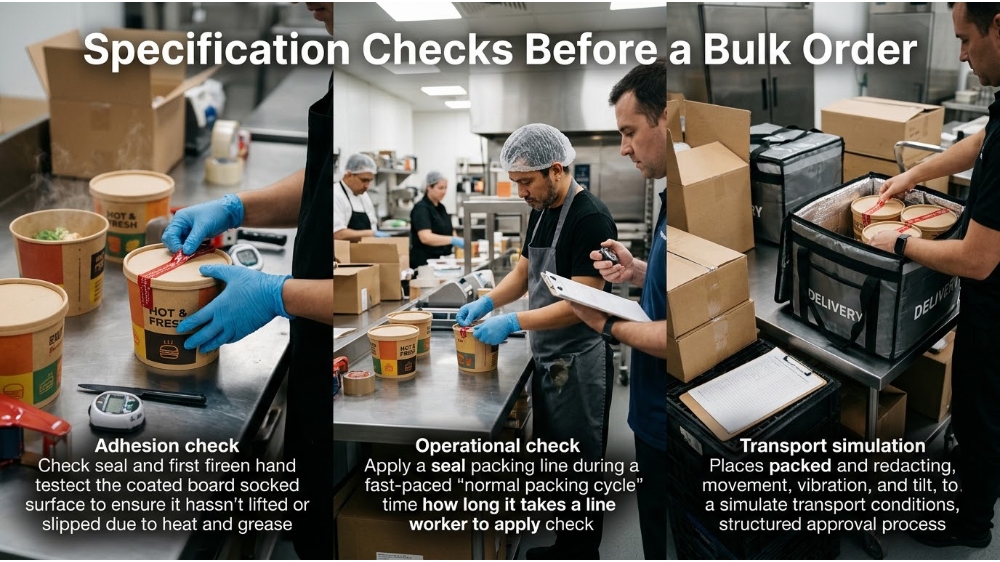
A tamper-evident seal that works on a clean, room-temperature sample can fail on a production line. The specification should require testing under the conditions the bucket actually experiences.
Adhesion is the first check. Apply the seal to the same coated board used in production, after the bucket has been filled with hot, greasy food and exposed to steam for the expected hold time. Check whether the seal lifts at the edges, slides on an oily surface, or tears the board when removed. A seal that cannot bond to the coated surface is not a security feature.
The second check is operational. Time how long it takes a line worker to apply the seal during a normal packing cycle. A format that adds several seconds per bucket can bottleneck a high-volume kitchen even if it passes every laboratory test. Run the trial across shifts and with different operators, not only the most experienced packer.
The third check is transport simulation. Pack a representative order, seal it, place it in a delivery bag, and subject it to vibration, tilt, and the maximum expected hold time. Inspect the seal for accidental tears, partial lift, or movement that could be mistaken for tampering. A structured paper bucket sample approval process should include these seal checks alongside board, coating, and lid fit, because a seal failure is a delivery failure even when the bucket itself is structurally sound.
Need tamper-evident paper buckets matched to your delivery route?
Talk to a packaging specialist about seal format, venting, and board coating as one system for your menu and hold time.
Frequently Asked Questions
Are tamper-evident seals required on paper food buckets everywhere?
No. There is no universal federal requirement in the United States for ordinary food buckets. California AB-3336 requires a tamper-evident method for ready-to-eat food delivered through third-party platforms. Other jurisdictions and platform policies may impose similar rules or expectations.
Can a tamper-evident seal also let steam escape?
Yes, if the seal is paired with a vented lid or the seal material is breathable or perforated. The security feature and the vent path should be specified as separate functions. A solid, airtight seal across a hot bucket will trap steam and soften fried food.
What is the cheapest tamper-evident option for a paper bucket?
A destructible paper or plastic sticker is usually the lowest-cost format. It is fast to apply and requires no tooling change. The trade-off is limited coverage: a sticker secures only the area it bridges, so the lid or opening must be designed so that the sticker covers the actual access point.
Does a tamper seal replace the need for a lid?
No. A seal can show interference across an open top, but it does not provide the stacking strength, spill protection, or controlled venting of a lid. For delivery, the closure decision and the tamper-evident decision should be made together, not as substitutes.
Post time: Nov-10-2026