

This guide explains when a lid is essential, why vented lids outperform sealed lids for hot crispy food, how lid format affects stacking and spill risk, and how to specify a closure that matches your menu and delivery route.
Paper Food Bucket Lids: Steam Venting and Transport Guide
Foodservice Packaging Guide
Do Paper Food Buckets Need Lids? Choosing Closure, Steam Release, and Transport Protection for Takeaway
Paper food buckets do not always need lids. For delivery and hot fried foods, a vented paper lid is usually the better choice: it releases steam while protecting the contents. Food type, hold time, and transport distance decide the rest.
A paper food bucket is a tapered paperboard container used for fried chicken, popcorn, wings, and family-size takeaway meals. The lid decision is often treated as a yes-or-no question, but closure design is really a moisture-management and transport-protection decision. A bucket that stays open in the store may need a vented lid the moment it enters a delivery bag.
The Short Answer: Lids Are Conditional, Not Universal
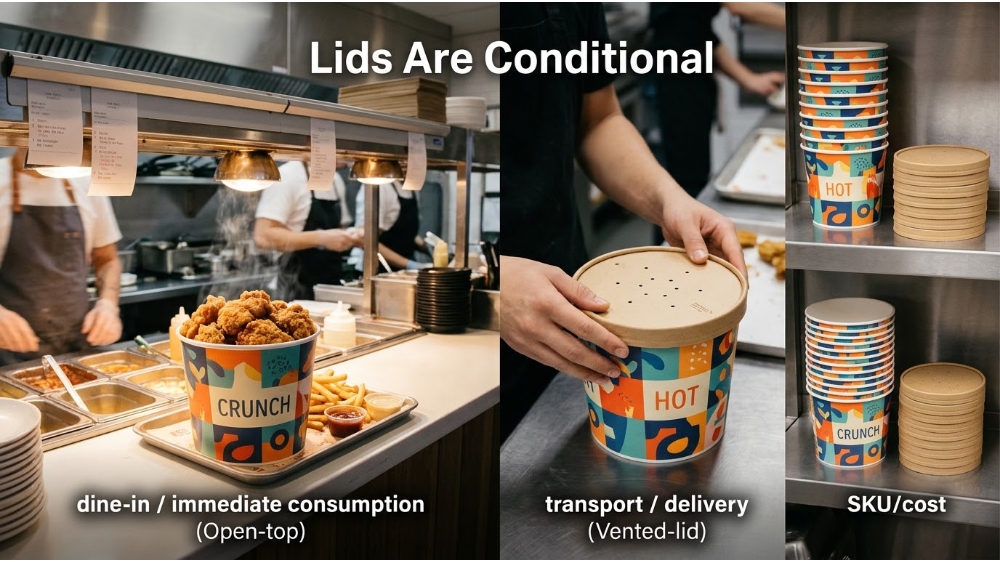
Paper food buckets do not always need lids. For dine-in service, counter pickup, or immediate consumption, an open bucket is functional and often preferred because steam escapes freely and the food stays visible. For transport, delivery, or any scenario where the bucket will be stacked, carried, or placed in a vehicle, a lid becomes a practical necessity.
The more useful distinction is not lid versus no lid. It is vented versus sealed. A sealed lid on a hot fried product traps steam and accelerates sogginess. A vented paper lid releases moisture while keeping the contents contained and protected. That is why the most common foodservice bucket lids are not solid discs but perforated paper covers with small openings.
Lids also change the cost and operational profile of a bucket. A lid adds a separate SKU, extra handling time, and a small per-unit cost. For high-volume fried chicken programs, that cost is usually justified by fewer soggy complaints and better transport performance. For short-hold snack service, the same lid may add cost without adding value.
Steam Release: Why Venting Matters More Than Closure
Hot fried food releases water vapor continuously after it leaves the fryer. In a closed container, that vapor saturates the internal air, condenses on the lid and walls, and drips back onto the food. The result is a soft, steamed coating instead of a crisp crust. Venting is the mechanism that interrupts this cycle.
A vented lid allows moist air to escape while still covering the bucket. The openings are typically small, often half-moon or circular perforations, and they are positioned to let steam rise and exit without creating a direct draft that cools the food too quickly. The vent area does not need to be large. Industry design practice generally keeps open area small enough to retain heat but large enough to prevent condensation from pooling.
The KFC bucket is a useful reference. Its paper lid uses a small number of openings specifically to let air and moisture escape, and later lid refinements have used venting combined with bucket-wall features to support the stack effect. The principle is consistent across suppliers: the lid must breathe.
A vented lid also works with the bucket wall, not in isolation. Some buckets use small side vents or gills in addition to lid vents. If the lid is vented but the bucket is sealed by a tight outer bag, the vent has nowhere to discharge. Transport packaging must allow the vented moisture to leave the system.
The coating on the bucket and lid interacts with venting. A PE coating provides a strong grease and moisture barrier, while aqueous coatings offer repulpability with slightly different moisture behavior. The right coating depends on the food and the hold time, not on a generic sustainability preference. For a detailed comparison of PE, PLA, and water-based coatings on paper buckets, see the coating selection guide.
Transport Protection: Lids as Structural Insurance
A lid is not only a cover. It is a structural component that keeps food inside the bucket during handling, prevents spills in delivery bags, and supports stacking in a carrier or on a shelf. Without a lid, a bucket of loose fried chicken is vulnerable to tipping, crushing, and cross-contamination.
Paper lids designed for food buckets usually seat into a rolled rim or circumferential groove near the top of the bucket. A proper fit creates friction that holds the lid in place without tape or film. Some lids include a finger-pull tab for removal, which improves service speed without compromising the seal.
Stacking is a separate transport benefit. A flat paper lid provides a stable surface for another bucket to sit on, which matters for multi-bucket family meals and catering orders. Interlocking or recessed lid designs can improve stack stability further. In delivery environments where buckets are packed into insulated bags, a lid also reduces the chance that loose pieces escape and become soggy against the bag wall.
For heavy bone-in chicken or sharp-edged foods, the lid also protects the bucket rim from deformation. A crushed rim can compromise the lid fit and create a gap that lets steam and grease escape into the bag. A lid that grips the rim distributes force more evenly than an open bucket.
Closure Options Compared: Paper, Vented Paper, and Plastic
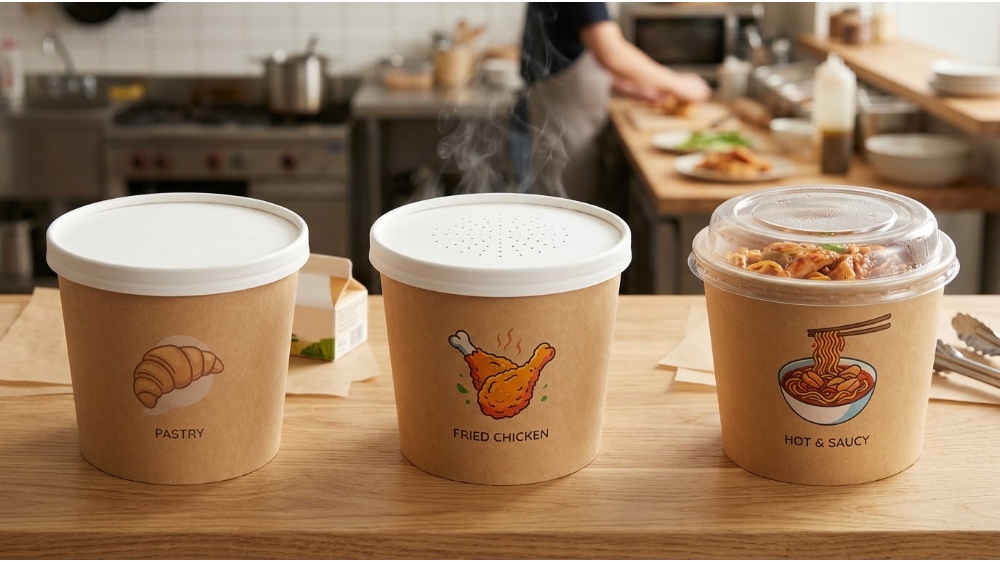
Paper food buckets are closed with three main lid families: flat paper lids, vented paper lids, and plastic lids. Each has a distinct performance profile.
Flat paper lids are the lowest-cost option. They cover the bucket and support stacking, but they do not vent unless perforated. They suit short-hold products or foods that are not sensitive to steam, such as certain pastries or cold items. For hot fried chicken, a flat unvented paper lid is usually the wrong choice because it traps moisture.
Vented paper lids are the standard for fried chicken, wings, and other hot crispy foods. They combine the transport protection of a lid with the steam release needed to preserve texture. The vent pattern can be customized, but the principle is fixed: small openings that let vapor out without letting heat escape too quickly.
Plastic lids, such as PP or PET, offer excellent leak resistance and rigidity. They are appropriate for saucy foods, noodle dishes, or liquid-heavy takeaway where paper would soften. For dry fried foods, plastic is often over-specified and can create a tighter seal that traps steam if not vented. Plastic also introduces a different sustainability profile and may not match a paper-forward brand.
| Lid type | Steam release | Transport protection | Best use |
|---|---|---|---|
| Flat paper, unvented | Poor | Moderate | Short-hold, low-steam foods |
| Vented paper | Good | Good | Fried chicken, wings, hot crispy takeaway |
| Plastic (PP/PET) | Poor unless vented | Excellent | Saucy, liquid-heavy, or leak-sensitive foods |
Matching Closure to Food and Hold Time
The right lid for a 5-minute counter hold is not the right lid for a 25-minute delivery. Hold time should drive the closure decision more than any other single variable.
For holds under 10 minutes, an open bucket or a flat paper lid is usually sufficient. The food is consumed before condensation becomes a serious problem. For holds between 10 and 20 minutes, a vented paper lid is the baseline. It provides containment and steam release for the duration of a typical delivery window. For holds beyond 20 minutes, the lid alone may not be enough. A vented lid combined with an absorbent base layer or a two-component system is more reliable.
Food type also matters. Thin shoestring fries and popcorn have high surface area and lose crispness quickly, so aggressive venting is helpful. Thick steak-cut fries and bone-in chicken are more forgiving but still benefit from vented paper. Saucy wings or glazed chicken introduce additional moisture, which may push the specification toward a leak-resistant lid with controlled venting rather than a fully open paper lid.
The bucket size and lid fit are part of the same decision. A lid that is slightly too loose will vent steam but may also leak grease or pop off in transit. A lid that is too tight can be difficult to remove and may crack the bucket rim. Lid sizing should be matched to the bucket’s top diameter and rim profile, not guessed from capacity alone. For a structured approach to bucket sizing and closure fit, see the paper bucket sizing guide.
How to Specify a Lid That Fits and Performs
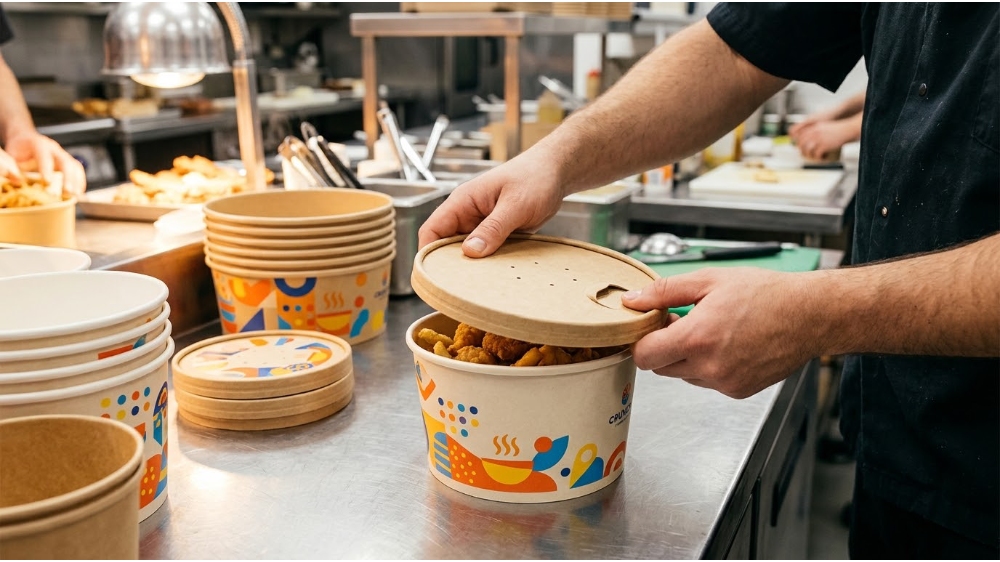
A lid specification should include more than diameter. The rim profile, vent pattern, material, and removal feature all affect performance.
Start with the bucket top diameter and rim type. A lid designed for a rolled rim will not fit a straight-wall bucket, and a lid for a grooved bucket will not seal on a plain rim. Confirm the fit with a physical sample, not a line drawing. The lid should seat firmly but release without tearing the bucket.
Next, define the vent requirement. For fried foods, specify a vented paper lid with a pattern that matches the expected steam load. The vent area should be large enough to prevent condensation but small enough to retain heat. Test the actual menu item in the actual lid and bucket combination at the expected hold time. If the food is soggy at 15 minutes, increase vent area or change the coating. If the food is cold but crisp, reduce vent area.
Material and coating should be chosen with the food and hold time in mind. A grease-resistant coated paper lid prevents oil from wicking through and weakening the lid structure. The coating also affects how the lid behaves when exposed to steam. A lid that softens under steam can sag into the bucket and contact the food, which defeats the purpose of venting.
Finally, consider the removal and service experience. A finger-pull tab or a slight overhang makes the lid easier to remove during service. A lid that requires two hands or a tool slows down the line and increases the risk of spills. For high-volume operations, small service friction becomes a real labor cost.
Frequently Asked Questions
Do paper food buckets need lids for delivery?
For delivery, a lid is strongly recommended because it contains the food, supports stacking, and protects against spills. A vented paper lid is usually the best choice for hot fried foods because it also releases steam. An open bucket is vulnerable to tipping and crushing in a delivery bag.
Are vented lids better than sealed lids for fried chicken?
Yes, for fried chicken and similar hot crispy foods, vented lids are better than sealed lids. A sealed lid traps steam and softens the coating. A vented lid allows moisture to escape while keeping the food contained. The vent area should be sized to the food and hold time, not left to chance.
Can I use a plastic lid on a paper food bucket?
A plastic lid can work if the bucket is designed for it and the food is saucy or leak-prone. However, plastic lids are usually not vented, so they can trap steam on fried foods. For dry fried foods, a vented paper lid is a better match. For liquid-heavy foods, a plastic lid with a secure fit may be necessary.
How do I test whether a bucket lid is working?
Pack a fresh batch of the actual menu item in the actual bucket and lid, then hold it for the expected delivery time. Check crispness at 10, 20, and 30 minutes. If the food is soggy, increase venting or change the coating. If it is cold but crisp, reduce vent area. Test with the lid in the transport bag you actually use, because the bag affects airflow.
Need bucket lids that balance steam release and transport protection?
Talk to a packaging specialist about matching lid format, vent pattern, and bucket fit to your menu, your hold times, and your delivery route.
Post time: Nov-09-2026