Complete Guide to Coffee Cup Accessories for Takeaway Businesses: Carriers, Staws, and Sleeves
Complete Guide to Coffee Cup Accessories for Takeaway Businesses: Carriers, Straws, and Sleeves
Foodservice Packaging Guide
Complete Guide to Coffee Cup Accessories for Takeaway Businesses: Carriers, Straws, and Sleeves
The cup gets all the attention in a packaging order, but carriers, straws, and sleeves are what decide whether that order survives the walk to the car. Here’s how to spec all three without over-buying or under-protecting a single drink.
Most sourcing guides treat cups as the whole packaging decision and file carriers, straws, and sleeves under “extras” to sort out later. That ordering is backwards. A perfectly specified cup still fails if a 4-cup order goes out in a carrier built for 2, if a paper straw disintegrates before the drink is finished, or if a customer burns a hand because the sleeve SKU ran out during a rush. The three accessories in this guide aren’t add-ons to the cup decision — they’re the parts of the order that actually get handled, carried, and complained about.
This guide works through each accessory the way a buyer actually has to spec it: what it’s built from, what it costs once labor and fit are counted (not just the unit price), which regulations already limit your options, and how to size a lineup instead of guessing at reorder quantities. For the cup itself, see single wall vs double wall coffee cup comparison, and for the full range of ready-stock carriers, straws, and sleeves by size, see the accessories solution.
Why Accessories Decide Whether Your Packaging Actually Works
A cup order is judged on the drink; a carrier, straw, and sleeve order is judged on everything that happens after the drink leaves the counter. Get the cup right and get an accessory wrong, and the failure still shows up as a one-star review about the coffee.
Three accessories cover almost every point of contact after the pour: a carrier keeps multiple cups upright between counter and car, office, or delivery bag; a straw is the only packaging component that goes directly into a customer’s mouth, which is why it carries the strictest material rules of anything on this list; and a sleeve is the difference between a comfortable grip and a scalded palm on a single wall hot cup. Each one solves a different failure mode — spills, sogginess, and burns, respectively — and buying them as a single generic “accessories” line item, rather than sizing each against your actual order patterns, is how a shop ends up over-stocked on 4-cup carriers nobody orders and permanently out of the 2-cup carrier everyone does.
The buying mistake repeats across all three: treating unit price as the only variable. A carrier that’s a cent cheaper but doesn’t fit your most common order size gets thrown out and replaced mid-shift. A straw that’s cheaper per thousand but softens in an iced drink before the customer finishes it becomes a refund. A sleeve that’s cheaper but doesn’t grip the cup tightly enough slides off during hand-off. Fit and failure rate, not sticker price, are what these three categories are actually priced on.
Drink Carriers: Matching the Carrier to the Order Pattern
A drink carrier’s job isn’t to hold cups — it’s to hold cups through motion, and the right format depends entirely on how many drinks leave the counter together, not how many a carrier is rated for. Buying carriers by cup count alone, without checking whether that count matches your actual order size, is the single most common overspend in an accessories budget.
Carriers fall into three practical categories. Flat-pack paperboard carriers ship flat, assemble at point of use, and dominate 2-cup and 4-cup takeaway service because they’re cheap to freight and store; their main weakness is wet strength if a cold, condensing cup sits sealed in a delivery bag for a long ride. Molded pulp trays are pre-formed with deeper cup cavities, giving better lateral stability and moisture tolerance at the cost of more storage volume and a higher unit price. Handled carriers add a top handle for one-handed transport and are the format of choice for curbside pickup, drive-through hand-off, and office coffee runs where a customer needs a free hand for a door or a phone.
Order size should drive the count, and it rarely matches what a menu suggests. Two-cup orders — a customer and a coworker, a latte and a tea — are the most common multi-drink pattern in real café service, which is why a single-cup or 2-cup carrier with a handle covers more real orders than a 4-cup tray does, even though the 4-cup tray looks like the more “complete” purchase. The 4-cup format earns its place for office runs, catering, and delivery-platform orders where basket size is genuinely larger, but stocking it as the default carrier for a shop whose typical order is one or two drinks just adds shelf space and cost for a size most customers don’t need.
Carrier type
Best fit
Watch for
Single-cup carrier or sleeve-handle
Gift-style single drinks, farmers markets, pop-ups
Adds cost for orders that would travel fine in-hand
2-cup flat-pack carrier
Pair orders — the most common multi-drink order in café service
Wet strength on long rides with sealed, condensing cold cups
4-cup tray or handled carrier
Office runs, group orders, catering
Bulky for single customers; over-stocking this size wastes storage
Higher unit cost and more storage volume than flat-pack
The practical test for any carrier, regardless of type, is the same one worth running before a bulk order: fill the cups, seal the lids, load the carrier, and carry it for the length of your actual longest delivery or walk. If a cup shifts, tips, or the carrier deforms before that distance is covered, the spec is wrong for your business — no listed weight rating or material claim substitutes for that walk-test.
Straws: Paper, PLA, and What the Ban Actually Requires
Straw sourcing looks like a materials decision, but for most businesses it’s a compliance decision first — the region a shop operates in has usually already ruled out plastic straws, which narrows the real question to which non-plastic option holds up in the drinks actually being served. Getting the regulatory boundary wrong costs more than getting the material choice wrong, because a compliance miss can mean the product can’t be placed on the market at all, not just that it underperforms.
Since 3 July 2021, the European Union has restricted single-use plastic straws from being placed on member-state markets, alongside plastic cutlery, plates, and stirrers, as part of a wider directive targeting the single-use plastic items most commonly found in marine litter. That restriction is a market-placement ban, not a use-it-until-stock-runs-out grace period, which means any business still holding plastic straw inventory for EU service needs a compliant replacement lined up before the current stock is gone, not after. Businesses outside the EU should still check local rules directly, since a growing number of cities and states have passed comparable restrictions on their own timelines rather than following the EU date.
With plastic off the table in most regulated markets, the real decision is between the two dominant paper-based options and their trade-offs:
Paper straws
Paper straws are the lowest-cost, most widely accepted non-plastic option, and the default choice for hot drinks and short-consumption cold drinks where the straw isn’t sitting in liquid for more than a few minutes. Their known weakness is structural softening in drinks held longer than roughly fifteen to twenty minutes, particularly acidic or high-sugar cold drinks, which is why a shop with slow-consumption iced drinks — big-format cold brew, bubble tea, anything nursed over an hour — will see more complaints from paper straws than a shop serving quick espresso-bar traffic.
PLA (bioplastic) straws
PLA straws hold their rigidity in cold, wet conditions far longer than paper, closely mimicking the feel of a plastic straw, which makes them the stronger fit for long-hold cold drinks and bubble tea service. The trade-off is end-of-life: PLA requires industrial composting conditions to break down and is not accepted in most standard paper or plastic recycling streams, so a “compostable” claim on a PLA straw is only accurate where a commercial composting facility actually exists to receive it.
The buying rule that avoids the most complaints is matching straw material to hold time rather than to drink category alone: short-hold drinks default to paper, long-hold and iced drinks that customers sip over time are the stronger case for PLA, and any claim about either one being “eco-friendly” should specify the material and the local processing infrastructure rather than asserting it in general terms — the same discipline that applies to cup coating claims.
Cup Sleeves: Material, Fit, and When They Beat Double Wall
A cup sleeve is a single layer of corrugated kraft paper wrapped around a single wall hot cup, and its entire function is to put an air-cushioned barrier between a hot cup’s outer wall and a customer’s hand. The corrugated flutes inside the sleeve trap a thin layer of air in the same way a double wall cup’s inner air gap does, which is why the sleeve-versus-double-wall choice is really a packaging-format decision, not an insulation-quality one — both solve the same heat-transfer problem through the same basic mechanism.
Sleeves are commonly produced from kraft paper, corrugated cardboard, or SBS paperboard depending on the insulation and branding needs, die-cut and glued into a curved shape that grips the cup’s taper without sliding. That grip matters more than most spec sheets suggest: a sleeve cut for the wrong cup taper will ride up or spin during hand-off, which defeats its entire purpose regardless of how well the corrugation performs in isolation.
The case for choosing a sleeve over a double wall cup comes down to volume and branding flexibility rather than a fixed rule that either is cheaper. A single wall cup plus sleeve keeps one cup SKU serving both hot and cold drinks, since the sleeve is only added when a drink is hot, while a double wall cup commits that SKU to hot service permanently. Sleeves also print as flat blanks, which is often cheaper to customize in small runs than a formed double wall cup, making them the better branding surface for shops that change seasonal designs often. Where sleeves lose is exactly where a high-volume hot bar operates: added labor seconds to apply a sleeve during a rush, and a second SKU to track, reorder, and never run out of independently of the cup — the same four-line-item math that decides the single-wall-plus-sleeve-versus-double-wall trade-off on the cup side of a packaging order.
Sleeve sizing checklist before a bulk order:
Confirm the sleeve’s cut matches your cup’s actual taper — a universal-fit claim doesn’t guarantee grip on every cup profile
Check flute height against your hottest drink category, since taller flutes trap more air and insulate longer holds better
Decide whether the sleeve or the cup itself carries the primary branding, since printing both is rarely necessary
Stock sleeves as a percentage of hot-cup volume only — cold and iced orders never need one
The Real Cost Math: Accessories Per Order, Not Per Unit
Accessory pricing sold per thousand units hides the number that actually matters to a takeaway business: cost per completed order. A carrier, a straw, and a sleeve are rarely bought or used one at a time — they’re consumed in combinations that vary by order size, drink type, and service format, and pricing them individually understates what a typical order actually costs to package.
Run the math per order rather than per SKU and the picture changes. A single hot drink at the counter might use one cup and one sleeve — no carrier, no straw. A two-drink iced order for delivery might use two cups, two straws, and one 2-cup carrier, plus a sealed bag. A four-drink office order adds a 4-cup carrier and, if any drink is hot, sleeves for that portion only. Pricing accessories by the order profile your business actually runs — not by an assumed one-of-each per drink — is what prevents both over-ordering carriers that sit in storage and under-ordering the straws or sleeves that run out mid-shift.
Labor is the line item most cost comparisons skip entirely. Applying a sleeve, assembling a flat-pack carrier, and dropping a straw into a lid all take seconds that add up across a rush, and a format that saves half a second per drink compounds into real throughput over a full shift. When comparing two accessory formats that are close in unit price, the format that assembles faster under pressure is very often the better buy even at a slightly higher per-unit cost, because the labor time saved shows up in more orders served per hour rather than in the per-unit line on an invoice. Learn more by reading Wholesale Coffee Cups Buying Guide.
Recyclability and Compostability of Each Accessory
Each accessory has a different, and sometimes contradictory, end-of-life path, and lumping “packaging” together under one sustainability claim overstates what actually happens to any single piece. A cardboard carrier, a paper sleeve, a paper straw, and a PLA straw are not interchangeable in a recycling stream even though they’re all paper-based.
Carriers and sleeves are the easiest of the three: uncoated corrugated cardboard and kraft paperboard are widely accepted in standard paper and cardboard recycling streams, since neither typically carries a plastic liner the way a cup does. Removing a cup’s paper sleeve and recycling it with corrugated cardboard recycle-paper-cups is a standard disposal step precisely because the sleeve, unlike the lined cup underneath it, has no plastic coating working against it. Straws split along the same PLA-versus-paper line as sleeves-versus-cups: an uncoated paper straw breaks down in standard paper composting far more reliably than a PLA straw, which needs industrial composting conditions most municipal systems don’t provide and is typically rejected by both standard recycling and home compost bins.
The defensible sustainability claim for an accessories order is, again, specific rather than blanket: state which pieces are recyclable in a standard paper stream (carriers, sleeves, paper straws) and which require industrial composting infrastructure that may or may not exist locally (PLA straws), rather than describing the whole accessories order as “eco-friendly” without distinguishing between the two. Maibao Packaging can confirm coating and material specifics per SKU for businesses that need documentation to back a sustainability claim to customers or regulators.
Matching an Accessory Lineup to Your Service Format
Service format — counter, drive-through, or delivery — predicts accessory needs more reliably than menu size does, because it determines hold time, transport distance, and how much of the packaging job falls on staff versus the customer. A specialty café and a drive-through kiosk selling nearly identical drinks need very different accessory stocks.
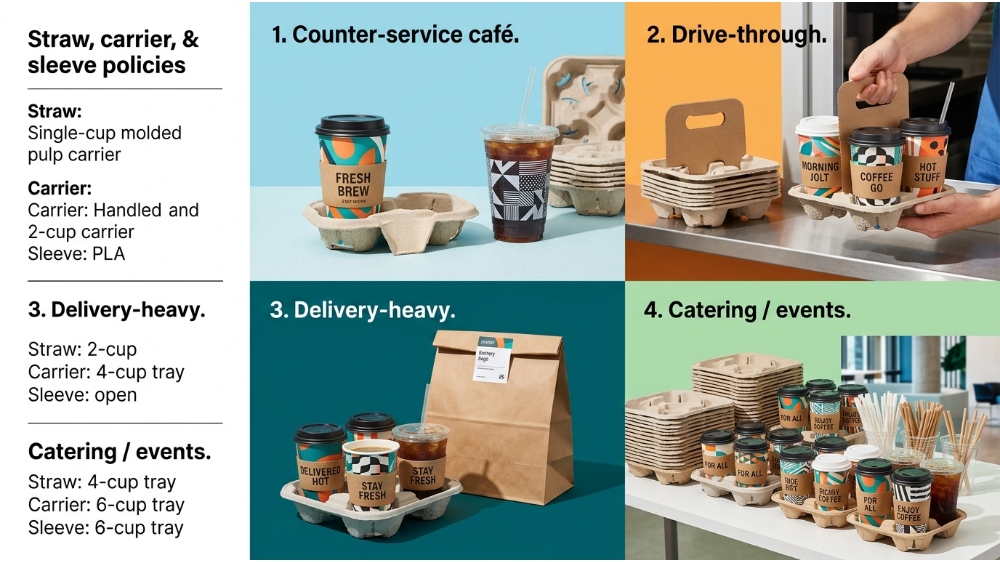
Counter-service cafés with mostly single-drink orders can run lean: a single-cup or 2-cup carrier for the occasional pair order, sleeves sized to hot-cup volume only, and paper straws as the default with PLA reserved for iced drinks held longer than a quick walk out the door. Drive-through and delivery-heavy operations need the opposite emphasis — carriers should default to handled 2-cup and 4-cup formats since customers can’t set drinks down mid-transit, sleeves should be applied to every hot cup rather than judged case by case since staff can’t gauge how long a driving customer will hold the cup, and PLA straws earn their place across more of the cold menu because delivery hold times routinely exceed the window paper straws handle well. Catering and event service sit at the high-volume end of carriers specifically, where 4-cup and 6-cup trays are the primary format rather than the exception, alongside bulk straw and sleeve stock sized to the event’s total drink count rather than a typical shift’s.
Service format
Carrier default
Straw default
Sleeve policy
Counter-service café
Single or 2-cup, stocked light
Paper, PLA for slow-sipped iced drinks
Hot cups only, applied at hand-off
Drive-through
Handled 2-cup and 4-cup as primary stock
PLA weighted higher across cold menu
Every hot cup, no case-by-case judgment
Delivery-heavy
Molded pulp or handled carriers for transit stability
PLA default for anything iced or held long
Every hot cup plus a sealed bag
Catering / events
4-cup and 6-cup trays as primary format
Bulk paper or PLA sized to guest count
Sized to expected hot-drink share of the order
How to Build Your Accessory Lineup
The right accessory lineup is a small, deliberate set sized against your actual order patterns and hold times — not one of every format a supplier offers. Most businesses land on one carrier size as primary with a second as backup, one straw material as default with a secondary for long-hold drinks, and sleeves stocked as a percentage of hot-cup volume rather than a fixed per-cup ratio.
Start by pulling a week of order data if you have it, or a shift’s worth of manual counts if you don’t: how many orders are single drinks versus pairs versus groups, what share of hot drinks get sleeved today, and how long your slowest-consumed cold drink typically sits before the last sip. That data, run against the format tables above, will point to a primary carrier size, a primary straw material, and a sleeve policy far more reliably than matching unit prices across suppliers. For businesses evaluating a full accessories lineup alongside their cup order, ready-stock and custom-printed carriers, straws, and sleeves can be reviewed side by side before committing to a production run, and the branding side of that decision — sleeve printing, carrier printing, or cup printing — is worth deciding once rather than defaulting to printing all three. If you need a packaging partner to size an accessories lineup against your specific order mix, contact Maibao Packaging.
Not sure which carriers, straws, and sleeves fit your order mix?
Talk to a packaging specialist about sizing your accessory lineup against your actual order sizes, hold times, and service format.
What size drink carrier should a coffee shop stock as its default?
Most cafés should default to a single-cup or 2-cup carrier, since pair orders are the most common multi-drink pattern in real service. A 4-cup format is worth keeping in smaller quantity for office runs and group orders rather than as the primary stock.
Are paper straws or PLA straws better for iced coffee?
Paper straws work well for drinks consumed within roughly fifteen to twenty minutes, but PLA straws hold their rigidity far longer in cold, wet conditions. For slow-sipped iced drinks like bubble tea or large cold brew, PLA is the more reliable choice.
Can plastic straws still be used for takeaway coffee in the EU?
No — single-use plastic straws have been restricted from being placed on EU member-state markets since July 2021 as part of the Single-Use Plastics Directive. Businesses operating in the EU need a compliant paper or PLA alternative already in place.
Is a cup sleeve as effective as a double wall cup for hand comfort?
Yes — a sleeve’s corrugated flutes trap air against a single wall cup in much the same way a double wall cup’s built-in air gap does. The choice between them is mostly about SKU flexibility and branding, not insulation performance.
Post time:
Jul-24-2026
For inquiries about our products or pricelist, please leave your email to us and we will be in touch within 24 hours.