

That is why coffee bag filling machine compatibility is not settled by a bag width and height range in a brochure. It is settled by whether the valve, zipper, gusset, film surface, and filled shape allow the machine to execute its sequence without jams, mis-seals, or product trapped in the seal zone.
Coffee Pouch Filling Machine Compatibility: Buyer Checklist
Coffee Packaging Machinery Guide
Coffee Bag Filling Machine Compatibility: What Buyers Should Confirm Before Ordering Pre-Made Pouches
Most pre-made coffee pouch failures are not caused by the machine or the bag alone. They happen at the interface between them: a valve in the wrong place, a zipper the opener cannot separate, or a laminate that sticks to the magazine. Compatibility is a mechanical problem before it is a commercial one. Confirm the interfaces below before you place a pouch order.
A pre-made pouch filling machine does not make the bag. It picks an already finished pouch from a magazine, opens it with suction cups, holds it open with grippers or guides, fills it through a nozzle or chute, and seals it. Every one of those steps depends on physical features that were set when the pouch was manufactured, often weeks before the machine ever sees it.
Compatibility Is a Mechanical Interface, Not a Size Range
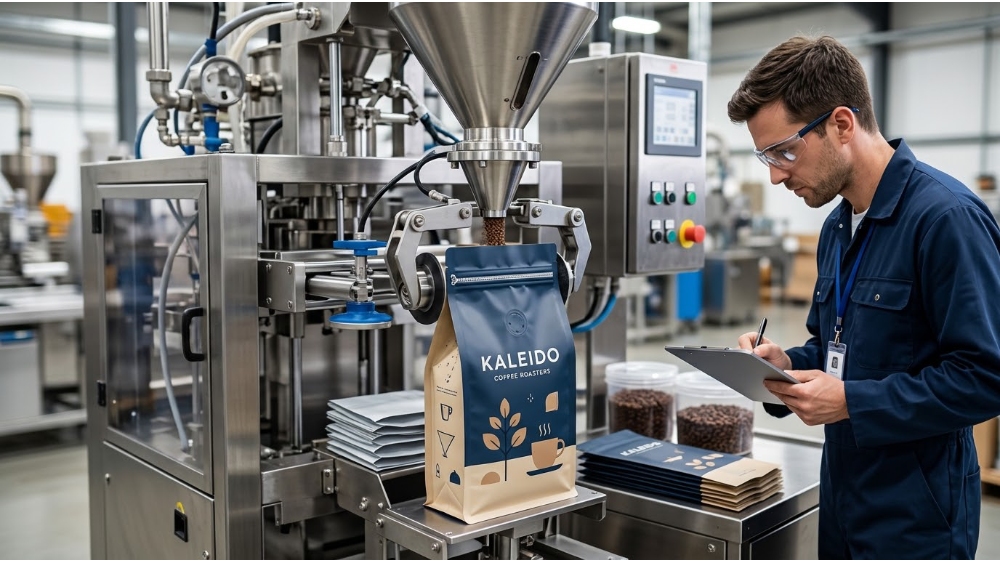
The first mistake buyers make is treating compatibility as a dimensional question. A machine rated for pouches from 100 mm to 200 mm wide will indeed accept a 150 mm pouch. But accepting a pouch is not the same as running it reliably for a full shift at the accuracy your coffee requires.
A pre-made pouch machine is a synchronized sequence of mechanical events. The magazine must separate one pouch from the stack. The suction cups must open the mouth without distorting the zipper track or catching the valve. The grippers must hold the pouch upright while the filler doses. The sealing jaws must close on a clean, flat seal zone that contains no coffee dust, oil, or wrinkles. If any feature of the pouch fights that sequence, the machine may still run, but the reject rate, changeover time, and seal integrity data will tell a different story.
This is why experienced buyers ask for a wet run with their actual pouches and their actual coffee before finalizing a machine specification. A supplier that cannot run your pouch with your product is not a compatible supplier, regardless of what the dimensional range says.
Pouch Format and Gripping Geometry
Pre-made coffee pouches are not a single format. Stand-up doypacks, flat-bottom bags, side-gusset bags, and quad-seal pouches each present a different physical profile to the machine. A stand-up pouch with a bottom gusset may stand reliably after filling, but the gusset expands during filling and changes the shape the grippers must control. A flat-bottom bag has more structure and material thickness at the base, which can require different gripping geometry than a simple doypack.
The practical question is not whether the machine supports your bag format on a specification sheet. The practical question is how many physical change parts are required to move between the formats you actually run, and how long that changeover takes. A machine that handles a 250 g stand-up pouch and a 1 kg flat-bottom bag may need different grippers, guide rails, opening suction cups, and sealing jaw profiles for each. If those parts are not quick-release or recipe-driven, the nominal speed of the machine becomes irrelevant at the end of a shift with multiple SKU changes.
For roasters planning private-label or multi-brand coffee pouch ranges, this is especially relevant. A pouch structure that works cleanly on the filling line for one retail bag may behave differently when scaled to a larger fill weight or a different gusset depth. The private-label coffee bag packaging guide covers how roasters serve multiple brands without creating SKU chaos; the filling-line implication is that every additional pouch format is also a changeover event that must be validated against the machine.
Confirm these geometry points before ordering pouches:
- Pouch width, height, and gusset depth at the filled state, not the empty dieline
- Bottom structure: does the bag stand reliably after the target fill weight
- Gripper contact points: are they clear of the valve, zipper, and tear notch
- Number of change parts and recorded changeover time between your actual formats
Valves, Zippers, and Physical Interference
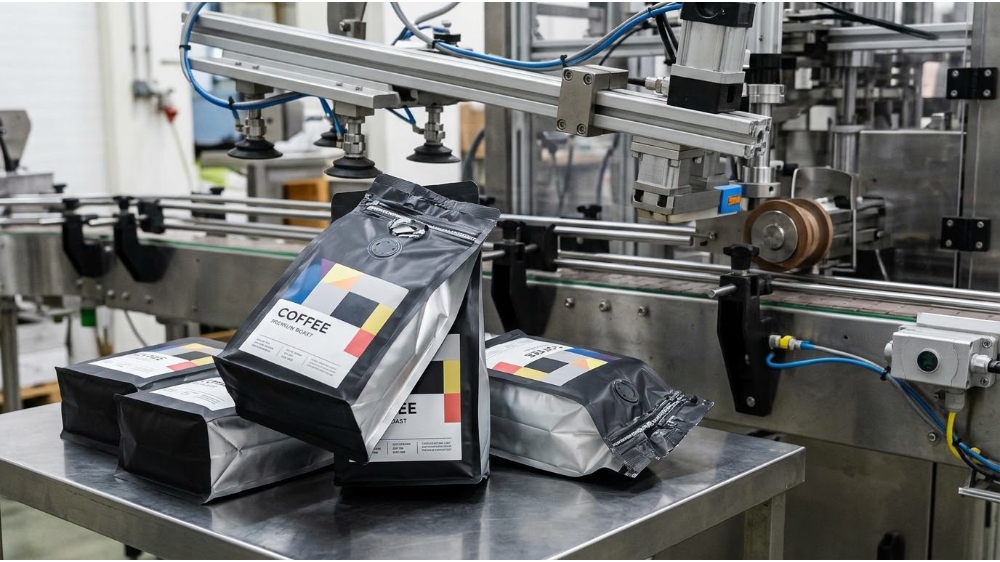
Coffee pouches often arrive with a one-way degassing valve already installed and a resealable zipper already attached. The filling machine does not install these features; it must work around them. That makes their position and profile a compatibility variable that is easy to overlook until the first production run.
A valve that sits too close to the top seal can be crushed by the sealing jaw, creating a leak path instead of a degassing path. A valve that sits on an active gusset fold can distort when the pouch is filled and cause the membrane to lift or block. A valve that protrudes from the front panel can snag on guide rails, magazine edges, or the opening suction cups as the pouch moves through the machine. The usual industry rule of thumb is to keep the valve in the top third of the front panel, at least 25 mm from any seal, and above the maximum fill line. Those distances must still be checked against the machine’s actual guide clearances, not only against the pouch drawing.
Zippers present a different problem. The opening device must separate the pouch mouth without damaging the zipper track. A thick zipper profile that sits very close to the top edge may leave too little film for the suction cups to grab. A zipper that is too easy to open may release during filling. A zipper with a wide landing zone can interfere with the seal bars if the seal zone is not positioned correctly on the final filled pouch. For pouches that also require nitrogen flushing, the gas path and the fill nozzle clearance must be confirmed with the zipper and valve in place, because the flush station occupies stations on the machine that may otherwise be used for opening or settling.
Film Behavior Inside the Machine
Two pouches can share identical dimensions and still behave differently on the same filling machine because their outer films have different surface properties. The coefficient of friction of the laminate’s outer layer determines how reliably the magazine separates the top pouch from the stack below it. A matte finish with a high coefficient of friction can cause double-picks or incomplete separation. A very glossy, high-slip film can slide too easily and misalign in the magazine.
Seal behavior is the second film variable. A PET, aluminum foil, and PE coffee laminate is relatively forgiving across a range of sealing temperatures. A mono-material PE or PP pouch designed for recyclability has a much narrower sealing window: too hot and the seal puckers or burns through, too cold and the seal peels under the weight of the filled pouch. A machine with a single sealing station and coarse temperature control may run a foil laminate acceptably but fail on a mono-PE coffee pouch that the brand has chosen for sustainability reasons.
This is not a reason to avoid recyclable or mono-material coffee pouches. It is a reason to confirm that the machine has independent seal jaw control, adequate dwell time, and a seal cooling zone before the pouch is discharged. Heavy coffee fills, particularly 1 kg and above, put load on the seal immediately after it is made. Without a cooling section, warm seals can creep open as the pouch drops into the collection bin.
Dosing Method and Filled Pouch Shape
The dosing system determines how the coffee enters the pouch, and that in turn affects the shape the pouch takes after filling. Whole bean coffee is typically dosed by a multi-head weigher or a linear weigher because the beans must not be crushed and the target weight must be held accurately. Ground coffee is typically dosed by an auger filler, because the powder flows consistently through a screw and can be controlled to a tight weight tolerance.
The compatibility question is whether the dosing method produces a filled pouch that the sealing station can close cleanly. An auger filler on finely ground coffee can generate dust at the pouch mouth. If the fill head is not close enough to the opening, or if there is no dust extraction or mouth-cleaning step before sealing, coffee particles land in the seal zone. A seal made over coffee dust is not a hermetic seal. It is a leak waiting to happen under nitrogen flush or during transport.
Whole bean fills change the shape of the pouch differently. Beans settle and bridge, and a flat-bottom bag filled with 1 kg of beans may present a different headspace and seal-zone geometry than the same bag filled with 250g of ground coffee. The valve position that works on the smaller fill may end up buried against the coffee surface on the larger fill, blocking the degassing path. Compatibility therefore has to be checked at the extremes of the fill range, not only at the nominal fill weight.
| Coffee form | Typical dosing method | Compatibility point to confirm | Common failure if missed |
|---|---|---|---|
| Whole bean | Multi-head or linear weigher | Pouch stands at full fill weight; valve stays above bean level | Bag leans or falls at sealing; valve buried under beans |
| Ground coffee | Auger filler | Fill-head clearance and dust control at the mouth | Coffee in seal zone; weak or leaking seal |
| Ground coffee, high oil | Auger with coated contact parts | Oil migration onto seal area; jaw cleaning interval | Seal contamination and delamination |
| Large fill, 1 kg and above | Weigher or auger, slower cycle | Seal cooling and discharge support | Seal creep under product weight |
How to Validate Compatibility Before Ordering
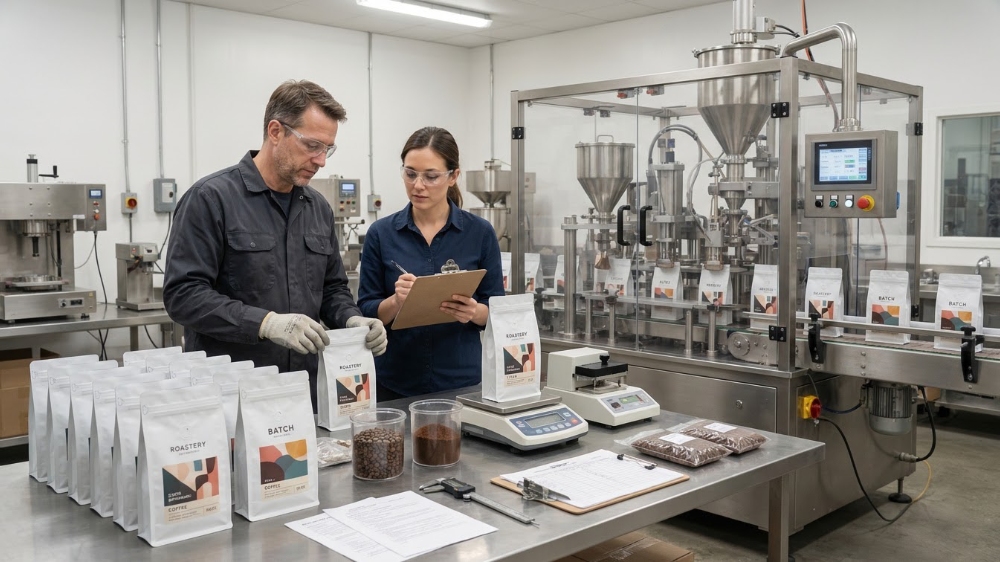
The only reliable way to confirm compatibility is to run your pouch, your coffee, and your target fill weight on the candidate machine before the purchase order is signed. A generic video of the machine running someone else’s product is not evidence. A filled sample that you can inspect, open, reseal, and test for seal integrity is evidence.
Send the machine supplier a minimum of 50 to 100 empty pouches, a production sample of your coffee at the target grind or bean size, the target fill weight and acceptable tolerance, and your expected speed and seal requirement. Ask for a short test report that records opening reliability, seal appearance, headspace, reject rate, and the actual weight of filled samples. If the application involves nitrogen flushing or a valve, specify the residual oxygen target and confirm that the flush station, valve position, and seal sequence work together on your pouch.
Changeover is the second validation. Ask the supplier to demonstrate a format change from your smallest pouch to your largest pouch during the factory acceptance test. Record the operator steps, the tools required, the number of adjustment points, and the time to return to saleable packs. A machine that runs one pouch at 40 bags per minute but loses 45 minutes on every format change may deliver fewer good bags per shift than a slower machine with a 15-minute changeover.
Questions to bring to every supplier conversation:
- Have you run this exact pouch laminate, with this valve and zipper, at my target fill weight
- Can I see a filled and sealed sample, not only a machine video
- What is the recorded changeover time between my smallest and largest formats
- How does the machine prevent coffee dust or oil from entering the seal zone
- If I switch to a mono-material pouch later, what sealing changes are required
For coffee packaging that must also survive e-commerce and subscription shipping, the filling-line seal is only the first barrier. The coffee packaging for e-commerce and subscription orders guide covers how bag structure and secondary protection work together after the pouch leaves the machine; compatibility at the filler is what makes that downstream protection meaningful.
Need pre-made coffee pouches that match your filling line?
Talk to a packaging specialist about valve position, zipper profile, film structure, and fill-weight extremes before you commit to a pouch order.
Frequently Asked Questions
Can any pre-made pouch run on any pre-made pouch filling machine?
No. A machine’s dimensional range describes what it can physically grip, not what it can open, fill, seal, and discharge reliably at production speed. Valve position, zipper profile, film friction, and filled pouch geometry all affect whether a specific pouch runs cleanly on a specific machine.
Do I need to change my pouch if I switch from a foil laminate to a recyclable mono-material?
The pouch dimensions may stay the same, but the sealing parameters will change. Mono-PE and mono-PP films have narrower sealing windows and may require longer dwell time, lower jaw temperature, or a seal cooling station. Confirm the machine can hold a consistent seal before ordering mono-material pouches at volume.
Why does the filling machine sometimes seal over the valve?
A valve placed too close to the top seal, or on a panel that shifts after filling, can enter the sealing jaw zone. The fix is usually a pouch drawing change, not a machine change. Valve position should be confirmed against the filled pouch geometry and the machine’s actual jaw clearance, not only against the empty dieline.
What is the minimum test I should ask for before buying a machine and ordering pouches?
Send your actual pouches and coffee for a wet run, and ask for filled and sealed samples with a short test report covering opening reliability, seal appearance, fill weight, and reject rate. A video of a different product is not a substitute for a test on your materials.
Post time: Nov-19-2026