7 Tips for Packing Takeaway Food Without Leaks, Sogginess or Heat Loss
Takeaway Food Packaging: 7 Tips to Prevent Leaks & Sogginess
Foodservice Packaging Guide
7 Tips for Packing Takeaway Food Without Leaks, Sogginess or Heat Loss
A burger arrives with a steamed bun. Fries are limp. Noodles have clumped into a single, gluey mass. These are the packaging failures that turn repeat customers into one-time buyers. This guide covers seven actionable strategies—rooted in food science and packaging engineering—to keep fried food crisp, burgers intact, noodles separate, and sauces contained, from your kitchen to the customer’s door.
The takeaway ecosystem is a hostile environment for freshly prepared food. Within minutes of leaving the kitchen, heat, steam, and gravity conspire to degrade texture, flavor, and structural integrity. Yet, some operators consistently deliver food that arrives as close to freshly plated as possible. The difference is not luck—it is a deliberate, systematic approach to packaging selection that accounts for moisture dynamics, thermal retention, mechanical stress, and food geometry.
This guide synthesizes food science research, packaging engineering principles, and real-world operational data to provide a clear framework. Whether you are packing crispy fries, saucy curries, delicate salads, or stacked burgers, these seven tips will help you eliminate leaks, prevent sogginess, and retain heat for the duration of the delivery journey.
Freshly cooked food releases water vapor as it cools. In a sealed container, this vapor has no escape route, so it saturates the air inside the package until relative humidity approaches 100%. When this humid air contacts a cooler food surface—such as a fry or a bun—it condenses into liquid water. This process, known as moisture migration, is the primary driver of sogginess.
Research from Worcester Polytechnic Institute (2025) confirms that starch-based foods like fries and bread products lose their crisp structure rapidly when exposed to humidity levels above 70%. The starch granules absorb ambient moisture, swell, and lose their rigid, brittle matrix. This degradation begins within five to eight minutes in a fully sealed package. The physics are unforgiving: without a pressure-driven airflow path to vent humid air and introduce drier ambient air, the food’s texture is compromised long before it reaches the customer.
For hot foods, steam management is the single most critical variable. For cold foods such as salads, the enemy is temperature fluctuation, which accelerates wilting and bacterial growth. Understanding this fundamental distinction—steam versus temperature—is the first step toward effective takeaway packaging.
How do you keep fried food crispy in takeout containers?
Fried foods—fries, chicken wings, onion rings—are the most structurally fragile items in the takeout menu. Their crispness relies on a dehydrated, porous starch or batter coating that shatters when bitten. Trapped steam is the direct antagonist.
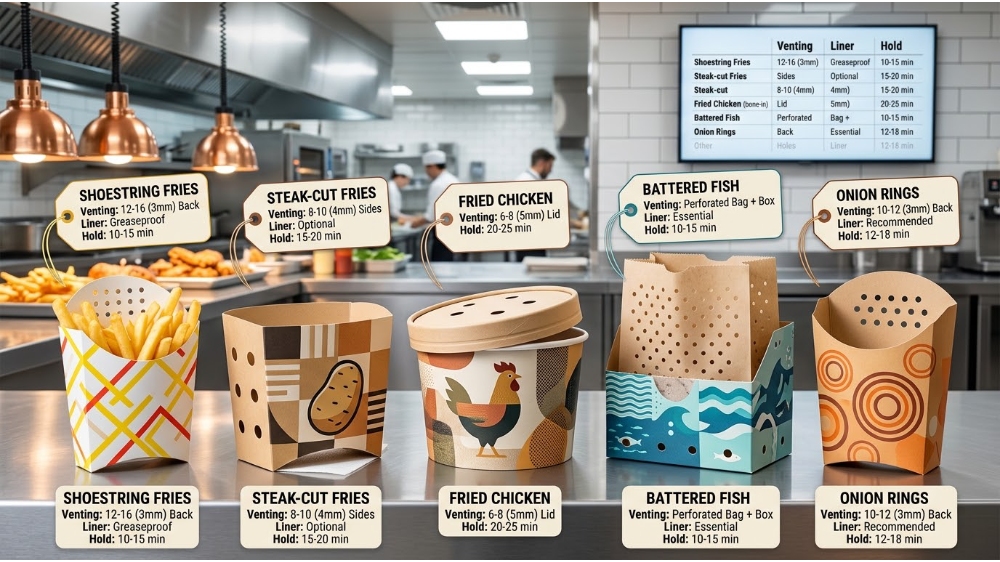
The solution is vented packaging. Holes in the sides or back of the box, typically 3mm to 5mm in diameter, create a chimney effect that allows steam to rise and escape before it can condense on the food. Imperial Dade’s 2023 guide on takeout packaging emphasizes that total open area should comprise 2% to 4% of the box surface to balance moisture release with heat retention. Too few holes and steam accumulates; too many and heat dissipates too quickly, leaving fries cold but crisp.
Food Type
Recommended Venting
Absorbent Layer
Hold Time (Minutes)
Shoestring fries
12–16 holes (3mm) on back panel
Greaseproof paper insert
10–15
Steak-cut fries
8–10 holes (4mm) on sides
Optional paper towel base
15–20
Fried chicken (bone-in)
6–8 holes (5mm) on lid
Not required (low surface area)
20–25
Battered fish
Perforated bag + box
Essential (oil drainage)
10–15
Onion rings
10–12 holes (3mm) on back
Recommended
12–18
In addition to venting, adding an absorbent base layer—such as a greaseproof paper liner or a plain paper towel—creates a physical barrier between the fries and any condensation that pools at the bottom of the box. This wicking action removes excess moisture without drying out the food. Tip Top Foodservice (2024) notes that combining vents with an absorbent insert extends crispness by an additional 5–10 minutes compared to venting alone.
What’s the best way to pack burgers so they don’t get soggy?
A burger’s structural integrity is a delicate balance of bun, patty, sauces, and fresh toppings. The bun is the primary vulnerability—its soft, porous crumb acts like a sponge for any moisture it contacts.
The golden rule of burger packaging is separation of wet and dry components. Sauces (mayo, ketchup, special sauce), pickles, tomatoes, and even the patty’s own juices must be physically isolated from the bun crown and heel. This is achieved through waxed paper liners, foil wraps, or compartmentalized clamshell boxes. A wrap that tightly encases the burger also prevents steam from escaping upward, but if the wrap is foil-lined, it reflects radiant heat back onto the patty while keeping the bun’s surface dry.
Bun selection matters. A brioche or potato bun with higher fat content and a tighter crumb structure resists moisture penetration better than a standard white flour bun. For delivery, consider using a bun that is slightly sturdier than your dine-in counterpart. Research by Detpak (2025) suggests that wrapping the burger in a greaseproof paper sleeve before placing it in a rigid box reduces condensation-related sogginess by up to 40% over a 20-minute delivery window. The sleeve absorbs excess grease from the patty and prevents steam from attacking the bun directly.
How do you pack noodles and pasta without sticking or getting mushy?
Noodles and pasta are starch-heavy and highly susceptible to overcooking from residual heat and moisture. In a sealed container, they continue to cook via trapped steam, leading to a mushy, clumped texture that is universally unappealing.
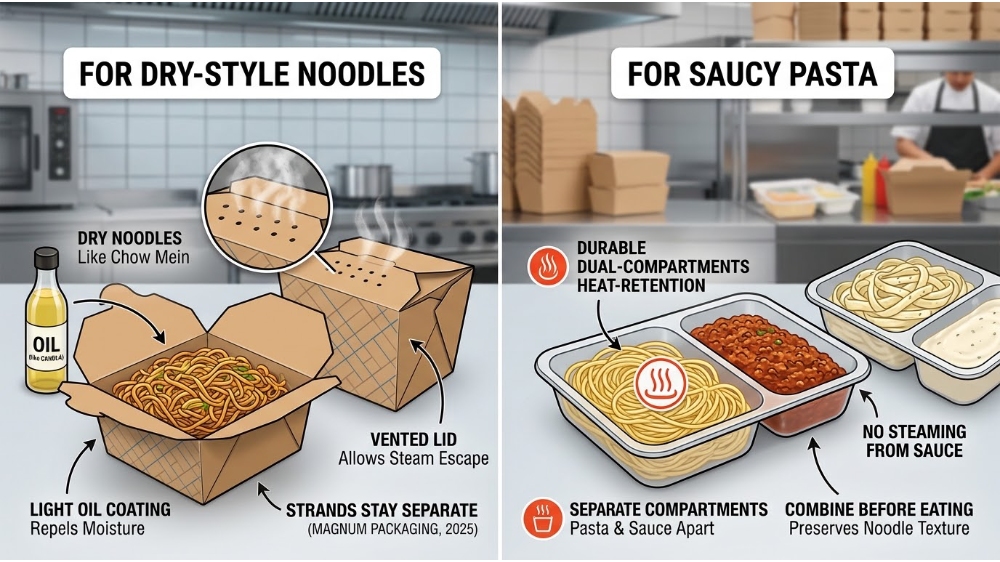
For dry-style noodles (chow mein, lo mein, or stir-fried noodles), the strategy is oil and ventilation. Tossing the noodles in a light coating of neutral oil (such as canola or vegetable oil) after cooking creates a hydrophobic barrier that repels moisture and prevents individual strands from fusing together. Packing them in a vented box with perforations on the lid allows steam to escape while the oil maintains separation. Magnum Packaging (2025) reports that oil-coated noodles packed in vented containers retain separate strands for up to 25 minutes, compared to 10 minutes in a sealed clamshell.
For saucy noodles and pasta (spaghetti bolognese, fettuccine alfredo), the sauce acts as a moisture source that accelerates mushiness. The optimal approach is sauce separation: pack the noodles and sauce in separate compartments or containers, with instructions for the customer to combine them just before eating. This not only preserves noodle texture but also allows the sauce to stay hot without steaming the pasta. Heat-retentive containers with dual compartments—one for solids, one for liquids—are ideal for this use case.
What’s the right packaging for salads and cold food delivery?
Cold food delivery presents a different challenge: temperature stability and texture preservation. Salads wilt when exposed to heat or when dressings are applied prematurely. The goal is to maintain an internal temperature below 40°F (4°C) while preventing condensation from sogging out the greens.
The foundational rule is compartmentalization. Keep leafy greens, crunchy toppings (croutons, nuts, seeds), proteins (chicken, tofu, hard-boiled eggs), and dressings in completely separate compartments until the moment of consumption. Container designs with divided trays or stacked compartments are ideal. The greens require a slightly breathable environment to release ethylene gas (which accelerates spoilage), so containers with micro-perforations are preferred for the main salad bed.
For temperature control, insulated bags with a built-in cold pack or gel pack maintain the cold chain for up to 45 minutes in moderate ambient conditions. According to findings from the 2022 Technomic consumer research cited by Anchor Packaging, 68% of consumers consider proper temperature maintenance as the most important factor in their satisfaction with cold takeaway orders. A clear lid that allows the customer to see the fresh, vibrant ingredients reinforces the perception of quality, even before the first bite.
How do you prevent leaks from saucy takeaway food?
Saucy dishes—curries, stews, chili, soups, and gravies—are the highest-risk category for leakage. A single failed seal can result in a customer receiving a greasy, stained bag and a half-empty container, often leading to a negative review and a chargeback.
The cornerstone of leak-proof packaging is the closure mechanism. Containers with four-corner locking lids, snap-on rims, or heat-sealed film provide the highest level of security. The lid must create a tight friction fit or a mechanical lock that resists the hydraulic pressure exerted by a sloshing liquid during transport. Double-sealing—using a foil or plastic film seal over the rim, followed by a snap-on lid—is the gold standard for soups and ultra-saucy curries.
Material selection is equally important. Polypropylene (PP) containers offer excellent chemical resistance and dimensional stability, maintaining their seal integrity even when filled with hot, oily liquids. Avoid thin polystyrene (PS) or unbranded low-grade plastics that warp under heat, as warping breaks the seal. Anchor Packaging’s 2022 research notes that containers with an integrated steam vent in the lid—specifically designed for liquids—prevent pressure buildup that can cause the lid to pop off during transit. Additionally, avoid overfilling. Leaving a 10-15% headspace in the container reduces the hydraulic force on the seal and allows for thermal expansion.
How does box strength and stacking affect delivery food quality?
During a typical delivery route, a single bag may contain multiple orders stacked vertically. The bottom box bears the weight of all containers above it. If the packaging lacks structural rigidity, it deforms, leading to crushed burgers, spilled contents, and broken seals.
Box strength is determined by the thickness of the paperboard (typically measured in GSM or points) and the design of the fold lines. A box with reinforced corners, a double-wall construction, or a roll-over edge can withstand significant vertical compression. The collapse strength of a box is critical—if the sidewalls buckle inward, they press against the food, squeezing out fillings and sauces. ECT (Edge Crush Test) ratings are the industry standard for measuring stacking strength. For multi-order delivery bags, boxes with an ECT rating of 32 or higher are recommended.
The design of the box also affects stackability. Flat-bottomed boxes with straight, vertical walls stack more securely than tapered or wedge-shaped designs. When boxes are stacked, the load distribution must be even. Using a rigid, corrugated carry tray that holds individual boxes in place prevents shifting and reduces the force applied to any single container. According to foodservice logistics data from the 2025 industry benchmarks, inadequate box strength accounts for approximately 15% of all delivery-related quality complaints. Investing in heavier-duty board stock, combined with intelligent compartmentalization, dramatically reduces these incidences.
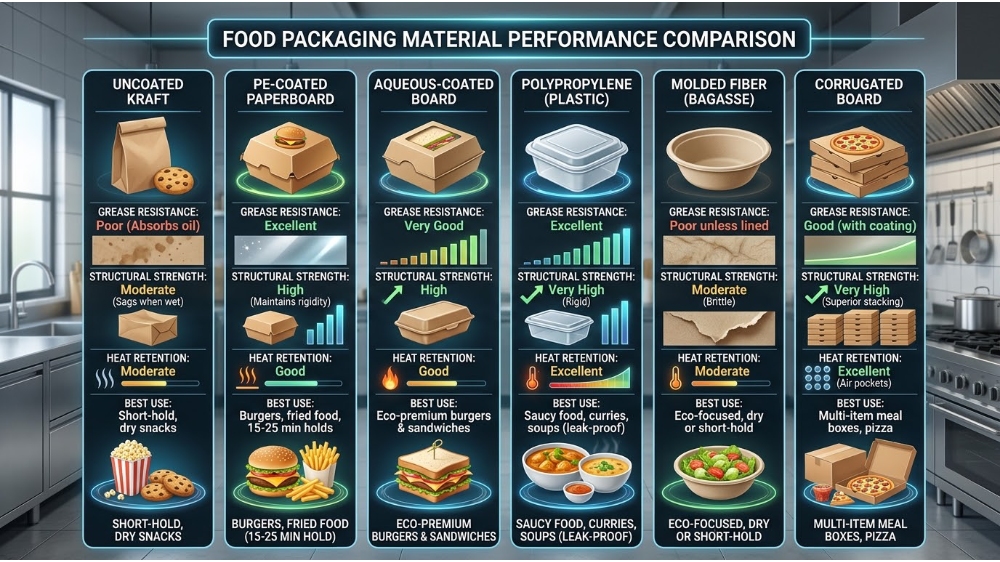
Material
Grease Resistance
Structural Strength (Stackability)
Heat Retention
Best Use
Uncoated Kraft
Poor (absorbs oil)
Moderate (sags when wet)
Moderate
Short-hold, dry snacks
PE-Coated Paperboard
Excellent
High (maintains rigidity)
Good
Burgers, fried food, 15-25 min holds
Aqueous-Coated Board
Very Good
High
Good
Eco-premium burgers & sandwiches
Polypropylene (Plastic)
Excellent
Very High (rigid)
Excellent
Saucy food, curries, soups (leak-proof)
Molded Fiber (Bagasse)
Poor unless lined
Moderate (brittle)
Moderate
Eco-focused, dry or short-hold
Corrugated Board
Good (with coating)
Very High (superior stacking)
Excellent (air pockets)
Multi-item meal boxes, pizza
Frequently Asked Questions
How long can food stay in takeout packaging before losing quality?
For hot fried food, quality declines after 10–15 minutes in standard vented packaging, though coated boxes with optimized vents can extend this to 25 minutes. Cold salads hold for 30–45 minutes with an ice pack, while saucy dishes maintain safety and texture for up to 2 hours if held above 140°F or below 40°F.
Do vented containers lose heat faster than sealed ones?
Yes, but the temperature drop is marginal (approximately 2–3°F over 15 minutes) compared to the significant moisture reduction. The trade-off is favorable, as crispness retention is generally more critical to customer satisfaction than a 5-degree temperature difference, especially for fried foods.
What is the most leak-proof takeaway container material?
Polypropylene (PP) with a four-corner locking lid offers the highest leak resistance. When combined with a heat-sealed film layer, it creates a near-impenetrable barrier against liquids, making it the top choice for soups, curries, and stews.
Can you reuse takeaway packaging for other food types?
Structural integrity often degrades after one use, particularly with paperboard and molded fiber. Additionally, material coatings may not be designed for reheating or different moisture profiles, so reuse is not recommended for commercial operations seeking consistent quality.
Need packaging that solves leaks, sogginess, and heat loss?
Our packaging specialists analyze your specific menu items, delivery radius, and hold times to recommend the optimal box designs, materials, and venting configurations.