
This guide separates the three variables that determine whether a paper food bucket is recyclable in practice: the lining chemistry, the amount and form of grease residue, and the acceptance rules of the local materials recovery facility or municipal program. It is written for foodservice operators, packaging buyers, and brand owners who need to make defensible end-of-life claims rather than rely on a symbol printed on a lid.
Are Paper Food Buckets Recyclable? Linings, Grease, and Local Rules
Foodservice Packaging Guide
Are Paper Food Buckets Recyclable? What Linings, Grease Residue, and Local Rules Actually Decide
Paper food buckets are not automatically recyclable: PE-lined buckets are usually rejected curbside because the plastic lining and grease interfere with pulping. Exceptions include aqueous-coated buckets, clean/empty PE-lined buckets in select municipalities, and industrial composting. Recyclability is a system property, not a material label.
Paper food buckets occupy an awkward position in packaging sustainability. They look like paper, feel like paper, and are marketed alongside paper-based alternatives to foam and rigid plastic. Yet the functional layer that makes them hold greasy food without collapsing—usually a thin polyethylene film—is precisely what prevents many recycling systems from accepting them. The result is a familiar confusion: a bucket can carry a recycling symbol and still belong in the trash where the customer lives.
The Lining Decides the Bucket’s Fate More Than the Paper
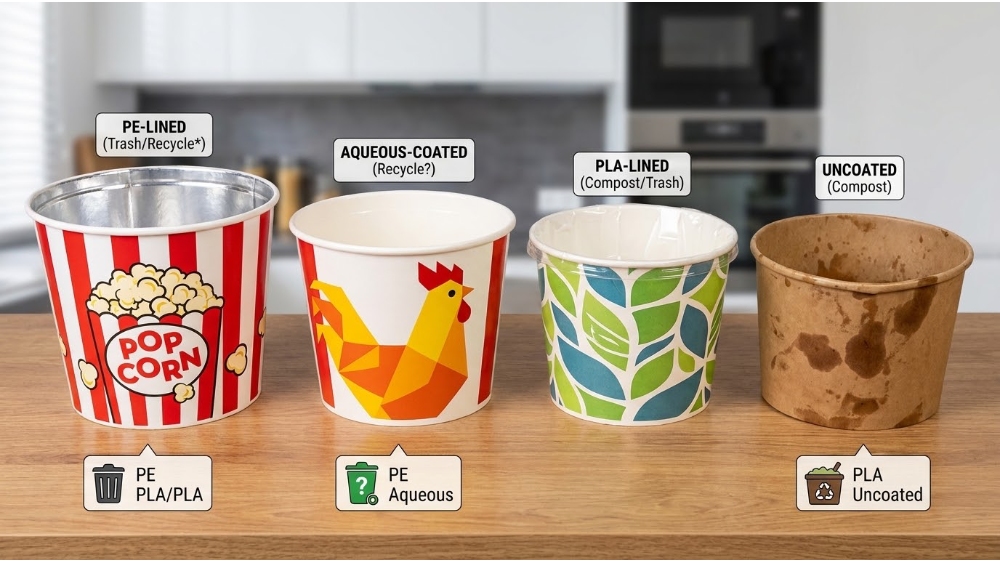
Most paper food buckets on the market use a polyethylene (PE) lining. Product specifications for common food buckets describe the interior as “PE lining” and rate the container as highly resistant to greasy food or oil. That resistance is the point: without a barrier, hot oil and steam would soften the paperboard within minutes.
The problem is that PE does not break down at the same rate as uncoated paper during repulping. Municipal guidance in several U.S. jurisdictions states plainly that poly-coated paper packaging is not recyclable because the plastic coating “does not break down at the same rate as non-coated paper” and must be removed as waste in the papermaking process. A separate recycling guide for plastic-coated food service ware instructs residents to look for the shiny interior coating and place those items in the garbage. In Burbank, California, the guidance is categorical: wax- or plastic-lined paperboard takeout containers cannot be recycled because “the lining can’t be separated,” and the container belongs in the trash.
Not every jurisdiction agrees. Calgary, Alberta, accepts empty and clean paper fast food buckets in its blue cart and at community recycling depots. The same guidance notes that “some grease on cardboard is ok” but confirms the bucket cannot go in the green compost cart because it has a plastic lining. This is not a contradiction in the science. It is a difference in what the local sorting and pulping infrastructure can handle. A facility equipped to separate or tolerate a thin PE layer may accept the bucket. A facility that cannot will reject it, regardless of how clean the consumer makes it.
The lining hierarchy for paper food buckets:
- PE-lined: Standard for grease resistance; rejected by most curbside programs, accepted by some municipal programs when empty and clean.
- Aqueous-coated: Water-based dispersion barrier; designed to be repulpable in standard paper recycling streams, but acceptance still depends on the mill.
- PLA-lined: Often marketed as compostable, but many recycling guides classify PLA-lined food service ware as garbage unless industrial composting is available.
- Uncoated kraft: Breathable and potentially recyclable, but absorbs grease and loses structural integrity quickly; rarely used for hot, oily foods.
Grease Residue: What Recyclers Actually Tolerate
The conventional recycling instruction is to scrape food residue and keep paper packaging “clean and dry.” That instruction is directionally correct but imprecise. Recent industry research has begun to separate two kinds of residue that were previously lumped together: absorbed grease and actual food pieces.
A study by the Sustainable Packaging Coalition interviewed paper recyclers and brokers about the point at which food residue disqualifies packaging from recycling. The industry response clustered around a threshold described as “we don’t want actual pieces of food entering our operations.” Absorbed grease was treated as less of a concern than solid food remnants, which carry higher risks of pests, odors, and quality loss in the sorted paper bale. In practical terms, a bucket with grease absorbed into the fiber is more likely to be accepted than a bucket containing a piece of fried chicken or a clump of cheese.
This nuance matters for paper food buckets because their design encourages grease absorption. The PE lining prevents oil from wicking through the sidewall, but the rim, the base seam, and the vent holes are often uncoated or minimally coated. Grease collects in exactly those places. A consumer who empties the bucket and wipes the interior has removed the solid food risk. They have not removed the absorbed grease, and that is acceptable to many recyclers. The more consequential question is whether the lining itself will be tolerated, not whether a faint grease mark remains.
The practical takeaway for operators is that “clean enough” for a paper bucket means empty of food pieces, not pristine. Packaging guidance that asks customers to scrape and empty—rather than rinse and scrub—is aligned with what recyclers say they need. Over-washing a PE-lined bucket does not make the lining disappear.
Why Local Rules Diverge So Sharply
Paper food bucket recyclability is not governed by a single national standard in most markets. It is governed by the acceptance criteria of the materials recovery facility that receives the material, and those criteria vary with equipment, end markets, and contamination tolerance.
In the United States, curbside programs are fragmented. A municipal guide in Andover, Minnesota, lists “to-go food containers” among items that should not be recycled, alongside poly-coated boxes and food-soiled paper. Calgary’s program accepts clean paper fast food buckets. Burbank’s program does not accept wax- or plastic-lined paperboard at all. These differences are not anomalies; they reflect different contracts with different mills. A bucket that is recyclable in one city may be contamination in another 30 miles away.
In the United Kingdom, the Simpler Recycling framework is intended to standardize household collections in England, requiring paper and card to be collected separately by default from March 2026. That harmonization improves consistency at the collection stage, but it does not automatically resolve the lined-bucket question. A paper bucket with a PE barrier still has to find a mill willing to process the lining. The collection rule and the processing reality are separate layers of the system.
In the European Union, recyclability claims are increasingly assessed against harmonized standards such as EN 13430, which provides a framework for evaluating whether packaging is recoverable by material recycling. New barrier papers are being launched with explicit claims of compliance with EN 13430 and CEPI protocols, often paired with PFAS-free formulations. These developments raise the technical ceiling for what a “recyclable” paper bucket can mean, but they do not override local collection infrastructure. A bucket certified recyclable under a laboratory protocol may still lack a collection pathway in a given municipality.
The Gap Between “Recyclable” and “Actually Recycled”
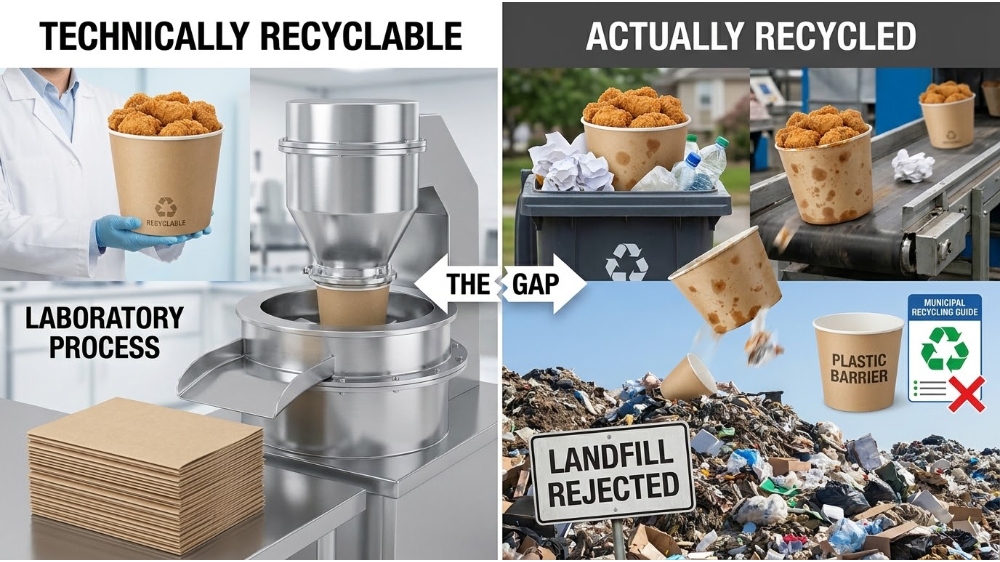
The most important distinction in paper food bucket recyclability is between technical recyclability and real-world recycling. A package is technically recyclable if a laboratory or mill can process it into a new fiber product. It is actually recycled only if it is collected, sorted, accepted by a reprocessor, and converted into a secondary material with a viable end market.
The numbers illustrate the gap. Paper and cardboard packaging as a broad category has one of the highest recycling rates of any packaging material, often cited above 80% in European markets. But that figure is dominated by corrugated boxes and clean office paper. Paper containers and packaging that are not corrugated boxes—a category that includes food buckets, cups, and takeout boxes—have shown recycling rates closer to 20% in U.S. data, with contamination cited as a primary reason for the difference. Some market analyses put the actual recycling rate for “recyclable” food boxes at 10–25% in most markets, far below the rates for aluminum cans or office paper.
For paper food buckets specifically, the bottleneck is not consumer willingness. It is the combination of a plastic barrier that many mills cannot process and a collection system that often tells consumers to throw the item away. When a municipal guide says “plastic-lined paper goes in the garbage,” the recycling rate for that format is effectively zero in that jurisdiction, regardless of what a material scientist might say about repulpability.
| Bucket format | Grease barrier | Recyclability in practice | Most realistic end-of-life today |
|---|---|---|---|
| PE-lined paperboard | Excellent | Low to moderate—rejected by many curbside programs; accepted by some municipal programs when clean | Landfill, or municipal recycling in select cities |
| Aqueous-coated paperboard | Good | Moderate to high—repulpable in standard paper streams; acceptance varies by mill | Paper recycling where infrastructure exists |
| PLA-lined paperboard | Good | Low—often classified as garbage unless industrial composting is available | Landfill or industrial compost |
| Uncoated kraft | Poor | Moderate—recyclable if clean, but rarely suitable for hot greasy food | Limited use; short-hold applications |
The table points to a decision rule that is more useful than a general “paper is recyclable” claim: the bucket format with the best end-of-life outcome is the one whose barrier chemistry matches the dominant local processing infrastructure. In markets with paper mills equipped to handle aqueous coatings, an aqueous-coated bucket may be genuinely recyclable. In markets where the only realistic destination is landfill, a “recyclable” label on a PE-lined bucket is a technical statement with limited operational value.
A Practical Framework for B2B Packaging Decisions
For foodservice operators and brand owners, the question is not “are paper food buckets recyclable?” in the abstract. The question is “is this specific bucket recyclable in the markets where my customers will dispose of it?” That reframing changes the procurement criteria.
Start with the destination, not the material. Identify the two or three largest municipal recycling programs in your delivery footprint and check their published acceptance lists for poly-coated paper and paper food buckets. If the dominant programs reject PE-lined buckets, a “recyclable” claim on that format is not defensible in those markets, even if the paperboard itself is technically repulpable.
Ask suppliers for evidence, not symbols. A recycling symbol on a bucket is not proof of recyclability. Ask the supplier for the specific mill or reprocessor that accepts the bucket, the geographic area covered, and whether the acceptance is unconditional or limited to clean and empty containers. Aqueous-coated buckets that comply with EN 13430 or pass repulpability testing have a stronger technical case than PE-lined buckets, but the case still depends on a collection pathway.
Match the format to the hold time and the disposal context. A PE-lined bucket is a strong functional choice for hot, greasy foods and long holds. If the disposal context cannot handle PE, the options are to switch to an aqueous-coated format where recycling infrastructure exists, to pair the bucket with clear customer disposal instructions for a specific program, or to accept landfill as the realistic end-of-life and avoid an unqualified recyclability claim.
Treat “compostable” as a separate claim with its own infrastructure requirement. A bucket marketed as compostable may require industrial composting that is not available to most households. Several recycling guides explicitly classify PLA-lined and plastic-lined paper food service ware as garbage, not compost. Compostability claims should be validated against the same infrastructure test as recyclability claims.
Need paper food buckets with a defensible end-of-life story?
Talk to a packaging specialist about lining chemistry, grease resistance, and disposal claims matched to your menu, delivery footprint, and target markets.
Frequently Asked Questions
Can PE-lined paper food buckets go in curbside recycling?
In most curbside programs, no. The polyethylene lining is a plastic barrier that many paper mills cannot process, and municipal guides frequently list poly-coated paper food containers as trash. A minority of programs accept them when they are empty and clean, but acceptance is municipal-specific and should not be assumed from a recycling symbol.
Do aqueous-coated paper buckets solve the recycling problem?
They solve the repulpability problem in principle. Aqueous dispersion coatings are designed to break down in standard paper recycling streams, and suppliers position them as recyclable and repulpable. The remaining constraint is infrastructure: the bucket still needs a collection program and a mill that accepts the coated material. Aqueous coating improves the technical case but does not create a collection pathway where none exists.
How clean does a paper food bucket need to be for recycling?
Clean enough to be free of solid food pieces. Recent industry research indicates that recyclers are more concerned about actual food remnants—which cause pests, odors, and quality problems—than about grease absorbed into the paper fiber. Emptying and scraping the bucket is the practical threshold. Rinsing is not necessary and does not remove the lining.
Why do some cities accept paper food buckets while others reject them?
Because acceptance is determined by the sorting and pulping capability of the local materials recovery facility, not by the bucket’s material category. A facility with equipment or end markets that can tolerate a thin coating may accept the bucket. A facility that cannot will reject it, even if the bucket is clean and the paper fiber is technically recyclable.
Post time: Oct-26-2026