
This guide is written for importers, distributors, and private-label buyers sourcing paper buckets for restaurants, cinemas, convenience stores, and delivery operators. It explains the document package to request, the difference between US and EU expectations, and the details that separate a useful declaration from a generic certificate that adds little protection.
Paper Bucket Food-Contact Documents for US and EU
Food-Contact Compliance Guide
Food-Contact Documents for Paper Buckets: What Importers Should Request for the US and EU
Request five core documents for paper buckets: a product-specific food-contact declaration, specification sheet, migration test summary, GMP statement, and lot traceability. For the US, confirm FDA food-contact compliance. For the EU, request a Declaration of Compliance covering the finished bucket and national rules.
A paper bucket looks simple: board, a coating, a printed sidewall, and a rolled rim. For a food importer, however, that simple object carries a chain of compliance questions. The board may contain recycled fiber. The coating may be polyethylene, aqueous, or a compostable polymer. The ink may sit on the outside, or it may be closer to the food than the buyer expects. Each choice affects which food-contact documents the supplier should provide and how those documents should be read.
What documents should importers request?
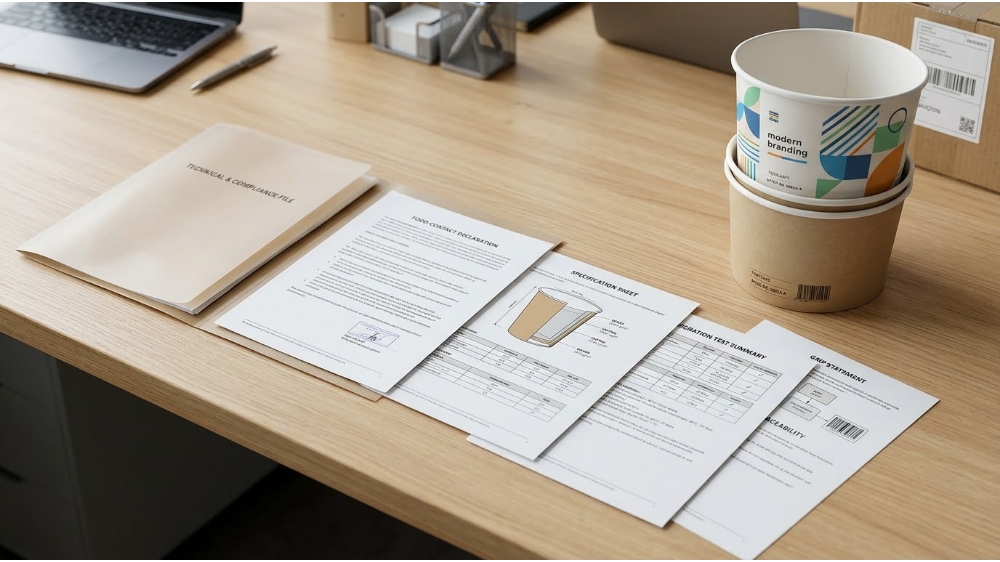
A paper bucket supplier should be able to provide a product-specific document package, not a folder of general company certificates. The core package should include a food-contact declaration for the finished bucket, a full specification sheet, a migration test summary, a GMP statement, and lot traceability.
For coated or printed buckets, add coating and ink details. For export to the EU, add a Declaration of Compliance that covers the finished article and its intended use.
Food-contact document package for paper buckets:
- Food-contact declaration for the finished bucket, not just the board
- Specification sheet with board grade, coating type, and grammage
- Migration test summary with test conditions and limits
- GMP statement covering the production site
- Lot coding, traceability, and change notification process
- Coating, adhesive, and printing ink information
- Storage, shelf-life, and intended-use statement
- EU Declaration of Compliance when the destination is the EU
The specification sheet matters because paper buckets are often described only by size and print. A buyer needs to know the board composition, the coating weight, the rim construction, and whether the bucket is designed for hot, cold, fatty, or aqueous food. Those details determine which migration tests are relevant and whether the supplier’s declaration actually covers the product being imported.
US market: what the paperwork must show
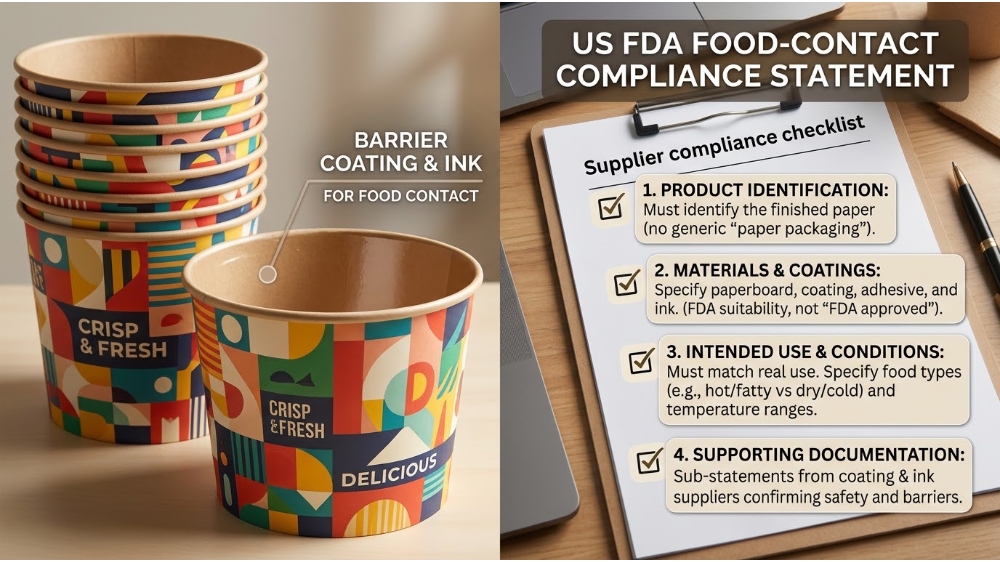
For the US market, the supplier should provide a food-contact statement that identifies the finished paper bucket and confirms that its components are suitable for direct food contact under FDA requirements.
The statement should not rely on the phrase “FDA approved,” because FDA does not approve finished food-contact articles in the way many buyers assume. Instead, the supplier should identify the food-contact substances used in the board, coating, adhesive, and ink, and confirm that each component is authorized for its intended use.
A useful US food-contact statement should answer four questions. What is the product? Which materials and coatings contact food? What food types and temperature ranges are covered? What documentation supports the statement?
If the bucket is coated, the coating supplier should provide a food-contact statement for the coating. If the bucket is printed, the ink supplier should confirm that the ink is suitable for food-contact applications or that a functional barrier prevents migration.
The statement should also match the real use. A bucket for hot fried food is not the same as a bucket for cold popcorn. Hot, fatty food creates different migration conditions from dry, ambient food.
A generic statement that covers “paper packaging” without naming the product, coating, and use conditions is weak evidence. Importers should ask for a product-specific statement and keep it with the purchase specification.
EU market: the Declaration of Compliance

For the EU market, the key document is the Declaration of Compliance for the finished food-contact article. The declaration should state that the paper bucket complies with the EU framework regulation for food-contact materials and the EU GMP regulation for food-contact materials.
It should identify the product, the materials used, the intended contact conditions, and the basis for compliance. A declaration that only covers raw paperboard is not enough for a coated or printed bucket.
The EU approach is not fully harmonized for paper and board at the EU level. That means the supplier should also consider national rules in the destination country.
A Declaration of Compliance for a paper bucket should therefore be clear about its scope. Does it cover the board only, or the finished bucket? Does it include the coating, adhesive, and ink? Does it cover hot food, fatty food, or aqueous food? Does it state the maximum temperature and contact time?
A strong EU Declaration of Compliance should include the supplier’s identity, the product name or reference, the date and version, the compliance statement, the substances or materials of concern, the migration limits that apply, the test conditions used, and any limitations of use.
It should be signed and traceable to the production site. If the declaration is several years old, ask for a current version and a change notification statement.
Check coatings, inks, and adhesives
Paper buckets usually combine several materials. The board provides structure. The coating provides grease and moisture resistance. The adhesive holds the side seam. The ink carries the brand. Each material can affect food-contact compliance, and each should be covered by the supplier’s documentation.
Coating type is the first detail to confirm. Polyethylene coating is common for grease resistance, but the buyer should confirm that the specific coating is suitable for the intended food and temperature. Aqueous coatings are used in some markets as a repulpable alternative, but performance varies by application. Compostable or bio-based coatings may have different heat limits.
Printing inks deserve separate attention. Inks on the outside of a bucket are not normally in direct contact with food, but migration can still occur through the board or through stacked buckets.
The supplier should confirm that the ink system is suitable for food packaging and that the print design does not place ink on food-contact surfaces. The same logic applies to adhesives and rim coatings. A complete document package should not leave the buyer guessing which component has been assessed. Read Coating Chemistry & Food-contact Scope before preparing documents.
Read the declaration like a buyer
A Declaration of Compliance is not a badge. It is a technical statement that should be read against the product specification. Start with the product identity. The declaration should name the paper bucket or a product family that clearly includes the bucket being purchased.
If the declaration covers “paper containers” in general, ask for a product-specific annex or a written confirmation that the imported item is covered. Next, check the intended use. The declaration should state whether the bucket is for hot or cold food, fatty or aqueous food, and short-term or extended contact.
If the bucket is marketed for hot fried food, but the declaration only covers dry food at ambient temperature, the document does not support the claim. The buyer should also check the test conditions. Migration tests should reflect the food type, temperature, and contact time that the bucket will actually face.
Finally, check the administrative details. Is the declaration dated? Is it signed? Does it identify the production site? Is there a version number? Does it include a statement that the supplier will notify customers of changes?
These details matter because food-contact compliance is not a one-time event. A supplier that cannot control versions and changes is a supplier that cannot reliably support an importer’s due diligence.
Match migration tests to real use
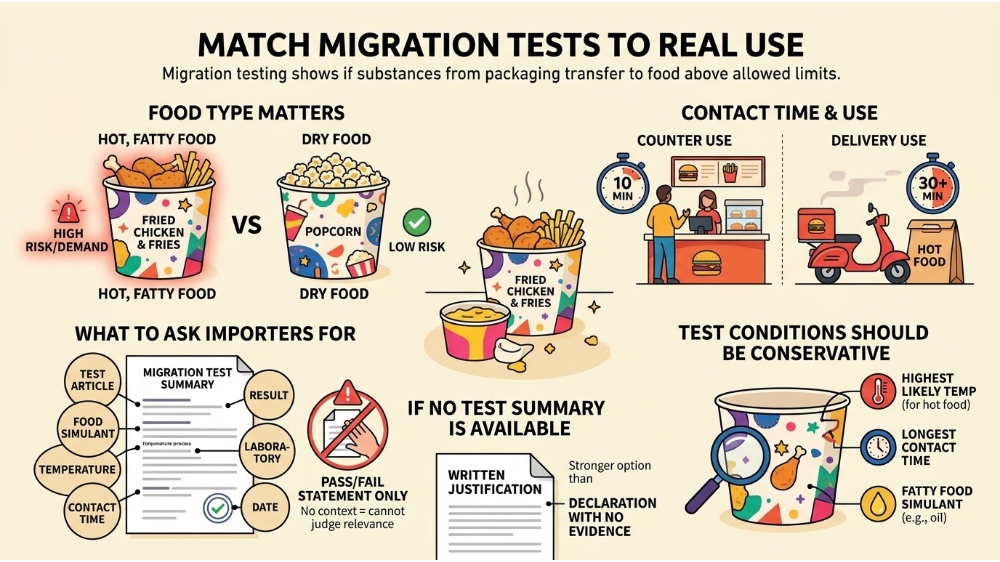
Migration testing is used to show that substances from the packaging do not transfer to food above applicable limits. For paper buckets, the relevant test conditions depend on the food and the use.
A hot, fatty food such as fried chicken or loaded fries is more demanding than dry popcorn. A bucket used for 10 minutes at the counter is different from a bucket that holds hot food for 30 minutes in delivery.
Importers should ask for a migration test summary, not necessarily the full laboratory report. The summary should identify the test article, the food simulant, the temperature, the contact time, and the result.
If the supplier provides only a pass or fail statement without conditions, the buyer cannot judge whether the test is relevant. The summary should also identify the testing laboratory and the date.
Test conditions should be conservative for the intended use. If the bucket is used for hot food, the test should cover the highest likely temperature and the longest likely contact time. If the bucket is used for fatty food, the test should use a fatty food simulant.
If the supplier cannot provide a test summary, the buyer should ask for a written justification based on the materials and the intended use. A declaration without supporting evidence is weaker than a declaration backed by relevant test data.
Build a living supplier file
Food-contact documents should be managed as a living file, not a one-time email attachment. For each paper bucket SKU, keep the current specification, the food-contact declaration, the migration test summary, the GMP statement, and the traceability information.
Record the date received, the version, and the next review date. If the supplier changes the board, coating, ink, or production site, the file should be updated before the next shipment.
A living file also helps with customer requests. Restaurant chains, distributors, and private-label buyers increasingly ask their suppliers for food-contact documentation. An importer that can respond quickly with a complete, product-specific package has a commercial advantage. An importer that has to chase the factory for basic documents creates delay and risk.
The file should also include a change notification clause in the supply agreement. The supplier should commit to informing the buyer before changing materials, coatings, inks, or production locations.
This is especially important for paper buckets because a small coating change can alter the food-contact profile. Without change notification, the buyer may be shipping a product that no longer matches the documents on file.
Red flags in paper bucket paperwork
Some documents look impressive but provide little protection. A generic ISO certificate is not a food-contact declaration. A food-contact declaration for raw paperboard does not cover a coated and printed bucket.
A declaration that does not name the product, the coating, or the intended use is too broad to support due diligence. A statement that says “FDA approved” without identifying the food-contact substances is a warning sign.
Other red flags include expired declarations, missing signatures, no version control, and no test conditions. A supplier that cannot explain which migration test applies to hot fried food should not be treated as compliant without further evidence.
A supplier that provides the same declaration for every product in its catalog is probably not providing product-specific documentation. The buyer should also be cautious when the declaration is in a different language from the destination market.
A translation can be useful, but the buyer should confirm that the translated document matches the original and that the supplier stands behind the translation. If the declaration includes limitations or exclusions, those should be understood before the first shipment.
Turn documents into a purchase decision

The right document package does more than satisfy a checklist. It tells the buyer whether the supplier understands food-contact compliance at the product level.
A supplier that can provide a clear specification, a product-specific declaration, relevant migration data, and a change notification process is easier to qualify and easier to keep qualified. A supplier that treats documents as a sales formality creates risk that surfaces later.
For importers building a paper bucket program for the US or EU, the practical step is to request the full package before approving the first production run. Compare the documents with the actual product and the actual use.
If the bucket is for hot, fatty food, make sure the declaration and test summary cover hot, fatty food. If the bucket is for the EU, make sure the Declaration of Compliance covers the finished article and the destination country’s national rules.
Need a food-contact document package for paper buckets?
Talk to a packaging specialist about matching paper bucket specs, coatings, and market documentation to your US or EU import plan.
Frequently asked questions
Is a food-contact declaration the same as a certificate?
No. A certificate usually confirms that a management system or process has been audited. A food-contact declaration is a product-specific statement about materials, intended use, and compliance. Importers should request both only when both are relevant, but they should not accept a generic certificate in place of a product declaration.
Does a paper bucket need migration testing?
Migration testing is usually expected when the bucket is used for food that could extract substances from the board, coating, or ink. Hot, fatty, and aqueous foods are the most common triggers. The test conditions should match the intended use, including temperature and contact time.
Can one EU Declaration of Compliance cover several bucket sizes?
It can cover a product family if the materials, coatings, inks, and intended use are the same. The declaration should clearly define the family and the limits of use. If a different coating or print system is used, the buyer should request a separate declaration or a written confirmation that the existing declaration still applies.
What should an importer do if the supplier cannot provide documents?
Treat the missing documents as a supply risk. Ask for a written explanation, a product-specific declaration, and a migration test summary. If the supplier cannot provide them, the importer should consider another supplier or require additional testing before shipment. A low price does not offset the risk of a non-compliant food-contact article.
Post time: Nov-05-2026