
This guide works through the part of custom printing that brand guidelines never cover: what the Halal mark actually commits the packaging converter to, where standard ink systems create risk, and how the same box can be compliant in one export market and non-compliant in another.
Halal Mark on Custom Burger Boxes: Ink & Export Rules
Foodservice Packaging Compliance Guide
Custom Printing for Burger Boxes: Logo, Color & Halal Mark Export Compliance
Printing a Halal mark on a custom burger box is a compliance decision made before artwork approval. Three layers must align: Halal-acceptable ink and coating chemistry, a certifier recognized by the destination market, and a legal regime that matches the buyer’s assumption. Miss one, and the box becomes a liability at scale.
A burger box is the most printed object in a fast-food order. It carries the logo at its largest size, the brand color at its most saturated, and increasingly a Halal mark that tells a customer the food inside is permissible. Those three elements are designed together, approved together, and printed in a single pass — which is exactly why the compliance question gets lost between them.
Why the Halal Mark on a Burger Box Is a Supply-Chain Claim, Not a Design Choice
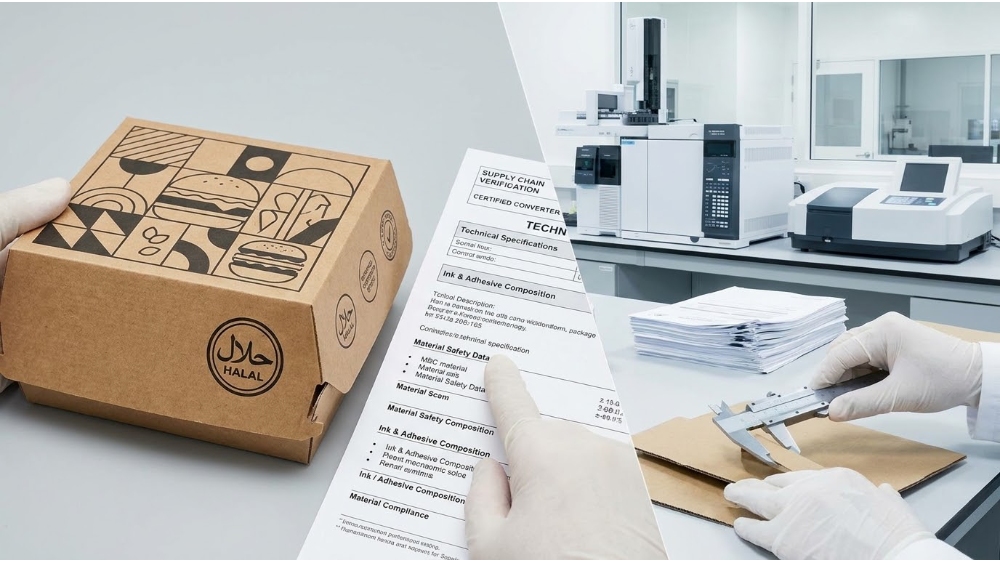
Start with what the mark asserts. A Halal logo printed on a burger box is not a statement about the burger inside it. It is a statement that the box — its board, its coating, its inks, its adhesives, and the conditions under which it was printed and stored — contains nothing a Halal certifier would object to, and that the converter can prove it on request.
Certifiers treat packaging as a critical control point for two reasons. Packaging touches food directly, and migration is a real mechanism rather than a theoretical one: ink components, coating residues, and adhesive plasticizers can transfer to a greasy surface at serving temperature. A burger box is a high-contact, high-fat, warm environment, which is the worst combination for migration and the reason packaging sits inside the scope of most certification schemes rather than outside it.
Once the mark is printed, the burden shifts in a way most buyers do not expect. The food manufacturer’s Halal certificate covers the food and the process that produced it. It does not automatically extend to a box specification that the converter changed last quarter, or to a new ink system introduced to hit a color target. A company-level certificate is not a product-level certificate, and a product-level certificate names specific materials.
The practical implication is that a Halal mark creates a documentary obligation on the converter, not only on the brand. If nobody asked the converter for a declaration on the specific board, coating, and ink used in that specific run, the chain has a gap — even if every other part of the operation is certified.
The Hidden Ink Problem: Which Printing Components Trigger Halal Non-Compliance
Four component categories account for most of the risk in a printed burger box. None of them are visible on the finished product, and none of them appear on a standard food-contact compliance certificate.
Solvent carriers. Solvent-based flexographic and lithographic inks commonly use ethanol as a carrier. Most certifying bodies accept industrial alcohol in printing inks on the condition that it fully evaporates and leaves no detectable residue in the finished pack. The condition is the whole point: it requires process validation and a residue statement, not a verbal assurance that the ink “dries completely.”
Animal-derived additives. Slip agents, release agents, and stearates used to control how ink behaves on press can be tallow-derived or sourced from other animal fats. Glycerin, a common ink and coating component, can be animal- or vegetable-derived. These are functional additives present at low percentages, which is precisely why they are rarely examined.
Shellac and natural resins. Shellac is an insect-derived resin used in some coatings and overprint varnishes to add gloss and scuff resistance. Acceptance varies between certifying bodies rather than being uniformly prohibited, which means the answer depends on who is certifying and where the box is going.
Pigments. Bone black appears in some deep blacks, carmine in certain bright reds, and gelatin can be used in pigment encapsulation. A color brief specified only by name — “warm red,” “rich black” — gives the converter freedom to select a pigment system the brand has never reviewed.
Why “Food-Grade Ink” Is Not the Same as “Halal Ink”
Food-contact regulation and Halal certification answer different questions. Food-contact rules assess toxicology and set migration limits for substances that could harm a consumer. Halal rules assess origin and process: what the material is made from, how it was handled, and whether anything impermissible entered the stream. A fully compliant, low-migration ink can still fail a Halal review because of a single animal-derived additive. A Halal-acceptable ink still has to satisfy food-contact law. They are two audits producing two documents, and one does not substitute for the other.
Shared Presses and Cleaning Validation
Dedicated Halal-only presses are rarely economical for burger box volumes, so the realistic question is changeover control. A converter running mixed jobs must be able to show a written cleaning protocol between runs and records that it was followed. Two further surfaces are frequently overlooked: the adhesive on glued seams, and the board itself. Recycled fiber can contain unknown post-consumer content, and certifiers differ on how much recycled content they will accept without additional documentation.
For the buyer, the deliverable is a component-by-component declaration — board, coating, each ink, adhesive — rather than a single certificate issued against a finished box.
Logo Is Not Certification: Matching the Printed Mark to a Recognized Body
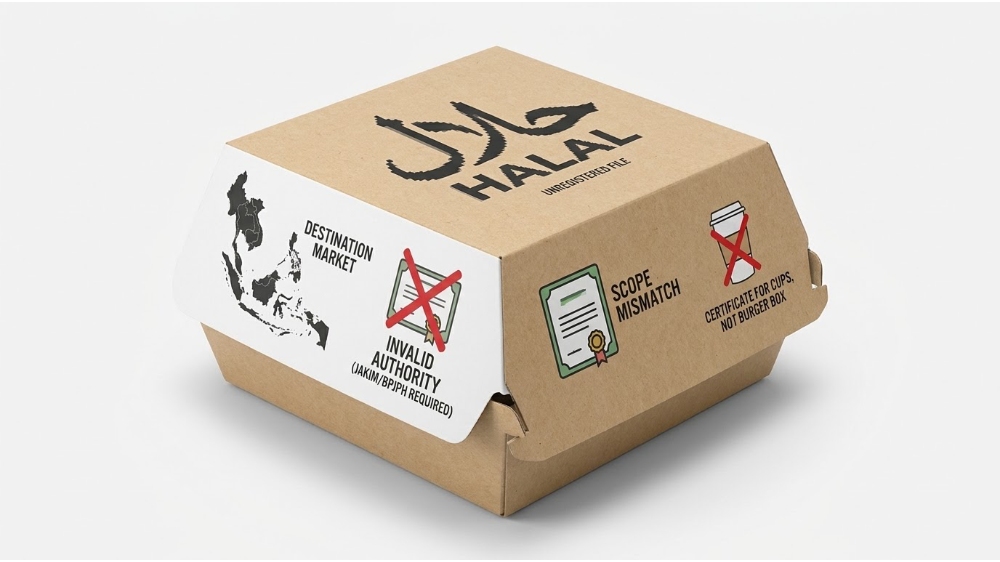
A Halal logo is a registered mark owned by a certifying body, and printing it is a reproduction of that mark under that body’s brand rules. Three failure modes account for nearly every problem.
The mark comes from an unregistered file. Logos get redrawn by designers, pulled from a competitor’s packaging, or reconstructed from a low-resolution photo. The result is a mark that looks correct and is not the controlled artwork, which in markets that regulate the mark itself is the difference between a certified claim and an unauthorized one.
The certifier is legitimate but not recognized where the box is sold. This is the most expensive failure because everything upstream looks clean. The converter holds a valid certificate from a respected body, the artwork is accurate, and the consignment is still refused — because the destination market accepts only its own designated authority. Malaysia works through JAKIM. Indonesia requires BPJPH. The UAE maintains a list of approved foreign bodies. A certificate from a body outside that recognition is a valid document in the wrong market.
The certificate scope does not match the box. Certificates can be issued at company level, at facility level, or against named product categories. A certificate covering a converter’s paper cups tells a buyer almost nothing about a new burger box built on a different board grade with a different coating.
The practical implication is a three-question test, asked before any artwork file is opened. Which body issued the certificate? Is that body recognized by the authority in the destination market? Does the certificate name this material and this process — not a sibling product, not the facility in general?
Export Market Law: Voluntary Claims in the West, Mandatory Regimes in Asia and the Gulf
Legal treatment splits into two families, and the split determines what the buyer must be able to prove.
In the UK and EU, a Halal claim is generally voluntary. There is no single state-run certification requirement that must be satisfied before the word or a symbol appears on packaging. The exposure is different in kind: the claim must not be misleading, and an unsubstantiated Halal claim can be challenged under consumer protection rules. Enforcement is largely complaint-driven rather than pre-market, which makes it easy to ship for years without ever testing the position. In the United States there is no federal Halal standard at all; a patchwork of state statutes addresses misrepresentation instead.
Malaysia, Indonesia, and the Gulf invert this logic. The mark is controlled, the certifier is specified, and market access depends on both. Malaysia recognizes JAKIM, and printing the official mark without authorization is treated as an offense rather than a labeling irregularity. Indonesia requires BPJPH certification across food and beverage categories, with the logo and certificate number reproduced on the pack. In the UAE, a Halal claim generally requires certification from a body on the approved list.
| Market | Status of the Halal mark | Recognized certifier | Certificate number on pack | Main exposure |
|---|---|---|---|---|
| UK / EU | Voluntary claim; must not mislead | Any body; no state register | Not required | Misleading-claim challenge |
| United States | Voluntary; state fraud statutes | Any body | Not required | State-level misrepresentation claims |
| Malaysia | Controlled mark | JAKIM | Required in practice | Unauthorized use of the mark |
| Indonesia | Mandatory for most food categories | BPJPH | Logo plus certificate number | Product held at entry |
| UAE / GCC | Required for any Halal claim | Approved foreign bodies | Required | Consignment rejection |
The consequence is that compliance attaches to the market of sale, not the country of printing. A box printed in one country, filled in a second, and sold in a third inherits the rules of the third. That usually forces one of two production decisions: separate printed SKUs per destination, or a shared box with a reserved blank panel where a market-specific label is applied at the filling line. The second option is cheaper until someone applies the wrong label to the wrong pallet. Explore the Full Guide of Burger Box Export Rules and Customs Risks
Color, Coating, and Artwork Decisions That Interact with Halal Status
Every artwork approval is a compliance approval wearing a design hat. Three decisions made during that review carry most of the risk.
Color specified by name instead of by system. Deep blacks and saturated reds are where pigment risk concentrates. A brief that names a color without naming an approved pigment system hands the decision to the converter, and the converter will choose whatever matches the proof most economically. Specify the pigment family, not the swatch.
Coating chosen for feel rather than for composition. A high-gloss overprint varnish may deliver the premium finish a burger brand wants, and may also introduce shellac. Aqueous coatings and polyethylene coatings typically carry lower Halal risk and are adequate for most burger box applications where grease resistance is the priority rather than reflectivity. Ultraviolet-cured coatings raise a separate migration question that certifiers frequently ask about, so the finish should be agreed with both audits in mind.
Artwork approved without the certifier’s brand rules. Registered marks come with rules on minimum size, clear space, color reproduction, and permitted placement. Certificate numbers, where the destination requires them, need a fixed position that survives die-cutting and glue flaps. If the mark sits across a fold, part of it disappears in the finished box and the reproduction is defective regardless of intent.
The practical implication is procedural rather than technical. The person who signs off artwork should be the person accountable for the compliance claim, the approved file version should be locked and referenced on the purchase order, and any later change to ink, coating, or board should trigger a re-review rather than a silent substitution.
A Buyer’s Verification Sequence Before Approving Halal Artwork
Six confirmations, in this order. If any one is missing, the artwork is not ready for print.
Six checks before the first Halal print run:
- Certifier identity — which body issued the certificate, and is it recognized by the authority in the destination market?
- Certificate scope — does it name this board grade, this coating, and this printing process, or only the facility?
- Component declaration — written confirmation per ink, coating, adhesive, and board, not a single certificate for the finished box.
- Press changeover control — a documented cleaning protocol between jobs and records showing it was applied to your run.
- Destination label requirements — logo file from the certifier, certificate number if required, and any language or placement rules.
- Locked artwork version — the approved file referenced on the purchase order, with a re-review triggered by any material change.
Most of these are documents a converter either already holds or cannot produce quickly. That asymmetry is useful: the speed of the response tells you whether the converter has handled a Halal-scoped job before, without asking the question directly.
Need burger boxes printed to a Halal-compliant specification?
Talk to a packaging specialist about matching ink systems, coatings, and certifier artwork to your destination markets and your filling line.
The Halal Mark Is Earned in the Supply Chain, Not the Artwork
The mark on the box is the last step in a chain that starts with board and ink selection and ends with a certificate someone can point to. A logo can be printed in an afternoon; the evidence behind it takes longer, and it is the evidence that determines whether the box clears customs and survives an audit.
One condition matters more than the rest: a supplier’s Halal certificate for one product line does not extend to a new burger box specification. Treat every new box as a new scope question, and confirm the destination market before the artwork, not after.
Frequently Asked Questions
Does a Halal-certified food manufacturer automatically have Halal-compliant packaging?
No. The manufacturer’s certificate covers the food and its production process, not the box. The converter’s board, inks, coatings, and adhesives need separate verification, and a new box specification falls outside an existing certificate until the scope is formally extended.
Can water-based inks be assumed Halal-compliant without certification?
No. Water-based systems reduce solvent-carrier risk, which is genuinely helpful, but they do not resolve pigments, slip agents, or cross-contamination on a shared press. The carrier is one variable out of four, and the other three still need documentation.
Is printing a Halal logo without certification illegal in the UK?
Not automatically. The mark is generally a voluntary claim rather than a licensed one, so the exposure is a misleading or unsubstantiated claim under consumer protection rules. That is a different legal route from a certification requirement, and it is enforced differently — usually after a complaint rather than before shipment.
Does the outer shipping carton need Halal verification too?
Usually not, because the shipping carton does not contact the food. The line is drawn at materials that touch the product or sit in direct contact with it, which means the inner box, any wrap, and any insert are in scope while the corrugated shipper generally is not. Confirm the boundary with the certifier for unusual configurations.
Post time: Oct-23-2026