Compostable Burger Boxes: Global Environmental Rules & Export Customs Pitfalls
Compostable Burger Boxes: Export Rules and Customs Risks
Packaging Export Compliance Guide
Compostable Burger Boxes: Global Environmental Rules & Export Customs Pitfalls
A burger box is “compostable” only if the whole package passes: certified materials, PFAS limits, label law, and matching paperwork.
Three checks decide most outcomes: EU PFAS limits (from 12 Aug 2026), California compostable-label rules, and customs HS/coating/certificate consistency. Align them before booking freight—or risk port delays and label liability.
Most guides to compostable burger boxes stop at material choice: bagasse, kraft, or PLA-lined board. For exporters, that is the easy part. The harder part is proving, in terms an importer and a customs officer both accept, that the box is what the label says it is.
This guide covers the rules that matter most to a compostable clamshell, paperboard, or molded fiber burger box leaving the factory today: certification scope, PFAS limits, compostable claims, and the customs mistakes that turn a compliant product into a delayed shipment.
What “Compostable” Must Cover Before You Export
Compostable is a certified property of the finished item, not of its base material. A bagasse or kraft box with a coating, ink, or adhesive must be tested as a complete system. The reference standards are EN 13432 in Europe and ASTM D6400 (plastics) or D6868 (paper with plastic coatings) in the United States. Each checks disintegration, biodegradation, heavy metals, and ecotoxicity under industrial composting conditions.
Two scope limits catch exporters out. First, certificates are typically tied to a specific formulation and thickness range, so a thicker lining or a new ink supplier can fall outside the certificate. Second, industrial and home compostable are separate claims. A box certified for industrial composting cannot be marketed as home compostable without its own certification.
The practical rule: ask for the certificate, the exact product code it covers, and the full coating, ink, and glue list. If the box that arrives differs from the certified sample, the claim does not travel with it.
PFAS Limits: The Rule That Decides Market Access
If a burger box has a grease-resistant finish, PFAS is now the first compliance question. PFAS are widely used as grease and water repellents on paper, board, and molded fiber, and a plant-based box is not exempt just because the fiber is natural.
Since 12 August 2026, the EU Packaging and Packaging Waste Regulation (PPWR) has barred food-contact packaging from the market when PFAS reach set limits. The European Commission has confirmed there is no general stock-exhaustion period. Boxes made before that date but first placed on the EU market after it must still comply.
EU PFAS limits for food-contact packaging:
25 ppb for any single targeted PFAS
250 ppb for the sum of targeted, non-polymeric PFAS
50 ppm for total PFAS, including polymeric PFAS
No distinction between intentionally added and trace PFAS
The United States is a patchwork. About a dozen states, including New York, Minnesota, Colorado, Vermont, and Washington, have food-packaging PFAS laws, mostly aimed at intentionally added PFAS. Several require a certificate of compliance on request, and some reach suppliers and distributors as well as manufacturers.
The implication for exporters: a PFAS test report on the finished, printed box protects you far better than one on raw pulp. The Commission itself notes there is no harmonised PFAS test method for food-contact packaging, so ask which method the laboratory used and which substances it screened.
From 27 September 2026, the Empowering Consumers Directive prohibits generic environmental claims such as “eco-friendly” or “biodegradable” unless recognised excellent environmental performance can be shown. Design cues count too: swapping the word “green” for leaf imagery does not automatically remove the problem. A specific, certified statement, such as industrially compostable to EN 13432, is a safer message than a broad one.
California
California goes further. To use “compostable” there, a product must meet ASTM D6400 or D6868, contain under 100 ppm total organic fluorine, and, from 30 June 2027, qualify as an allowable input under the USDA National Organic Program. In fall 2025 the National Organic Standards Board voted against adding synthetic compostable polymers to that list. A certified box with a synthetic lining, such as PLA, may therefore lose the right to carry the word in California even though it composts correctly.
Fiber-only designs without synthetic polymers face fewer problems, but they must still solve grease resistance without fluorinated treatment. For a buyer, that trade-off belongs in the specification before artwork is printed.
Market Snapshot: What Buyers and Authorities Ask For
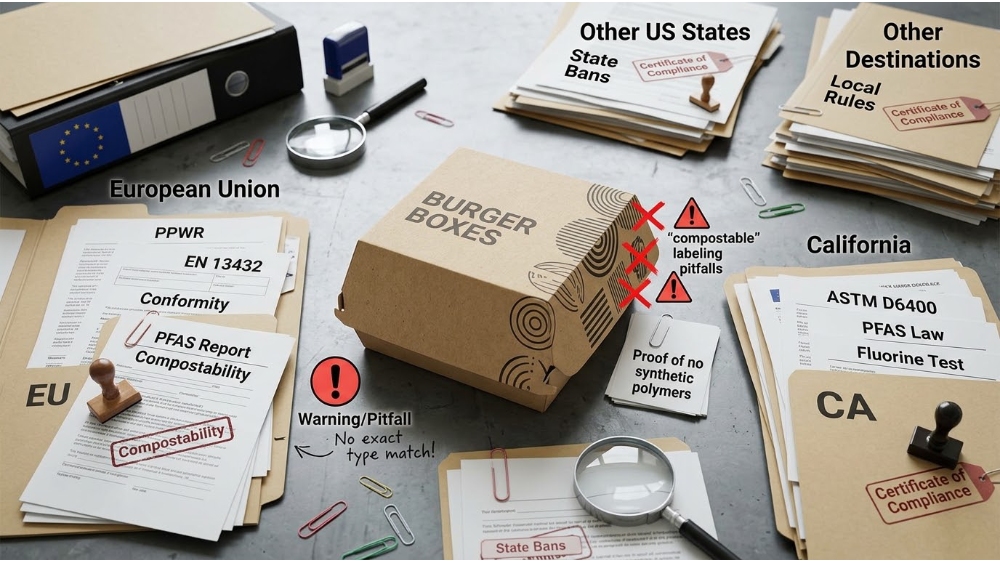
The same box meets different gatekeepers in different markets. This table shows where the paperwork requests diverge.
Destination
What decides entry
Documents usually requested
Common pitfall
European Union
PPWR PFAS limits and conformity rules; EN 13432 for the compostable claim
EU declaration of conformity, technical documentation, PFAS report, compostability certificate
No declaration covering the exact box type shipped
California
“Compostable” labeling statute and state PFAS law
ASTM D6400 or D6868 certificate, fluorine test, proof of no synthetic polymers
PLA-lined box printed with “compostable”
Other US states with PFAS laws
State food-packaging PFAS bans
Certificate of compliance, often on request
Certificate that does not name the product
Other destinations
Local composting, food-contact, and labeling rules
Food-contact test report, local-language label review
Assuming EU or US certificates are accepted as they are
EU documents answer the PPWR, while California documents answer a labeling statute. They overlap but are not interchangeable, so build the file per destination.
Customs Pitfalls That Hold Up Compostable Burger Boxes
Delays on compostable boxes rarely come from the material. They come from files that contradict each other. Four patterns appear most often.
HS code chosen by material name, not by form
Construction decides the heading. Folding paperboard cartons sit under heading 4819, while molded or pressed pulp articles sit under 4823.70. U.S. Customs rulings have placed a one-piece hinged molded-pulp clamshell meal box under 4823.70. Some systems, including the EU’s, also separate molded pulp packaging from other molded pulp articles, so one box can land on different codes in different countries. Agree the code with your broker before the proforma invoice is issued.
The coating described three ways
A lining called PLA on the spec sheet, “biodegradable film” on the invoice, and “plastic-free” on the carton invites questions and, in some cases, reclassification. Use identical wording for the coating on the invoice, packing list, certificate, and test report, and describe the goods in neutral terms (material, construction, coating) rather than marketing words.
Certificates that do not match the shipped SKU
A certificate for one size or lining does not cover another. In the EU, the importer carries the legal accountability: it must verify the manufacturer’s declaration of conformity, keep a copy for five years, and produce technical documentation to authorities on request. An importer who cannot get these from the factory has every reason to refuse the shipment.
Claims printed on the box
The label is part of the goods. A printed “compostable” or leaf icon that fails the destination’s claim rules can trigger a review after arrival, when fixing it means reprinting. Clear the artwork for the destination before the print run, not after loading.
Pre-Shipment Document Checklist
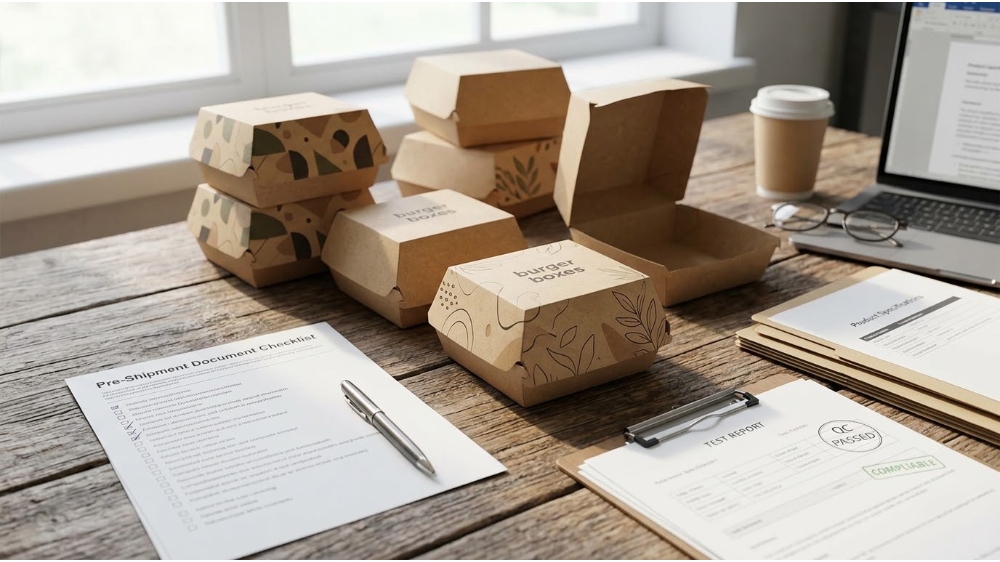
Build one file per product and destination, then update it whenever the formulation, coating, or supplier changes.
Before the container is booked:
Compostability certificate covering the exact product code, formulation, and coating thickness
PFAS test report on the finished, printed box, with the method stated
Food-contact test report suited to the destination market
EU declaration of conformity and technical documentation, or the state certificate of compliance for U.S. buyers
One HS code, agreed with the broker and identical on every document
Label artwork cleared for the destination’s claim rules
Batch records linking shipped lots to the tested production run
A supplier who can produce this pack on request saves more time than one who quotes a lower unit price and cannot. For a sourcing consultation on compostable burger boxes, test report requirements, and export documentation, contact Maibao Packaging.
Exporting compostable burger boxes and need the paperwork to match?
Talk to a packaging specialist about material systems, test reports, and document packs matched to your destination market.
Are compostable burger boxes automatically PFAS-free?
No. Plant fiber boxes can still carry fluorinated grease repellents. Compostability and PFAS content are tested separately, so you need both a compostability certificate and a PFAS report for the finished box.
Can PLA-lined boxes be sold as compostable in the United States?
Certification to ASTM D6400 or D6868 is the baseline for the claim. California adds fluorine limits and, from 30 June 2027, an organic-input requirement that puts synthetic linings at risk, so confirm the wording with counsel before printing.
Does the EU PFAS rule apply to boxes already in a warehouse?
Yes, if they are first placed on the EU market after 12 August 2026. Packaging placed on the market before that date may stay on sale, but new imports must meet the limits.
Who is responsible for the compliance paperwork, the factory or the importer?
Both, with different duties. The manufacturer prepares the technical documentation and declaration of conformity, and the EU importer must verify them and keep a copy. A factory that cannot supply them leaves the importer exposed.
Post time:
Oct-20-2026
For inquiries about our products or pricelist, please leave your email to us and we will be in touch within 24 hours.