Are Kraft Paper Bags Food Safe? Materials, Certifications & Food Packaging Guide
Are Kraft Paper Bags Food Safe? FDA Rules & Material Guide
Foodservice Packaging Compliance
Are Kraft Paper Bags Food Safe? FDA Rules, Material Science & Supplier Compliance
Not every brown paper bag is safe for food. From FDA 21 CFR regulations to PFAS‑free coatings and ink migration, this guide unpacks the science and standards that determine whether a kraft paper bag is truly food‑grade.
A kraft paper bag may look like a simple brown sack, but its journey to becoming “food safe” involves a complex web of chemistry, regulation, and supply‑chain diligence. The base paper is only the beginning; coatings, inks, adhesives, and even the manufacturing process itself must meet strict criteria to ensure that no harmful substances migrate into the food.
This guide moves beyond the marketing claims to provide a technical, regulatory, and practical framework for evaluating kraft paper bags for food contact. Whether you’re a restaurant owner, a packaging buyer, or a quality assurance professional, you’ll learn exactly what questions to ask and which documents to request.
What makes kraft paper “food grade”? Defining the standard
The term “food grade” is not a regulated designation in itself; rather, it is an industry shorthand for materials that comply with applicable food‑contact regulations. For kraft paper, this means the finished bag—including all its components—must not impart any substance into food that could be harmful to human health or alter the food’s composition, taste, or odor. The foundation is the pulp. Food‑grade kraft paper must be made from virgin fibers that are free from contaminants such as heavy metals, dioxins, and other industrial residues. Unbleached natural kraft is often preferred because it avoids the chemical residues associated with chlorine bleaching. However, the pulp alone does not guarantee safety; the true test lies in the additives and treatments applied during and after papermaking.
FDA 21 CFR 176.170 & 176.180: The legal framework
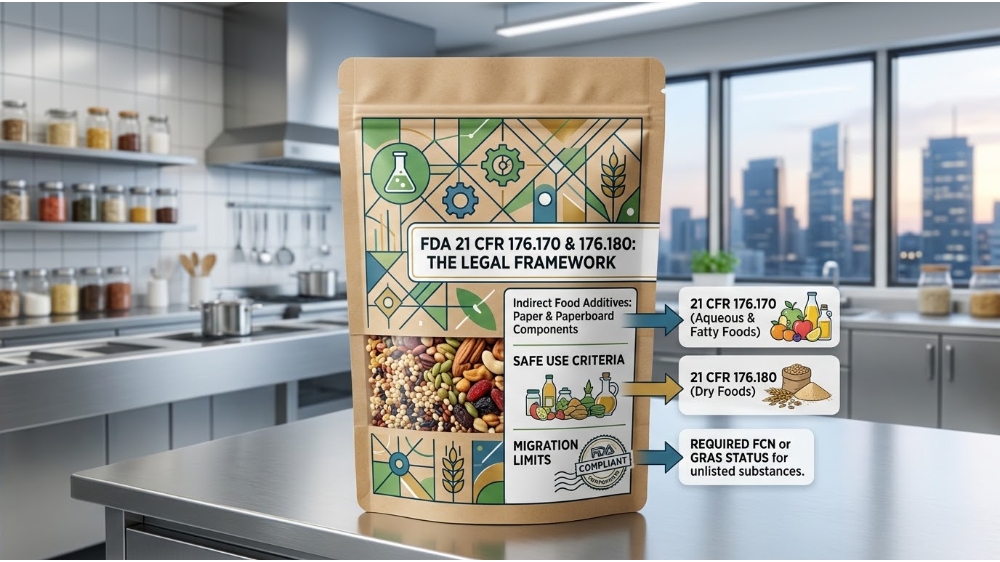
In the United States, the safety of paper and paperboard used in food packaging is primarily governed by the Code of Federal Regulations (CFR) Title 21, Part 176. This section, titled “Indirect Food Additives: Paper and Paperboard Components,” establishes the criteria for substances that may be safely used as components of the food‑contact surface. The two most relevant subsections are 21 CFR 176.170, which covers paper and paperboard in contact with aqueous and fatty foods, and 21 CFR 176.180, which addresses contact with dry foods. These regulations specify which substances are permitted, set migration limits, and require that any additive not explicitly listed must have a valid Food Contact Notification (FCN) or be Generally Recognized as Safe (GRAS). For a kraft bag to be FDA‑compliant, every component—from the paper fibers to the coating to the adhesive—must be accounted for under these regulations.
Coatings & barriers: PE, aqueous, and the PFAS phase‑out
Uncoated kraft paper is highly absorbent and offers little protection against grease or moisture. To make it suitable for foods like burgers, pastries, or fried items, manufacturers apply barrier coatings. The most common is polyethylene (PE) extrusion coating, which creates a thin plastic film. PE is effective and widely accepted under FDA regulations, provided the resin meets purity specifications. However, PE‑coated bags are not recyclable in standard paper streams, which has driven interest in alternatives. Aqueous coatings—water‑based dispersions of polymers like styrene‑acrylate—offer a repulpable option that provides good grease resistance while allowing the bag to be recycled. More recently, the industry has seen a push toward bio‑based coatings derived from renewable sources like soybean oil or cellulose nanofibers, which can achieve performance comparable to PE without the environmental drawbacks. The regulatory landscape for coatings is dynamic; in 2025, the FDA revoked 35 Food Contact Notifications for per‑ and polyfluoroalkyl substances (PFAS) used in paper packaging, signaling a definitive shift away from fluorinated barriers.
Inks & adhesives: The hidden migration risks
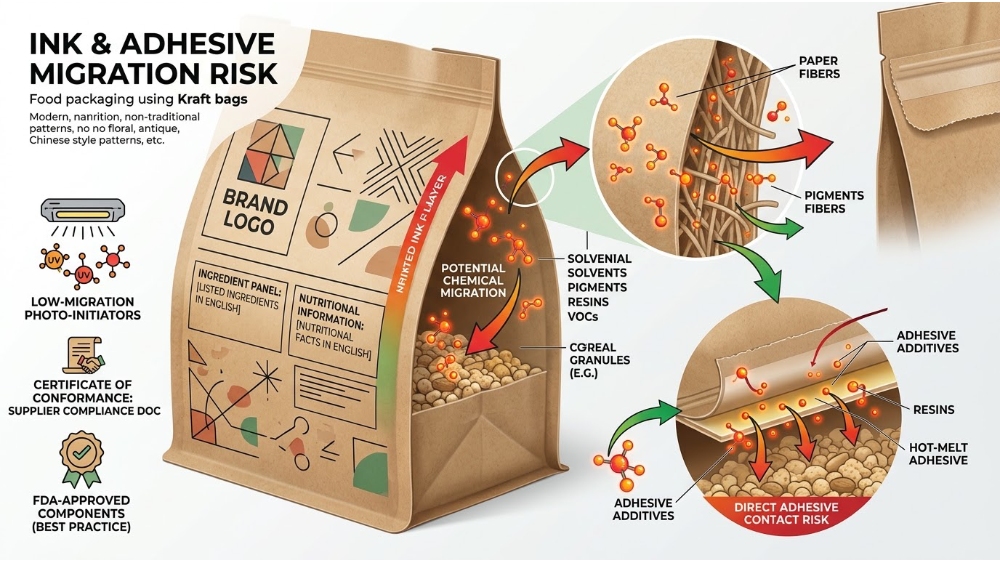
Printed logos, ingredient panels, and nutritional information are common on kraft bags, but the inks used to create them can be a source of chemical migration. Conventional solvent‑based inks contain pigments, resins, and volatile organic compounds that can migrate through the paper if the printing is on the inner side or if the ink layer is in direct contact with food. The FDA does not have specific regulations for printing inks as separate food additives; instead, they are evaluated under the general requirement that no substance migrates into food at levels that would pose a safety risk. Industry best practice dictates that inks for food packaging should be formulated from components that are either FDA‑approved or have a food‑contact clearance. This includes the use of low‑migration photo‑initiators in UV‑curable inks. Adhesives used to seal bags—whether hot‑melt, cold‑seal, or water‑based—are regulated under 21 CFR 175.105, which sets requirements for adhesives used in food packaging. Reputable suppliers will provide a Certificate of Conformance stating that their inks and adhesives are compliant with FDA regulations and are applied only on the outside of the bag, never on the interior food‑contact surface unless explicitly certified as safe.
Grease resistance is a critical requirement for bags holding fried foods, burgers, or baked goods. Historically, the industry relied on fluorochemicals—PFAS—to create oil‑repellent barriers. These compounds are highly effective at low add‑on levels, but growing evidence of their persistence in the environment and potential health risks has prompted regulatory action. The FDA’s 2025 revocation of 35 FCNs for PFAS in food‑contact paper effectively ended their use in new production. In response, manufacturers have turned to PFAS‑free alternatives. These include silicone‑based coatings, fluoropolymer‑free oil barriers, and bio‑based waxes such as carnauba wax or beeswax. Some suppliers now offer kraft bags that are explicitly labeled “No PFAS Added”. When evaluating a supplier, it is essential to request documentation confirming that the grease‑resistant treatment is PFAS‑free and has been tested under FDA extraction conditions. Third‑party certifications such as “Fluorine‑free” from OEKO‑TEX® or the “GreenScreen” certification provide additional assurance. Click to explore grease resistant paper bag
Direct vs. indirect food contact: Regulatory distinctions
Not all kraft paper bags are intended to touch food directly. Some serve as outer carriers for packaged items, while others are designed to hold loose fries or a sandwich with no inner wrapper. The FDA distinguishes between direct food contact—where the paper is physically touching the food—and indirect contact, where a barrier (like a wrapper or a tray) separates the paper from the food. The regulatory requirements are stricter for direct contact because the potential for migration is higher. For indirect contact, the paper only needs to comply with general food‑contact regulations if there is a foreseeable possibility of migration through the barrier. However, in practice, most foodservice operators use kraft bags as direct contact containers because customers eat directly from the bag. Therefore, the bag must meet all direct‑contact criteria. The distinction becomes important when sourcing: a bag labeled “for packaging of non‑food items” cannot be repurposed for food without re‑evaluation. If you use a kraft bag as an inner liner for a box, the bag itself is still direct contact with the food inside. There is no “wrapper exemption.” Every material that touches food must be compliant.
Supplier certifications: What to verify
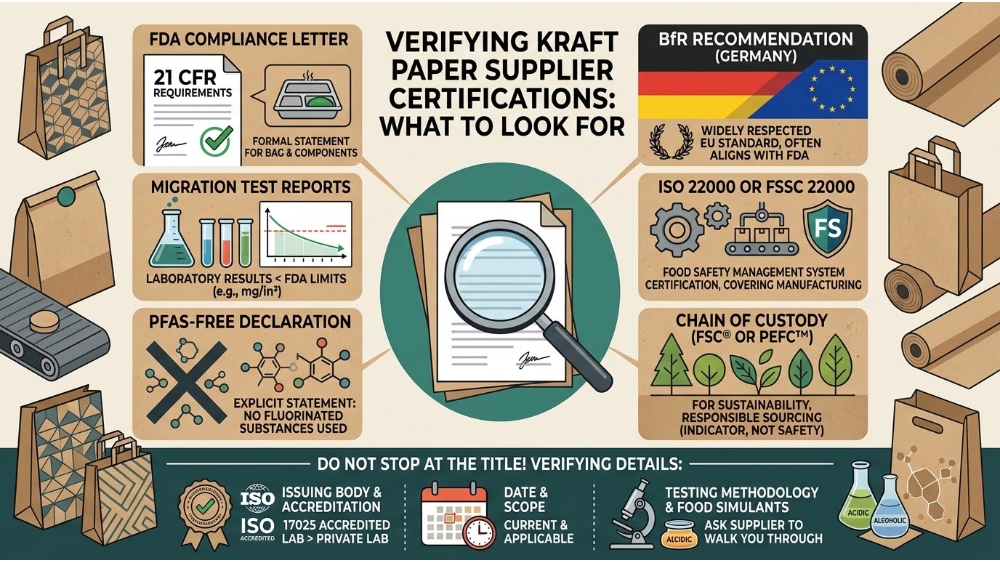
When sourcing kraft paper bags, never rely on a supplier’s verbal assurance. Request documented certifications. The most relevant include:
FDA Compliance Letter: A formal statement that the bag and its components meet all applicable 21 CFR requirements.
BfR (German Federal Institute for Risk Assessment) recommendation: Though EU‑based, BfR standards are widely respected and often align with FDA requirements.
ISO 22000 or FSSC 22000: Certification for food safety management systems, covering the manufacturing process.
Chain of Custody (FSC® or PEFC™): For sustainability, but not safety—however, it indicates responsible sourcing.
PFAS‑free declaration: An explicit statement that no fluorinated substances are used, often backed by test results.
Migration test reports: Actual laboratory results showing extractable levels below FDA limits (typically expressed in mg/in²).
Do not stop at the certificate title. Verify the issuing body, the date, and the scope. A certificate from a private lab with no accreditation is less reliable than one from an ISO 17025‑accredited lab. Ask the supplier to walk you through the testing methodology and the specific food simulants used. This due diligence protects your brand from liability and ensures your customers receive safe packaging.
Compliance documentation: Building your paper trail
Beyond certifications, you need a complete compliance file for each kraft bag SKU you purchase. This should include:
Material Safety Data Sheet (MSDS) / Safety Data Sheet (SDS): For all chemicals and additives used in the bag.
Declaration of Compliance (DoC): A signed document from the supplier affirming that the article complies with all applicable regulations.
Supplier’s product specifications: Detailed breakdown of paper weight, coating type, ink composition, adhesive type, and grease‑resistant treatment.
Test reports from an accredited lab: Covering migration tests for total extractives, heavy metals, and specific monomers (e.g., bisphenol A, if any).
Traceability records: Batch numbers linking each shipment to production records and quality control checks.
Keep these documents for at least three years from the date of production, as per FDA record‑keeping expectations. If a regulatory inspection occurs, these records prove your diligence. Also, review them annually for changes in regulations or supplier formulations. The 2025 PFAS revocation is a prime example of why ongoing vigilance is necessary. In practice, many buyers neglect this step because they trust established suppliers. However, formulation changes can happen without notice, and a bag that was compliant last year may not be compliant today. Build a system to request updated documentation with every new order—not just the first one.
Maintain a digital folder with all documents per batch.
Frequently Asked Questions
Are kraft paper bags food safe by default?
No. Only kraft paper bags that are manufactured with FDA‑compliant components (paper, coatings, inks, adhesives) and have documented migration test results are considered food‑safe. Uncoated, unprinted kraft may be safe for dry foods, but any additive changes the status.
Can I use any brown paper bag for food packaging?
Legally, no. Unless the bag is explicitly labeled for food contact and comes with a compliance declaration, it cannot be used for food in commercial settings. Home use is less regulated, but for commercial operations, you must source from certified suppliers.
What is the difference between food‑grade kraft and regular kraft paper?
The difference lies in the purity of the pulp, the absence of harmful additives, and compliance with migration limits. Regular kraft may contain recycled fibers, optical brighteners, or sizing agents that are not approved for food contact.
Do I need to test kraft bags myself for FDA compliance?
You are not required to conduct your own testing if your supplier provides valid third‑party test reports. However, you should periodically audit those reports and, for high‑volume orders, consider spot testing through an independent lab to verify consistency.
Need Kraft Paper Bags That Meet FDA Food Safety Standards?
Get expert guidance on material compliance, PFAS‑free coatings, and supplier documentation. Our packaging specialists help you source food‑grade kraft bags tailored to your restaurant or food business.